

Foreign Education and Degrees of Dr. Bhimrao Ambedkar
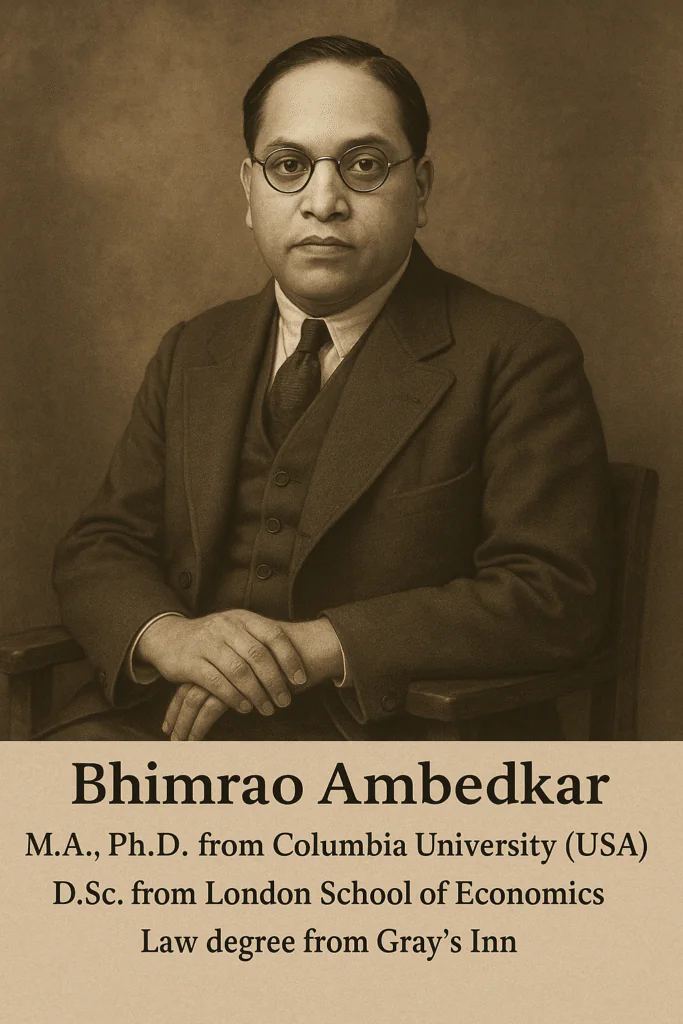
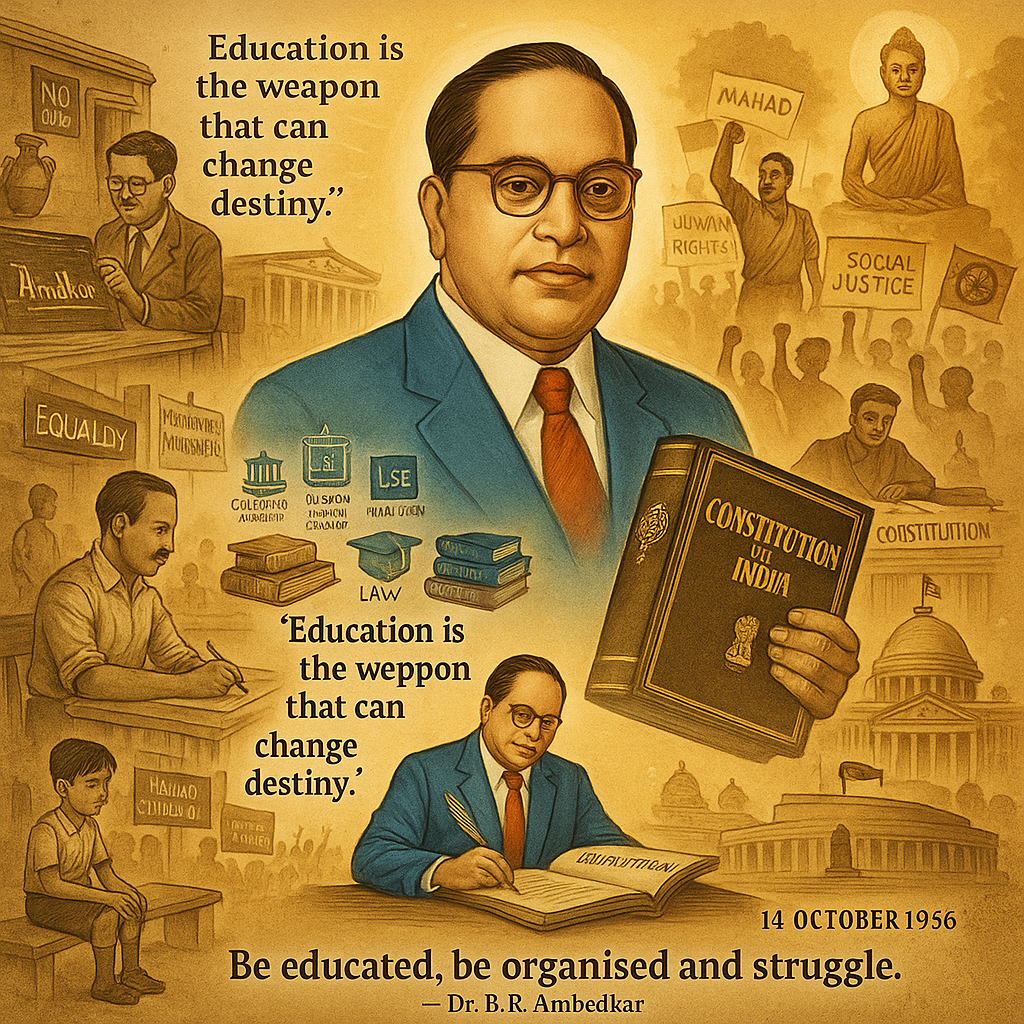
Dr. Bhimrao Ambedkar’s academic life was extraordinary and deeply inspiring. After completing his primary education in India, he went abroad for higher studies, where he earned degrees from some of the world’s most prestigious UNiversities. His aim was not just personal advancement but to make education a weapon for the empowerment of the oppressed.
Baroda State Scholarship
In 1913, Dr. Ambedkar received the Baroda State Scholarship granted by Maharaja Sayajirao Gaekwad, Who recognized his talent and supported his higher studies abroad.
Columbia University, USA (1913–1916)
- Location: New York, USA
- Entry: 1913
- Major Subjects: Economics, Sociology, Politics
Degrees Earned
- MA (1915): Subject – Ancient Indian Commerce
- Ph.D. (1917): Subject – The Evolution of Provincial Finance in British India

Check Latest Price on Amazon
View on AmazonAs an Amazon Associate, I earn from qualifying purchases.
At Columbia University, Dr. Ambedkar was deeply influenced by the principles of American democracy, human rights, and social justice.
London School of Economics (LSE), England
- Entry: 1916
- D.Sc. in Economics (1923): Research Topic – The Problem of the Rupee: Its Origin and Its Solution
This research was later published as a book and is considered a milestone in the formulation of India’s economic policy.
Gray’s Inn, London
Dr. Ambedkar studied law at Gray’s Inn, one of the four major legal institutions in London, and obtained the prestigious Barrister-at-Law degree.
Major Degrees of Dr. Ambedkar – A Summary
| Year | Institute | Degree | Subject |
|---|---|---|---|
| 1915 | Columbia University | M.A. | Economics |
| 1917 | Columbia University | Ph.D. | Indian Finance |
| 1923 | London School of Economics | D.Sc. | Monetary Policy |
| 1923 | Gray’s Inn | Barrister-at-Law | Law and Justice |
Special Highlights
- He was the first Indian to receive doctorates from two of the world’s leading institutions.
- His research remains a milestone in India’s economic and constitutional history.
- He viewed education as a tool for social revolution and promoted it throughout his life.
Social Conflicts and Movements Led by Dr. Bhimrao Ambedkar
Dr. Ambedkar’s life was not limited to academics and constitution-making. He fought lifelong battles against caste inequality, untouchability, and social injustice. He was not only an intellectual thinker but also a revolutionary social reformer who initiated several historic movements.
1. Struggle Against Untouchability
Dr. Ambedkar launched numerous social reform campaigns to bring Dalits into the mainstream. He emphasized that education, political representation, and self-respect were the natural rights of Dalits.
2. Mahad Satyagraha (1927)
- Location: Mahad, Maharashtra
- Objective: To give Dalits the right to drink water from the Chavdar Pond
During this movement, Dr. Ambedkar publicly burnt the Manusmriti, symbolizing opposition to caste discrimination.
3. Kalaram Temple Satyagraha, Nasik (1930)
Thousands of followers, under Dr. Ambedkar’s leadership, protested for the right of Dalits to enter the Kalaram Temple. This movement became a symbol of the demand for religious equality.
4. Poona Pact (1932)
Under the 'Communal Award,' the British proposed separate electorates for Dalits. Mahatma Gandhi opposed it and began a fast unto death, leading to the historic Poona Pact between Dr. Ambedkar and Gandhi. As a result:
- Dalits received reserved seats instead of separate electorates.
- This agreement formed the basis for permanent Dalit representation in Indian politics.
5. Establishment of Social Organisations
- Bahishkrit Hitakarini Sabha (1924): For Dalit education and social reform
- Samta Sainik Dal (1927): An organisation of volunteers for social justice
- Independent Labour Party (1936): Political voice for workers and the oppressed
- Scheduled Castes Federation (1942): A national organisation for Dalit rights
6. Work for Women’s Rights
Dr. Ambedkar strongly advocated for women’s education, property rights, and equal opportunities. He drafted the Hindu Code Bill, which granted women the right to inheritance and divorce, although it was not passed at that time.
Key Characteristics of His Social Struggle
- All his movements were constitutional, non-violent, and justice-based.
- He aimed to create informed and empowered citizens rather than mere voters.
- His efforts strengthened the foundations of equality, secularism, and human rights in India.
Motivational Quote
“I like the religion that teaches liberty, equality and fraternity.”
— Dr. B. R. Ambedkar
Leadership of Dr. Ambedkar in Major Movements
1. Mahad Satyagraha (1927)
Objective: Right for Dalits to use public water sources
Feature: First organised mass satyagraha against untouchability
2. Manusmriti Burning Day (1927)
- Date: 25 December 1927
- Location: Mahad
Manusmriti was burnt publicly as a protest against caste-based discrimination and anti-women rules.
3. Kalaram Temple Satyagraha (1930)
A protest demanding equal rights in religious places — a major moment in India’s social equality movement.
4. Poona Pact (1932)
A landmark agreement ensuring reserved seats for Dalits instead of separate electorates.
5. Political Rights Movements (1936–1942)
- Formation of Independent Labour Party
- Creation of Scheduled Castes Federation
6. Movement for Accepting Buddhism (1956)
- Date: 14 October 1956
- Location: Deekshabhoomi, Nagpur
- Impact: One of the largest Religious Conversion movements in India
Conclusion
The movements led by Dr. Ambedkar were not limited to the upliftment of Dalits; they reshaped India’s social harmony, secular values, and constitutional awareness. His efforts sparked a wave of social change that continues to influence India today.
Contribution of Dr. Bhimrao Ambedkar in the Making of the Constitution
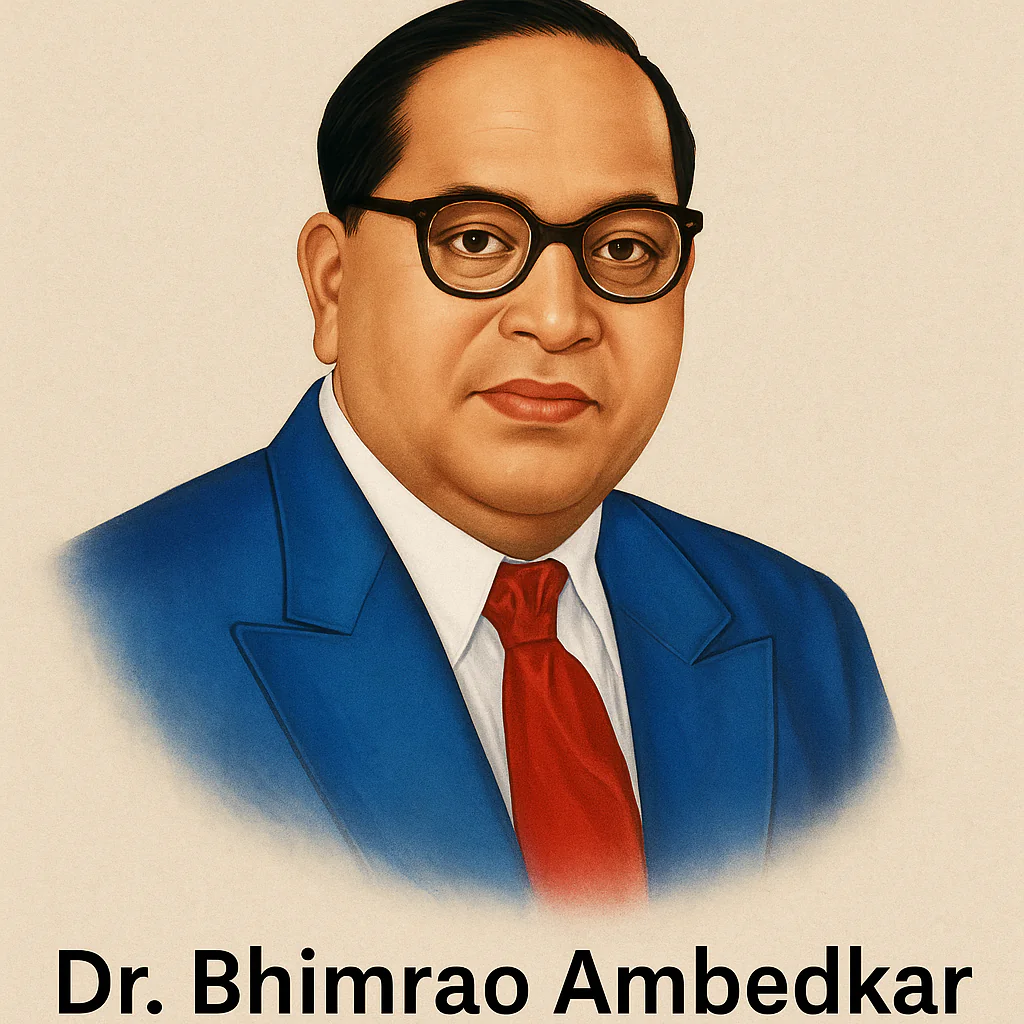
The most historic and UNforgettable contribution of Dr. Bhimrao Ambedkar was in the making of the Constitution of India. He was not only a member of the Constituent Assembly but was also appointed as the Chairman of the Constitution Drafting Committee. His leadership and vision laid the foundation for India as a democratic, secular, egalitarian and just republic.
1. Appointment to the Constituent Assembly (1946)
- Dr. Ambedkar was first nominated to the Constituent Assembly from Bengal (later elected from Bombay).
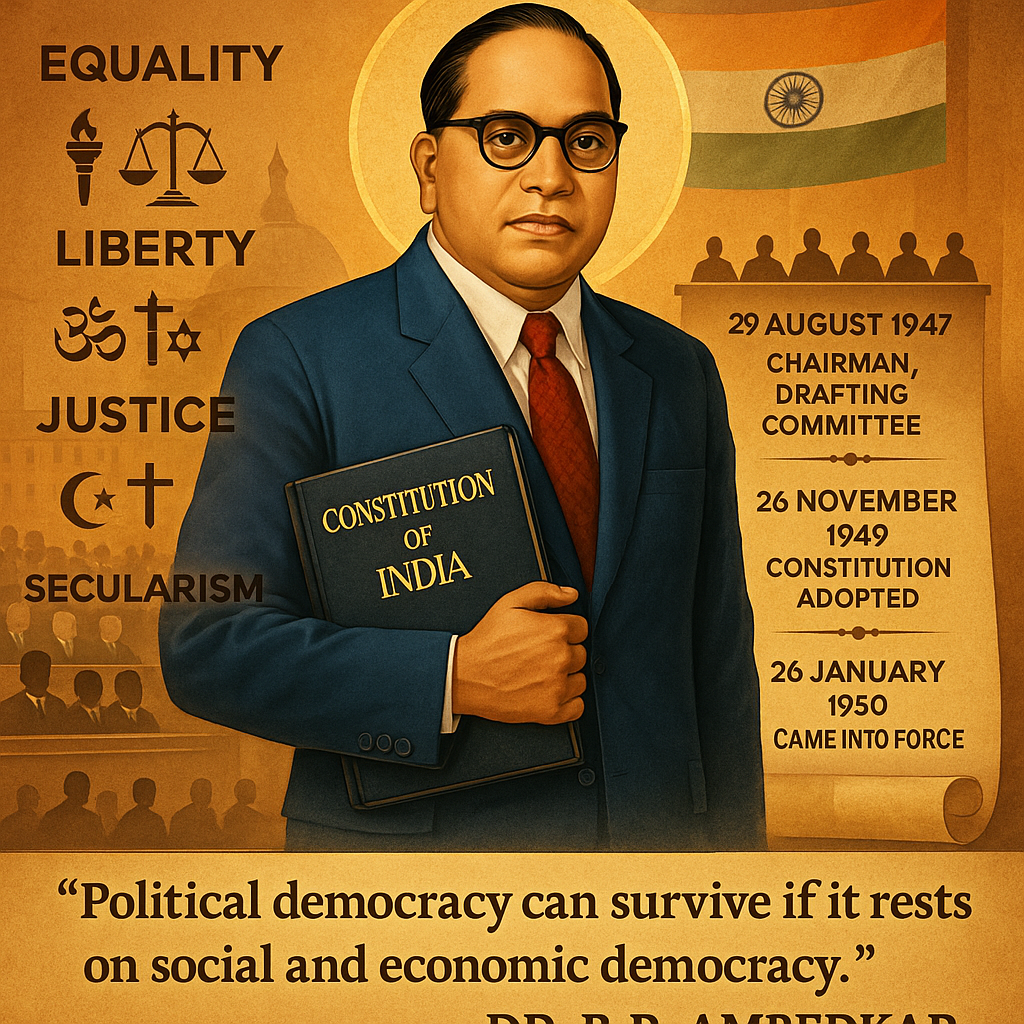
- On 29 August 1947, he was appointed as the Chairman of the Constitution Drafting Committee.
2. Basic Principles Shaped by Dr. Ambedkar
He incorporated the following core ideas into the Constitution:
- equality: Prohibition of discrimination on the basis of race, religion, caste, sex, language or place of birth.
- Liberty: Freedom of speech, expression, religion, movement and occupation.
- Fraternity: Promoting brotherhood among all citizens.
- social justice: Reservation for Scheduled Castes, Scheduled Tribes and Backward Classes.
- secularism: No state religion; equal rights for all.
He transformed the Constitution into not just a book of laws, but a guiding document for social revolution.
3. Fundamental Rights and Directive Principles
- Fundamental Rights: Rights to life, liberty, equality and expression.
- Directive Principles: Guidelines for socio-economic equality and welfare state formation.
“Political democracy can survive only if it is based on social and economic democracy.”
— Dr. B. R. Ambedkar
Check Latest Price on Amazon
View on AmazonAs an Amazon Associate, I earn from qualifying purchases.
4. Rights of Minorities and Underprivileged Classes
- Reservations in education and government jobs.
- social equality and entry rights to public places.
- Protection of women’s rights (through the Hindu Code Bill draft).
5. Passing of the Constitution and Ambedkar’s Historic Statement
The final draft of the Constitution was adopted on 26 November 1949 and came into force on 26 January 1950.
“We have achieved political freedom, but it is incomplete without social and economic equality.”
— Dr. B. R. Ambedkar
Dr. Ambedkar’s Contribution in Brief
| Role | Description |
|---|---|
| Constitution Drafting Committee | Chairman (1947) |
| Total Articles | 395 Articles, 8 Schedules |
| Key Principles | Equality, Liberty, Justice, Secularism |
| Date Adopted | 26 November 1949 |
Conclusion
Dr. Ambedkar, the “Maker of the Constitution of India,” was not only a jurist but a visionary Who gave the Constitution the power to transform society. His leadership shaped the democratic soul of India, which continues to guide the nation even today.
Role of Dr. Ambedkar in the Constituent Assembly
Dr. Bhimrao Ambedkar’s role in the Constituent Assembly is one of the most decisive and historic moments in the evolution of Indian democracy. He was not only the legal expert of the Assembly but also the spirit behind the Constitution.
1. Entry into the Constituent Assembly
- He was first elected from Bengal Province in 1946.
- Later, he joined the Assembly as a member from Bombay Presidency.
- He became the strongest and most influential voice of the Scheduled Castes.
2. Chairman of the Drafting Committee (29 August 1947)
- A 7-member Drafting Committee was formed for Constitution-making.
- Dr. Ambedkar was appointed the Chairman.
- The committee worked for 2 years, 11 months and 18 days to produce the Constitution draft.
3. Historic Speeches in the Constituent Assembly
Dr. Ambedkar delivered several landmark speeches on democracy, equality and justice. In his final speech on 26 November 1949, he declared:
“We have made a Constitution that ensures political equality, but without social and economic equality, freedom will remain incomplete.”
4. Major Contributions in the Assembly
| Area | Contribution |
|---|---|
| Fundamental Rights | Equality, freedom, religion, education |
| Social Justice | Reservation for SC/ST |
| Secularism | Equal respect for all religions |
| Women Empowerment | Drafted rights to inheritance, marriage, property (Hindu Code Bill) |
| Federal System | Division of powers between Centre and States |
| DPSP | Guidelines for social and economic justice |
5. Dedication to Constitution Making
- Dr. Ambedkar studied more than 2,000 parliamentary debates.
- Examined constitutions of various countries including America, Britain, France and Ireland.
- Finalized a comprehensive Constitution with 395 Articles.
Conclusion
Dr. Ambedkar considered the Constitution not merely a legal document but a manifesto of social revolution. His leadership gave India a strong, democratic and secular foundation.
Dr. Bhimrao Ambedkar’s Adoption of Buddhism
Dr. Ambedkar’s life was not only a symbol of political and social transformation but also a significant chapter of religious renaissance. In the final phase of his life, disheartened by caste discrimination in Hinduism, he chose to adopt Buddhism—an act that symbolized dignity, liberation and equality for millions of Dalits.
1. Background of Religious Conversion
- Dr. Ambedkar faced untouchability and discrimination since childhood.
- He raised his voice against casteism repeatedly but found no lasting remedy within Hinduism.
“I was born as a Hindu, but I will not die as a Hindu.”
2. Why He Chose Buddhism
- He studied Christianity, Islam, Sikhism and Buddhism.
- He believed Buddhism embodied logic, humanity, non-violence and equality.
- He called it a “confluence of religion and science.”
3. Buddhist Conversion Ceremony (14 October 1956)
- Location: Deekshabhoomi, Nagpur
- Attendance: Nearly 5 lakh followers
- Event: Dr. Ambedkar took 21 vows and initiated followers into Buddhism.
“Today I am being reborn as a Buddhist. This is my new birth.”
4. The 22 Vows (Pledge Sutra)
- I will not worship Hindu gods and goddesses.
- I will not give offerings to Brahmins.
- I will believe in Buddha, Dhamma and Sangha.
- I will follow the path of equality and justice.
- I will never accept caste discrimination.
5. “The Buddha and His Dhamma”
His final major work interpreting Buddhism from a scientific and reformist perspective, published in 1957.
Conclusion
Dr. Ambedkar’s acceptance of Buddhism was not just a religious step—it was a historic movement of liberation, dignity and equality. It awakened a new consciousness in millions and gave birth to the modern Neo-Buddhist identity.
Religious Conversion and Its Impact
Dr. Ambedkar’s conversion to Buddhism on 14 October 1956 became one of the most revolutionary events in the socio-religious history of India. It sparked a powerful movement for equality and self-respect among Dalits and redefined the discussion on caste, identity and human dignity.
1. Restoration of Self-Esteem
Millions who suffered humiliation due to caste found a dignified identity through Buddhism. Dr. Ambedkar said:
“Religion should lead to equality, liberty and brotherhood.”
2. Beginning of the Neo-Buddhist Movement
- An organised Neo-Buddhist movement emerged after the conversion.
- Millions abandoned the identity of “untouchable” and embraced Buddhism.
- The movement spread across Maharashtra, Madhya Pradesh, Uttar Pradesh and many other states.
3. Social Change and Spread of Education
The Neo-Buddhist community gave priority to education, organisation and economic upliftment. Many Buddhist schools, monasteries and cultural institutions emerged as symbols of this transformation.
4. Impact on Hindu Society and Politics
- Triggered introspection within Hindu society on caste-based discrimination.
- Dalit politics and issues of social justice entered the national mainstream.
- Strengthened demands for reservation and civil rights.
5. International Influence
- Brought global attention to Ambedkar’s teachings and human rights advocacy.
- Recognised internationally as a modern Buddhist thinker.
- Influenced Buddhist communities in Sri Lanka, Japan, Thailand and beyond.
Influence of the 22 Vows
- Condemned caste discrimination and inequality.
- Promoted women’s dignity and equality.
- Encouraged self-reliance, education and organised living.
- Rejected Brahmanical dominance.
Conclusion
Dr. Ambedkar’s religious conversion was a turning point that reshaped India’s social landscape. The Neo-Buddhist movement, its institutions, and its literature continue to reflect his revolutionary vision. He proved that religion can also be a powerful path toward equality and justice.
Demise and Legacy of Dr. Bhimrao Ambedkar
The life of Dr. Bhimrao Ambedkar was profoUNdly inspiring, and his death marked the end of an era. Throughout his life, he fought relentlessly against social injustice, casteism and inequality, showing millions the path of human rights, education and self-respect.
1. Demise
- Date: 6 December 1956
- Place: Delhi, at his residence
- Cause: Diabetes and heart-related complications
He passed away at the age of 65, leaving behind an indelible impact on the nation. Just two months before his death, on 14 October 1956, he embraced Buddhism—an event considered the final revolution of his life.
2. Mahaparinirvana
Ambedkar’s passing is regarded by his followers as Mahaparinirvana, similar to the Nirvana of Gautama Buddha. His funeral was held at Chaityabhoomi, Mumbai, which today stands as one of the most important Buddhist and memorial sites in India.
Every year on 6 December, millions of followers visit Chaityabhoomi to pay tribute.
3. Legacy
| Area | Contributions / Influence |
|---|---|
| Constitution | Architect of the Indian Constitution; symbol of equality, justice and secularism |
| Education | “Education is the key to all problems” — made education a tool for liberation |
| Politics | Father of Dalit politics; icon of the Bahujan movement |
| religion | Pioneer of the Neo-Buddhist movement; author of the 22 vows |
| Global Recognition | Honoured by UN, Columbia University, human rights organisations |
4. Recognitions
- 1990: Awarded the Bharat Ratna (posthumously)
- 2012: TIME magazine listed him as “The Greatest Indian”
- Universities, memorials, museums, statues, stamps and international awards continue to honour his legacy.
Conclusion
Dr. Ambedkar’s life teaches that “There is no change without struggle.” Although he is no longer alive physically, his ideas on equality, social justice and constitutional values remain alive in the hearts of millions. He was not only a person, but an ideology, a movement and a lasting source of inspiration.
Major Books of Dr. Bhimrao Ambedkar
Dr. Ambedkar was not only the architect of the Constitution and a social reformer but also a prolific writer, thinker and philosopher. His literary works offer deep insights into caste, religion, economics, politics and social justice.
1. Annihilation of Caste (1936)
- Language: English
- Theme: A powerful critique of the caste system in Hindu society
- Special Note: Originally written for a speech banned by the Hindu Mahasabha; Ambedkar later published it himself.
“Caste not only divides, it murders humanity.”
2. The Buddha and His Dhamma (1957)
His last and most spiritual work, published posthumously. It presents Buddhism from a scientific and social reform perspective and is considered a central text for Neo-Buddhists.
3. Who Were the Shudras? (1946)
A historical and linguistic analysis of how Shudras were originally Kshatriyas who later faced social degradation.
4. The Problem of the Rupee: Its Origin and Solution (1923)
A landmark thesis on India's monetary policy and British economic exploitation. Based on this work, he received his doctorate from the London School of Economics.
5. Thoughts on Linguistic States (1955)
Discusses whether states in independent India should be reorganized on linguistic lines. Ambedkar supported linguistic states but also warned against threats to national unity.
6. Riddles in Hinduism
A critical examination of Hindu scriptures, traditions and deity narratives. The book faced controversy due to Ambedkar’s rational questioning of figures like Rama, Krishna and Manu.
7. Pakistan or the Partition of India (1940)
A detailed study of the Muslim League’s demand for Pakistan. Ambedkar analyzed the political, social and economic implications of partition.
Other Significant Works
| Work | Subject |
|---|---|
| Castes in India – Their Mechanism, Genesis and Development | Origin and functioning of the caste system |
| The Evolution of Provincial Finance in British India | Provincial finance system under British rule |
| Administration and Finance of the East India Company | British administrative and financial policies |

Check Latest Price on Amazon
View on AmazonAs an Amazon Associate, I earn from qualifying purchases.
Conclusion
Dr. Ambedkar’s books are more than academic writings; they are instruments of social revolution. Rooted in research, logic and lived experience, his works continue to shape universities, competitive examinations, social movements and intellectual discourse in India.
Conclusion: A Man of the Era, an Ideology
Dr. Bhimrao Ambedkar was not just a person, but a symbol of equality, justice and freedom. His life combines struggle, knowledge, revolution and service—values that continue to inspire millions.
From an untouchable child to the architect of the Constitution of India, his journey proves that with education, self-confidence and courage, anyone can break social barriers. Ambedkar not only drafted the Constitution but shaped the future of India by building a secular and just social structure.
He made education a weapon for liberation and gave a new dimension to the struggle for dignity through religious transformation. His legacy lives not only in monuments and statues but in the minds of all those who stand against discrimination and injustice.
In today’s India, where social and constitutional values are constantly challenged, Ambedkar’s ideology is more relevant and essential than ever.
Sources and References
Books
- Annihilation of Caste — Dr. B. R. Ambedkar (1936)
- The Buddha and His Dhamma — Dr. B. R. Ambedkar (1957, posthumous)
- Dr. Babasaheb Ambedkar: Writings and Speeches (26+ Volumes) — Government of Maharashtra
- Ambedkar: Towards an Enlightened India — Gail Omvedt
- Revolution and Counter-Revolution in Ancient India — Dr. B. R. Ambedkar
- Dr. Ambedkar and Untouchability — Christophe Jaffrelot
Online Sources
- Government of India — Ministry of External Affairs: https://www.mea.gov.in
- Ambedkar Studies Archive: https://www.ambedkar.org
- Digitized Works Archive: https://archive.org/details/@babasahebambedkar
- NITI Aayog Research: https://niti.gov.in
- UNESCO Resources: https://en.unesco.org
- Ministry of Culture: https://indiaculture.gov.in
Major Articles and Journals
- Indian Journal of Social Work — Ambedkar and Social Justice
- Economic and Political Weekly — Ambedkar’s Economic Thought
- UNESCO Archives — Ambedkar and International Human Rights
Academic Sources
- Columbia University Library — Ambedkar’s thesis and academic records
- London School of Economics Archives
- IGNOU eGyankosh — Ambedkar Studies Collection
Miscellaneous Credible Sources
- PRSIndia — Constitution-making insights
- Padma Awards Official Portal — Bharat Ratna records
- Maharashtra Govt. — Dr. Babasaheb Ambedkar: A Study in Social Democracy
- Constituent Assembly Debates: https://eparlib.nic.in
- Ambedkar Foundation: http://ambedkarfoundation.nic.in
- Encyclopaedia Britannica — B. R. Ambedkar
- National Book Trust — Biographies on Ambedkar