
Germany

Germany – Full Introduction, Geography, Politics, Economy, Education & Culture

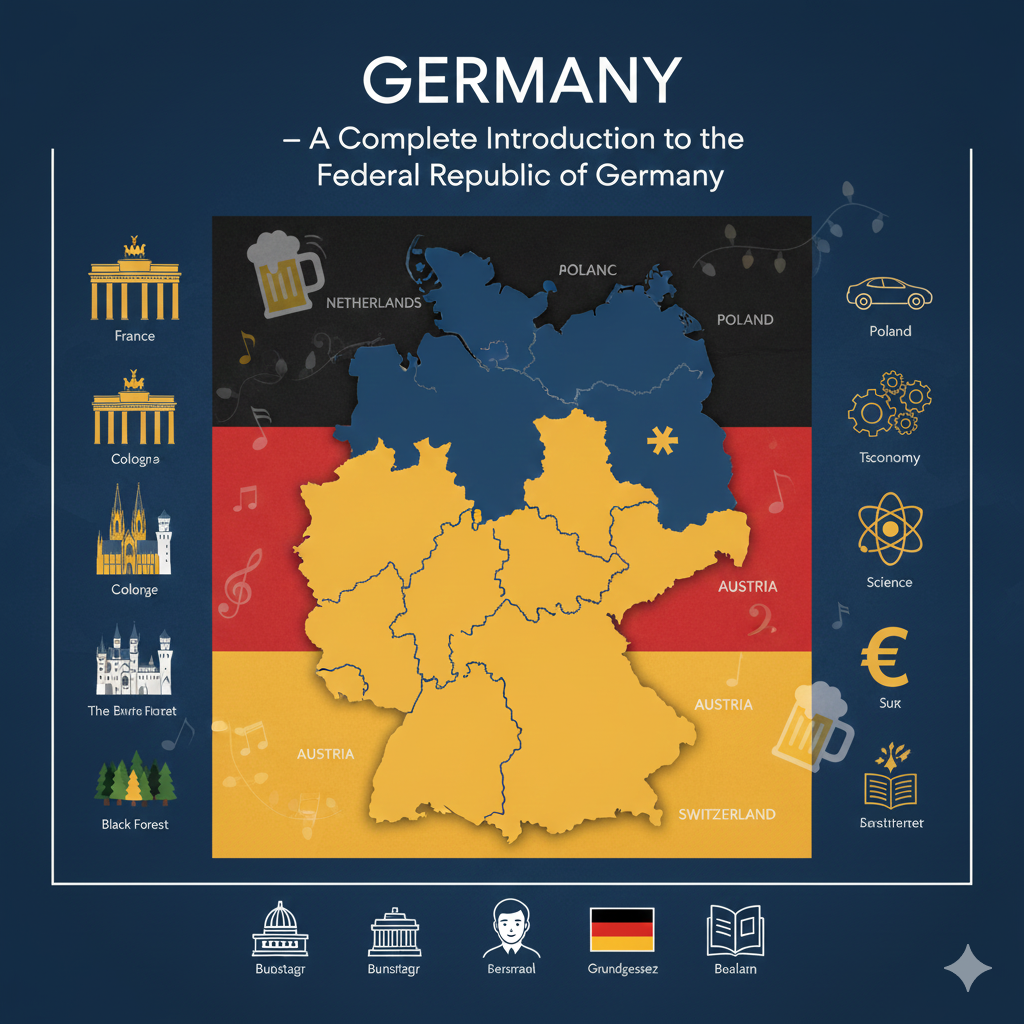
Germany – A Complete Introduction to the Federal Republic

Germany, officially known as the Federal Republic of Germany, is one of Europe’s most influential and developed nations. It is a founding member of the European Union (EU) and is renowned for its advanced technology, strong economy, rich culture, and historical significance.

1. A Brief Introduction

This European nation is recognized globally for its engineering excellence, innovation, cultural heritage, and world-class education system. As one of the world’s strongest economies, it plays a major role in European and global affairs.

2. Geographical Location

Located in Central Europe, the country shares borders with nine nations, making it strategically important in trade and diplomacy.

Basic Details

  • Continent: Europe
  • Capital: Berlin
  • Main Cities: Munich, Hamburg, Frankfurt, Cologne
  • Language: German
  • Currency: Euro (€)
  • Population: About 8.4 crore (as of 2024)

3. Political System

The country follows a Federal Parliamentary Republic system. Democracy, rule of law, and the constitution called the Basic Law (Grundgesetz) guide its governance structure.

4. Economy

It has the fourth-largest economy in the world. Its industrial strength is driven by engineering, automotive manufacturing, machinery, electronics, and pharmaceuticals.

Leading Companies

  • BMW
  • Mercedes-Benz
  • Volkswagen
  • Siemens
  • Bosch

5. Education and Science

The education system is known for offering free or low-cost higher education, making it a preferred destination for international students. Thousands of learners choose this country each year for quality research and innovation.

6. Society and Culture

Its culture reflects deep traditions in literature, music, art, and philosophy. Society values punctuality, discipline, and efficiency.

7. Tourism

Millions of tourists visit every year. From Berlin’s historic landmarks to Bavaria’s scenic landscapes, the tourism sector is diverse and vibrant.

8. India–Germany Relations

India and Germany share strong economic, educational, technological, and cultural ties. The strategic partnership continues to grow in renewable energy, defence, and innovation.

9. Geography and Natural Features

The country is home to beautiful rivers, forests, plains, and mountain ranges. Major rivers include the Rhine, Danube, and Elbe.

10. Conclusion

Germany is a modern, progressive, and globally influential nation. Whether for higher education, business opportunities, tourism, or research, it remains one of the most powerful and stable countries in Europe. Its future looks strong in technology, sustainability, and global leadership.

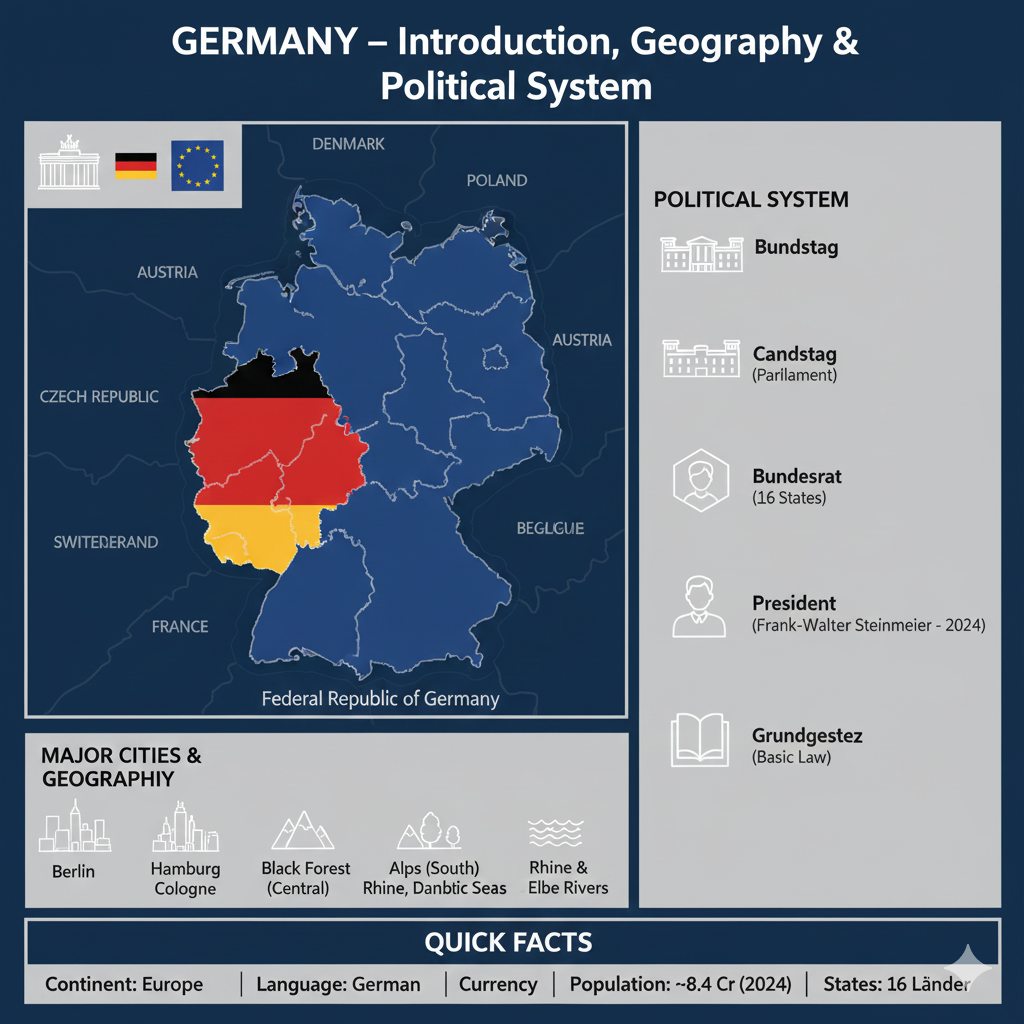
Germany – Introduction, Geography, and Political System

1. A Brief Introduction

Germany, officially known as the Federal Republic of Germany, is a developed and industrialized nation in Europe. It is a global leader in technology, education, economy, and culture. Its capital is Berlin, and the official language is German. The country has a population of approximately 8.4 crore and is an important member of the European Union (EU).

The nation is recognized worldwide for its advanced engineering, strong automobile industry (BMW, Mercedes-Benz), high-quality education system, and disciplined lifestyle. Its democratic governance operates through a federal structure, and the national parliament is called the Bundestag.

It has also made significant contributions to science, music, literature, and philosophy. Today, this European state stands as a global example of peace, innovation, and sustainability.

2. Geographical Location

Position in Europe

Located in Central Europe, the country holds a strategic economic and political position within the continent. Its topography, climate, and natural resources have played a crucial role in its development.

Bordering Countries

It shares borders with nine countries, making it a central link in Europe:

  • North: Denmark
  • East: Poland and Czech Republic
  • South: Austria and Switzerland
  • West: France, Luxembourg, Belgium, and the Netherlands

Sea Coast

The country also has coastlines along the North Sea and the Baltic Sea, strengthening maritime trade and economic connectivity.

Natural Topography

  • North: Flat plains
  • Central Region: Hills and dense forests
  • South: The Alps mountain range, including the highest peak Zugspitze

Major Rivers

  • Rhine River: Important for trade and transportation
  • Danube: Second-longest river in Europe
  • Elbe: Flows through the eastern region

Climate

It experiences a temperate climate with moderate rainfall throughout the year. This balanced climate supports agriculture, tourism, and comfortable living conditions.

  • Summer Temperature: 20°C to 30°C
  • Winter Temperature: –5°C to 5°C

Conclusion on Geography

Its geographical location makes it extremely important from an economic, cultural, and strategic perspective in Europe. Natural diversity supports tourism, agriculture, and trade, making the country prosperous and well-connected.

3. Political System

The nation follows a Federal Parliamentary Democracy. Governance functions under its constitution, officially known as the Grundgesetz (Basic Law).

Constitution

The Basic Law was implemented on 23 May 1949. It protects fundamental rights and ensures democratic values within a federal framework.

Structure of Government

The government is divided into three major organs:

1. Executive

  • Federal President: Ceremonial head of state (Frank-Walter Steinmeier, 2024)
  • Chancellor: Head of Government (Olaf Scholz, 2024)

2. Legislature

It has a bicameral parliament:

  • Bundestag (Lower House): Directly elected representatives.
  • Bundesrat (Upper House): Represents the 16 states (Länder).

3. Judiciary

The Federal Constitutional Court is the highest judicial authority. It interprets the constitution and safeguards citizens’ rights.

Federal Structure

The country is divided into 16 states (Länder), each with its own government. These states have significant authority in education, policing, and cultural matters.

Electoral System

  • Bundestag elections are held every five years.
  • A mixed electoral system is followed.

Conclusion on Political System

This federal parliamentary model is a strong example of stability, transparency, and democratic governance, ensuring efficient administration and long-term policy continuity.

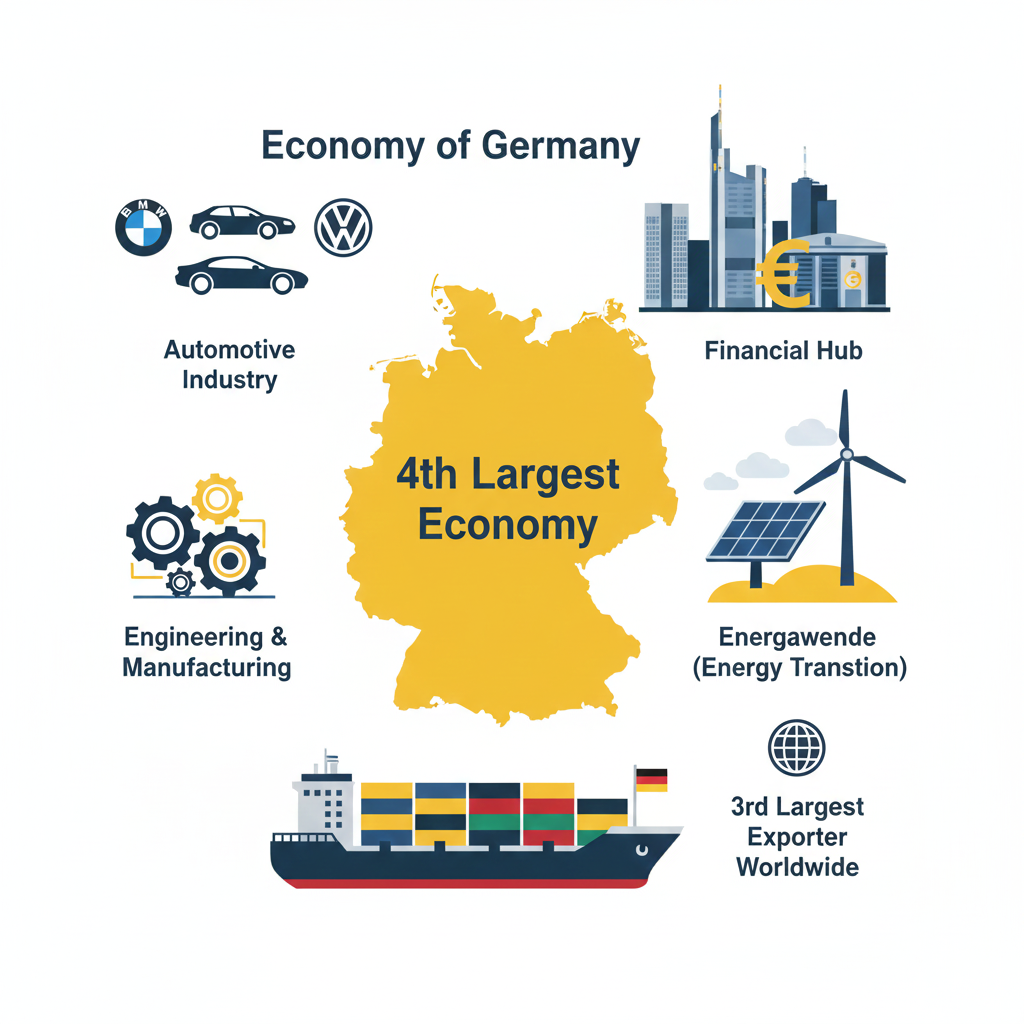
Economy of Germany

4. Economy

Germany has one of the most powerful and stable economies in the world. It is the largest economy in Europe and the fourth-largest globally (based on GDP). Its economic strength is built on industrial development, export-led production, technological innovation, and a highly skilled workforce.

Main Economic Characteristics

The country follows a Social Market Economy model, combining free-market principles with strong social welfare policies.

Key Industries

Automobile

  • Home to world-famous brands like BMW, Mercedes-Benz, Volkswagen, Audi.
  • Often referred to as the “World’s Car Factory.”

Engineering and Machinery

  • Known globally for precision industrial machines and equipment.

Chemicals and Pharmaceuticals

  • Major companies such as BASF and Bayer.
  • Leading exporter of chemicals and medical pharmaceuticals.

Electronics and Technology

  • Key companies include Siemens and Bosch.
  • Strong innovation in automation, AI, and robotics.

Green Energy

  • Global leader in solar and wind energy.
  • Transitioning from nuclear energy under the policy Energiewende.

Exports and Trade

  • Major Exports: Vehicles, machinery, electronic goods, chemicals, medical equipment.
  • Major Trading Partners: China, USA, France, Netherlands, UK.
  • It ranks among the top exporters globally.

Banking & Finance

  • Deutsche Bank and Commerzbank are major financial institutions.
  • Frankfurt serves as Europe’s financial hub and hosts the European Central Bank (ECB).

Conclusion on Economy

Its economy is built on industry, innovation, exports, and sustainability. Strong infrastructure and skilled labour make it a major economic power in Europe.

5. Education and Science

The country is counted among the world’s leading nations in education and scientific research. The system emphasizes quality, research, and technical training. Public universities offer low-cost or tuition-free education, attracting thousands of international students each year.

Education Structure

School Level

  • Grundschule (Grades 1–4).
  • After Grade 4: Hauptschule, Realschule, or Gymnasium (ending with Abitur).

Higher Education

  • Universitäten: Research-based institutions.
  • Fachhochschulen: Applied sciences and technical focus.
  • Strong dual training system combining theory and practice.

Famous Universities

  • Heidelberg University (Founded 1386)
  • Technical University of Munich (TUM)
  • Humboldt University of Berlin
  • RWTH Aachen University

Scientific Contributions

  • Albert Einstein – Theory of Relativity
  • Robert Koch – Bacteriology
  • Max Planck – Quantum Physics

Research Institutions

  • Max Planck Society
  • Fraunhofer Society
  • Leibniz Association

Conclusion on Education

With strong academic standards and research output, the nation remains a global hub for innovation and scientific excellence.

6. Society and Culture

Society represents a blend of tradition and modernity. The country is renowned for its contributions to literature, music, philosophy, and architecture. Values such as punctuality, honesty, and discipline shape everyday life.

Cultural Heritage

  • Goethe – Literature
  • Immanuel Kant – Philosophy
  • Beethoven & Bach – Classical music

Festivals

  • Oktoberfest – Munich
  • Christmas Markets
  • Karneval

Conclusion on Culture

Its cultural identity reflects a deep historical legacy while embracing modern democratic values.

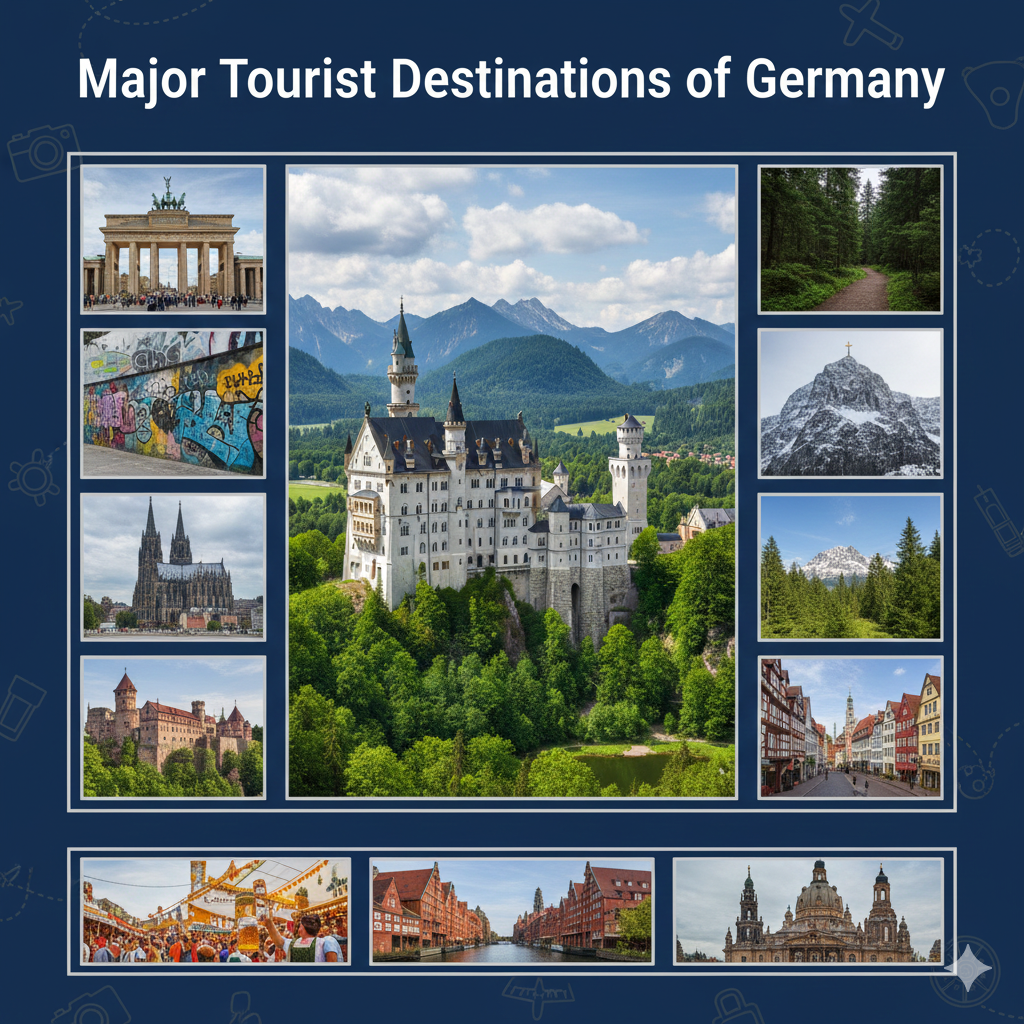
Major Tourist Destinations of Germany

7. Major Tourist Destinations

Germany is a wonderful European country filled with natural beauty, historic castles, modern cities, and rich cultural heritage. Whether you are a history lover, an art enthusiast, or a nature explorer, this nation offers something unique for every type of traveler.

1. Neuschwanstein Castle – Bavaria

  • This fairy-tale castle was built by King Ludwig II.
  • It inspired the iconic Disney Cinderella Castle.
  • Located amidst the Alps, it is one of the most famous castles in Germany.

2. Berlin Wall & Brandenburg Gate – Berlin

  • The Berlin Wall stands as a historic symbol of the Cold War, now preserved as a memorial.
  • The nearby Brandenburg Gate represents unity and peace.

3. Cologne Cathedral – Cologne

  • One of Europe’s most magnificent Gothic cathedrals.
  • A designated UNESCO World Heritage Site.
  • Its height (approx. 157 meters) makes it one of the country’s most visited landmarks.

4. Black Forest – South-West Region

  • Known for dense forests, mountain villages, lakes, and waterfalls.
  • Home of the famous Cuckoo Clock.
  • Ideal for trekking, hiking, and experiencing natural tranquility.

5. Romantic Road

  • A 350-km scenic route passing through historic towns, castles, and wine regions.
  • Includes picturesque towns like Rothenburg, Dinkelsbühl, and Füssen.

6. Munich

  • Capital of the state of Bavaria.
  • A beautiful blend of tradition and modernity.
  • Famous for Oktoberfest, museums, art galleries, and Bavarian culture.

7. Hamburg

  • One of Europe’s major port cities.
  • Known for its canals, lakes, and historic warehouse district (Speicherstadt – UNESCO Site).
  • Perfect destination for lovers of modern architecture and music.

8. Heidelberg

  • A charming old university town.
  • Known for its river views, hilltop castle, and medieval architecture.
  • Popular for its literary and cultural environment.

9. Zugspitze – Highest Peak

  • Located in the Alps mountain range.
  • Ideal for skiing, snowboarding, and scenic cable-car rides.
  • Height: 2,962 meters above sea level.

10. Dresden

  • A cultural and historical city located on the banks of the Elbe River.
  • Attractions include Frauenkirche, Zwinger Palace, and Semper Opera House.
  • A remarkable example of reconstruction after World War II.

Conclusion

Germany offers a diverse tourism experience—combining history, culture, nature, adventure, and modern lifestyle. From fairy-tale castles to scenic mountain landscapes, visitors can enjoy unforgettable experiences across this vibrant European nation.

India Germany Relations

8. Relations Between India and Germany

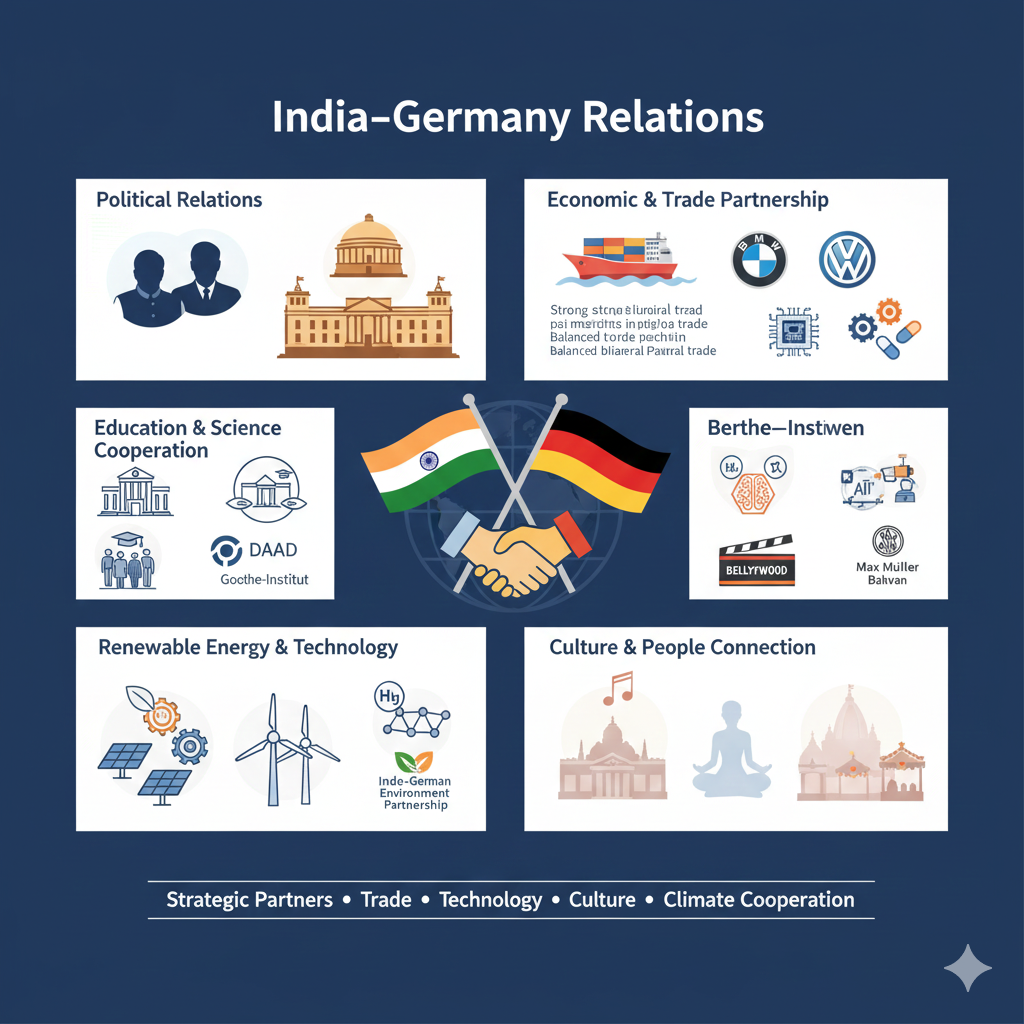
Relations between India and Germany are strong, deep, and multidimensional. Both nations share common values such as democracy, human rights, environmental protection, and global peace. Over time, these relations have become increasingly robust and diverse across political, economic, educational, cultural, and scientific areas.

Political Relations

  • India and Germany are Strategic Partners.
  • Since 2001, the two countries have held India–Germany Intergovernmental Consultations (IGC) — a mechanism India shares with very few nations.
  • Regular high-level meetings take place between Indian Prime Ministers and German Chancellors.
  • Germany is India’s largest trading partner within the European Union.

Economic and Trade Relations

AreaStatistics / Facts
Bilateral TradeUSD $30+ Billion (2023–24 estimate)
Major Exports (India → Germany)Gems & Jewellery, Pharmaceuticals, Textiles, IT Services
Major Imports (Germany → India)Machinery, Automobiles, Chemicals, High-tech Equipment
German Companies in India1800+ (including Siemens, Bosch, BMW, etc.)
  • Germany has shown strong interest in India’s Make in India initiative.
  • India is emerging as a major technology and startup hub for German businesses.

Education and Academic Collaboration

  • Thousands of Indian students pursue higher education in German universities, especially in STEM fields.
  • DAAD (German Academic Exchange Service) provides scholarships to Indian students.
  • The Goethe-Institut (Max Mueller Bhavan) promotes German language studies in India.
  • There are several academic MoUs and joint research programs between IITs, IISc, and leading German universities.

Amazon Product
Your Product Title Here
Buy on Amazon

Science and Technology Cooperation

  • Both countries collaborate in biotechnology, environment, AI, space research, and energy.
  • The Indo-German Science & Technology Center (IGSTC) supports joint research projects.

Renewable Energy and Environmental Cooperation

  • Strong partnership in solar energy and green hydrogen development.
  • Germany has supported India’s National Solar Mission (NSM) with technical and financial assistance.
  • The Indo-German Green and Sustainable Development Partnership focuses on climate-friendly solutions.

Cultural and People-to-People Contact

  • Max Mueller Bhavan (Goethe-Institut) plays a key role in connecting Indians with German culture and language.
  • German film festivals, art exhibitions, concerts, and academic conferences are held across India.
  • Indian Yoga, Ayurveda, and Bollywood are highly popular in Germany.

Conclusion

India–Germany relations are built on trust, cooperation, and shared interests. The two nations are working closely to address global challenges such as climate change, technological innovation, education, and world peace. This partnership is expected to grow even stronger and more diverse in the years ahead.

Conclusion

Germany is not only a leading European nation but also a global symbol of science, technology, education, innovation, environmental protection, and cultural values. Along with its historic castles and modern cities, Germany’s social structure, democratic governance, and economic progress make it a respected nation worldwide.

The relationship between India and Germany shows how two countries with different cultural backgrounds can build a strong and successful partnership based on shared values, mutual respect, and cooperation.

References

  • Federal Foreign Office of Germany (Auswärtiges Amt)
  • Germany – Country Profile, Federal Ministry of the Interior
  • Statistisches Bundesamt (Federal Statistical Office of Germany)
  • German Missions in India – Indo-German Relations
  • CIA World Factbook – Germany
  • Encyclopaedia Britannica – Germany
  • Study in Germany – DAAD (German Academic Exchange Service)

Leave a Comment

Your email address will not be published. Required fields are marked *

Scroll to Top