
Russia
1. Introduction
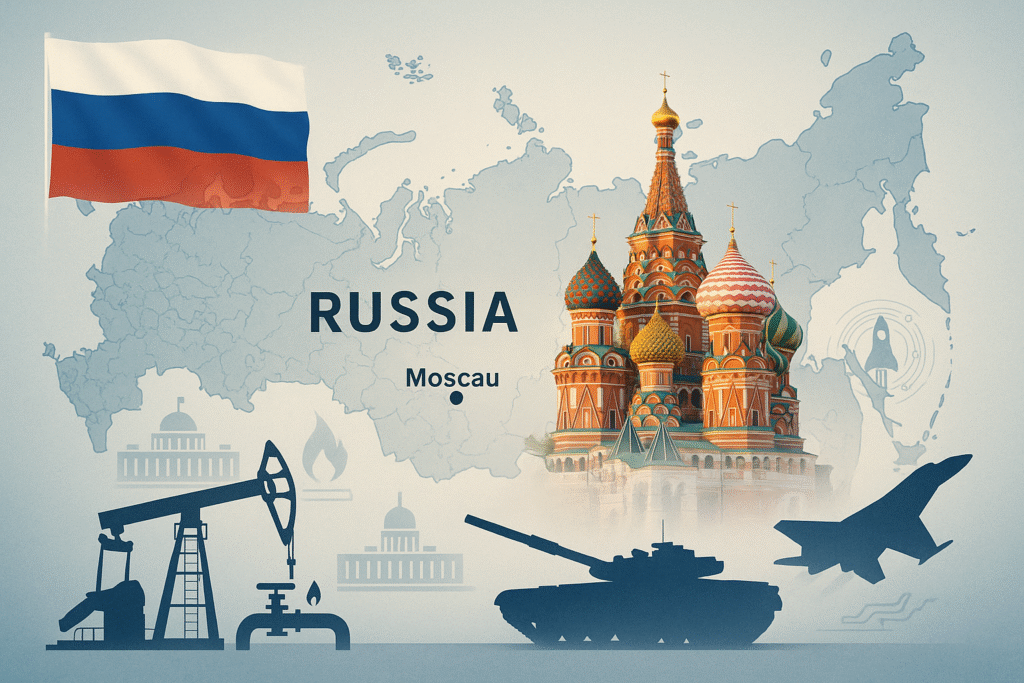
The Russian Federation is the largest country in the world by land area, stretching across Eastern Europe and northern Asia. This vast Eurasian nation plays a major role in global geopolitics, energy markets, military strategy and cultural history. Moscow serves as its capital and political center.
2. Geography and natural resources
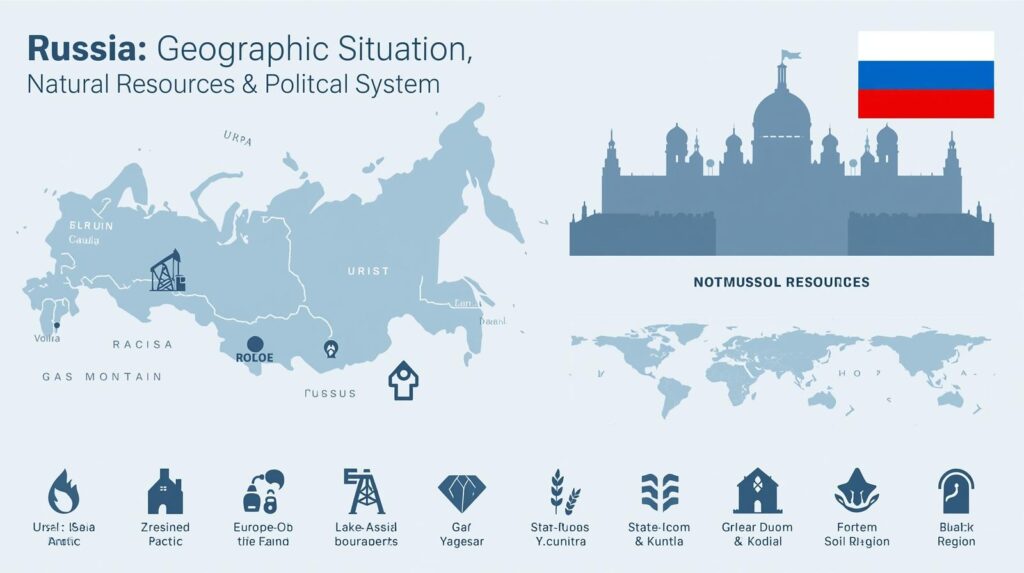
Covering approximately 17.1 million square kilometres, the federation extends from the Arctic Ocean to the Black Sea and from the Baltic region to the Pacific coastline. Major rivers include the Volga, Yenisei, Lena and Ob.
The country possesses immense reserves of oil, natural gas, coal, uranium, diamonds, gold and timber. It remains one of the world’s leading energy exporters and a key supplier of natural gas to several regions.
3. Political System
The Russian Federation functions as a federal state with a strong presidential system. The President serves as head of state, while the Prime Minister leads the government. Parliament consists of the State Duma and the Federation Council. Analysts often describe the political structure as highly centralized.
4. Economic Structure
The economy is heavily resource-oriented, with hydrocarbons forming the backbone of export earnings. Important sectors include:
- Energy production
- Defence industry
- Agriculture
- Mining and metals
- Technology and cybersecurity
Following sanctions imposed after 2014 and expanded after 2022, trade patterns increasingly shifted toward Asian markets.
5. Military Capabilities
The country maintains one of the largest nuclear arsenals in the world alongside advanced conventional forces. It invests significantly in defence modernization, cyber capabilities and strategic missile systems.
The Ukraine conflict intensified global scrutiny of its military doctrine and Hybrid warfare approach.
6. Foreign Policy
Foreign policy priorities generally include support for a multipolar world order, limiting Western dominance, and preserving influence in post-Soviet states. Strategic cooperation exists with China, India, Iran and several developing regions.
7. Society and Culture
Russian culture has deeply influenced global literature, music, philosophy and cinema. Writers like Tolstoy and Dostoevsky, composers such as Tchaikovsky and the tradition of ballet are internationally recognized.
More than 190 ethnic communities live across the federation, reflecting significant cultural and linguistic diversity.
8. human rights Concerns
International observers have expressed concern regarding press freedom, political opposition restrictions and civil liberties. Debates surrounding governance and individual freedoms continue to shape global discussions.
9. Science and Technology
The space program remains historically significant — being the first nation to send a human into orbit in 1961. Advances also exist in nuclear energy, defence systems and artificial intelligence research.
10. India – Russia Relations
India and the Russian Federation share a long-standing strategic partnership covering defence procurement, energy trade, nuclear cooperation and participation in BRICS and SCO platforms.
11. Environmental Challenges
Melting permafrost, Siberian wildfires and industrial pollution present environmental challenges. Climate policy debates continue within international frameworks such as the Paris Agreement.
12. Contemporary Challenges
- Geopolitical tensions related to Ukraine
- Economic sanctions
- Demographic decline
- Energy transition pressures
- Balancing relations with China
13. Conclusion
The Russian Federation remains a significant actor in global politics. Its geography, energy resources, military capabilities and cultural legacy ensure continued influence in world affairs despite evolving geopolitical pressures.
Strategic Importance
- Polar Access: Control over Arctic resources and emerging shipping routes
- Eurasian Position: Influences both European and Asian geopolitical spheres
- Energy Exports: Major oil and gas supplier to Europe, China and India
Political Arrangement and Government System
The Russian Federation follows a federal semi-presidential system, where executive authority is shared between the President and the Prime Minister. In practice, however, presidential power remains dominant, and many analysts describe the system as highly centralized.
Main Institutions
1. President
- Highest constitutional authority
- Supreme Commander of the Armed Forces
- Directs Foreign Policy and national security
- Appoints judges, ministers and regional governors
- Can dissolve parliament and declare emergencies
- Current President: Vladimir Putin
2. Prime Minister
- Heads government and administration
- Implements economic and social policies
- Appointed by the President and approved by the State Duma
- Current Prime Minister: Mikhail Mishustin
3. Federal Assembly (Parliament)
- State Duma: Lower house (450 members)
- Federation CoUNcil: Upper house representing federal regions
4. Constitutional Court
Responsible for interpreting the constitution and resolving legal disputes.
Political Parties and Electoral System
- United Russia: Dominant political party
- Communist Party (KPRF)
- Liberal Democratic Party (LDPR)
- A Just Russia
Elections are conducted regularly, though opposition parties, independent media and civil society organizations face significant regulatory restrictions.
Key Features of the Government System
Centralized Authority
Executive power remains heavily concentrated in the presidency.
Federal Structure
The federation consists of 80+ administrative units (oblasts, krais and republics), though policymaking authority is largely centralized.
Judicial Oversight
While constitutional provisions guarantee judicial independence, critics argue that courts remain influenced by executive power.
Opposition and Expression
- Restrictions on public protests
- Regulation of media and internet platforms
- NGOs often designated as “foreign agents”
Constitutional Amendments (2020)
- Extended presidential eligibility until 2036
- Expanded executive authority
- Prioritized domestic law over certain international agreements
Conclusion
Formally structured as a federal democratic republic, the political framework operates with strong presidential dominance and centralized governance. This model has provided administrative continuity and stability, though it has also drawn international criticism.
Economic Structure
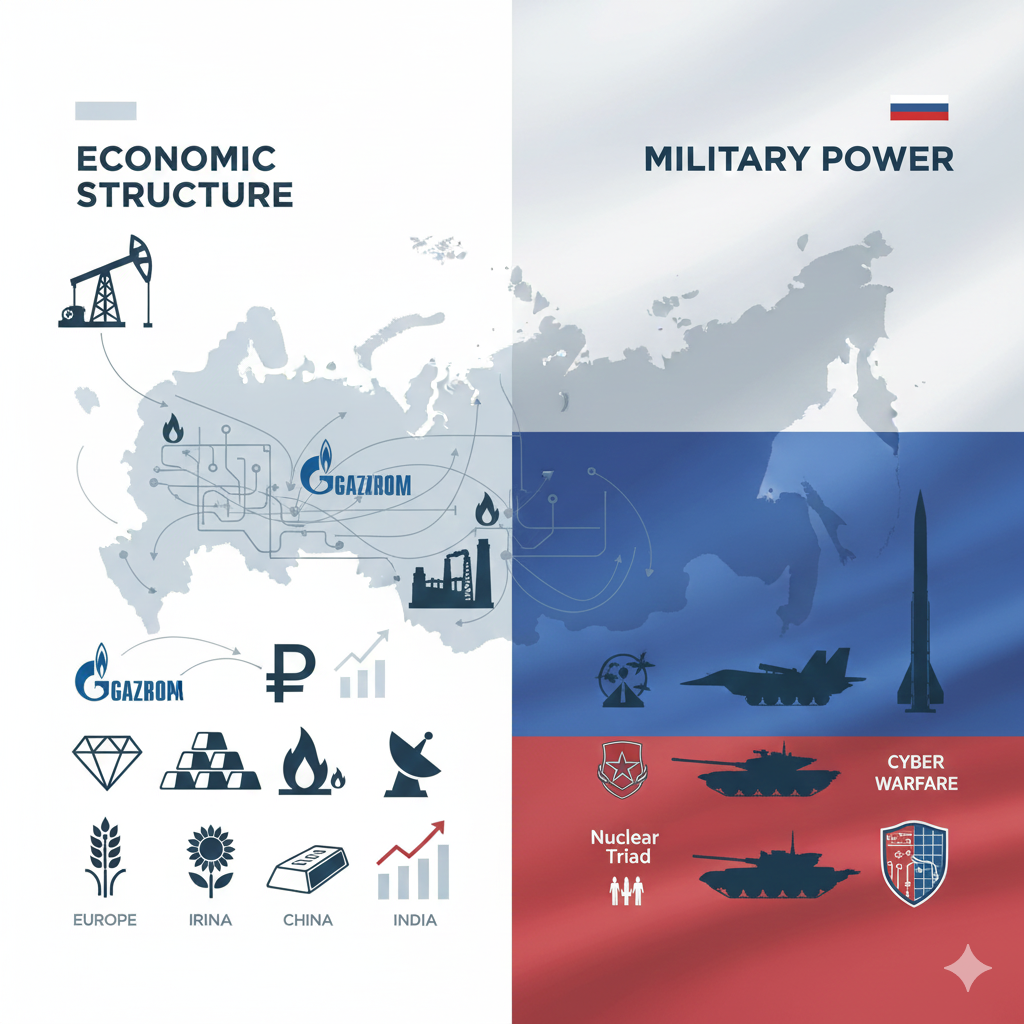
The Russian Federation operates a mixed economy in which natural resource–based industries dominate. It is widely recognized as an energy-exporting superpower. Following the dissolution of the Soviet Union in 1991, the coUNtry transitioned toward market-oriented reforms, although strategic sectors remain strongly influenced by state policy.
Main Features
| Speciality | Description |
|---|---|
| GDP (2024) | $1.9 trillion (nominal), $4.6 trillion (PPP) |
| Currency | Russian Ruble (RUB) |
| Main Sectors | Energy, Defence, Agriculture, Minerals, Manufacturing, IT, Services |
| Key Exports | Crude oil, natural gas, weapons, grain, metals |
| Key Imports | Machinery, electronics, pharmaceuticals, consumer goods |
Chief Economic Areas
1. Energy Sector
- The federation ranks among the top three oil producers and leading natural gas exporters.
- State-controlled giants such as Gazprom and Rosneft dominate the energy landscape.
- Exports to Europe, China and India serve as major instruments of geopolitical leverage.
2. Mineral and Metal Industry
- Extensive reserves of diamonds, gold, iron, nickel, uranium and coal.
- Among the world’s leading diamond producers and significant exporters of steel and aluminium.
3. Agriculture and Food Production
- One of the largest wheat exporters globally.
- Major outputs include cereals, sunflower oil, potatoes, meat and dairy products.
- Sanctions accelerated efforts toward agricultural self-sufficiency.
4. Industry and Manufacturing
- Highly developed defence and aerospace sectors.
- Advanced capabilities in nuclear reactors, missile systems and submarine construction.
- Civilian manufacturing includes vehicles, railway equipment and food processing.
5. IT and Cyber Sector
- Strong reputation in cybersecurity, AI development and software engineering.
- Companies like Yandex and Kaspersky compete in international markets.
Market System and State Control
Strategic industries—especially energy and defence—remain under significant state influence. After privatization in the 1990s, the 2000s marked a shift toward state capitalism, with close coordination between political leadership and major corporations.
Western Sanctions and Economic Response
Sanctions (2014 & 2022)
- Partial removal from the SWIFT financial network
- Restrictions on foreign capital and technology transfers
- Asset freezes targeting companies and individuals
Strategic Response
- Development of alternative payment systems (MIR, ruble–yuan settlements)
- Expanding trade with Asia, Middle East and Africa
- “Import Substitution” policies to boost domestic production
Contemporary Economic Challenges
- Currency volatility and inflationary pressure
- Dependence on foreign technology
- Demographic-driven labour shortages
- Declining long-term foreign investment
- governance and efficiency concerns
Innovation and Future Direction
Policymakers aim to diversify beyond hydrocarbons by investing in IT, pharmaceuticals, agriculture technology and space research. Structural reform remains critical for long-term competitiveness.
Conclusion
The economy of the Russian Federation is deeply shaped by energy wealth, state coordination and geopolitical realities. While sanctions and structural limits pose challenges, strategic diversification efforts continue.
Military Power and Strategy
The Russian Federation maintains one of the most powerful Armed Forces globally. Its military doctrine combines nuclear deterrence, conventional strength and cyber capabilities, positioning it among the world’s leading military powers.
Military Structure
| Branch | Description |
|---|---|
| Ground Forces | Armoured and mechanized divisions |
| Navy | Baltic, Black Sea, Arctic and Pacific fleets |
| Air Force | Fighter jets, helicopters and UAV systems |
| Strategic Rocket Forces | Nuclear missile command |
| Aerospace Forces | Air defence and satellite systems |
Nuclear Capability
The federation possesses over 6,000 nuclear warheads, forming a complete nuclear triad:
- Land-based ICBMs (Topol-M, Yars)
- Submarine-launched ballistic missiles
- Strategic bombers (Tu-160, Tu-95)
Strategic Doctrine
- Hybrid warfare (cyber + conventional integration)
- Deterrence-based nuclear strategy
- Forward presence in key geopolitical zones
Contemporary Impact
The Ukraine conflict reshaped operational priorities, accelerated drone warfare, and increased domestic defence production despite sanctions.
Conclusion
Military strength remains a central pillar of national strategy. Nuclear deterrence, technological modernization and geopolitical positioning ensure continued influence in global security affairs.
Foreign Policy and Diplomatic Relationship
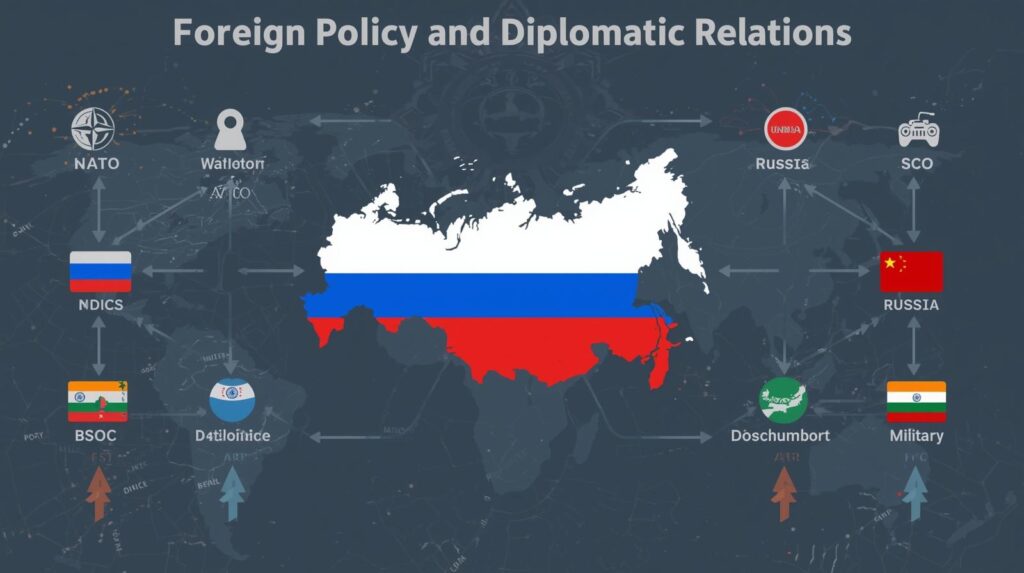
The foreign policy of the Russian Federation emphasizes national sovereignty, support for a multipolar world order and protection of strategic influence zones. The coUNtry views itself as a major global power balancing Western dominance, particularly that of the United States and NATO.
Main Objectives of Foreign Policy
- Maintaining influence in Eurasia, especially former Soviet republics
- Balancing NATO, EU and US strategic expansion
- Promoting a multipolar international system
- Strengthening partnerships with China, India, Iran and Turkey
- Expanding security cooperation in the Middle East, Africa and the Arctic
Important Diplomatic Fronts
1. Relations with Western Countries and NATO
- Key disputes include Ukraine, cyber issues and human rights concerns
- NATO’s eastward expansion is viewed as a security threat
- Sanctions intensified after 2014 (Crimea) and 2022 (Ukraine conflict)
- Energy reorientation reduced dependence on European markets
2. Relations with China
- Strong cooperation in energy, defence and technology
- Joint military exercises
- Coordination within BRICS and SCO frameworks
- China seen as an alternative global pole, though economic imbalance concerns remain
3. India–Russia Relationship
- Long-standing strategic partnership
- Defence: BrahMos missile, S-400 system, Sukhoi aircraft
- Energy: Oil, gas and nuclear projects (e.g., Kudankulam)
- Cooperation within BRICS, SCO and G20
- Expanded energy trade after 2022 through discounted crude supplies
4. Central Asia and the Caucasus
- Considered part of its traditional influence zone
- Security cooperation through CSTO
- Military bases in Kazakhstan, Tajikistan and Armenia
- Rising Chinese economic presence presents strategic competition
5. Middle East Policy
- Military presence in Syria since 2015
- Strategic engagement with Iran and Turkey
- Balancing US influence in regional affairs
6. Africa and Latin america
- Security cooperation and mineral partnerships
- Support for governments critical of Western influence
Participation in Multilateral Forums
| Forum | Role |
|---|---|
| BRICS | Founder member promoting multipolarity |
| SCO | Security and counter-terror cooperation |
| EAEU | Regional economic integration platform |
| UN Security Council | Permanent member with veto power |
| G20 | Active participant in global economic dialogue |
New Foreign Policy Directions (Post-2022)
- Strategic pivot toward Asia, Africa and Latin America
- Alternative financial mechanisms (MIR, yuan–ruble trade)
- Diplomatic flexibility to mitigate sanctions impact
Conclusion
The federation’s external strategy combines confrontation and cooperation, seeking strategic autonomy while building alternative alliances. Despite sanctions and criticism, it continues efforts to preserve global influence.
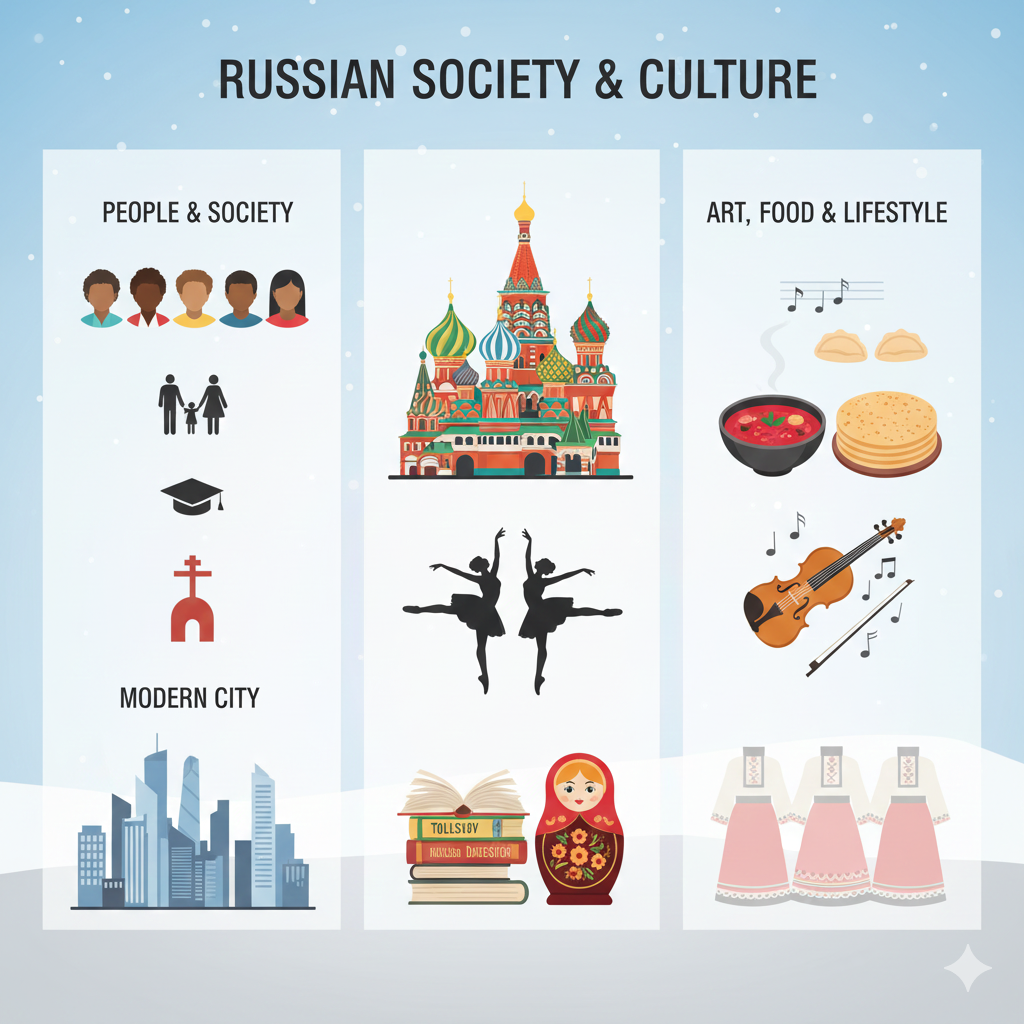
Society and Culture
The society of the Russian Federation reflects centuries of history, ethnic diversity and intellectual achievement. Traditional values coexist with modern urban lifestyles shaped by post-Soviet transformation.
Demographic Structure
| Aspect | Description |
|---|---|
| Population (2024) | ~143 million |
| Ethnic Composition | Majority Russian; Tatars, Bashkirs, Chechens and others |
| Language | Russian (official) + 190 regional languages |
| Religion | Orthodox Christianity, Islam and others |
Cultural Heritage
Literature
- Leo Tolstoy
- Fyodor Dostoevsky
- Anton Chekhov
- Alexander Pushkin
Music and Dance
- Classical composers like Tchaikovsky
- World-renowned ballet institutions such as Bolshoi and Mariinsky
Art and Architecture
- Iconic religious art and Orthodox churches
- Landmarks such as Saint Basil’s Cathedral and the Kremlin
Education and Science
- Literacy rate above 99%
- Prestigious institutions including Moscow State University
- Strong tradition in mathematics, physics and engineering
Food and Lifestyle
| Dish | Description |
|---|---|
| Borscht | Beetroot soup |
| Pelmeni | Meat dumplings |
| Blini | Thin pancakes |
| Kvass | Fermented bread drink |
Modern Trends
- Urban expansion in Moscow and St. Petersburg
- Growth of digital platforms and AI adoption
- Ongoing balance between tradition and modernization
Conclusion
Cultural identity remains rooted in deep historical traditions while adapting to technological and social change. This blend of heritage and modernity defines contemporary national life.
Society and Culture
The society of the Russian Federation reflects centuries of history, ethnic diversity and intellectual achievement. Traditional values coexist with modern urban lifestyles shaped by post-Soviet transformation.
Demographic Structure
| Aspect | Description |
|---|---|
| Population (2024) | ~143 million |
| Ethnic Composition | Majority Russian; Tatars, Bashkirs, Chechens and others |
| Language | Russian (official) + 190 regional languages |
| Religion | Orthodox Christianity, Islam and others |
Cultural Heritage
Literature
- Leo Tolstoy
- Fyodor Dostoevsky
- Anton Chekhov
- Alexander Pushkin
Music and Dance
- Classical composers like Tchaikovsky
- World-renowned ballet institutions such as Bolshoi and Mariinsky
Art and Architecture
- Iconic religious art and Orthodox churches
- Landmarks such as Saint Basil’s Cathedral and the Kremlin
Education and Science
- Literacy rate above 99%
- Prestigious institutions including Moscow State UNiversity
- Strong tradition in mathematics, physics and engineering
Food and Lifestyle
| Dish | Description |
|---|---|
| Borscht | Beetroot soup |
| Pelmeni | Meat dumplings |
| Blini | Thin pancakes |
| Kvass | Fermented bread drink |
Modern Trends
- Urban expansion in Moscow and St. Petersburg
- Growth of digital platforms and AI adoption
- Ongoing balance between tradition and modernization
Conclusion
Cultural identity remains rooted in deep historical traditions while adapting to technological and social change. This blend of heritage and modernity defines contemporary national life.
Science and Technology Development
The Russian Federation has long been recognized as a global leader in science and technology. From the historic space race to nuclear engineering, mathematics and physics, its contributions—especially during the Soviet era—shaped modern scientific progress. Despite sanctions and brain drain challenges, the coUNtry continues pursuing technological self-reliance.
Historical Background and Scientific Heritage
| Field | Key Contributions |
|---|---|
| Space | Sputnik (1957), Yuri Gagarin – first human in space (1961) |
| Nuclear Science | Early nuclear power plants, atomic research, submarine technology |
| Mathematics & Physics | Scientists such as Kolmogorov, Landau and Kapitsa |
| Computing & Cryptography | Advanced Soviet-era encryption and computational systems |
Major Scientific Institutions
- Russian Academy of Sciences (RAS): Established in 1724; supervises 1000+ institutes.
- Roscosmos: National space agency managing satellite launches and ISS missions.
- Kurchatov Institute: Leading center for nuclear research.
- Skolkovo Innovation Center: Major technology and startup hub.
Space Science and Technology
- Development of the reliable Soyuz spacecraft system
- Significant participation in ISS operations
- Future lunar exploration initiatives
Nuclear Technology and Energy
- Rosatom: Builds nuclear reactors domestically and internationally (e.g., Kudankulam in India)
- Advanced research in fast breeder reactors
- Atomic-powered submarines and icebreakers
IT, Cyber and Digital Technologies
- Strong cybersecurity capabilities and AI development
- Major firms: Yandex, Kaspersky, VKontakte
- Growing focus on defence-oriented digital systems
Present Challenges
| Challenge | Description |
|---|---|
| Brain Drain | Skilled professionals relocating abroad |
| Funding Limits | Reduced Western partnerships |
| Aging Infrastructure | Outdated laboratories and facilities |
Conclusion
Scientific advancement remains a pillar of national power. Historic achievements in space and nuclear research continue to define technological identity, while modernization efforts focus on digital, defence and indigenous innovation.
India–Russia Relationship
India and the Russian Federation share a long-standing strategic partnership rooted in trust, defence cooperation and diplomatic alignment. From the Cold War era to today’s multipolar world, the relationship spans security, energy, trade and space collaboration.
Historical Background
- Soviet support to India during early developmental years
- 1971 Indo–Soviet Treaty of Peace, Friendship and Cooperation
- Renewed strategic engagement after 1991
Defence and Security Collaboration
- Major defence supplier for decades
- S-400 system, Su-30MKI aircraft, T-90 tanks
- BrahMos missile (joint venture)
- “Indra” joint military exercises
Space and Nuclear Cooperation
- Support in India’s early human space missions
- Collaboration between ISRO and Roscosmos
- Development of Kudankulam Nuclear Power Plant
Trade and Economic Relations
| Aspect | Description |
|---|---|
| Bilateral Trade (2023–24) | ~$65 billion |
| India’s Imports | Crude oil, fertilizers, defence equipment |
| India’s Exports | Pharmaceuticals, machinery, electronics |
| Currency Mechanism | Rupee–ruble settlement discussions |
Multilateral Cooperation
- BRICS and SCO frameworks
- Coordination in G20 discussions
- Support for India’s UNSC permanent membership aspiration
Ukraine War Context
- India maintained a neutral diplomatic stance
- energy trade expanded through discounted oil supplies
Conclusion
The partnership remains durable and multi-dimensional. Despite global geopolitical shifts, cooperation in defence, energy, space and diplomacy continues to deepen.
Frequently Asked Questions (FAQs)
1. Why is Russia considered the largest coUNtry in the world?
Russia is the world's largest country by land area, covering approximately 17.1 million square kilometers across Eastern Europe and Northern Asia. Its vast territory spans eleven time zones and contains abundant natural resources, making it strategically important in global affairs.
2. What are the main strengths of Russia's economy?
Russia's economy is primarily driven by energy resources such as oil and natural gas, along with mining, defense manufacturing, agriculture, nuclear technology, and metallurgy. It is also one of the world's leading exporters of wheat, crude oil, and natural gas.
3. Why is Russia regarded as a major military power?
Russia possesses one of the world's largest nuclear arsenals, advanced missile systems, a powerful air force and navy, and significant cyber capabilities. Its military strength plays a central role in its Foreign Policy and global strategic influence.
4. What is the importance of India–Russia relations?
India and Russia maintain a long-standing strategic partnership based on defense cooperation, energy security, nuclear power, space collaboration, and multilateral organizations such as BRICS and the Shanghai Cooperation Organisation (SCO).
5. What are the major Environmental Challenges facing Russia?
Russia faces several environmental issues, including melting Arctic permafrost, Siberian forest fires, industrial pollution, climate change, and the environmental impacts of large-scale oil, gas, and mining activities.
6. What are the biggest challenges facing Russia today?
Russia currently faces Geopolitical tensions, international sanctions, demographic decline, economic diversification challenges, technological restrictions, and the need to balance long-term growth with changing global energy and security dynamics.
7. Why is Russia an important topic for UPSC and other competitive exams?
Russia is frequently asked in competitive examinations because of its Geography, political system, economy, military capabilities, foreign policy, India–Russia relations, Arctic importance, energy resources, and its significant role in global geopolitics.
Environment and Climate Change
The Russian Federation, as the world’s largest coUNtry by land area, plays a vital role in global climate stability and biodiversity conservation. Its vast forests, Arctic territories, freshwater reserves and mineral wealth hold international ecological importance. However, rapid industrialization and fossil fuel dependence have created significant environmental pressures.
Ecological Zones
| Region | Features |
|---|---|
| Siberia | Extensive taiga forests and permafrost zones |
| Arctic Region | Glaciers, oil reserves, emerging sea routes |
| Central Territories | Lakes including Baikal, wetlands |
| Southern Belt | Steppe grasslands and fertile soil |
Key Environmental Challenges
Climate Warming
- Arctic temperatures rising nearly twice the global average
- Melting permafrost releasing methane emissions
- Infrastructure damage in northern settlements
industrial pollution
- Oil and mining sectors causing soil and water contamination
- Urban air quality concerns in major industrial cities
- Large-scale oil spill incidents affecting freshwater systems
Forest Fires and Deforestation
- Millions of hectares burned annually in Siberia
- Rising carbon emissions and biodiversity loss
Climate Commitments
- Paris Agreement ratified in 2019
- Emission reduction target linked to 1990 levels
- Limited renewable energy transition; nuclear promoted as low-carbon source
Conclusion
Environmental policy will significantly shape the federation’s long-term sustainability. Greater investment in renewable energy, transparent governance and conservation strategies would strengthen its role as a responsible global stakeholder.
Chief Contemporary Challenges
Despite its geopolitical influence, the federation faces interconnected domestic and international pressures affecting economic growth, demographics and diplomatic positioning.
Geopolitical tensions
- Ukraine conflict leading to sanctions and diplomatic isolation
- Expanded NATO presence in Eastern Europe
- Restricted access to global financial systems
Economic Pressures
| Issue | Impact |
|---|---|
| Technology sanctions | Slower industrial modernization |
| Energy export limits | Revenue volatility |
| Corporate exits | Reduced foreign investment |
Demographic Decline
- Low birth rates
- Migration of skilled workforce
- Labour shortages
Governance Concerns
- Restrictions on opposition activity
- Media regulation and digital monitoring
- International criticism over civil liberties
Conclusion
Long-term stability will depend on economic diversification, institutional reforms and balanced foreign engagement.
Final Conclusion
The Russian Federation stands at a strategic crossroads in the 21st century. Its vast Geography, scientific achievements, military capabilities and energy resources make it a significant global actor. At the same time, geopolitical tensions, economic restructuring, demographic decline and environmental stress present major tests.
Strengths
- Extensive natural resources
- Advanced defence and space technology
- Influence in Eurasian geopolitics
- Deep cultural and scientific heritage
Structural Challenges
- Sanctions and global isolation
- Economic concentration in energy exports
- Demographic and workforce imbalance
- Environmental sustainability concerns
Global Outlook
The future trajectory of this Eurasian power will depend on institutional reform, economic diversification and constructive international cooperation.
Relevance for India
India–Russia relations remain strategically important, particularly in defence, energy and multilateral diplomacy, contributing to India’s policy of strategic autonomy.
Frequently Asked Questions (FAQs)
1. Why is Russia considered the largest coUNtry in the world?
Russia is the world's largest country by land area, covering approximately 17.1 million square kilometers across Eastern Europe and Northern Asia. Its vast territory spans eleven time zones and contains abundant natural resources, making it strategically important in global affairs.
2. What are the main strengths of Russia's economy?
Russia's economy is primarily driven by energy resources such as oil and natural gas, along with mining, defense manufacturing, agriculture, nuclear technology, and metallurgy. It is also one of the world's leading exporters of wheat, crude oil, and natural gas.
3. Why is Russia regarded as a major military power?
Russia possesses one of the world's largest nuclear arsenals, advanced missile systems, a powerful air force and navy, and significant cyber capabilities. Its military strength plays a central role in its Foreign Policy and global strategic influence.
4. What is the importance of India–Russia relations?
India and Russia maintain a long-standing strategic partnership based on defense cooperation, energy security, nuclear power, space collaboration, and multilateral organizations such as BRICS and the Shanghai Cooperation Organisation (SCO).
5. What are the major Environmental Challenges facing Russia?
Russia faces several environmental issues, including melting Arctic permafrost, Siberian forest fires, industrial pollution, climate change, and the environmental impacts of large-scale oil, gas, and mining activities.
6. What are the biggest challenges facing Russia today?
Russia currently faces Geopolitical tensions, international sanctions, demographic decline, economic diversification challenges, technological restrictions, and the need to balance long-term growth with changing global energy and security dynamics.
7. Why is Russia an important topic for UPSC and other competitive exams?
Russia is frequently asked in competitive examinations because of its Geography, political system, economy, military capabilities, foreign policy, India–Russia relations, Arctic importance, energy resources, and its significant role in global geopolitics.