
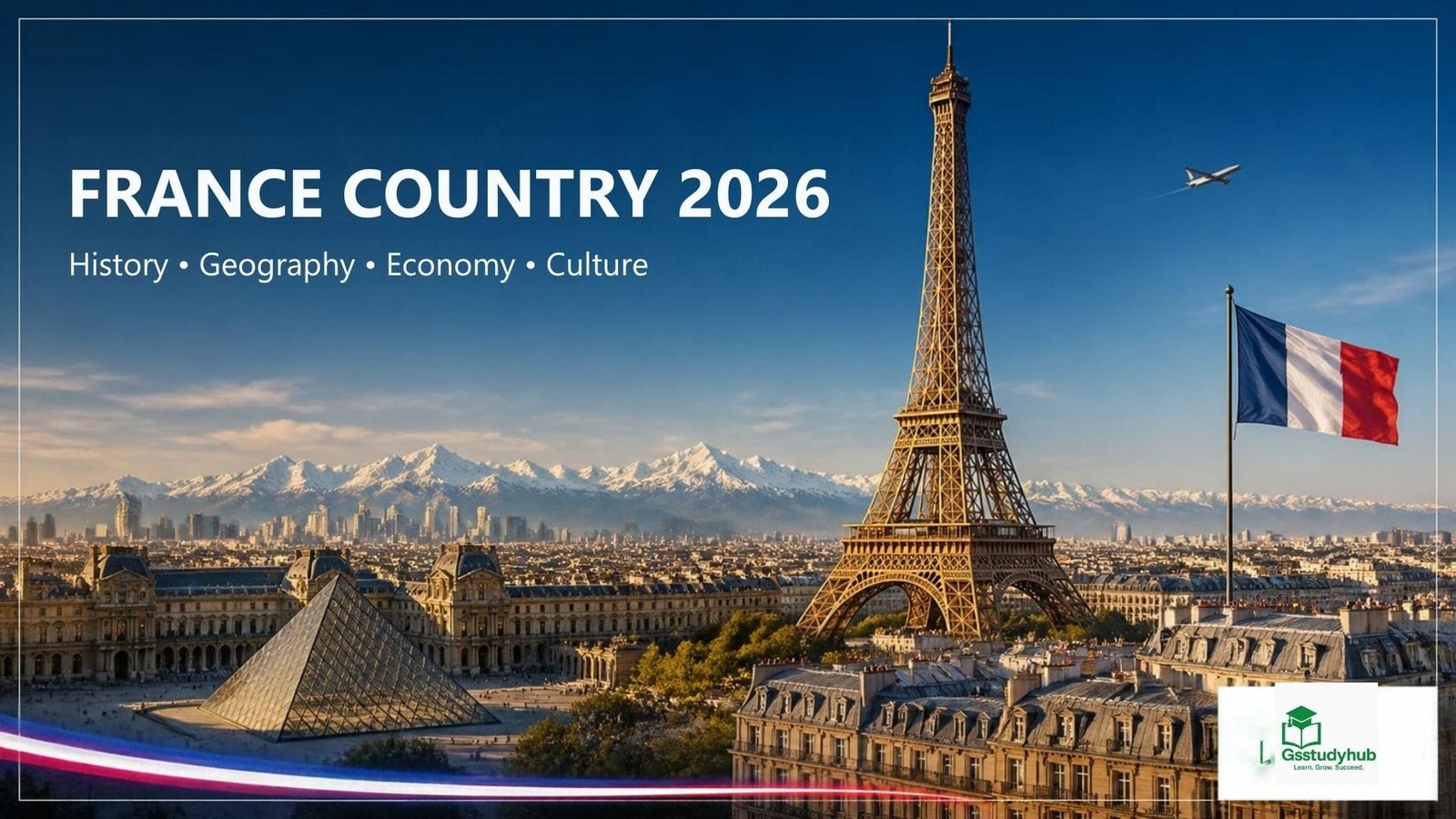
France Country 2026: History, Geography, Economy, and Global Importance
France is one of the major developed countries in Europe, widely known for its rich history, democratic system, modern economy, art, and culture. In 2026, France plays an important role in European politics, international diplomacy, defense, aviation, and global trade.
France Country 2026: Introduction and Key Facts
France is known for the historical ideals of liberty, equality, and fraternity associated with the French Revolution. The Eiffel Tower, Louvre Museum, French fashion, literature, and famous cuisine strengthen its global cultural identity.
General Information About France
- Official Name: French Republic
- Capital: Paris
- Continent: Europe
- Official Language: French
- Currency: Euro (€)
- Political System: Semi-presidential republic
- Population: Approximately 69.1 million, estimated as of January 1, 2026
- Area of Metropolitan France: Approximately 552,000 square kilometers
- National Day: July 14
Global Importance of France in 2026
France is a permanent member of the United Nations Security Council and one of the leading powers in the European Union. It has a strong international presence in aircraft manufacturing, defense technology, agriculture, tourism, nuclear energy, and luxury goods.
Relations Between India and France
India and France maintain a strategic partnership in defense, space research, trade, clean energy, and scientific technology. Despite political, economic, and environmental challenges, relations between the two countries are likely to remain important in the future.
Geographical Location of France
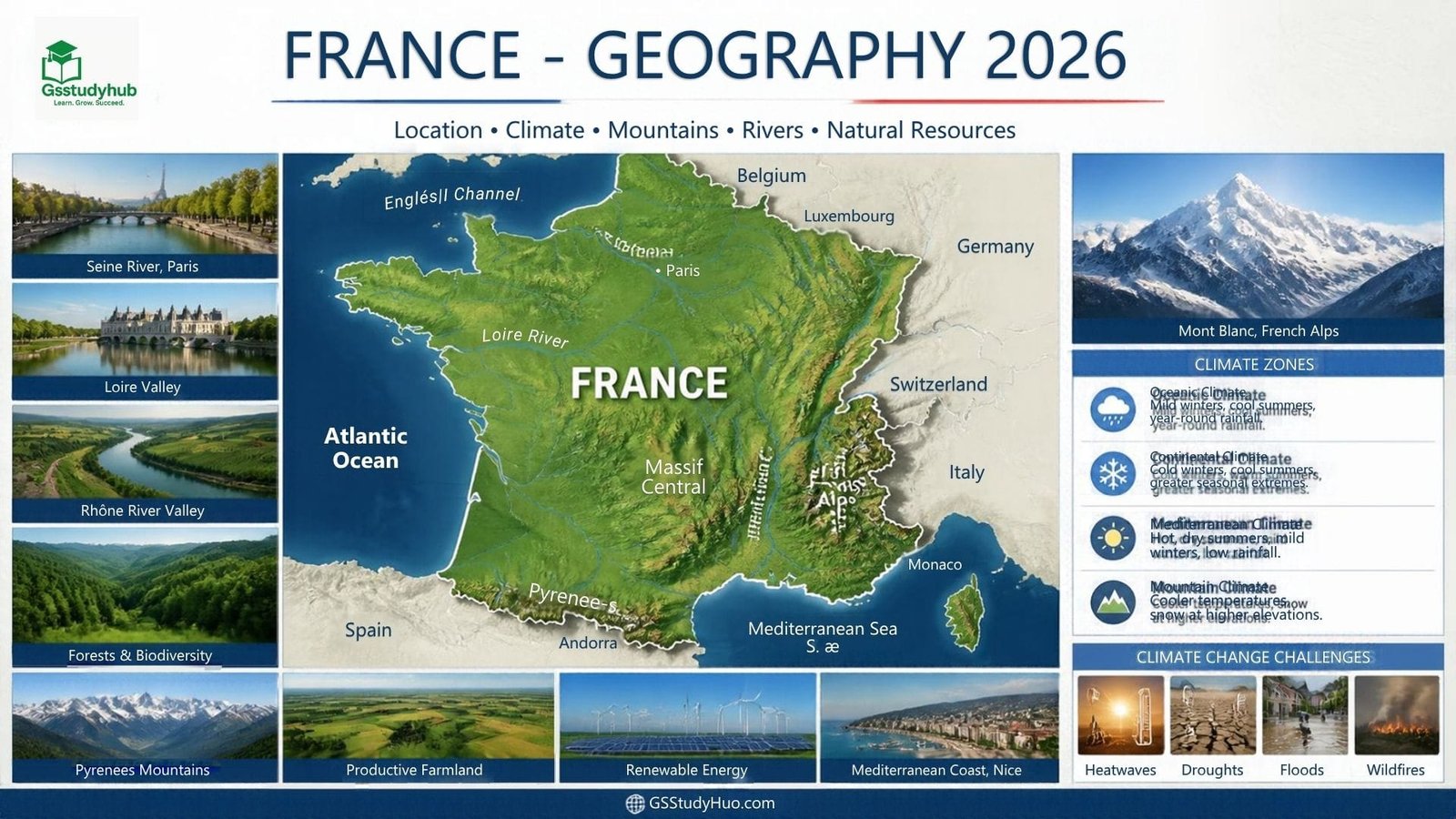
France is an important country in Western Europe. Its geographical location gives it special importance in European trade, transportation, and international relations. The main European territory of France is known as Metropolitan France. In addition, France has overseas departments and territories located in various geographical regions, including the Caribbean, the Indian Ocean, and South America.
Neighboring Countries and Maritime Boundaries of France
In Europe, France shares its borders with Belgium, Luxembourg, Germany, Switzerland, Italy, Monaco, Spain, and Andorra. The Atlantic Ocean lies to its west, the English Channel to its northwest, and the Mediterranean Sea to its south. Access to the sea provides France with advantages in international trade, maritime transportation, and tourism.
Major Mountains and Rivers
The Alps and the Pyrenees
The Alps are located in southeastern France, and Mont Blanc is one of the region's famous high peaks. In the southwest, the Pyrenees Mountains form a natural boundary between France and Spain. These mountainous regions are important for tourism, mountaineering, and winter sports.
The Seine, Loire, and Rhône Rivers
The Seine River flows through Paris and plays an important role in the city's historical development. The Loire River is famous for its valley and historic castles. The Rhône River is useful for agriculture, water resources, transportation, and hydroelectric power generation.
Climate and Natural Resources
France has oceanic, continental, Mediterranean, and mountain climates. The western region generally experiences relatively humid weather due to maritime influences, while warm and sunny weather is common in the south. France has agricultural land, forests, water resources, and mineral resources. Nuclear energy, hydropower, and renewable energy also make important contributions to its energy system.
Challenges of Climate Change
Climate change exposes France to challenges such as heatwaves, droughts, floods, and wildfires. These events can affect agriculture, water availability, biodiversity, and tourism. Therefore, water conservation, clean energy, and environmental protection are important components of France's long-term development policies.
Ancient Gaul and Roman Rule in France
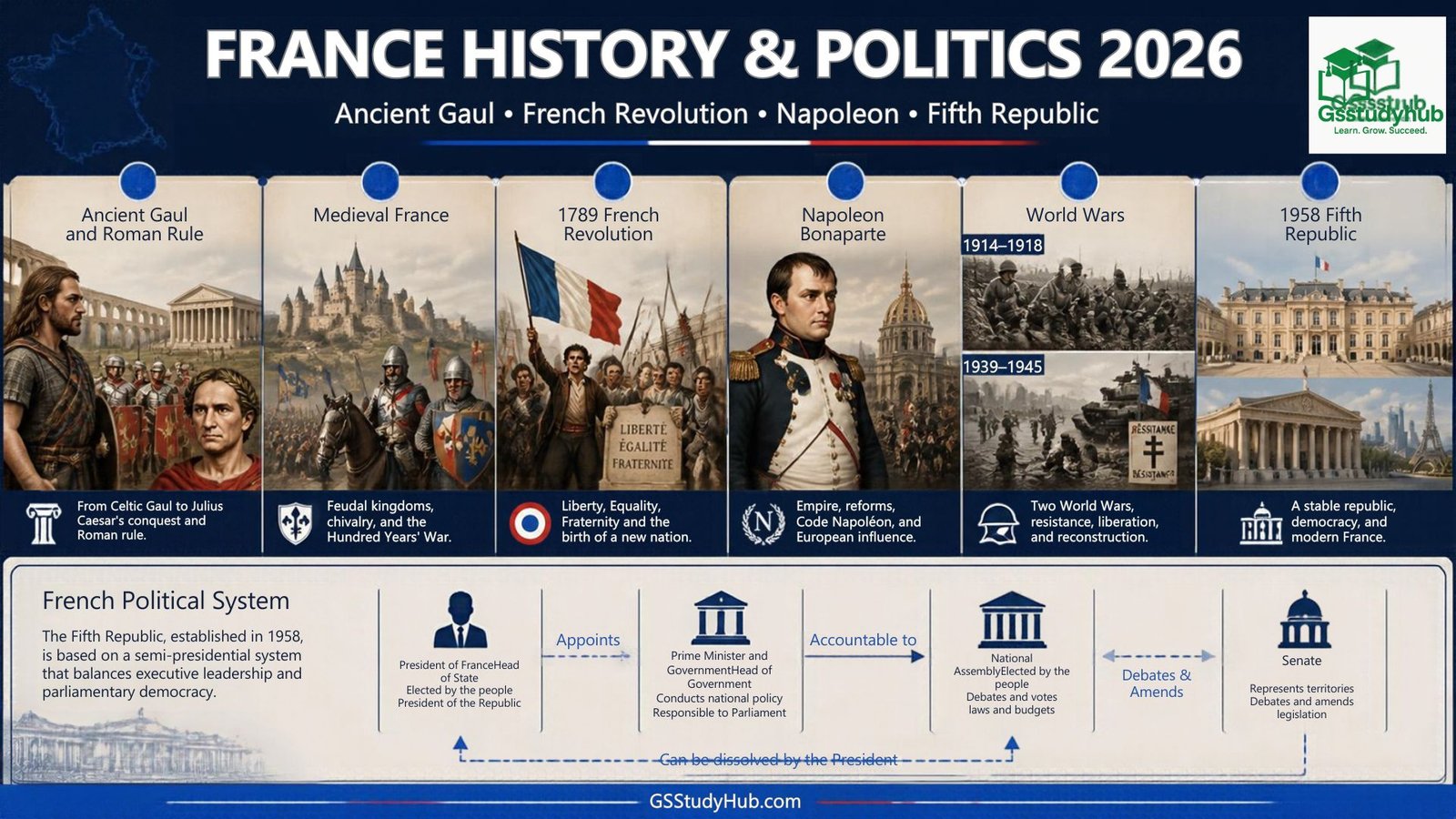
The history of France dates back to ancient Gaul, a region inhabited by Celtic peoples known as the Gauls. In the first century BCE, Roman forces led by Julius Caesar conquered most of Gaul. Under Roman rule, the region experienced changes in language, administration, urban development, and trade. Over time, Latin influenced the development of the French language.
Medieval France and the French Revolution of 1789
During the Middle Ages, France developed through the growth of feudalism, the influence of the Church, and the strengthening of royal authority. The Hundred Years’ War between England and France, fought mainly from 1337 to 1453, played an important role in shaping French national identity.
The French Revolution began in 1789 amid financial difficulties, social inequality, and opposition to absolute monarchy. It challenged the privileges of the nobility and clergy and promoted ideas of liberty, equality, and citizenship. The revolution transformed France’s political system and influenced democratic movements across the world.
Napoleon Bonaparte and Modern French History
The Rise of Napoleon
Napoleon Bonaparte rose to power in 1799 and became Emperor of the French in 1804. His government introduced important administrative and legal reforms, including the Napoleonic Code. After military defeats, he lost power in 1815.
France in the Two World Wars
France fought against Germany and its allies during the First World War (1914–1918), suffering heavy casualties and extensive destruction. During the Second World War (1939–1945), Germany occupied much of France in 1940. Resistance movements and Free French forces contributed to the liberation of the country.
The Fifth Republic and the Political System of France
In 1958, France established the Fifth Republic under a new Constitution, associated with Charles de Gaulle. The system combines a powerful presidency with a government led by a prime minister. The president is elected for a five-year term and appoints the prime minister. The official Élysée website explains the country's institutions.
President and Prime Minister in 2026
As of October 2026, Emmanuel Macron is the President of France, and Sébastien Lecornu is the Prime Minister. The president represents the state and plays a major role in foreign affairs and national defence, while the prime minister directs the government's work and implements laws. The French government's official website lists the current government.
French Parliament: National Assembly and Senate
The French Parliament has two chambers: the National Assembly, whose 577 members are directly elected, and the Senate, whose members are indirectly elected. Both chambers examine and pass legislation and oversee government activity. In the event of certain legislative disagreements, the National Assembly can have the final say.
France's Political Situation in 2026
France's political system continues to operate under the Fifth Republic. A divided National Assembly makes parliamentary negotiations important for passing laws and budgets. The balance between presidential leadership, the government's parliamentary support, and the two chambers remains central to French politics in 2026.
France's Economy in 2026
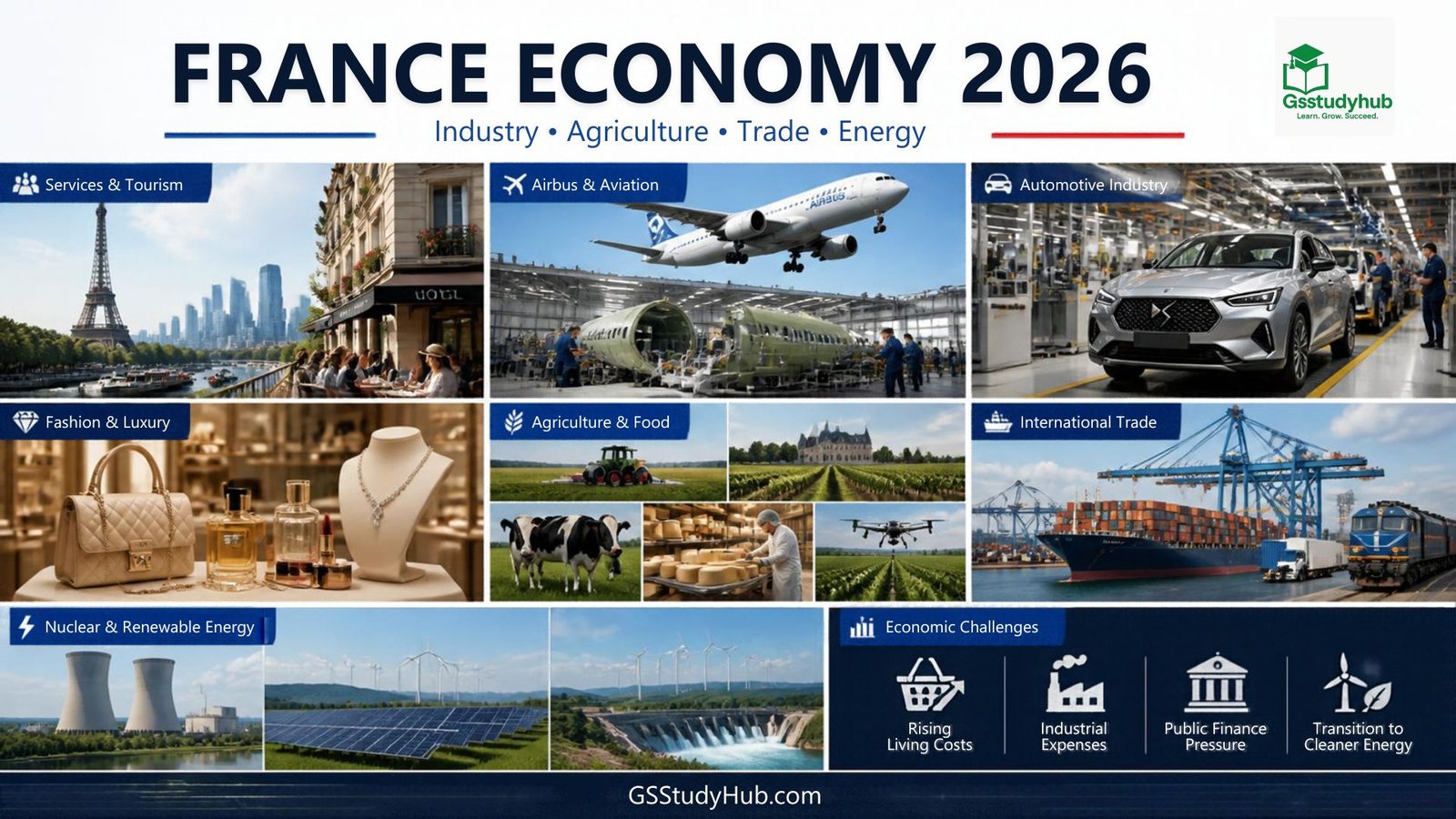
France is one of the major developed economies in Europe. Its economy depends on services, manufacturing, agriculture, tourism, aircraft manufacturing, and luxury goods. The country uses the euro and is one of the leading economic members of the European Union. According to the European Commission's May 2026 forecast, France's real GDP growth was projected to be approximately 0.8% in 2026. This is a forecast, not the final annual figure.
Major Sectors of France's Economy
1. Services and Tourism
The service sector is an important part of France's economy. It includes banking, insurance, transportation, education, healthcare, information technology, and trade. Paris, the Eiffel Tower, museums, historic castles, and the French Riviera attract international visitors. Tourism generates employment and supports hotels, restaurants, transportation services, and local businesses.
2. Major Industries and Airbus
France has well-developed industries, including aircraft manufacturing, defence equipment, chemicals, pharmaceuticals, food processing, and machinery. Airbus is a major European aircraft manufacturer, and France plays an important industrial and engineering role in the group. The aviation industry contributes to exports, research, and highly skilled employment.
3. Automotive Industry, Fashion, and Luxury Goods
France's automotive industry is involved in passenger cars, commercial vehicles, and automotive technology. Groups such as Renault and Stellantis are major players in this sector. France is also famous for fashion, perfumes, cosmetics, jewellery, watches, and premium leather goods. These industries give French brands a strong presence in international markets.
Agriculture, Trade, and Energy
4. Agriculture and Food Production
France is one of Europe's major agricultural producers. Its agricultural output includes wheat, maize, grapes, barley, dairy products, meat, and various vegetables. French cheese, wine, and other food products are well known in international markets. Modern agricultural technology and food processing support the rural economy.
5. International Trade
France exports aircraft, machinery, pharmaceuticals, vehicles, agricultural products, and luxury goods. Countries within the European Union, including Germany, are among its major trading partners. Dependence on imported energy and raw materials, along with international market competition, can affect France's trade balance.
6. Nuclear, Solar, and Wind Energy
Nuclear power plays a major role in France's energy system. According to France's official energy statistics, nuclear power remained the largest source of primary energy production in 2025. Renewable energy sources, including solar, wind, and hydropower, also contribute to the country's energy supply. In 2025, renewable sources represented approximately 24% of France's primary energy production. Developing clean energy is important for strengthening energy security and reducing greenhouse gas emissions.
Major Economic Challenges Facing France
In 2026, France faces economic challenges such as slow growth, public debt, the government budget deficit, unemployment, and fluctuations in energy prices. The European Commission projected inflation of approximately 2.4% and an unemployment rate of 8.3% for 2026. These are forecasts rather than final annual results. Rising production costs and international uncertainty can put pressure on industries and consumers. Improving productivity, encouraging innovation, expanding clean energy, and maintaining sustainable public finances remain important goals of France's economic policy.
Official Sources: European Commission's Economic Forecast for France, France's Key Energy Statistics 2026.
France's Population and Demographic Changes in 2026
According to France's National Institute of Statistics and Economic Studies (INSEE), the population of France was estimated at 69.08 million on 1 January 2026. This figure covers France as a whole, including metropolitan France and its overseas departments. Metropolitan France accounted for approximately 66.79 million people, while the overseas departments accounted for approximately 2.3 million. These figures are provisional estimates.
France is experiencing demographic changes, including declining birth rates and an ageing population. In 2025, approximately 645,000 babies were born, while around 651,000 people died. On 1 January 2026, people aged 65 and above represented approximately 22.2% of the population. These trends increase the importance of healthcare, pensions, and social support.
French Language and Society
French is the official language of France and an important part of its national identity. It is also widely used in international diplomacy, education, literature, and cultural exchange. French society is diverse, shaped by regional traditions, migration, and connections with overseas territories.
French society places importance on education, equality before the law, freedom of expression, and cultural heritage. Food, family gatherings, festivals, regional cuisines, and traditional markets remain important parts of everyday life.
Education System and Universities in France
Schools and Higher Education
France has a structured education system that includes primary school, lower secondary school, upper secondary school, and higher education. Public education plays a major role in the country. Students can continue their studies at universities, engineering schools, business schools, and specialised institutions.
In the 2025–2026 academic year, approximately 1.67 million students were enrolled at French universities, according to the Ministry of Higher Education and Research. Universities offer bachelor's, master's, and doctoral degrees in subjects such as science, medicine, technology, humanities, and the arts. Institutions such as Sorbonne University and Paris-Saclay University are recognised for teaching and research.
Scientific Achievements and Research
France has made significant contributions to mathematics, physics, medicine, chemistry, aerospace, and nuclear research. Its universities and research organisations support scientific discoveries, technological innovation, space exploration, and medical development.
French Literature, Painting, and Cinema
Literature and Painting
French literature has produced influential writers such as Victor Hugo, Molière, and Marcel Proust. French painting has also shaped global art through movements such as Impressionism, associated with artists including Claude Monet, Edgar Degas, and Pierre-Auguste Renoir.
Cinema and Cultural Identity
France is one of the historic centres of world cinema. The Lumière brothers helped pioneer early filmmaking, while the Cannes Film Festival became an internationally recognised film event. French architecture, fashion, cuisine, museums, music, and regional traditions continue to shape the country's cultural identity.
Official Sources: INSEE — France's National Institute of Statistics, France's Education Statistics 2026, University Enrolment Statistics 2025–2026, Campus France — Higher Education and Research.
Major Tourist Attractions in France
France is famous for its historical monuments, museums, coastlines, mountains, and cultural heritage. Paris, the capital city, attracts millions of visitors with landmarks such as the Eiffel Tower and the Louvre Museum. The Palace of Versailles is renowned for its royal history, magnificent architecture, and beautiful gardens.
Famous Tourist Destinations
Nice is known for its Mediterranean beaches and scenic coastline, while Lyon attracts visitors with its historic centre and traditional cuisine. Mont Saint-Michel, located off the coast of Normandy, is famous for its medieval abbey and remarkable coastal setting. The French Alps are popular for skiing, mountaineering, hiking, and winter tourism. Tourism supports employment and generates income for hotels, restaurants, transport services, and local businesses.
France's Foreign Policy and International Role
France's foreign policy focuses on national security, diplomacy, international law, human rights, and addressing global challenges such as climate change. France is one of the five permanent members of the United Nations Security Council and holds veto power. It participates in major international decisions concerning peace, security, and conflict resolution.
France is a founding member of the European Union (EU) and the North Atlantic Treaty Organization (NATO). Through these organisations, it contributes to European cooperation, collective defence, and international security. France also supports reform of the United Nations Security Council and has expressed support for India's permanent membership.
India-France Strategic Relations in 2026
India and France established their strategic partnership in 1998. On 17 February 2026, the two countries agreed to elevate their relationship to a Special Global Strategic Partnership. They also inaugurated the India-France Year of Innovation 2026 to encourage collaboration in research, advanced technology, and industry.
Defence, Aviation, and Space Cooperation
Defence is a major pillar of India-France relations. Both countries cooperate in military exercises, defence technology, research, and the development and production of advanced equipment. The Rafale fighter aircraft and Scorpène-class submarines are important examples of their defence cooperation. India and France also work together on satellite technology, space research, and emerging technologies.
Clean Energy, Trade, and Education
Civil nuclear energy, renewable energy, and climate action are important areas of cooperation. Both countries are exploring opportunities in advanced nuclear technologies, including small modular reactors. Trade and investment cover aviation, pharmaceuticals, industrial products, and digital technology. Universities, student exchanges, joint research, and skill development also help strengthen educational and cultural connections between the two countries.
Official Sources: France's Official Tourism Portal, France's Role in the UN Security Council, India-France Joint Statement, 17 February 2026, France Diplomatie: India-France Strategic Partnership.
France's Political and Economic Challenges in 2026
In 2026, France faces political divisions, slow economic growth, a government budget deficit, and rising public debt. According to the European Commission's May 2026 forecast, real GDP growth was projected at 0.8%, while the government deficit was expected to remain at 5.1% of GDP. These are forecasts rather than final annual results. Political disagreements make it difficult to reach consensus on taxation, public spending, and economic reforms.
Government Budget, Public Debt, and Employment
France must balance spending on healthcare, education, pensions, defence, and social security with the need to control public debt. High interest payments can reduce the money available for public services and investment. Employment is another important challenge, particularly for young people and workers who need new skills. The European Commission projected an unemployment rate of 8.3% for 2026.
Cost of Living, Immigration, and an Ageing Population
Housing, food, transport, and energy expenses affect household budgets, especially in major cities. Rising living costs can increase pressure on families and lower-income households. Immigration and social integration are also important public issues. Language education, access to employment, equal rights, and effective public services can help newcomers participate in French society.
France also has an ageing population. Growing demand for pensions, healthcare, and elderly care creates long-term financial and social challenges. Policies that support healthy ageing, employment, and intergenerational solidarity will be increasingly important.
Climate Change and Environmental Challenges
Heatwaves, droughts, floods, and wildfires can affect agriculture, water supplies, biodiversity, and tourism. France needs to expand renewable energy, improve energy efficiency, protect natural resources, and promote cleaner transport. Nuclear power, solar energy, and wind energy can all contribute to a more secure and lower-carbon energy system.
Future Technological and Economic Opportunities
Artificial Intelligence, Aviation, and Clean Energy
France has strong development opportunities in artificial intelligence, aerospace, pharmaceuticals, digital technology, advanced manufacturing, and clean energy. Investment in research, startups, technical education, and innovation can improve productivity and create skilled jobs. Maintaining international competitiveness while managing public finances will be essential for sustainable economic growth.
The Future of India-France Cooperation
In February 2026, India and France elevated their relationship to a Special Global Strategic Partnership and launched the India-France Year of Innovation 2026. Future cooperation can expand in defence production, aviation, space research, artificial intelligence, clean energy, trade, healthcare, and higher education. India's growing market and France's technological expertise offer opportunities for research, investment, skills development, and employment.
Conclusion: The Importance of France in 2026
France in 2026 combines a rich history, democratic institutions, a developed economy, scientific achievements, and a distinctive cultural identity. Its strengths include tourism, agriculture, aviation, fashion, nuclear energy, and advanced technology. However, public debt, political divisions, employment pressures, living costs, demographic changes, and climate risks require long-term solutions. By investing in innovation, clean energy, education, and social inclusion, France can strengthen its economic resilience and global influence. Its expanding partnership with India creates further opportunities for technological progress, economic development, and international cooperation.
Official Sources: European Commission: Economic Forecast for France, INSEE: France's National Institute of Statistics, India-France Joint Statement, 17 February 2026.