
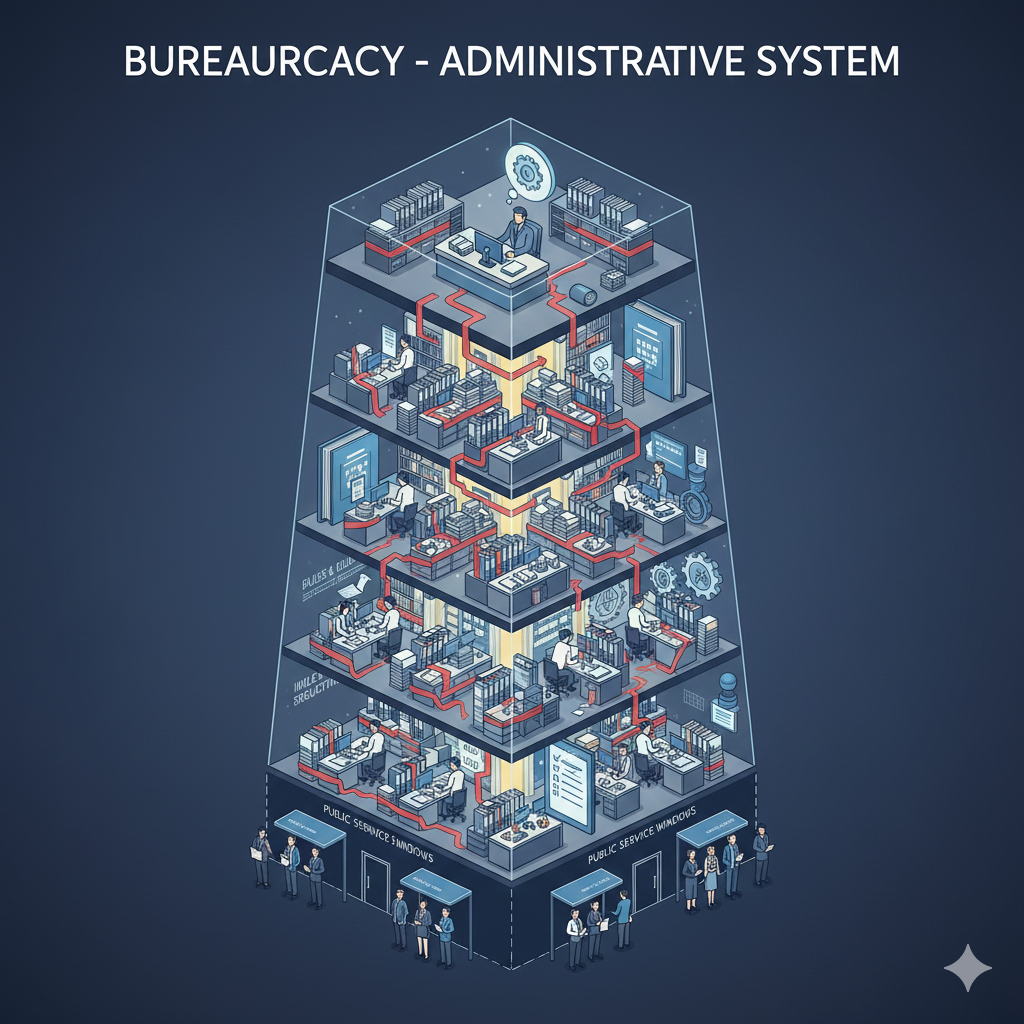
Bureaucracy: Meaning and Administrative Structure
Bureaucracy is an organized administrative system through which government functions are carried out in a structured and systematic manner. It consists of appointed officials who work at different levels to implement policies, enforce laws, and ensure smooth governance.
🏛️ Introduction to the Administrative System
The term bureaucracy originates from the French word bureau (office) and the Greek suffix -cracy (rule). It refers to a structured system of governance operated by trained officials working under constitutional rules and established procedures.
🔑 Key Features of the Bureaucratic System
1. Hierarchical Structure
A clearly defined chain of command ensures responsibility and smooth coordination from top to bottom.
2. Rule-Based Administration
All tasks are performed according to predefined rules, ensuring uniformity and fairness.
3. Neutrality and Impartiality
Officials are expected to act without bias and remain politically neutral.
4. Professional Competence
Officers are selected through competitive examinations to ensure expertise and efficiency.
5. Permanency of Tenure
Administrative continuity is maintained even when governments change.
6. Relative Independence
Ideally, public administrators function without undue political interference.
🧱 Types of Administrative Services
1. Central Services
Includes IAS, IPS, IFS and other All India Services functioning under the Union Government.
2. State Services
Includes State Administrative Services such as RAS and State Police Services.
3. Technical and Specialist Services
Engineers, doctors, scientists, and experts working in specialized departments.
📜 Role in Governance
1. Policy Support
Civil servants assist ministers in drafting policies and preparing official reports.
2. Implementation of Government Schemes
They ensure that welfare programs and policies are effectively implemented.
3. Monitoring and Evaluation
Development programs are supervised and reviewed regularly.
4. Public Service Delivery
Essential services like education, health, transport, and water supply are delivered through administrative mechanisms.
5. Law and Order Maintenance
Administrative authorities work with police and other agencies to maintain stability.
⚖️ Advantages of Bureaucratic Governance
- Stability and continuity in administration
- Rule-based functioning
- Expertise in governance
- Structured decision-making
- Institutional discipline
⚠️ Major Criticisms
1. Red Tapism
Excessive procedures often slow down decision-making.
2. Rigid Attitude
Overemphasis on rules may reduce flexibility.
3. Political Pressure
Interference may affect neutrality.
4. Corruption Risks
Misuse of authority can undermine public trust.
5. Accountability Issues
Transparency mechanisms are sometimes inadequate.
🧩 Administrative System in India
Under Article 312 of the Constitution of India, All India Services such as IAS, IPS, and IFS were established. Officers are selected through UPSC and serve both central and state governments, ensuring administrative coordination across the country.
🔚 Conclusion
The bureaucratic system forms the backbone of democratic governance. While it ensures discipline and stability, reforms are necessary to improve transparency, responsiveness, and citizen-centric administration. A balanced and accountable administrative structure strengthens national development.
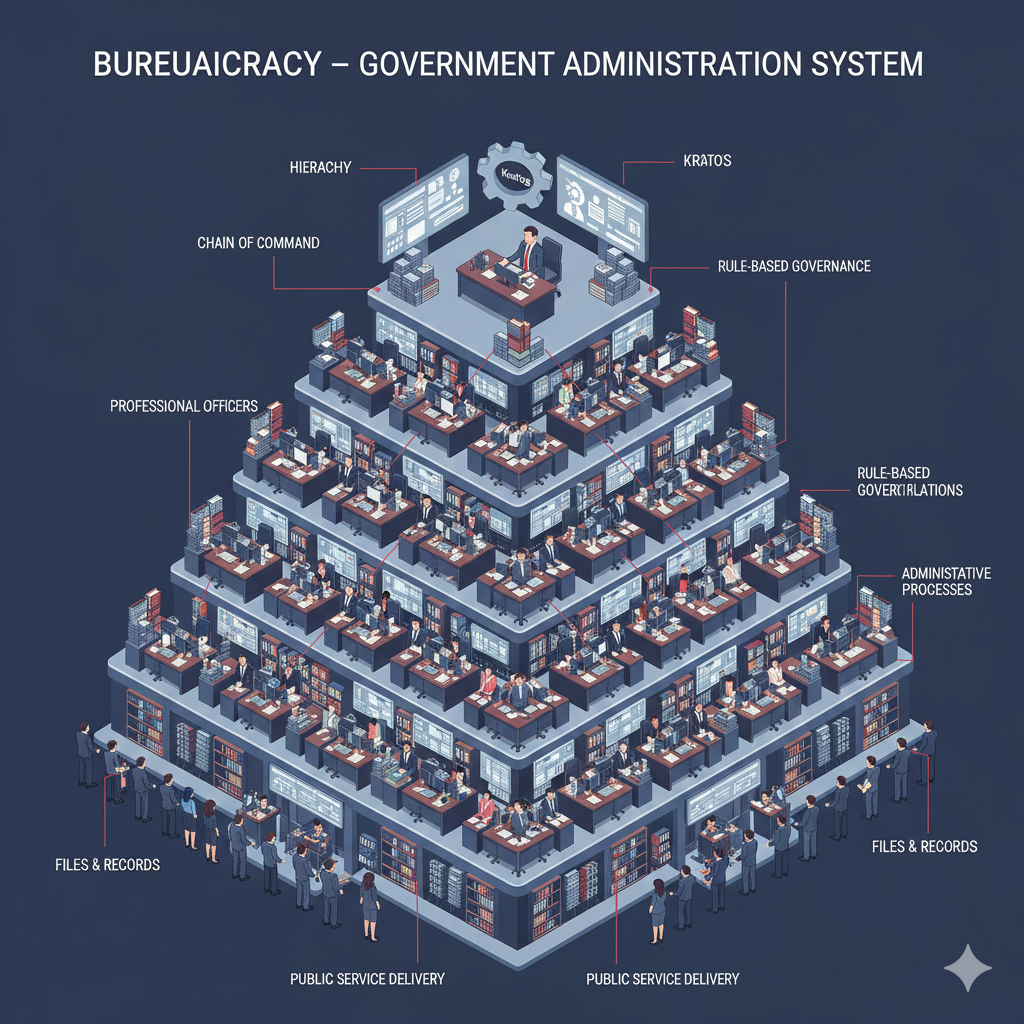
Bureaucracy: Meaning, Structure and Role in Governance
Bureaucracy refers to a permanent and professional administrative system through which government policies are implemented. It consists of trained and rule-bound officials responsible for maintaining continuity in governance.
📚 Meaning and Etymology
The word originates from the French term bureau (office) and the Greek word kratos (power). Thus, it literally means “rule through offices”.
🧱 Key Characteristics
1. Hierarchical Structure
A clear chain of command exists from higher authorities to subordinate officials.
2. Rule-Based System
Decisions are taken according to established laws and procedures.
3. Neutrality and Impartiality
Officials are expected to remain politically unbiased.
4. Professional Competence
Recruitment is based on merit and competitive examinations.
5. Permanency
The administrative system continues despite political changes.
6. Administrative Rigidity (Criticism)
Strict adherence to rules may slow innovation and reforms.
🏢 Major Types of Administrative Services
| Type | Description |
|---|---|
| Central Services | IAS, IPS, IFS and other All India Services under the Union Government. |
| State Services | State administrative and police cadres. |
| Technical Services | Engineers, doctors, scientists and other specialists. |
| Local Administration | Officials working in municipalities and panchayats. |
🎯 Objectives
- Implementation of public policies
- Delivery of essential services
- Maintaining administrative order
- Supervision and evaluation of schemes
- Advising ministers and lawmakers
⚖️ Role in Governance
| Area | Function |
|---|---|
| Administrative | Ensures smooth functioning of government operations |
| Developmental | Implements economic and social development plans |
| Social | Executes welfare schemes related to education and health |
| Economic | Manages taxation, budgeting and financial planning |
| Political Support | Provides reports and administrative advice |
✅ Advantages
- Stability and continuity in governance
- Rule-based decision-making
- Professional expertise
- Organized administrative framework
⚠️ Limitations and Criticism
Red Tapism
Excessive paperwork may delay decision-making.
Centralisation
Power concentration may reduce flexibility.
Lack of Creativity
Innovation can be restricted due to strict procedures.
Accountability Issues
Direct public accountability mechanisms are sometimes weak.
📜 Administrative Structure in India
Article 312 of the Constitution provides for All India Services such as IAS, IPS and IFS. Officers are recruited through UPSC and serve at both central and state levels.
This system is often considered the backbone of democratic governance in India.
🧠 Views of Thinkers
Max Weber
Defined it as a rational-legal authority system based on hierarchy and rules.
Woodrow Wilson
Emphasized separation between politics and administration.
❓ Frequently Asked Questions
What is bureaucracy?
It is a professional administrative system responsible for implementing government policies.
who recruits civil servants in India?
The Union Public Service Commission (UPSC) conducts recruitment.
Why is it called the backbone of governance?
Because it ensures continuity, stability and disciplined administration.
🔚 Conclusion
The administrative system plays a vital role in modern governance. While it ensures order and stability, continuous reforms are necessary to enhance transparency, accountability and responsiveness.
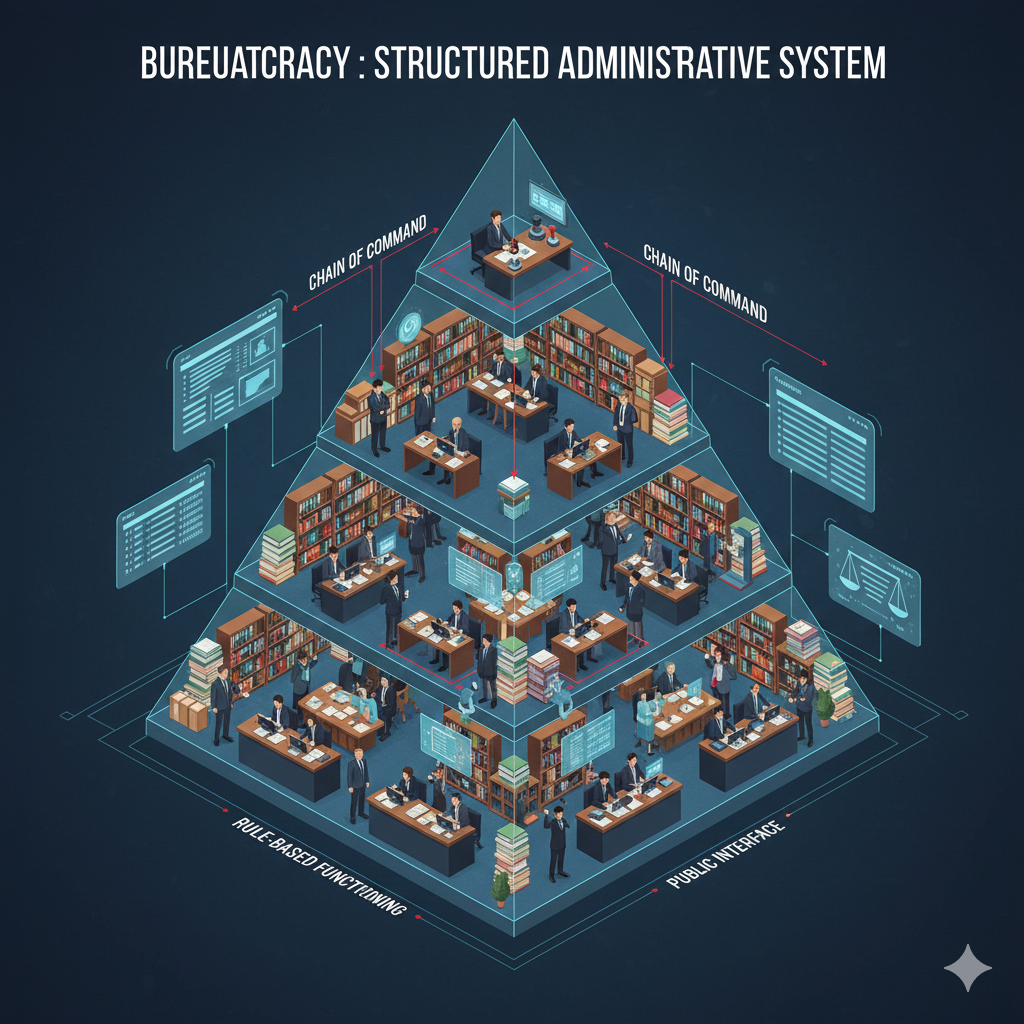
Main Features of Bureaucracy in Public Administration
The main features of bureaucracy include hierarchy, rule-based functioning, neutrality, professionalism, permanency, accountability and written documentation. These characteristics make it a structured and disciplined administrative system.
1. Hierarchical Structure
A clear chain of command exists in which higher authorities supervise subordinate officials. Orders flow downward, while accountability moves upward.
Benefits
- Clear division of responsibility
- Strong coordination and discipline
- Defined accountability
Limitations
- Slow decision-making
- Excessive centralization
2. Rule-Based Functioning
All administrative actions are carried out according to established rules and procedures. Decisions are not based on personal preference but on legal authority.
- Ensures fairness and equality
- Promotes transparency
- Provides legal validity to decisions
- Strengthens accountability
3. Neutrality and Impartiality
Officials are expected to remain politically neutral and treat all citizens equally without bias.
4. Professional Competence
Recruitment is based on merit, competitive examinations, and specialized training to ensure expertise and efficiency.
5. Permanency
The administrative system continues despite changes in political leadership, ensuring stability in governance.
6. Anonymity
Civil servants work behind the scenes and are not publicly responsible for policy decisions.
7. Accountability
Officials are accountable to constitutional provisions, laws, and parliamentary oversight mechanisms.
8. Written Records
All decisions and communications are documented for transparency and future reference.
9. Full-Time Service
Public administration is a full-time profession, ensuring dedication and expertise.
10. Resistance to Change
The system adopts reforms gradually to maintain stability, though this may slow innovation.
❓ Frequently Asked Questions
What are the main features of bureaucracy?
Hierarchy, rule-based functioning, neutrality, professionalism, permanency, accountability and written records.
Why is hierarchy important?
It ensures clear responsibility and coordination within the administrative system.
What is rule-based functioning?
It means decisions are taken according to established laws and procedures, not personal preferences.
🔚 Conclusion
The structured and rule-bound nature of bureaucracy ensures order, stability and discipline in governance. While it may sometimes be rigid, its professional and accountable framework remains essential for effective administration.

Types of Bureaucracy in Public Administration
The types of bureaucracy include Central, State, Technical, Political, Neutral, Digital and Citizen-Centric forms. These classifications help explain how administrative systems function at different levels and under different approaches in governance.
1. Based on Level of Functioning
All India Services (AIS)
- IAS, IPS, IFoS
- Serve at both Centre and State levels
- Selected through UPSC
Central Services
- IRS, IRTS, IAAS, IES
- Work under the Union Government
State Services
- RAS, UPPCS, BPSC
- Selected through State PSC
2. Based on Nature of Work
Administrative Services
Handle governance, land revenue and law & order.
Technical / Specialist Services
Include engineers, doctors and scientists working in specialized departments.
3. Based on Attitude or Approach
Political Bureaucracy
Closely aligned with ruling political leadership.
Neutral Bureaucracy
Works strictly according to constitutional and legal norms.
4. Theoretical Model (Max Weber)
- Clear hierarchy
- Division of labour
- Written records
- Merit-based recruitment
- Rule-based authority
5. Modern Forms
Digital Bureaucracy
Uses e-governance tools such as DigiLocker and online portals.
Citizen-Centric Model
Focuses on transparency, accountability and public participation.
❓ Frequently Asked Questions
What are the main types of bureaucracy?
Central, State, Technical, Political, Neutral, Digital and Citizen-Centric forms.
What is Central bureaucracy?
It includes All India and Central Services working under the Union Government.
What is Technical bureaucracy?
It consists of specialists such as engineers, scientists and doctors.
🔚 Conclusion
Different types of bureaucracy ensure structured governance at multiple levels. Modern reforms aim to transform traditional administrative systems into digital and citizen-focused models for better democratic governance.
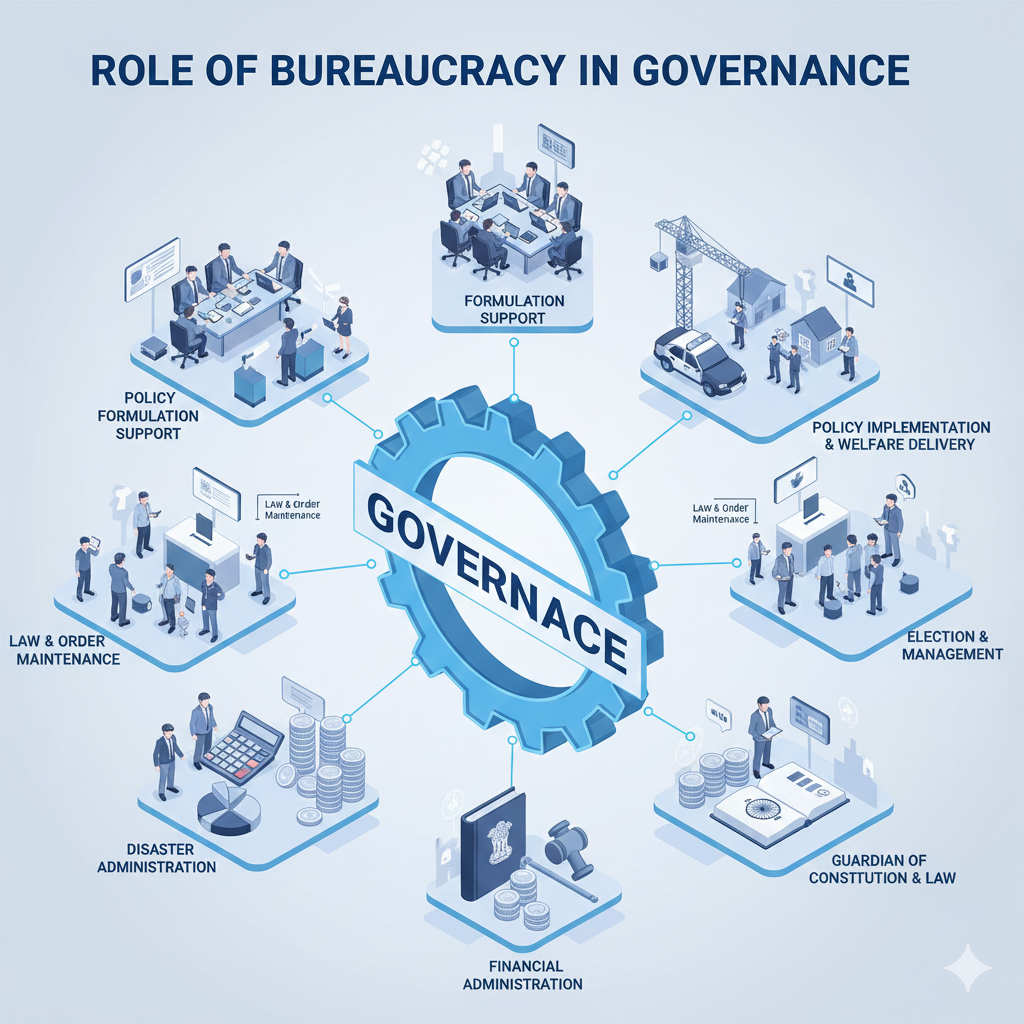
Role of Bureaucracy in Governance and Public Administration
The role of bureaucracy includes policy support, implementation of Government Schemes, maintenance of law and order, delivery of public services, financial management, and protection of constitutional values. It ensures stability, continuity, and efficiency in democratic governance.
🎯 Major Functions of the administrative system
1. Policy Formulation Support
Civil servants assist ministers by preparing reports, data analysis, draft bills and expert recommendations.
2. Policy Implementation
Government schemes are executed at district and village levels through administrative officials.
3. Law and Order Maintenance
Administrative and police authorities maintain peace, manage emergencies and ensure internal security.
4. Public Service Delivery
Essential services such as education, health, transport and welfare benefits are delivered through the administrative framework.
5. Execution of Development Programmes
Development initiatives such as infrastructure projects and employment schemes are monitored and evaluated.
6. Election and Census Management
Officials conduct elections in coordination with constitutional bodies and manage census operations.
7. Disaster Management
During floods, earthquakes or pandemics, administrative authorities coordinate relief and rehabilitation.
8. Financial Administration
Public funds are managed through budgeting, auditing, taxation and expenditure monitoring.
9. Constitutional Responsibility
Officials function according to constitutional provisions and safeguard citizens’ rights.
📊 Summary Table
| Function | Area |
|---|---|
| Policy Support | Drafting and advisory |
| Implementation | Scheme execution |
| Security | Law & order management |
| Welfare | Public service delivery |
| Finance | Budget & tax management |
| Constitutional Duty | Legal compliance |
❓ Frequently Asked Questions
What is the main role of bureaucracy?
Its primary role is to implement government policies and ensure administrative continuity.
How does bureaucracy maintain law and order?
Through coordination between administrative and police authorities under legal frameworks.
Why is bureaucracy important in democracy?
Because it ensures stability, neutrality and rule-based governance.
🔚 Conclusion
The administrative system plays a vital role in transforming policies into practical outcomes. Efficient, transparent and accountable functioning strengthens democratic governance and national development.
Criticism and Limitations of Bureaucracy in Public Administration
The criticism of bureaucracy focuses on issues such as red tapism, rigidity, corruption, political interference, lack of accountability and administrative delays. While bureaucracy ensures stability and continuity, these limitations may reduce efficiency and responsiveness in governance.
🔍 Major Criticisms
1. Red Tapism
Excessive paperwork and procedural formalities often delay decision-making and service delivery.
2. Rigidity and Inflexibility
Strict adherence to rules limits innovation and adaptability to ground realities.
3. Alienation from People
Social distance between officials and citizens weakens public trust and responsiveness.
4. Excessive Centralization
Decision-making authority concentrated at higher levels reduces local participation.
5. Lack of Accountability
Permanent tenure sometimes weakens responsibility and transparency mechanisms.
6. Political Interference
External pressure may compromise neutrality and fairness.
7. Corruption
Bribery, misuse of authority and irregularities damage public confidence.
8. Low Motivation
Uniform pay structures and limited performance-based incentives may reduce efficiency.
9. Workload and Delays
Staff shortages and traditional file systems increase administrative burden.
📊 Summary Table
| Limitation | Impact |
|---|---|
| Red Tapism | Slow decision-making |
| Rigidity | Reduced flexibility |
| Corruption | Loss of public trust |
| Political Pressure | Compromised neutrality |
| Lack of Accountability | Administrative negligence |
❓ Frequently Asked Questions
What is red tapism?
Red tapism refers to excessive paperwork and procedural delays in administration.
Why is bureaucracy criticized?
It is criticized for rigidity, corruption, centralization, political interference and slow decision-making.
Can bureaucracy be reformed?
Yes, through digital governance, transparency measures, accountability systems and citizen-centric reforms.
📝 Conclusion
Although bureaucracy plays a vital role in governance, reforms are essential to make it more transparent, flexible and accountable. Strengthening institutional integrity and adopting digital tools can improve administrative efficiency.
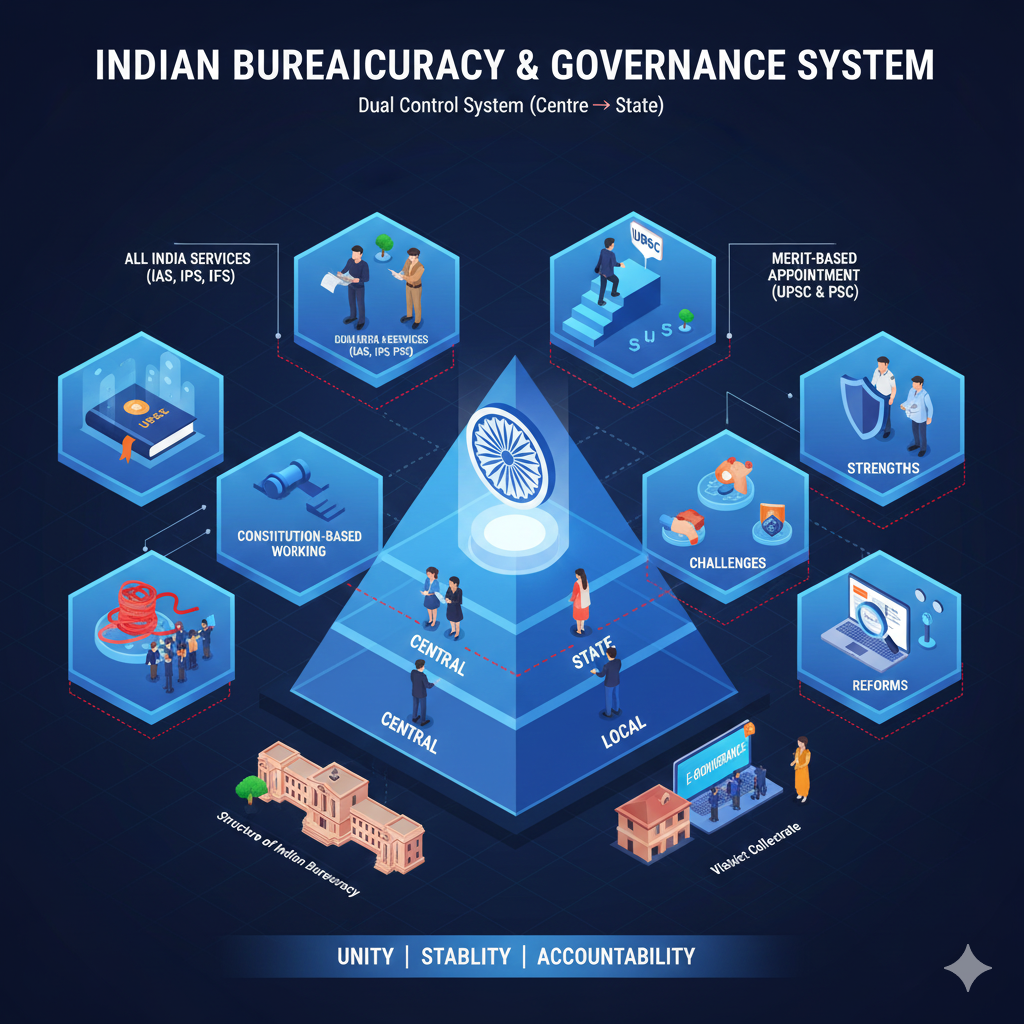
Indian Reference in Bureaucracy
India, being a vast, diverse, and democratic country, depends heavily on its bureaucracy. It is not only the administrative backbone but also a key pillar supporting policy formulation, implementation, governance stability, and democratic strength.
📌 Chief Features of Indian Bureaucracy
1. Working Under the Constitution
Indian bureaucracy operates strictly within the framework of the Constitution and legal systems. Its primary responsibility is to provide fair, competent, and accountable administration.
2. All India Services (AIS)
A unique feature of Indian bureaucracy is the All India Services:
| Service | Work Area |
|---|---|
| IAS | Policy-making, district administration, leadership |
| IPS | internal security, police administration |
| IFS (Forest) | Forest and environmental protection |
These officers work at both Central and State levels.
3. Dual Control System
Under India’s federal system, certain services—especially AIS—are controlled jointly by the Central and State governments.
4. Merit-Based Appointment
Selections are conducted through UPSC and State PSC examinations, ensuring transparency and merit-based recruitment.
🧱 Structure of Indian Bureaucracy
- Central Level: Secretary, Joint Secretary, Director
- State Level: Principal Secretary, Collector, Tehsildar
- Local Level: Panchayat Secretary, Gram Vikas Officer
🎯 Role of Bureaucracy in India
| Area | Role |
|---|---|
| Policy Construction | Advising ministers with data, analysis, and reports |
| Policy Implementation | Delivering schemes to ground level |
| Law and Order | Police, DM, SDM maintain internal peace and security |
| Public Welfare | Health, education, social security programs |
| Election & Census | Neutral and independent management |
| Disaster Management | Rapid response during natural calamities |
✅ Positive Strengths
- Administrative stability and continuity
- Highly trained and capable officers
- Unity in diversity through uniform governance
- Support for democratic and constitutional institutions
- Protection of constitutional values
❌ Challenges
- Corruption and bribery
- Political interference in administration
- Red tape and slow processes
- Lack of communication with citizens
- Weak accountability mechanism
- Slow reform implementation
🔄 Essential Reforms Needed
- Strengthening e-governance and digital bureaucracy
- Enhancing Lokpal and vigilance mechanisms
- Ensuring transparency and timely service delivery
- Performance-based promotions and incentives
- Improving public relations and communication skills
Bureaucracy – Conclusion
Bureaucracy is considered the backbone of any democratic government. It provides stability, continuity, fairness, and impartiality in governance. In a diverse country like India, bureaucracy is not limited to administration—it is central to nation-building, public welfare, and social justice.
🔍 Key Points in Conclusion
- Bureaucracy aids the government in policy formation and plays the key role in policy implementation.
- It functions according to the Constitution and safeguards the rule of law.
- Through its channels, Government Schemes reach the last person—fulfilling the spirit of “Sabka Saath, Sabka Vikas”.
- Issues such as corruption, red tapism, and lack of people-connect limit its effectiveness.
- Reforms are essential to make it more transparent, accountable, people-centric, and technology-driven.
🧾 Summary Conclusion
“If democracy is the body, bureaucracy is its functional soul. A fair, accountable, and skilled bureaucracy is the cornerstone of good governance and holistic national development.”
References
- Wilson, W. (1887). The Study of Administration. Political Science Quarterly.
- Nigro, F. A., & Nigro, L. G. (1989). Modern Public Administration. HarperCollins.
- Denhardt, R. B. (2015). Theories of Public Organization. Cengage Learning.
- Encyclopaedia Britannica – Bureaucracy Section.
- United Nations Public Administration Network (UNPAN).
- India.gov.in – National Portal of India (Governance & Bureaucracy).
- OECD Reports on Public Governance.