
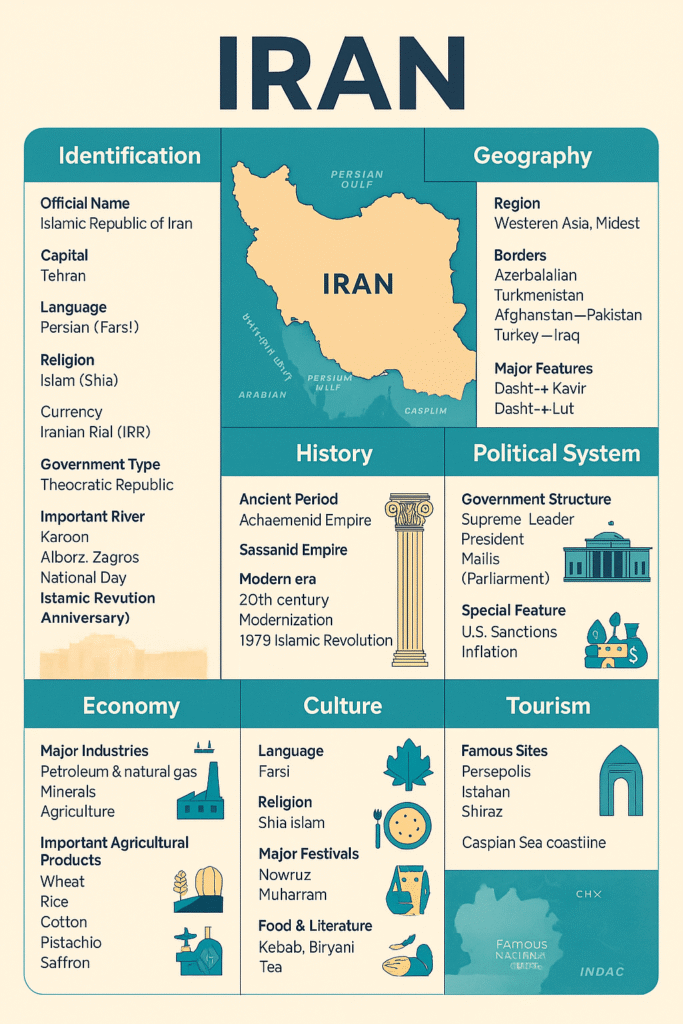
Iran: A Complete Geographic, Cultural and Historical Overview
Located in Western Asia, this historic nation is one of the world’s oldest civilizations. Known historically as Persia, it stands at the crossroads of ancient tradition and modern geopolitics. The Islamic Republic, with Tehran as its capital, reflects thousands of years of imperial legacy, cultural evolution and strategic importance.
1. Introduction
The civilization of this Persian state traces back to the powerful Achaemenid Empire, which shaped global administration, art and architecture. Today, the country blends ancient heritage with modern governance, forming a unique national identity.
Key Identity Details
- Official Name: Islamic Republic of Iran
- Capital: Tehran
- Language: Persian (Farsi)
- Religion: Islam (primarily Shia)
- Currency: Iranian Rial (IRR)
- Government Type: Theocratic Republic
2. Geographical Classification
This West Asian country features vast deserts, rugged mountains and important coastlines along the Persian Gulf and the Caspian Sea. Its varied landscape influences climate, agriculture and settlement patterns.
Bordering Countries
- North: Azerbaijan, Armenia, Turkmenistan
- East: Afghanistan, Pakistan
- West: Turkey, Iraq
- South: Persian Gulf & Gulf of Oman
3. Historical Background
The historical journey of the region includes major empires, Islamic transformation, and modern political changes that continue to shape global diplomacy.
Ancient Period
- Achaemenid Empire
- Sassanid Empire
Modern Era
- Reza Shah modernization
- 1979 Islamic Revolution
- Regional conflicts and diplomatic tensions
4. Political System
The governing structure combines religious leadership with republican institutions, making it distinct in global politics.
- Supreme Leader: Highest authority
- President: Executive head
- Majlis: Legislative body
5. Economic Structure
The economy depends heavily on oil, natural gas, agriculture and domestic industries. Sanctions and global restrictions have influenced financial stability and growth.
- Petroleum exports
- Mining sector
- Agriculture and saffron production
6. cultural heritage
Persian poetry, literature and traditional art remain globally admired. Writers like Rumi and Hafiz represent its enduring intellectual influence.
7. Education and Academia
The nation maintains a literacy rate above 85% and hosts major institutions such as the University of Tehran and Sharif University of Technology.
8. Tourism
Historic cities like Persepolis, Isfahan and Shiraz attract visitors with their architectural and cultural richness.
Conclusion
With deep historical roots and strong cultural identity, this Middle Eastern country continues to play an important role in regional and global affairs. Its blend of tradition and modern challenges makes it one of the most strategically significant states in Western Asia.
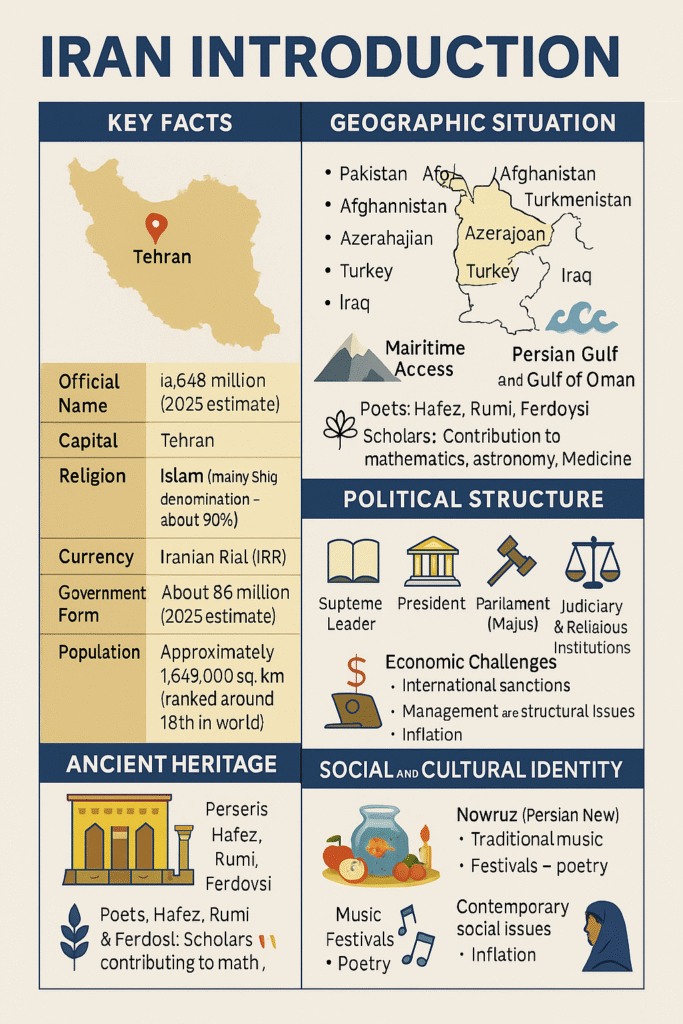
Iran: Complete Introduction
Historically known as Persia, this West Asian nation is one of the world’s oldest civilizations and holds immense cultural, strategic and geopolitical importance. With Tehran as its capital, the Islamic Republic combines religious authority and republican governance within a unique constitutional framework.
Key National Facts
| Category | Details |
|---|---|
| Official Name | Islamic Republic of Iran |
| Capital | Tehran |
| Language | Persian (Farsi) |
| Religion | Islam (Predominantly Shia) |
| Currency | Iranian Rial (IRR) |
| Population | Approx. 86 million |
| Area | Approx. 1.64 million sq. km |
Geographical Overview
The country shares borders with seven nations and enjoys maritime access to the Persian Gulf and Gulf of Oman. Mountain ranges such as Zagros and Alborz dominate the terrain, while central deserts shape settlement patterns and climate diversity.
Bordering Countries
- Pakistan
- Afghanistan
- Turkmenistan
- Azerbaijan
- Armenia
- Turkey
- Iraq
Ancient Heritage & Cultural Legacy
The Persian Empire was among the most powerful administrative systems of the ancient world. Sites like Persepolis symbolize architectural brilliance, while poets such as Rumi, Hafez and Ferdowsi shaped world literature.
- Major contributions to mathematics and astronomy
- Influential works in philosophy and medicine
- Rich tradition of carpets, miniature art and calligraphy
Political Structure
Following the 1979 Islamic Revolution, the state adopted a system where religious leadership operates alongside elected institutions.
- Supreme Leader: Highest authority
- President: Executive head
- Majlis: Legislative body
- Judiciary: Operates within Islamic law framework
Economic Profile
The economy is resource-driven, supported by large oil and natural gas reserves. Agriculture, manufacturing and pharmaceuticals also contribute significantly. International sanctions have influenced trade and financial stability.
- Petroleum and gas exports
- Agricultural products such as saffron and pistachios
- Manufacturing and domestic industries
Social & Cultural Identity
Persian traditions remain central to national identity. Festivals like Nowruz, classical poetry and artistic craftsmanship continue to shape society.
- Nowruz (Persian New Year)
- Carpet weaving tradition
- Strong literary heritage
Global Importance
This Middle Eastern state holds strategic influence in regional politics, energy markets and international diplomacy. Its position along key trade and maritime routes enhances geopolitical significance.
Conclusion
With deep historical roots and enduring cultural identity, Iran remains one of the most influential civilizations of Western Asia. Its blend of ancient tradition and modern governance continues to shape regional and global discussions.
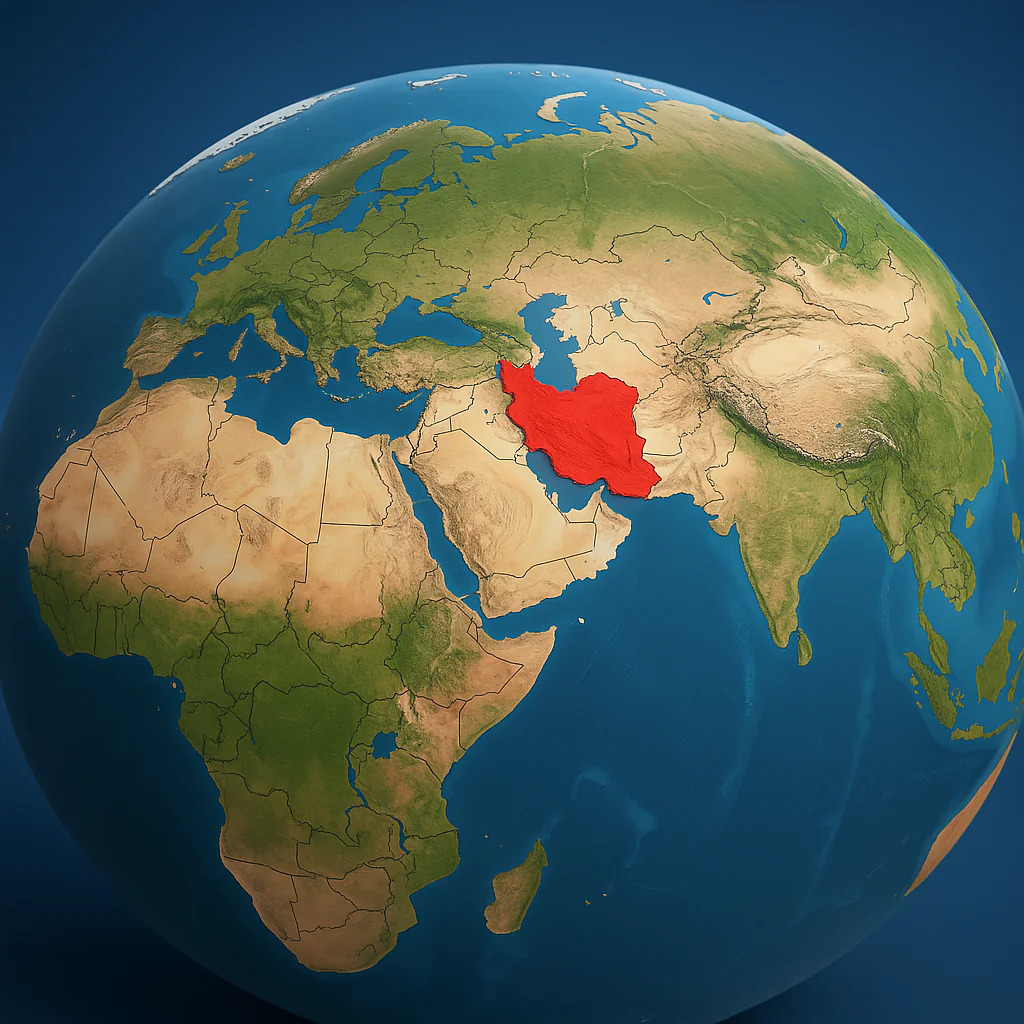
Geographic Classification of Iran
Located at the crossroads of Central Asia, West Asia and South Asia, this West Asian nation possesses remarkable geographic diversity. Its landscape includes high mountain chains, vast deserts, plateaus, fertile plains and strategic coastlines that shape climate, agriculture and geopolitical relevance.
1. Geographic Location
| Category | Details |
|---|---|
| Latitude & Longitude | Approx. 32° N, 53° E |
| Region | Western Asia / Middle East |
| Northern Borders | Azerbaijan, Armenia, Turkmenistan |
| Eastern Borders | Afghanistan, Pakistan |
| Western Borders | Turkey, Iraq |
| Southern Maritime Access | Persian Gulf & Gulf of Oman |
2. Natural Landforms
Mountains
- Zagros Range: Extends from eastern Turkey to the Persian Gulf.
- Alborz Range: Located in the north near the Caspian Sea; includes Mount Damavand (5,610 m).
Plateau
The Iranian Plateau dominates the central and eastern parts of the country, forming a vast elevated terrain.
Deserts
- Dasht-e-Kavir: Great Salt Desert.
- Dasht-e-Lut: Among the hottest places on Earth and a UNESCO site.
Plains & Valleys
The Caspian coastal plain supports dense agriculture due to its humid and fertile conditions.
3. Rivers and Lakes
- Karun River: Longest and most navigable river.
- Safidrud, Zarrineh Roud, Helmand
- Lake Urmia: Once one of West Asia’s largest salt lakes.
4. Climate
Climate varies significantly across regions due to elevation and terrain diversity.
| Region | Climate |
|---|---|
| Caspian Coast | Humid & temperate |
| Persian Gulf Coast | Hot & arid |
| Mountain Regions | Cold & snowy |
| Central Desert | Extremely dry & hot |
Temperature ranges from approximately -20°C to 50°C depending on region and season.
5. Natural Resources
- Large oil and natural gas reserves
- Copper, iron ore, uranium, coal
- Marble, gypsum, salt and other minerals
6. Geopolitical Importance
Situated near the Strait of Hormuz, this country holds strategic influence over a vital global energy corridor through which nearly 20% of global oil trade passes. This position enhances its importance in international security and diplomacy.
7. Seismic Activity
The territory lies within the active Alpide Earthquake belt, making it highly prone to seismic events.
- 2003 Bam Earthquake: One of the most devastating natural disasters in recent history.
Conclusion
The Geography of this Middle Eastern state reflects dramatic contrasts— from towering mountains and vast deserts to fertile coastlines and strategic waterways. Its physical structure continues to shape regional politics, climate patterns and economic development.
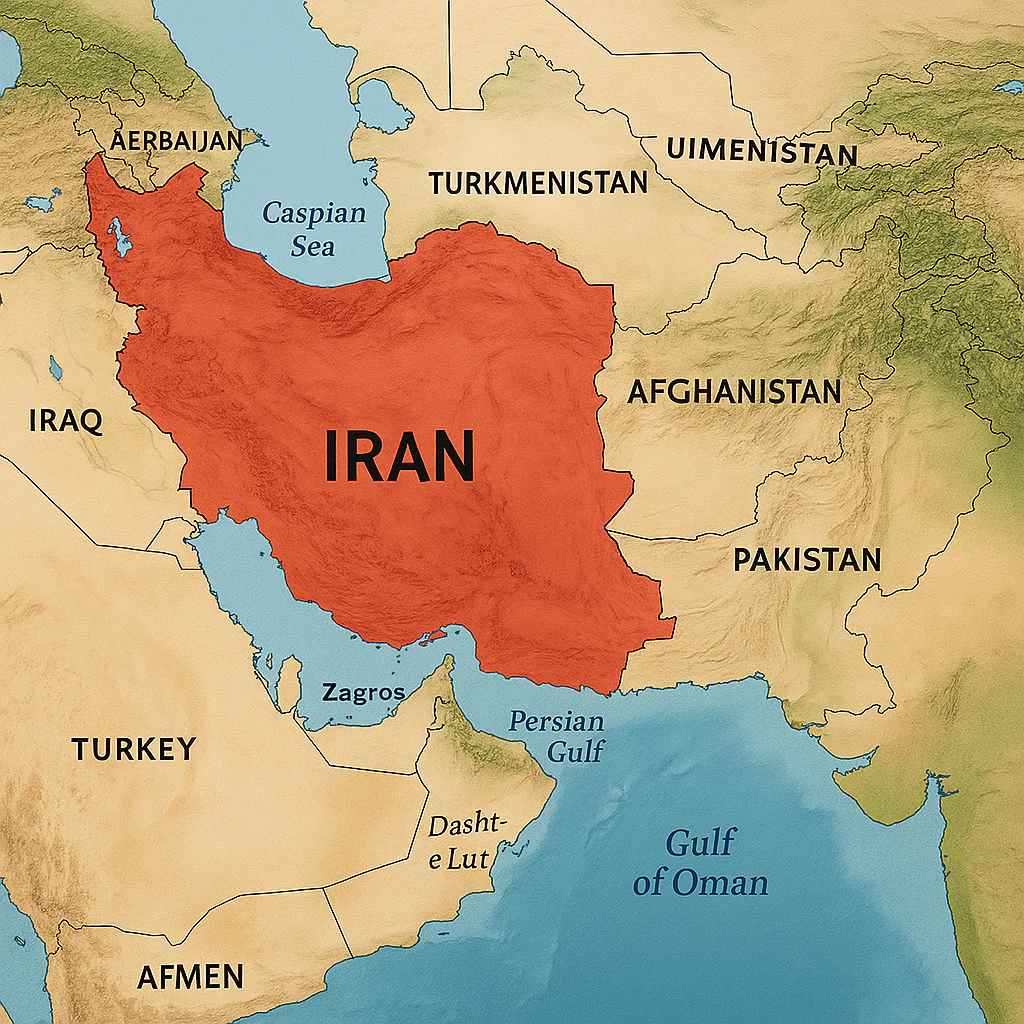
Iran: Geographic Location, Borders and Natural Features
Located at the intersection of Central Asia, West Asia and South Asia, this West Asian nation holds exceptional strategic importance. Its position in global energy corridors and regional trade routes enhances its geopolitical relevance.
1. Geographic Position
Continent & Region
- Asia
- Western Asia (Middle East)
Geographical Coordinates
- Latitude: 25°–40° N
- Longitude: 44°–63° E
- Northern & Eastern Hemispheres
Boundaries
| Direction | Country / Water Body |
|---|---|
| North | Turkmenistan, Azerbaijan, Armenia, Caspian Sea |
| East | Afghanistan, Pakistan |
| South | Persian Gulf, Gulf of Oman |
| West | Iraq, Turkey |
strategic waterways
- Caspian Sea: Largest inland water body
- Persian Gulf: Major global oil route
- Strait of Hormuz: Key international energy corridor
The country historically functioned as a bridge between Asia and Europe, forming part of the ancient Silk Route network.
2. Neighboring Countries
This Middle Eastern state shares borders with seven nations and major maritime zones, linking South Asia, Central Asia and the Caucasus region.
| Direction | Neighbor | Approx. Border Length |
|---|---|---|
| North-West | Armenia | ~44 km |
| North-West | Azerbaijan | ~689 km |
| North-East | Turkmenistan | ~992 km |
| East | Afghanistan | ~936 km |
| South-East | Pakistan | ~909 km |
| West | Iraq | ~1,599 km |
| West | Turkey | ~534 km |
3. Natural Features
The landscape includes mountains, plateaus, deserts, plains, rivers and extensive coastlines that shape climate and settlement.
Mountain Ranges
- Zagros Mountains: Western region; rich in hydrocarbons
- Alborz Mountains: Northern belt; includes Mount Damavand (5,610 m)
- Khorasan Range: Northeastern highlands
Plateaus & Plains
- Iranian Plateau: Dominant central landform
- Caspian Coastal Plain: Fertile and humid
- Khuzestan Plain: Oil-rich southwestern zone
Deserts
- Dasht-e-Kavir (Salt Desert)
- Dasht-e-Lut (Extremely high surface temperatures)
Rivers & Lakes
- Karun River – Longest navigable river
- Safidrud – Flows into the Caspian Sea
- Lake Urmia – Major salt lake (shrinking)
- Lake Hamoon – Seasonal lake near eastern border
Climate Zones
- Humid temperate (Caspian coast)
- Hot and arid (southern coast)
- Cold mountainous climate
- Extremely dry central desert climate
Conclusion
The geographic diversity of this West Asian country—from mountain chains to strategic coastlines—continues to influence its climate, economy, and regional political importance. Its physical structure plays a key role in shaping both domestic development and international engagement.
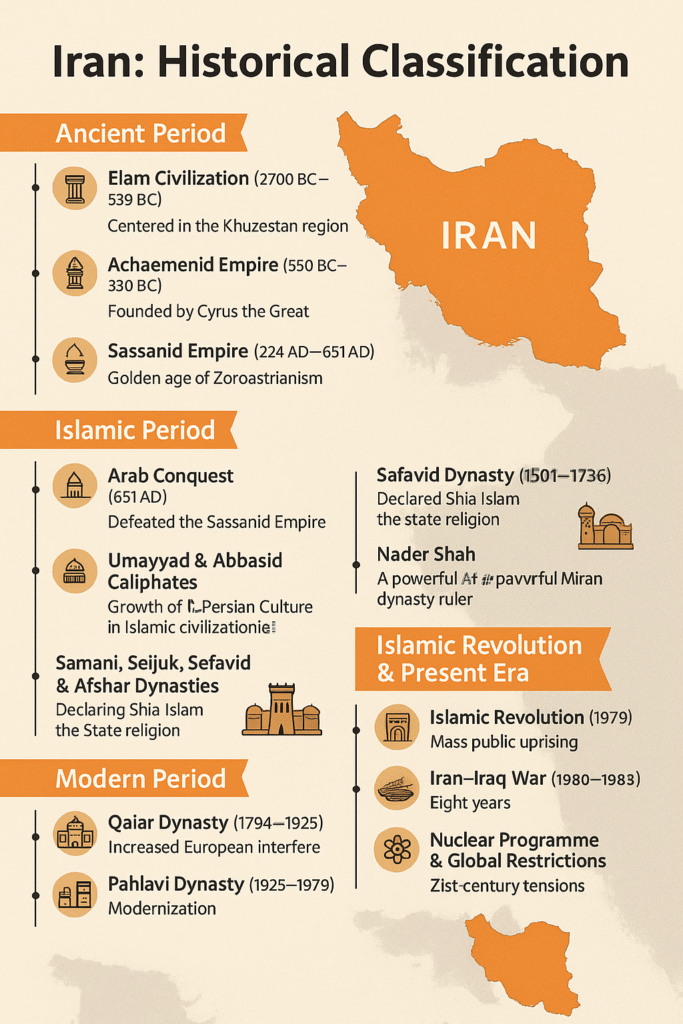
Iran: Historical Classification
The historical journey of this ancient Persian civilization spans thousands of years. From early empires to the modern Islamic Republic, the region has experienced political, cultural and religious transformations that shaped not only Asia but world history. Its legacy continues to influence governance, literature, architecture and faith traditions.
1. Ancient Period
Elam Civilization (2700 BC – 539 BC)
- Among the earliest civilizations of the Iranian plateau.
- Centered in present-day Khuzestan.
- Developed writing systems and administrative structures.
Achaemenid Empire (550 BC – 330 BC)
- Founded by Cyrus the Great.
- One of the first large-scale empires known for structured governance.
- Capital city: Persepolis.
- Expanded under Darius the Great.
- Territories stretched from the Mediterranean to South Asia.
Sassanid Empire (224 AD – 651 AD)
- Golden era of Zoroastrian tradition.
- Frequent conflicts with Roman and Byzantine forces.
- Last major pre-Islamic Persian dynasty.
2. Islamic Period (After 651 AD)
Arab Conquest
- Defeat of the Sassanid Empire.
- Gradual spread of Islam across the region.
- Integration into the wider Islamic Caliphate.
Umayyad & Abbasid Influence
- Persian culture deeply enriched Islamic civilization.
- Advancements in literature, science and philosophy.
Safavid & Later Dynasties
Safavid Dynasty (1501–1736)
- Declared Shia Islam as the official Religion.
- Major revival of Persian art and architecture.
Afshar Period (Nader Shah)
- Expanded military influence beyond regional borders.
- Conducted campaigns reaching the Indian subcontinent.
3. Modern Era
Qajar Dynasty (1794–1925)
- Increased European influence (Britain and Russia).
- Territorial losses and weakened sovereignty.
Pahlavi Dynasty (1925–1979)
- Reza Shah Pahlavi: Promoted modernization and industrialization.
- Mohammad Reza Shah: Expanded Western alignment.
- Political centralization and rising internal opposition.
4. Revolution & Contemporary Developments
Islamic Revolution (1979)
- Led by Ayatollah Khomeini.
- Monarchy overthrown; Islamic Republic established.
- Adoption of Sharia-based constitutional framework.
Iran–Iraq War (1980–1988)
- Eight-year regional conflict.
- Severe economic and human losses.
Nuclear Programme & Global Tensions
- International scrutiny over nuclear development.
- Sanctions and ongoing diplomatic negotiations.
Conclusion
The historical development of this Persian nation reflects cycles of empire, religious transformation, reform and resilience. From ancient imperial administration to contemporary political structures, its evolution demonstrates a continuous interplay between tradition and modern governance.
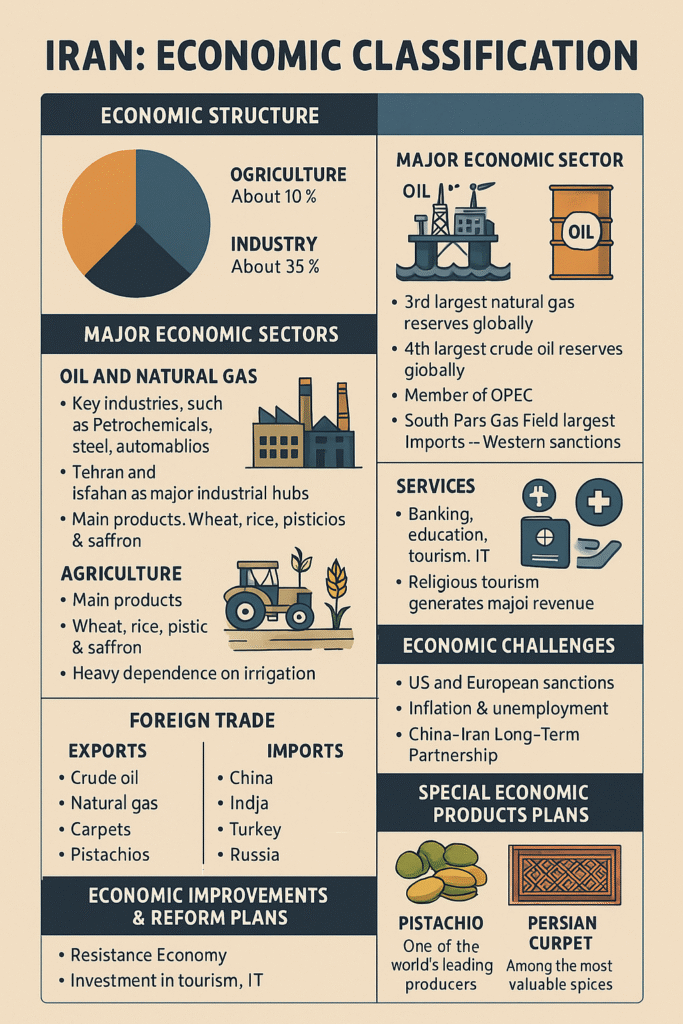
Iran: Economic Classification
The economy of this West Asian nation is heavily resource-driven, with oil and natural gas forming its structural backbone. Over time, sanctions, political tensions and structural constraints have influenced growth patterns and macroeconomic stability.
1. Economic Structure
| Sector | Estimated GDP Contribution (2025) |
|---|---|
| Agriculture | ~10% |
| Industry | ~35% |
| Services | ~55% |
The system follows a mixed model where both state-owned and private enterprises operate.
2. Major Economic Sectors
(i) Oil and Natural Gas
- Among the top global holders of natural gas reserves.
- Significant crude oil reserves.
- Member of OPEC.
- South Pars Gas Field is one of the largest globally.
- Energy exports remain central to fiscal revenue.
- Sanctions have affected export capacity.
(ii) Industry
- Petrochemicals, steel, automobiles, cement, textiles.
- Major industrial hubs include Tehran and Isfahan.
- Expansion in pharmaceuticals and defense production.
(iii) Agriculture
- Wheat, rice, barley, cotton, pistachio and saffron.
- Global leadership in pistachio and saffron production.
- Irrigation-dependent farming due to uneven rainfall.
(iv) Services
- Banking, healthcare, education, tourism and IT.
- Religious tourism contributes significantly.
- Public sector influence remains strong.
3. Foreign Trade
| Exports | Imports |
|---|---|
| Crude oil, natural gas, carpets, pistachios | Machinery, medicines, vehicles, food products |
Key Trading Partners
- China
- India
- Turkey
- Russia
- United Arab Emirates
Due to restrictions, alternative financial mechanisms and regional trade arrangements are frequently used.
4. Economic Challenges
- International sanctions linked to nuclear development.
- Inflation and youth unemployment.
- Currency depreciation (Iranian Rial).
- Informal economy and governance inefficiencies.
- Environmental and water resource stress.
5. Reform Initiatives
- Resistance Economy Doctrine: Focus on domestic production.
- Diversification into renewable energy and technology sectors.
- 2021 Long-Term Partnership with China: Infrastructure and trade expansion.
6. Special Economic Products
| Product | Global Standing |
|---|---|
| Pistachio | Leading global producer |
| Persian Carpet | Internationally renowned craft |
| Saffron | Among top global suppliers |
Conclusion
The economic profile of this Persian state reflects vast natural wealth combined with structural and geopolitical constraints. With diversification, policy reform and improved global integration, it holds significant potential for sustainable growth within the Middle East region.
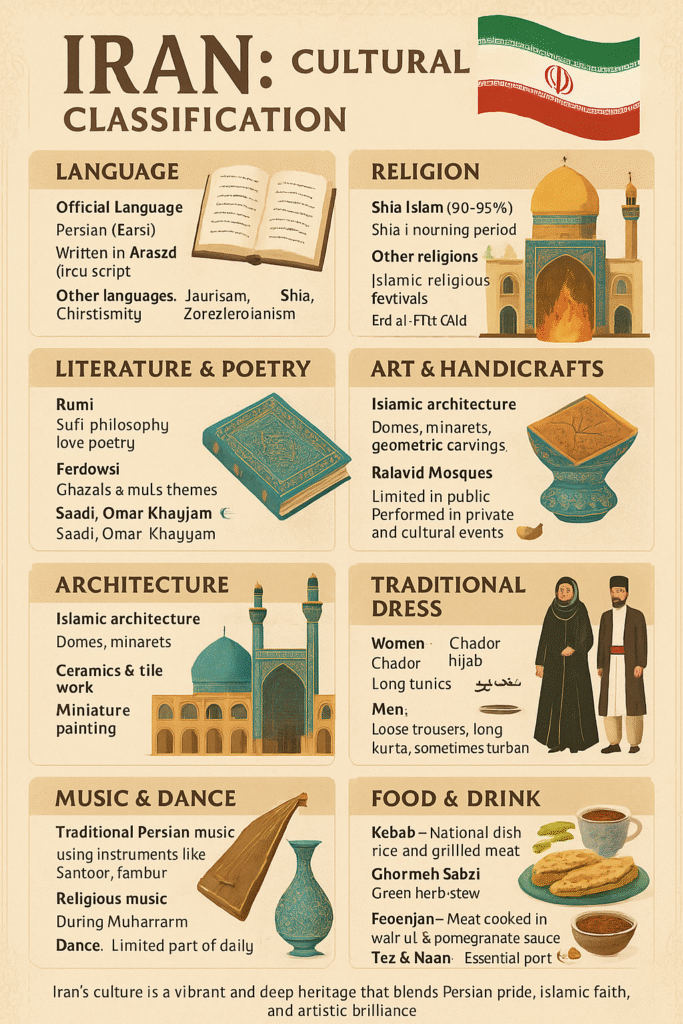
Iran: Cultural and Academic Classification
This West Asian nation possesses one of the world’s oldest cultural traditions. Its identity reflects a synthesis of Persian heritage and Islamic values, expressed through literature, architecture, music, education and scholarly traditions.
1. Cultural Profile
Language
- Official Language: Persian (Farsi)
- Written in modified Arabic script
- Other languages: Kurdish, Azerbaijani, Baluchi, Arabic
Persian literature remains one of the richest literary traditions globally.
Religion
- Main faith: Shia Islam (majority population)
- Minorities: Sunni Islam, Christianity, Judaism, Zoroastrianism
- Key religious centers: Mashhad, Qom, Shiraz, Isfahan
Festivals & Traditions
- Nowruz: Persian New Year (UNESCO-recognized)
- Muharram: Shia mourning observances
- Eid al-Fitr and Eid al-Adha
- Charshanbe Suri (pre-Nowruz fire festival)
Literature & Poetry
- Rumi – Sufi philosophy and love poetry
- Hafez – Mystical ghazals
- Ferdowsi – Author of *Shahnameh*
- Saadi & Omar Khayyam – Ethics and philosophy
Art & Architecture
- Persian carpets and miniature paintings
- Islamic domes and geometric tile work
- Safavid-era mosques (e.g., Isfahan)
- Persepolis as a symbol of ancient architectural heritage
Music & Traditional Dress
- Traditional instruments: Santoor, Setar, Tambur
- Religious music during Muharram
- Public dress influenced by Islamic regulations
Cuisine
- Kebab, Ghormeh Sabzi, Fesenjan
- Extensive use of saffron and pistachio
- Tea and naan as daily staples
2. Academic Structure
The education system combines religious foundations with modern scientific development. Since the 1979 revolution, curriculum design reflects both Islamic values and technological advancement.
Education Levels
- Primary education (6 years, compulsory)
- Secondary education (6 years total)
- Higher education (universities, technical institutes, seminaries)
Major Institutions
- University of Tehran
- Sharif University of Technology
- Amirkabir University of Technology
- Islamic Azad University
- Religious seminaries in Qom
Women’s Participation
- High female enrollment in universities
- Strong representation in medicine and sciences
- Some technical fields show imbalance
Research & Innovation
- Progress in nanotechnology, medicine and energy research
- Increasing international publications
- Investment in STEM fields
Challenges
- Brain drain
- International restrictions
- Digital access gaps in rural regions
- Ideological oversight in curriculum
Conclusion
The cultural and academic landscape of this Persian state demonstrates a dynamic balance between tradition and modernity. Deep literary heritage, religious scholarship and scientific progress together shape a distinctive identity within the Middle East and the broader global community.
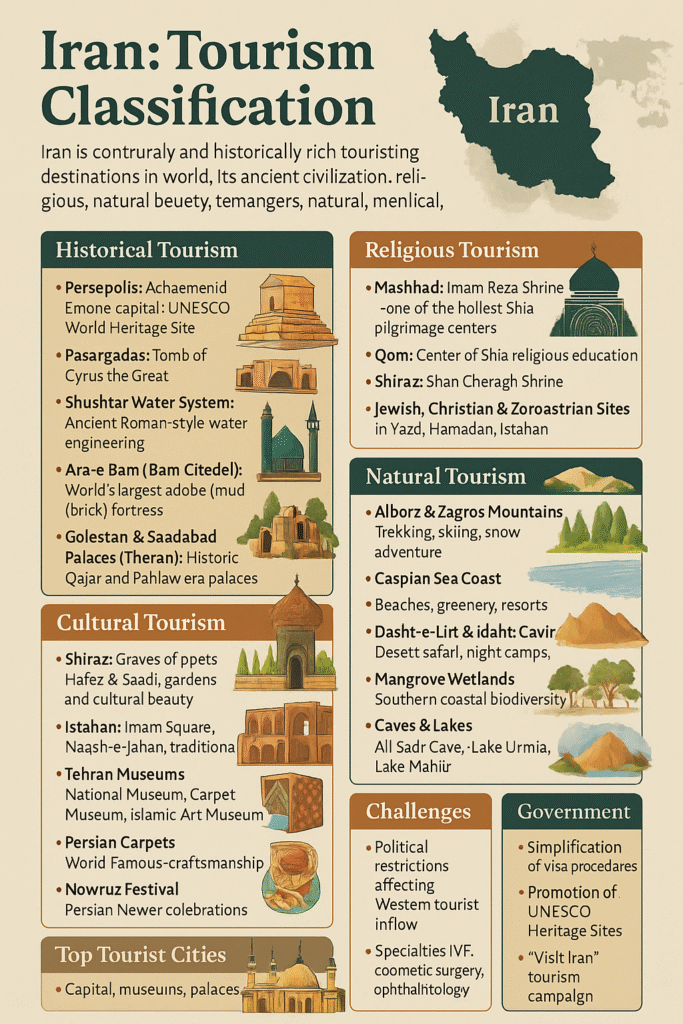
Iran: Tourism Classification and National Overview
This West Asian nation is known for its ancient civilization, architectural wonders, religious centers and diverse landscapes. From UNESCO World Heritage Sites to mountain ranges and coastal regions, the country offers a broad tourism spectrum including historical, cultural, religious, medical and adventure travel.
1. Historical Tourism
- Persepolis: Capital of the Achaemenid Empire (UNESCO site)
- Pasargadae: Tomb of Cyrus the Great
- Shushtar Water System: Ancient hydraulic engineering
- Arg-e Bam: Largest adobe fortress
- Golestan & Saadabad Palaces: Qajar and Pahlavi heritage
2. Religious Tourism
- Mashhad – Imam Reza Shrine
- Qom – Center of Shia scholarship
- Shiraz – Shah Cheragh Shrine
- Zoroastrian and Christian heritage sites in Yazd and Isfahan
3. Cultural Tourism
- Shiraz – Poetry, gardens and heritage
- Isfahan – Imam Square and bazaars
- Tehran – National and Carpet Museums
- Nowruz – Persian New Year celebrations
- World-famous Persian carpets
4. Natural Tourism
- Alborz & Zagros Mountains – Trekking and skiing
- Caspian Sea Coast – Green landscapes
- Dasht-e-Lut & Dasht-e-Kavir – Desert experiences
- Mangrove wetlands and coastal biodiversity
- Ali Sadr Cave and Lake Urmia
5. Medical & Adventure Tourism
- Affordable medical treatments (IVF, cardiology, cosmetic surgery)
- Mount Damavand – Mountaineering
- Dizin & Tochal – Ski resorts
- Desert safaris and camping
6. Major Tourist Cities
- Tehran – Capital city and museums
- Isfahan – Islamic architecture
- Shiraz – Cultural capital
- Mashhad – Pilgrimage center
- Yazd – Zoroastrian heritage
- Tabriz – Historic bazaar
7. Tourism Challenges
- Political restrictions impacting visitor inflow
- Language barriers in remote areas
- Infrastructure gaps in rural regions
- Cultural regulations for visitors
National Overview
Beyond tourism, this Persian state represents a blend of ancient history, religious scholarship, cultural depth and geopolitical influence. Its Geography spans mountains, deserts, plateaus and strategic coastlines. Historically, empires such as the Achaemenids and Safavids shaped global civilization, while modern governance reflects a unique religious-republican structure.
Economically, energy resources provide significant potential, although sanctions and structural challenges affect growth. Educational advancement, scientific research and literary heritage continue to strengthen national identity.
Final Summary
The identity of this Middle Eastern nation is defined by resilience, civilizational depth and cultural richness. With stability and broader international engagement, its tourism and development potential remain substantial.
Frequently Asked Questions (FAQs)
1. Why is Iran historically known as Persia?
Iran was historically known as Persia because the ancient Greek name for the region was derived from the province of Persis (Fars). In 1935, the government officially requested that the international community use the name "Iran," meaning "Land of the Aryans."
2. What makes Iran strategically important in world geopolitics?
Iran occupies a highly strategic location in West Asia, controlling access to the Strait of Hormuz, one of the world's busiest oil transit routes. Its large energy reserves, regional influence, and position between the Middle East, Central Asia, and South Asia make it geopolitically significant.
3. What are the major features of Iran's economy?
Iran's economy is largely based on oil and natural gas, along with petrochemicals, agriculture, mining, manufacturing, and services. It is also one of the world's leading producers of saffron and pistachios, although international sanctions have significantly affected trade and economic growth.
4. What is unique about Iran's political system?
Iran follows a theocratic republic in which religious and elected institutions coexist. The Supreme Leader is the highest authority, while the President heads the executive branch. The Majlis (Parliament) legislates, and the judiciary operates within the country's constitutional and legal framework.
5. What are the most famous tourist attractions in Iran?
Iran is home to numerous historic and cultural attractions, including Persepolis, Isfahan's Naqsh-e Jahan Square, Shiraz, Yazd, the Imam Reza Shrine in Mashhad, Mount Damavand, the Lut Desert, and several UNESCO World Heritage Sites.
6. What is Iran famous for culturally?
Iran is renowned for its Persian literature, poetry, carpets, miniature paintings, architecture, traditional music, and festivals such as Nowruz. Great poets including Ferdowsi, Hafez, Saadi, Omar Khayyam, and Rumi have made lasting contributions to world literature and culture.
7. Why is Iran an important topic for UPSC and other competitive exams?
Iran is frequently asked in competitive examinations because of its Geography, history, Islamic Revolution of 1979, political system, economy, energy resources, India–Iran relations, Strait of Hormuz, nuclear programme, and its central role in Middle Eastern and global geopolitics.
References
- Encyclopaedia Britannica – Iran History & Culture
- UNESCO World Heritage Centre – Iran Sites
- World Bank – Iran Economic Data
- UNWTO – Iran Tourism Statistics
- Iran National Statistics Center – Population & Education Reports
- Oxford University Press – Persian Literature Resources
- International Energy Agency (IEA) – Iran Oil & Gas Information
- Ministry of cultural heritage, Tourism and Handicrafts of Iran