
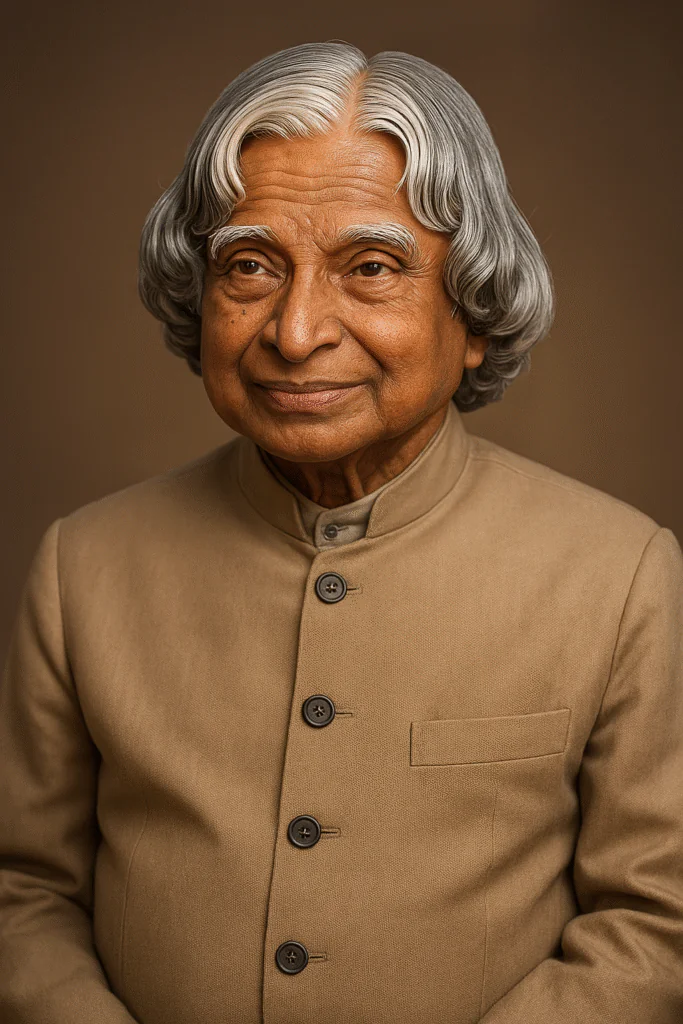
Dr. A. P. J. Abdul Kalam
Dr. A. P. J. Abdul Kalam was one of India’s greatest scientists, known as the “Missile Man,” and served as the 11th President of India (2002–2007). His full name was Avul Pakir Zainulabiddin Abdul Kalam. He was not only a pioneer in science and technology but also a lifelong inspiration to the youth. His life symbolized simplicity, patriotism, and dedication to education.
Early Life
Birth & Family Background
- Birth: 15 October 1931, Rameswaram (Tamil Nadu)
- He was born into a simple middle-class Muslim family.
- His father was a sailor/boatman who transported local pilgrims.
- His mother, Ashiamma, was a kind and religious woman who helped the needy.
Childhood
- Dr. Kalam helped his family by selling newspapers during his childhood.
- Despite financial struggles, he grew up with strong moral and spiritual values.
- He displayed honesty, discipline, and hard work from an early age.
Education
- Completed primary education in Rameswaram.
- Graduated in Physics from St. Joseph’s College, Tiruchirappalli.
- Studied Aeronautical Engineering at the Madras Institute of Technology (MIT).
- Inspired by teachers, especially Sivasubramaniam Iyer, who encouraged his interest in science and aeronautics.
Scientific Career
- Worked with the Indian Army and ISRO.
- Played a major role as Director of India’s first indigenous satellite launch vehicle (SLV-III).
- Contributed to missile development programs such as Prithvi, Trishul, Akash, and Agni.
- Earned the title “Missile Man of India.”
Presidential Tenure (2002–2007)
- Became the 11th President of India.
- Admired widely and often called the “People’s President.”
- Continued to motivate and encourage young minds to adopt scientific thinking.

Premium Amazon Product – Quality, Performance & Value
Discover this high-quality product designed for reliable performance and everyday practicality. Built with excellent materials and thoughtful design, it’s ideal for personal use or gifting. Click below to check the latest price, full specifications, and verified customer reviews on Amazon.
View on AmazonHonours and Awards
- Bharat Ratna (1997)
- Padma Vibhushan (1990)
- Padma Bhushan (1981)
- Received hundreds of national and international awards.
Writings and Thoughts
Dr. Kalam wrote many inspirational books that continue to guide millions:
- Wings of Fire (Autobiography)
- Ignited Minds
- India 2020
- Mission India
Death
Dr. Abdul Kalam passed away on 27 July 2015 while delivering a lecture in Shillong (Meghalaya). He continued educating and inspiring students until his last breath.
Conclusion
Dr. Kalam’s life is a timeless inspiration. Rising from a humble background to become one of the most respected leaders of India, he remained grounded in simplicity. He was a scientist, teacher, thinker, and true patriot whose legacy continues to fuel the dreams of millions.
Early Life (Detailed)
Birth and Background
Dr. Kalam was born on 15 October 1931 in Rameswaram, a small island town in today’s Tamil Nadu. His full name was Avul Pakir Jainulabdeen Abdul Kalam.
Family
- He belonged to a middle-class Muslim family.
- His father, Zainulabiddin, was a boatman engaged in transporting pilgrims.
- His mother, Ashiamma, was known for her kindness and generosity.
- The family was not financially wealthy but rich in cultural and moral values.
Childhood Struggles
- From a young age, he faced financial hardships.
- To support his family, he distributed newspapers while attending school.
- He embodied honesty, discipline, and perseverance throughout his childhood.
Education and Inspiration
- Studied at Ramanathapuram Schwartz High School.
- Had a deep interest in science and mathematics.
- Was influenced by his teacher, Sivasubramaniam Iyer, who nurtured his fascination with aeronautics.
This simple, disciplined, and value-driven early life shaped Dr. Kalam into the scientist, president, and national icon he eventually became.
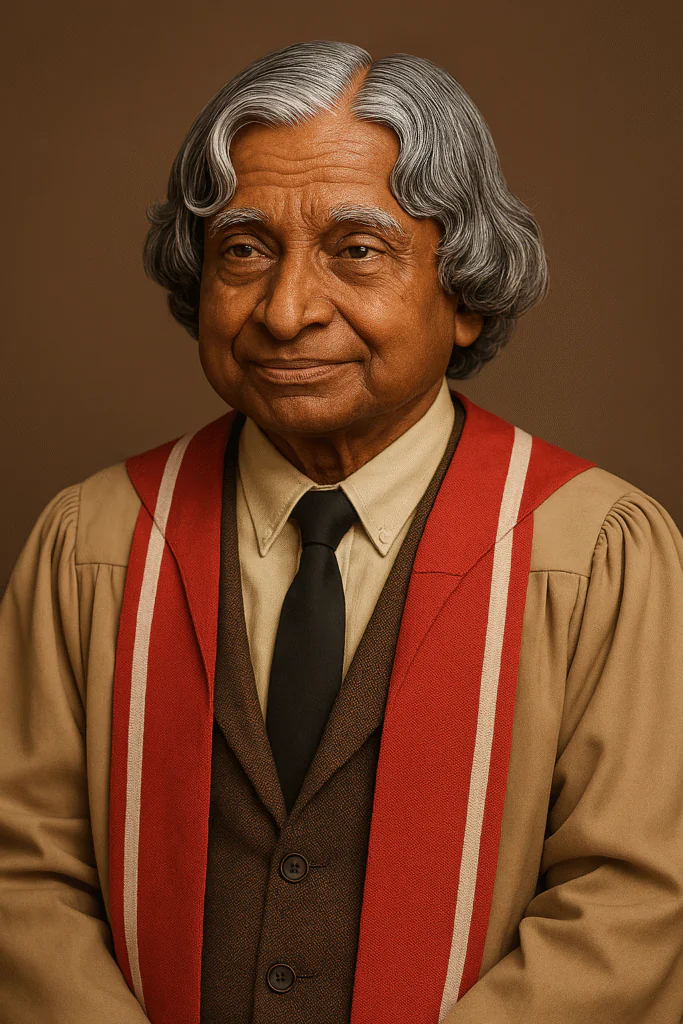
Dr. A. P. J. Abdul Kalam – Education
Dr. Kalam’s educational journey is a remarkable example of his hard work, dedication, and deep curiosity towards science. From an early age, he showed a strong inclination toward mathematics and scientific thinking.
Elementary Education
- He completed his early schooling at Rameswaram Elementary School.
- Later, he studied at Schwartz High School, Ramanathapuram.
- He was an intelligent and curious student with a keen interest in learning.
- Mathematics was his favourite subject, and he often spent hours solving mathematical problems.
Premium Amazon Product – Quality, Performance & Value
Discover this high-quality product designed for reliable performance and everyday practicality. Built with excellent materials and thoughtful design, it’s ideal for personal use or gifting. Click below to check the latest price, full specifications, and verified customer reviews on Amazon.
View on AmazonUndergraduate Education (Physics)
- After completing high school, he joined St. Joseph’s College, Tiruchirappalli (now affiliated with Bharathiar University).
- He completed his Bachelor’s degree in Physics from the same institution.
Technical Education (Aeronautical Engineering)
- After studying physics, Dr. Kalam’s dream was to become a pilot or contribute significantly to aeronautics.
- He took admission in the Madras Institute of Technology (MIT), Chennai, where he studied Aeronautical Engineering.
- At MIT, he worked on a challenging project and devoted days and nights to completing it on time—showcasing his talent, discipline, and determination.
Important Points
- While studying at MIT, he aimed to make India self-reliant through indigenous aircraft technology.
- He appeared for the Indian Air Force (IAF) pilot selection but missed qualifying by just a few marks.
- He did not allow this failure to discourage him; instead, he dedicated his life to science, innovation, and technical research.
Conclusion
Dr. Kalam’s education was far more than academic degrees. He learned equally from life, experiences, failures, and challenges. According to him:
“The purpose of education is to create skills and confidence, not just to pass exams.”
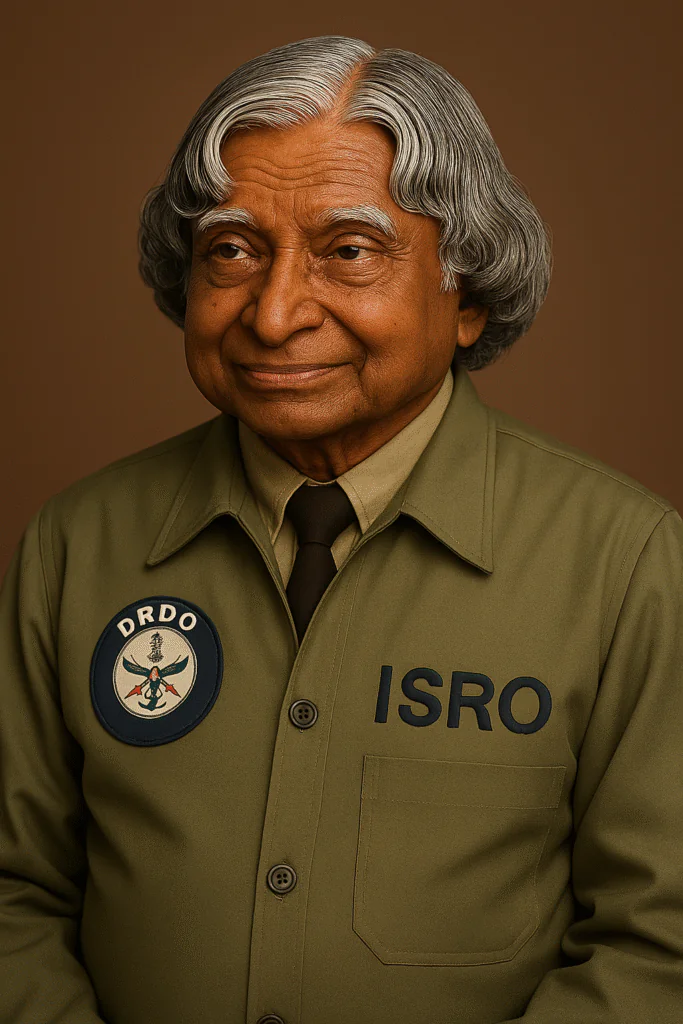
Dr. A. P. J. Abdul Kalam’s Scientific Career
Dr. Kalam’s scientific journey formed the backbone of India’s defense and space programs. Through his exceptional contributions, he strengthened India’s missile technology and satellite launch capabilities, making the country more self-reliant.
Early Scientific Journey (DRDO & ISRO)
- In 1958, Dr. Kalam began his career as a scientist at the DRDO (Defence Research and Development Organisation).
- He initially worked on a Hovercraft project, but it did not achieve major success.
- In 1969, he was transferred to ISRO (Indian Space Research Organisation), where his real scientific contributions began.
SLV-III and Satellite Launch
- At ISRO, he led the development of India’s first indigenous Satellite launch vehicle (SLV-III).
- This rocket successfully placed the ‘Rohini’ satellite into orbit in 1980—marking India’s major breakthrough in space technology.
Missile Programme and Return to DRDO
- In 1982, Dr. Kalam returned to DRDO and became the head of India’s Integrated Guided Missile Development Programme (IGMDP).
- Under his leadership, India developed several indigenous missiles:
- Agni – Medium-range ballistic missile
- Prithvi – Surface-to-surface missile
- Trishul, Nag, Akash – Other advanced missile systems
- These achievements earned him the title “Missile Man of India.”
Pokhran Nuclear Test (1998)
- Dr. Kalam played a key role in the Pokhran-II nuclear tests as Chief Scientific Advisor.
- He oversaw planning, monitoring, and maintaining the secrecy of the tests.
- His contribution helped India establish itself as a nuclear power nation.
Scientific Advisor and DRDO Chief
- He served as the Scientific Advisor to the Government of India and later as the Chief of DRDO.
- He promoted indigenous defense technology, advanced aviation systems, and technological innovations.
Honours and Evaluation of Contributions
- Under his leadership, India achieved significant milestones in missile systems, space science, and defense technology.
- He inspired the youth toward science, innovation, and nation-building through his work and vision.
Premium Amazon Product – Reliable Quality & Everyday Performance
Check out this well-designed, dependable product built for everyday convenience and solid performance. With strong build quality and positive user feedback, it’s a great choice for personal use or as a thoughtful gift. Click below to view the latest price, detailed features, and real customer reviews on Amazon.
View on AmazonConclusion
Dr. Kalam’s scientific career is a shining example of turning dreams into reality. His contributions gave India a new identity as a rising scientific power and continue to inspire generations.
Dr. A. P. J. Abdul Kalam’s Presidential Tenure (2002–2007)
On 25 July 2002, Dr. Kalam was sworn in as the 11th President of India. He became India’s first President with a scientific background, rising to the highest constitutional post without any political experience. His tenure was widely appreciated, earning him the title “The People’s President.”
Selection and Support
- He received support from the Bharatiya Janata Party (BJP) and the NDA alliance.
- Opposition parties like the Congress and Samajwadi Party also supported his nomination.
- He was not elected unopposed but won with an overwhelming majority.
Major Initiatives as President
Inspiration for the Youth
- He opened the Rashtrapati Bhavan to the general public, especially students.
- Visited schools and universities across India to interact with young minds.
- Presented his vision of making India a developed nation by 2020.
Simple Lifestyle
- He lived a simple and humble life in Rashtrapati Bhavan.
- He avoided extravagance, distinguishing himself from past presidents.
Constitutional Role and Decisions
- Maintained the dignity and neutrality expected from the President of India.
- Raised ethical questions on various policies but always upheld democratic processes.
Tough Stand on Mercy Petitions
- During his tenure, he rejected several mercy petitions, including high-profile terrorist cases like Afzal Guru.
- This brought both appreciation and criticism, as it was seen through the lens of his humanitarian values.
Opportunities and Honours
- He represented India at the United Nations General Assembly, the European Parliament, and various global forums.
- He was regarded as a scientific thinker and a peace ambassador.
Decision at the End of His Term
- He refused to seek a second term in 2007, despite strong public and political support.
- He believed that in a democracy, institutions and values must be placed above individuals.
Conclusion
Dr. Abdul Kalam’s presidential tenure remains one of the most inspiring periods in Indian history. He transformed the role of President from a ceremonial position into a platform for nation-building. His humility, intellect, and vision continue to inspire generations.
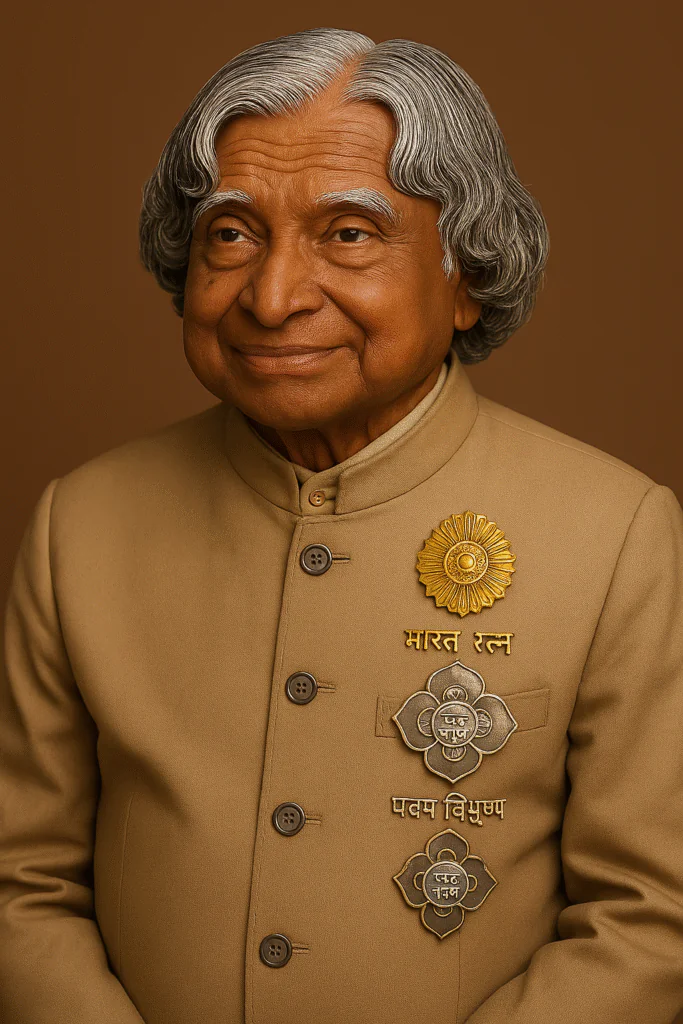
Dr. A. P. J. Abdul Kalam: Honours and Awards
Dr. A. P. J. Abdul Kalam was honoured with numerous prestigious awards for his scientific achievements, national service, and ability to inspire millions of young minds. He is one of the few Indians to receive all three major civilian honours—Padma Bhushan, Padma Vibhushan, and Bharat Ratna.
Honours by the Government of India
Padma Bhushan – 1981
- Awarded for his early contributions to India’s space and defense sectors.
- Recognized for leading the SLV-III project at ISRO.
Padma Vibhushan – 1990
- Given for his scientific leadership in DRDO and ISRO.
- Honoured for strengthening India’s defense and missile development programmes.
Bharat Ratna – 1997
- India’s highest civilian award.
- Acknowledged his role in missile development, space science, and national service.
Other Major National Honours
- Indira Gandhi National Integration Award (1997)
- Veer Savarkar Award (1998)
- Ramanujan Prize (2000) – For innovation in science and education.
International Honours
- Doctorate Degree – King Charles University, Czech Republic
- Honorary Doctorate – University of California, USA
- Honorary Degree – National University of Singapore
- Received honorary titles from institutions in the UK, Scotland, and Canada.
Recognition by Educational Institutions
- Over 40 universities in India and abroad awarded him honorary doctorates.
- IITs, NITs, and several institutes appointed him as an Honourable Professor.
Naming in His Honor
- Abdul Kalam Technical University (AKTU), Uttar Pradesh
- Dr. A. P. J. Abdul Kalam Science Centre, Tamil Nadu
- DRDO Missile Complex, Hyderabad – renamed as the “Dr. A. P. J. Abdul Kalam Missile Complex”
Conclusion
For Dr. Kalam, awards were not just honours but symbols of duty, responsibility, and motivation. His life itself was an award that continues to inspire future generations.
Bharat Ratna (1997) – Dr. A. P. J. Abdul Kalam
Dr. A. P. J. Abdul Kalam was awarded the Bharat Ratna in 1997, India’s highest civilian honour. It recognized his unparalleled contribution to India’s defense, space programs, and national development.
Main Reasons for Receiving Bharat Ratna
Scientific Achievements
- SLV-III project – successfully launched India’s first satellite “Rohini” into space.
- Leadership in India’s missile programs: Agni, Prithvi, Trishul, Nag, Akash.
- Promoted indigenous defense and space technologies.

Premium Amazon Product – Quality Build & Everyday Reliability
Discover this well-crafted product designed for reliable performance and everyday convenience. With strong build quality and user-friendly features, it’s a great choice for personal use or as a thoughtful gift. Click below to check the latest price, full specifications, and verified customer reviews on Amazon.
View on AmazonContribution to National Security
- Played a crucial role in Pokhran-II nuclear tests (1998).
- Helped India become strategically self-reliant.
Inspirational Personality
- Mentor, teacher, and visionary who inspired millions of youth.
- Presented the dream of a developed India through “India 2020”.
Features of Bharat Ratna
The Bharat Ratna is awarded for exceptional service in any field of human endeavour—including arts, literature, science, public service, and welfare. Dr. Kalam accepted this honour with humility and simplicity.
An Inspiring Response
“This honour is not for me, it is for every Indian who wants to do something for his country, in whatever field.”
Conclusion
The Bharat Ratna (1997) stands as a symbol of Dr. Kalam’s dedication to science and national service. It celebrates the idea that every child can dream fearlessly and achieve greatness.
Padma Vibhushan (1990) – Dr. A. P. J. Abdul Kalam
Dr. Kalam received the Padma Vibhushan in 1990, India’s second-highest civilian honour. The award recognized his extraordinary contributions to India’s defense and scientific research sectors.
Main Reasons for Honour
Leadership in Missile Development Programme
- Led the IGMDP (Integrated Guided Missile Development Programme) during the 1980s.
- Developed indigenous missiles such as Agni, Prithvi, Trishul, Nag, and Akash.
Leadership in Scientific Institutions
- Held key scientific positions in DRDO and ISRO.
- Played a major role in making India self-reliant in defense technology.
Contribution to Strategic and National Security
- Helped India progress as a strategically strong and self-dependent nation.
Prestige of Padma Vibhushan
The Padma Vibhushan is awarded for exceptional and distinguished service in fields like science, arts, industry, education, medicine, and public life. Dr. Kalam received this honour for his scientific vision and patriotic commitment.
Dr. Kalam’s Vision
He believed that science must directly contribute to national security, development, and societal growth. The award recognized this belief and his lifelong dedication to India.
Conclusion
The Padma Vibhushan (1990) reflects Dr. Kalam’s scientific leadership and his mission to make India self-reliant in defense and aerospace technologies.
Padma Bhushan (1981) – Dr. A. P. J. Abdul Kalam
Dr. Kalam was awarded the Padma Bhushan in 1981, India’s third-highest civilian honour. It recognized his early and influential contributions to India’s space and defense science sectors.
Reasons for Conferring the Honour
Contributions at ISRO
- Led the SLV-III project during the 1970s.
- Successfully launched the “Rohini” satellite in 1980—India’s first indigenous satellite launch.
Foundation of Technological Self-Reliance
- Promoted the development of indigenous launch technologies.
- His work laid the foundation for making India self-reliant in the space sector.
Scientific Innovation and Leadership
- Trained and guided a team of young scientists.
- Showcased strong leadership, scientific excellence, and patriotism.
Prestige of Padma Bhushan
The award recognizes notable service in administration, science, education, arts, and social service. Dr. Kalam received it at a time when he was emerging as one of India’s brightest scientific leaders.
Conclusion
The Padma Bhushan (1981) marked the beginning of Dr. Kalam’s recognized journey, establishing him as a visionary who advanced India’s space technology and scientific self-reliance.
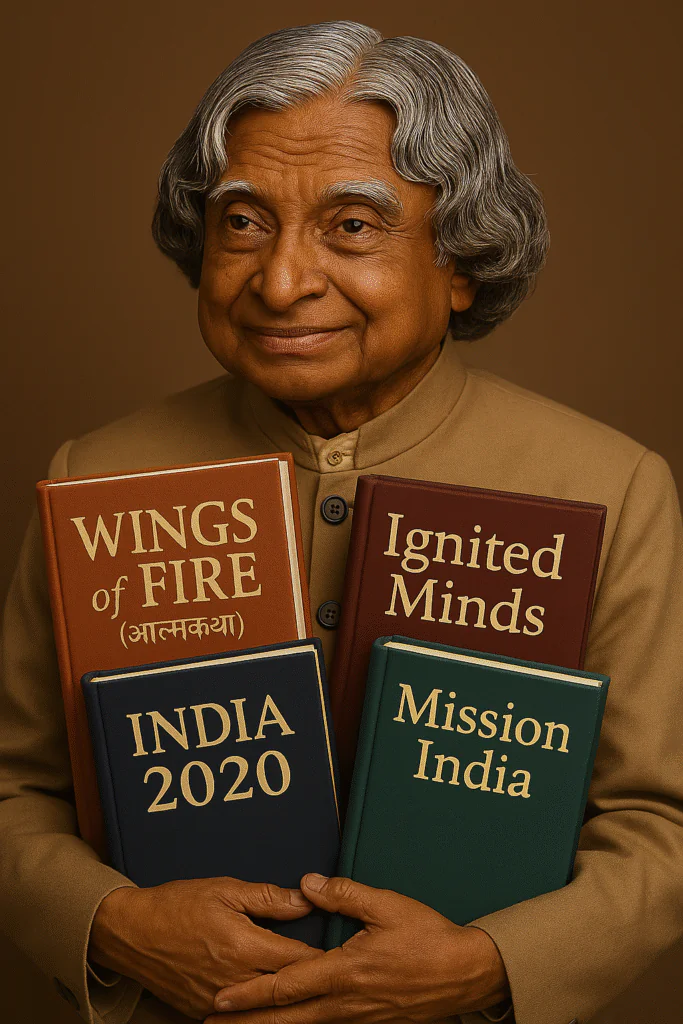
Dr. A. P. J. Abdul Kalam – Writings and Thoughts
Dr. Kalam was not only a scientist and the President of India, but also an outstanding writer, thinker, and educationist. His writings inspire the youth, empower India’s vision of becoming a developed nation, and promote ethical leadership. His books continue to guide millions across the world.
Key Books
1. Wings of Fire (Autobiography)
- Depicts Dr. Kalam’s early struggles, scientific journey, and rise to the Presidency of India.
- Written in simple language with a deeply inspirational tone.
2. Ignited Minds
- Focuses on the power of India’s youth and their role in nation-building.
- Encourages young Indians to dream big and make those dreams a reality.
3. India 2020: A Vision for the New Millennium
- Presents a roadmap to make India a developed nation.
- Discusses education, technology, rural development, and moral leadership.
4. My Journey: Transforming Dreams into Actions
- A collection of short episodes and experiences from his life.
- A simple, emotional, and inspiring book.
5. Transcendence: My spiritual Experiences with Pramukh Swamiji
- Highlights his spiritual experiences despite being rooted in science.
- Shows a beautiful balance between spirituality and scientific thought.
Key Ideas and Philosophy
- “Dreams are not what you see while sleeping; dreams are those that don’t let you sleep.”
- “If you fail, never give up — FAIL means ‘First Attempt In Learning’.”
- “The greatest source of knowledge is experience.”
- “Real education lies in character building, morality, and creativity.”
Characteristics of His Writings
- Simple, emotional, and powerful language.
- A blend of inspiration, patriotism, science, and spirituality.
- Aimed at instilling confidence, discipline, and responsibility.
Conclusion
Dr. Kalam’s writings are a form of inner energy that encourages every reader to pursue excellence. He was not just a master of the pen, but a craftsman of powerful, transformative thoughts.
Dr. A. P. J. Abdul Kalam Passes Away
Dr. Kalam passed away on 27 July 2015. He collapsed while delivering a lecture at IIM Shillong (Meghalaya) due to a sudden cardiac arrest. His passing reflected his lifelong commitment to learning, teaching, and inspiring the youth.
Premium Amazon Product – Quality, Performance & Everyday Use
Explore this well-designed product crafted for reliable performance and everyday convenience. With strong build quality and thoughtful features, it’s ideal for personal use or a thoughtful gift. Click below to view the current price, full specifications, and verified customer reviews on Amazon.
View on AmazonFinal Moments
- He was addressing students on the topic “Creating a Livable Planet Earth”.
- He suddenly felt unwell and fainted during the lecture.
- He was declared dead shortly after being taken to the hospital.
- Even in his final moments, he was doing what he loved most—teaching and inspiring.
Age
He was 83 years old at the time of his passing.
National Mourning
- The Government of India declared 7 days of national mourning.
- The entire nation expressed deep grief and paid emotional tributes.
- He was remembered as the “People’s President,” “True Son of India,” and an “Inspiration for the Youth.”
Funeral
- His body was brought from Shillong to Delhi, where thoUSAnds came to pay homage.
- On 30 July 2015, his last rites were performed at his hometown Rameswaram (Tamil Nadu) with full state honours.
Burial Site
In Rameswaram, the Dr. APJ Abdul Kalam National Memorial has been built in his honour. It has become a centre of inspiration, patriotism, and national pride.
Conclusion
Dr. Kalam’s life—and even his death—was inspiring and dignified. He continued sharing knowledge until his last breath, which remains his greatest legacy.
Conclusion – Life Message of Dr. A. P. J. Abdul Kalam
Dr. A. P. J. Abdul Kalam’s life represents the journey of an ideal Indian citizen—scientist, teacher, and President. From being the son of a poor fisherman in Rameswaram to becoming the President of India, his life shows that with dreams, hard work, honesty, and service, anything is possible.
His Greatest Characteristics
- Simple living, high thinking
- Unwavering faith in education and science
- Belief in the power and potential of the youth
- Deep dedication to the nation
His Inspiration
“Your dreams come true only when you live them with a true heart and work towards them every day.”
Legacy of Dr. Kalam
- His books, thoughts, speeches, and dreams continue to guide millions.
- He strengthened India not only in missile and space technology but also in confidence and moral values.
Final Thoughts
Dr. Kalam’s life teaches us that even a single individual can initiate a revolution in nation-building—if he makes honesty, education, and service the pillars of his life.
Final Conclusion – Dr. A. P. J. Abdul Kalam
Dr. A. P. J. Abdul Kalam’s life is a timeless example of how dedication, humility, and an unbreakable spirit can transform a simple child from a small town into a national icon. His journey from Rameswaram to Rashtrapati Bhavan reflects the power of education, discipline, and dreams. He proved that true greatness lies not in titles or positions, but in service, character, and actions that uplift the nation.
Throughout his life, he inspired millions through his scientific achievements, visionary leadership, and deep love for India. His commitment to youth empowerment, innovation, and nation-building continues to guide generations. Even today, his books, thoughts, and values ignite minds and encourage people to imagine, create, and achieve the impossible.
Dr. Kalam’s legacy is not limited to missiles, science, or awards—his real legacy is the belief that every child can dream big and work tirelessly to turn those dreams into reality. He reminded the world that integrity, hard work, and compassion are the foundations of true success.
Message of His Life
“Dream, dream, dream. Dreams transform into thoughts and thoughts result in action.”
Dr. Kalam lives on in the hearts of millions as the People’s President, a visionary scientist, a humble teacher, and a true patriot. His life is a guiding light for the present and a roadmap for the future.

Premium Amazon Product – Quality, Performance & Everyday Use
Discover this well-crafted product designed for reliable performance and practical everyday use. With solid build quality and positive user feedback, it’s a great choice for personal use or as a thoughtful gift. Click below to view the current price, full specifications, and verified customer reviews on Amazon.
View on AmazonHe may not be with us physically, but his ideas, values, and dreams will continue to inspire India—and the world—forever.