
Establishment of the United Nations
The United Nations was established on 24 October 1945, soon after the end of the Second World War. Its main objective was to promote peace, security, and cooperation in the world so that future global wars and conflicts could be prevented.
The Process of Establishment
(i) Atlantic Charter – 1941
In August 1941, U.S. President Franklin D. Roosevelt and British Prime Minister Winston Churchill signed the Atlantic Charter. It envisioned the creation of an international organization that would promote global cooperation and peace among nations.
(ii) Declaration of the United Nations – 1942
On 1 January 1942, 26 countries signed the Declaration of the United Nations. They pledged to fight unitedly against Nazi Germany and the Axis powers and expressed their commitment toward forming a future international peace-building organization.
(iii) Dumbarton Oaks Conference – 1944
In 1944, representatives of the United States, Britain, China, and the Soviet Union met at Dumbarton Oaks in Washington, D.C. Here, the basic structure, objectives, and functioning of the future United Nations were drafted.

Premium Amazon Product – Quality, Value & Everyday Use
Discover this feature-rich product designed for reliable everyday performance and practical functionality. With durable build quality and excellent user appeal, it’s a great choice for personal use or gifting. Click below to view the current price, full specifications, and verified customer reviews on Amazon.
View on Amazon(iv) San Francisco Conference – 1945
From 25 April to 26 June 1945, representatives of 50 countries met in San Francisco, USA, to discuss and finalize the United Nations Charter. The Charter was officially signed on 26 June 1945.
(v) Formal Establishment – 24 October 1945
The United Nations was formally established on 24 October 1945 when the Charter was ratified by 51 countries, including all the major powers required for ratification—particularly the five permanent members of the Security Council: the United States, Russia (then USSR), Britain, France, and China.
This day is celebrated annually as “United Nations Day”.
Initial Members
At the time of its establishment, the United Nations had 51 member countries. India was also one of the prominent founding members of the organization.
In Short
The United Nations was founded after the worst tragedy in human history—the Second World War—with the primary goal of protecting future generations from the horrors of war. Even today, the organization continues to work actively for global peace, development, and international cooperation.
Objectives of the United Nations
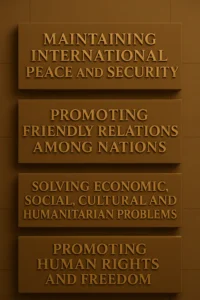
The primary purpose of establishing the United Nations was to ensure lasting peace, security, and cooperation across the world. The UN Charter clearly defines these objectives. They are as follows:
(i) Maintenance of International peace and security
The most important objective of the United Nations is to prevent conflicts between member states, avoid wars, and maintain global peace. For this, the UN uses methods such as mediation, negotiation, peacekeeping forces, and economic sanctions.
(ii) Promotion of Friendly Relations Among Countries
The UN encourages all nations to build friendly relations based on sovereignty, equality, and mutual respect. It promotes non-discrimination on the basis of race, caste, religion, or language.
(iii) Solving Economic, Social, Cultural, and Humanitarian Problems
The United Nations works to address global challenges such as poverty, hunger, disease, illiteracy, gender inequality, and environmental crises. It operates through various specialized agencies, including the World Health Organization (WHO), UNESCO, UNICEF, and UNDP.
(iv) Promotion and Protection of Human Rights
The UN works to safeguard human rights across the world. It promotes rights such as liberty, equality, freedom of expression, and religious freedom.
(v) Promoting international cooperation
The United Nations provides a common platform for countries to cooperate and coordinate, ensuring collective solutions to global issues.
(vi) Upholding Justice and Respect for International Law
The UN aims to ensure that international laws are respected worldwide. It encourages member nations to resolve disputes through peaceful means.
Conclusion
These objectives form the foundation of global peace, justice, and development. They help create an international environment where all nations and individuals can live with dignity, equality, and security.
Principal Organs of the United Nations
To function effectively, the United Nations is structured into six main organs. Each organ plays a unique role in fulfilling the UN’s objectives. Their powers, functions, and structure are defined in the UN Charter.
(i) General Assembly
- The main discussion forum of the United Nations.
- All member countries have equal representation—each country has one vote.
- Responsible for approving the budget, admitting new members, and discussing global issues.
- The General Assembly meets every year in September at the UN Headquarters in New York.
Premium Amazon Product – Quality, Functionality & Value
Discover this dependable, feature-rich product crafted for everyday convenience and reliable performance. With strong build quality and practical design, it’s ideal for personal use or as a thoughtful gift. Click below to check the latest price, full specifications, and genuine customer reviews on Amazon.
View on Amazon(ii) Security Council
- The most powerful organ of the United Nations, responsible for maintaining international peace and security.
- Consists of 15 members:
- 5 Permanent Members: USA, Russia, China, France, and the United Kingdom — all with veto power.
- 10 Non-Permanent Members: Elected for two-year terms.
- Can deploy peacekeeping forces, impose sanctions, or authorize military action.
(iii) Economic and Social Council (ECOSOC)
- Coordinates global economic, social, cultural, health, education, and human rights activities.
- Oversees specialized agencies like WHO, UNESCO, UNICEF, and UNDP.
- Composed of 54 member countries elected by the General Assembly for three-year terms.
(iv) International Court of Justice (ICJ)
- Located in The Hague, Netherlands.
- Settles legal disputes between nations based on international law.
- Comprises 15 judges elected for nine-year terms by the General Assembly and Security Council.
- Only nations, not individuals, can bring cases before the ICJ.
(v) Secretariat
- The administrative body of the United Nations, responsible for coordinating the work of all UN organs.
- Led by the United Nations Secretary-General.
- Term of the Secretary-General: Five years, appointed by the General Assembly.
- Current Secretary-General (as of 2025): Antonio Guterres.
(vi) Trusteeship Council
- Originally created to help transition trust territories into independent and self-governing nations.
- Since all trust territories have gained independence, the Council is currently inactive.
- The last official meeting of this organ was held in 1994.
Conclusion
These six principal organs work together to achieve the goals of global peace, development, justice, and cooperation. Their collective efforts make the United Nations one of the most influential international organizations in the world.
United Nations General Assembly
The United Nations General Assembly is the principal and most representative organ of the United Nations. It is often regarded as the “democratic parliament” of the UN because all member states have equal voting rights, irrespective of their size, population, or economic status.
Key Features
1. Membership
All member countries of the United Nations are part of the General Assembly. Each member state has one vote, ensuring equal representation for all nations.
2. Sessions
The regular annual session of the General Assembly is held every year in September at the UN Headquarters in New York. In addition, special sessions may be convened when necessary.
3. President
The President of the General Assembly is elected every year. The President guides and controls the proceedings of the sessions and gives member representatives the opportunity to speak.
Main Functions of the General Assembly
(i) Discussion and Recommendations
The Assembly discusses major global issues such as peace and security, development, human rights, environment, and refugee crises. It provides recommendations to member states on these issues.
(ii) Approval of the Budget
The General Assembly approves the annual UN budget and determines the financial contributions of member countries.
(iii) Admission of New Members
The Assembly has the authority to approve or reject the admission of new member states.
(iv) Election of Non-Permanent Members of the Security Council
It elects non-permanent members to the Security Council, ECOSOC, and other UN bodies.
(v) Participation in the Appointment of the Secretary-General
The General Assembly approves the appointment of the UN Secretary-General based on the Security Council’s recommendation.

Premium Amazon Product – Quality Performance & Everyday Value
Discover this well-designed product crafted for dependable performance and everyday convenience. Built with quality materials and thoughtful features, it delivers solid reliability and value. Perfect for personal use or as a thoughtful gift. Click below to view the latest price, full specifications, and real customer reviews on Amazon.
View on AmazonNo Judicial Power
Most decisions of the General Assembly are recommendations (non-binding). They do not have legal force, but they carry strong diplomatic and moral value.
Conclusion
The United Nations General Assembly is a global platform where all nations gather to discuss issues affecting humanity. It strengthens global democracy through dialogue, cooperation, and collective problem-solving.
Security Council of the United Nations
The Security Council is the most powerful and influential organ of the United Nations. Its primary responsibility is to maintain international peace and security. Whenever there is a situation of war, conflict, or violence in any region, the Security Council intervenes.
Key Features
1. Membership
The Security Council consists of 15 members:
Permanent Members (5)
- United States (USA)
- Russia
- China
- France
- United Kingdom (UK)
These five nations possess the Veto Power, meaning that if any one of them vetoes a proposal, it cannot be passed.
Non-Permanent Members (10)
- Elected by the General Assembly for two-year terms.
- Chosen based on regional representation.
- India has served as a non-permanent member multiple times.
Main Functions
(i) Maintaining International Peace
In situations of war or conflict, the Security Council suggests treaties, negotiations, arbitration, and ceasefires. In case of severe threats, it can also deploy UN peacekeeping forces.
(ii) Sanctions and Military Action
The Council can authorize economic sanctions, arms embargoes, or even military intervention when necessary.
(iii) Appointment of the Secretary-General
The Security Council recommends a candidate for the post of Secretary-General to the General Assembly.
(iv) Selection of ICJ Judges
Together with the General Assembly, the Council participates in electing judges to the International Court of Justice (ICJ).
Effect of Veto Power
If any permanent member casts a “NO” vote, the proposal is rejected—even if all other members support it. This often results in important global proposals remaining unapproved.
India and the Security Council
- India is a founding member of the United Nations.
- India has been elected as a non-permanent member several times.
- India has long advocated for permanent membership, and global support for this demand is steadily increasing.
Conclusion
The Security Council is the UN’s core decision-making body for resolving conflicts and maintaining peace. While its structure is powerful, the veto system sometimes limits its ability to act decisively. Nevertheless, it remains a crucial institution for global stability.
Economic and Social Council (ECOSOC)
The Economic and Social Council (ECOSOC) is one of the major organs of the United Nations. Its primary responsibility is to address global economic, social, cultural, health, and human rights issues and promote cooperation among nations. ECOSOC plays a vital role in global development, sustainability, and human well-being.
Key Features
1. Membership
- ECOSOC consists of 54 member countries.
- Members are elected by the General Assembly for a term of three years.
- Membership is chosen with attention to geographical representation (Asia, Africa, Europe, etc.).
2. Meetings and Sessions
- ECOSOC holds its annual session in July.
- Special sessions may also be convened to address urgent global issues.
Main Functions
(i) Promoting Economic and Social Development
ECOSOC works to address issues such as poverty, unemployment, inequality, and challenges faced by developing nations.
(ii) Promotion of Human Rights and Education
The Council promotes programs for the rights of women, children, minorities, and marginalized groups, and supports initiatives for global literacy and higher education.
(iii) Coordination of Specialized UN Agencies
ECOSOC coordinates the functioning of several specialized UN agencies, including:
- UNESCO – Education, Science, and Culture
- WHO – World Health Organization
- UNICEF – Children’s Fund
- ILO – International Labour Organization
- UNDP – United Nations Development Programme
(iv) Organizing International Conferences & Reports
ECOSOC organizes global conferences and publishes reports on sustainable development, climate change, gender equality, and other global challenges.
India and ECOSOC
India has been an active member of ECOSOC and has supported several initiatives related to social Justice, healthcare, and development assistance for developing countries.
Conclusion
The Economic and Social Council is the central platform for formulating policies related to development, equality, education, health, and economic growth. It strengthens global cooperation and contributes significantly to human welfare and progress.
International Court of Justice (Judicial Council)
The International Court of Justice (ICJ), also known as the Judicial Council of the United Nations, is the principal judicial organ of the UN. Its primary function is to settle international disputes and interpret international laws, thereby strengthening global justice and the rule of law.
Key Features
1. Location
The ICJ is headquartered in The Hague, Netherlands. It is the only UN organ located outside New York.
2. Establishment
The Court was established in 1945 along with the United Nations and began functioning in 1946.
3. Structure
- The Court has 15 judges.
- Judges are elected by the General Assembly and Security Council for nine-year terms.
- No two judges can be from the same country.
4. President and Vice-President
The ICJ elects a President and Vice-President from among its judges.
Main Functions
(i) Settlement of International Disputes
The Court settles cases related to border disputes, treaty interpretation, diplomatic relations, and human rights issues. Only countries can bring cases to the ICJ—individuals and private organizations cannot.
(ii) Advisory Opinions
The General Assembly, the Security Council, and other UN bodies may request legal advice from the Court. These opinions are non-binding but carry significant moral and legal influence.
Validity of Decisions
ICJ judgments are binding but apply only to countries participating in the case. If a country does not comply with a decision, the matter may be referred to the Security Council.
India and the ICJ
India has approached the ICJ in several important cases, including:
- Kulbhushan Jadhav Case (2017)
- Dadra and Nagar Haveli Case (1960)
Notable Indian judges who served at the ICJ include Nagendra Singh and Dalveer Bhandari.

Premium Amazon Product – Quality, Performance & Everyday Use
Explore this premium product designed for reliable performance, solid build quality, and everyday convenience. Ideal for personal use or as a thoughtful gift, it delivers great value and user satisfaction. Click below to view the latest price, full specifications, and verified customer reviews on Amazon.
View on AmazonConclusion
The International Court of Justice is a crucial pillar of the United Nations, ensuring peaceful resolution of disputes and strengthening legal order worldwide. It promotes justice, fairness, and rule of law among nations.
Secretariat of the United Nations
The Secretariat is the administrative organ of the United Nations. It is responsible for carrying out the day-to-day operations of the UN, supporting all other organs through technical, administrative, and research activities.
Key Features
1. Secretary-General
The Secretariat is headed by the United Nations Secretary-General. The Secretary-General serves as the chief administrative officer and spokesperson of the UN. The term is five years, appointed by the General Assembly on the recommendation of the Security Council.
Current Secretary-General (until 2025): Antonio Guterres (Portugal)
2. Headquarters
The Secretariat headquarters is located in New York City (USA), with regional offices in Geneva, Vienna, Nairobi, and other locations.
Main Functions
(i) Administrative Functions
Organizing UN meetings, preparing reports, translating and publishing documents, and assisting the General Assembly, Security Council, ECOSOC, and other organs.
(ii) Policy Implementation
The Secretariat ensures the implementation of decisions and policies adopted by the General Assembly and the Security Council. It also manages peacekeeping missions and development programs.
(iii) Confidential Reporting
The Secretary-General may send confidential reports to the Security Council or the General Assembly when crises or conflicts arise. This gives the Secretary-General an important diplomatic and political role.
(iv) Addressing Global Issues
The Secretariat brings attention to global issues such as climate change, sustainable development, human rights, and pandemics, and helps coordinate solutions.
Staff and Languages
- The Secretariat comprises approximately 40,000 employees from around the world.
- The six official languages of the United Nations are:
- English
- French
- Spanish
- Russian
- Arabic
- Chinese
Conclusion
The Secretariat is the backbone of the United Nations. Its administrative transparency, efficiency, and leadership under the Secretary-General play a crucial role in the successful functioning of the organization.
Trusteeship Council
The Trusteeship Council is one of the principal organs of the United Nations. It was established to supervise and guide territories that were not self-governing—primarily former colonies administered by victorious nations.
Establishment and Objectives
- Established under Chapter 13 of the UN Charter in 1945.
- Its main objective was to help trust territories develop politically, economically, socially, and educationally, and become independent nations.
Main Functions
- Monitoring the progress of trust territories.
- Ensuring that administrative authorities governed these areas in the interest of the people.
- Promoting development in education, law, health, and infrastructure.
- Helping these territories achieve independence and self-governance.
Members
Members included nations administering trust territories (such as the United States, Britain, and France), along with all permanent members of the Security Council.
Examples of Trust Territories
Several territories in Africa and the Pacific—such as Tonga, Papua New Guinea, and Namibia—were under the trusteeship system.
Cessation of Work
All trust territories eventually gained independence. The Trusteeship Council effectively completed its mission with the independence of Palau in 1994. Since then, it has remained inactive, though it still formally exists as a UN organ.
Conclusion
The Trusteeship Council played a crucial role in ending colonial rule and promoting the principles of independence and self-determination. Its contributions were vital in shaping newly independent nations and advancing human rights across the world.

Premium Amazon Product – Quality, Durability & Everyday Use
Discover this high-quality product designed for reliable performance and everyday convenience. Featuring durable build quality and practical functionality, it’s perfect for personal use or as a thoughtful gift. Click below to view the latest price, full specifications, and verified customer reviews on Amazon.
View on Amazon