
Delhi — Detailed Introduction: History, Geography, Administration & Learnings
Introduction
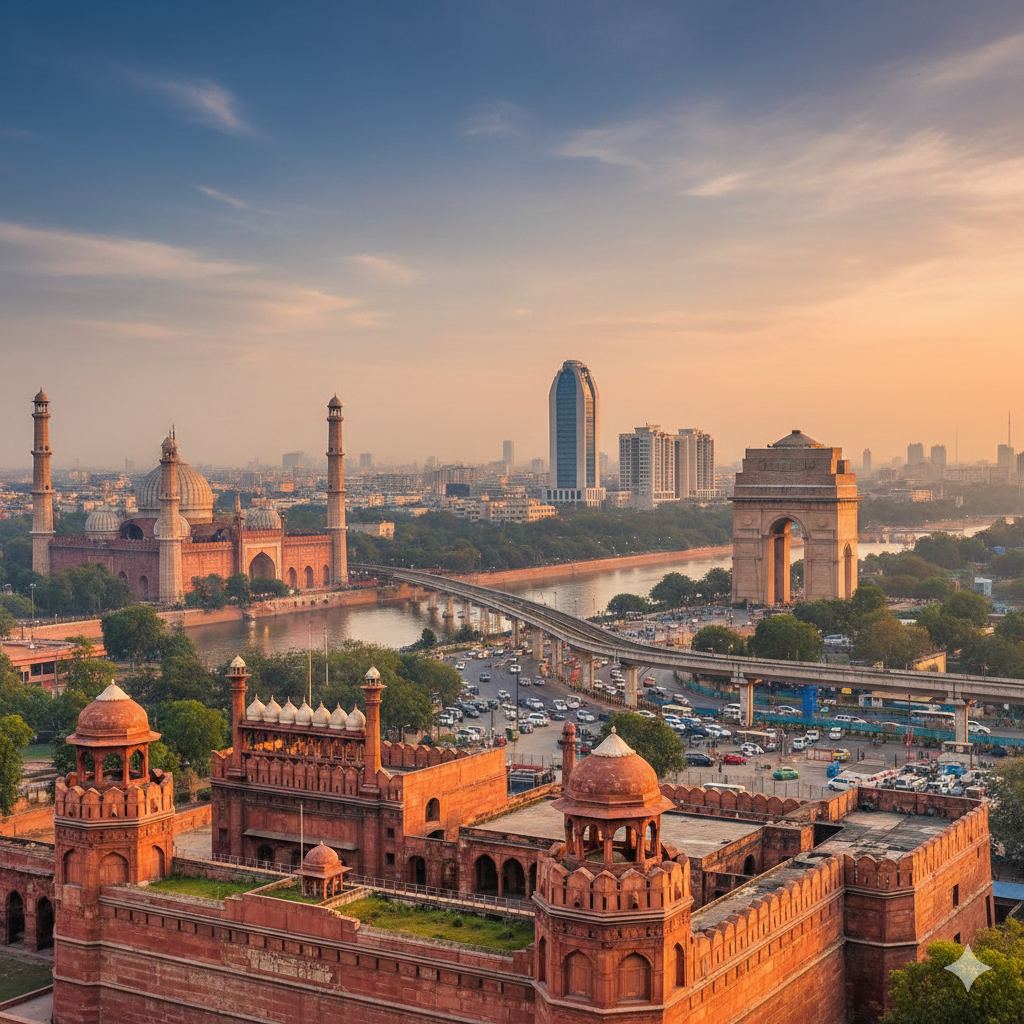
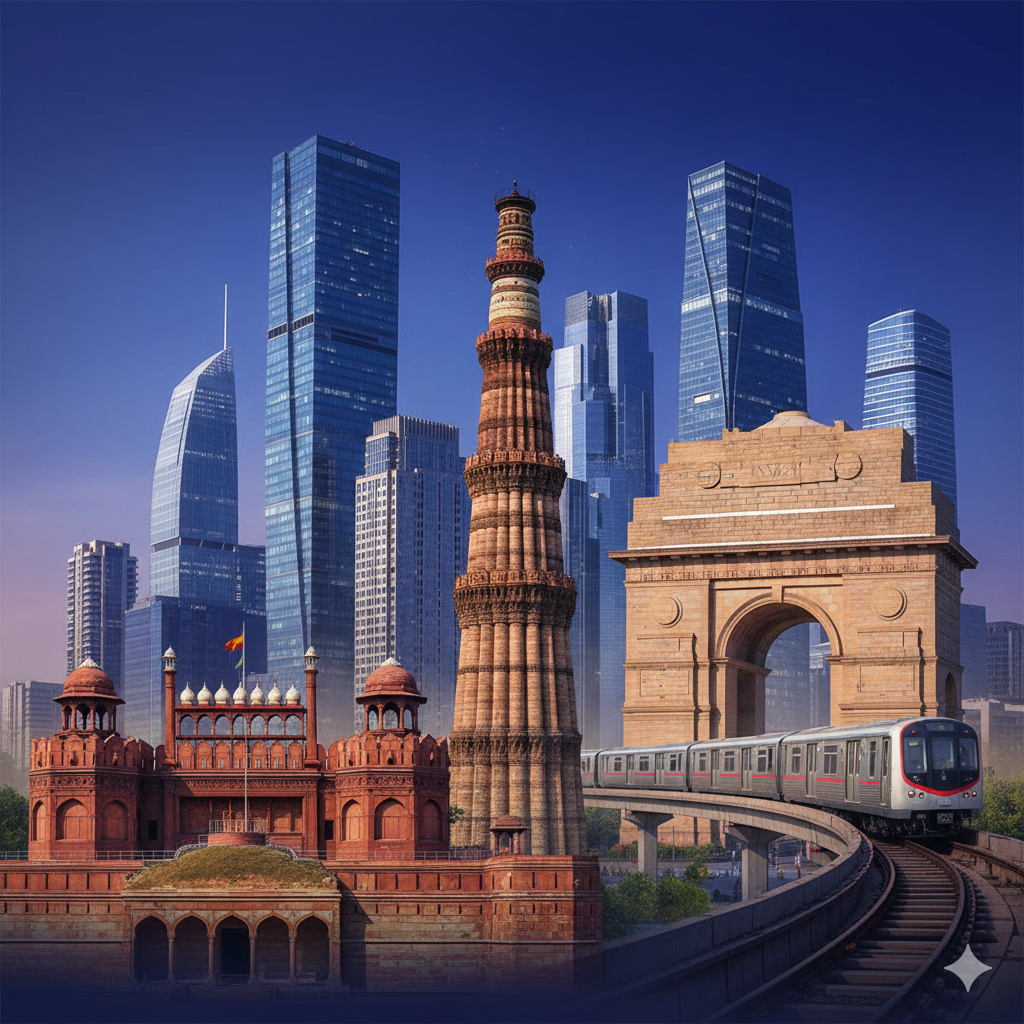
Delhi — the capital region of India — is a city of immense historical, cultural, political and economic importance. With a recorded past stretching back thousands of years, Delhi has served as the capital for many empires and remains a living blend of heritage and modernity.
This detailed introduction covers Delhi's history, geography, administration, culture and other important aspects to give readers a thorough understanding of the city.
1. Historical Background
Delhi's history dates back over 3,000 years. The city is associated with several dynasties and rulers — including the Tomars, Chauhans, the Delhi Sultanate, the Mughals and the British. Its mention as Indraprastha in the Mahabharata links Delhi to ancient Indian traditions.
Major Periods
- Ancient period: Indraprastha (Mahabharata-era reference).
- Medieval period: Delhi Sultanate and the Mughal Empire made Delhi a major capital for centuries.
- Modern period: In 1911 the British announced the transfer of the capital from Calcutta to Delhi; New Delhi was planned and inaugurated in the early 20th century.
- Independent India: In 1950, Delhi became the seat of the Republic and evolved as the National Capital Territory.
2. Geographic Situation
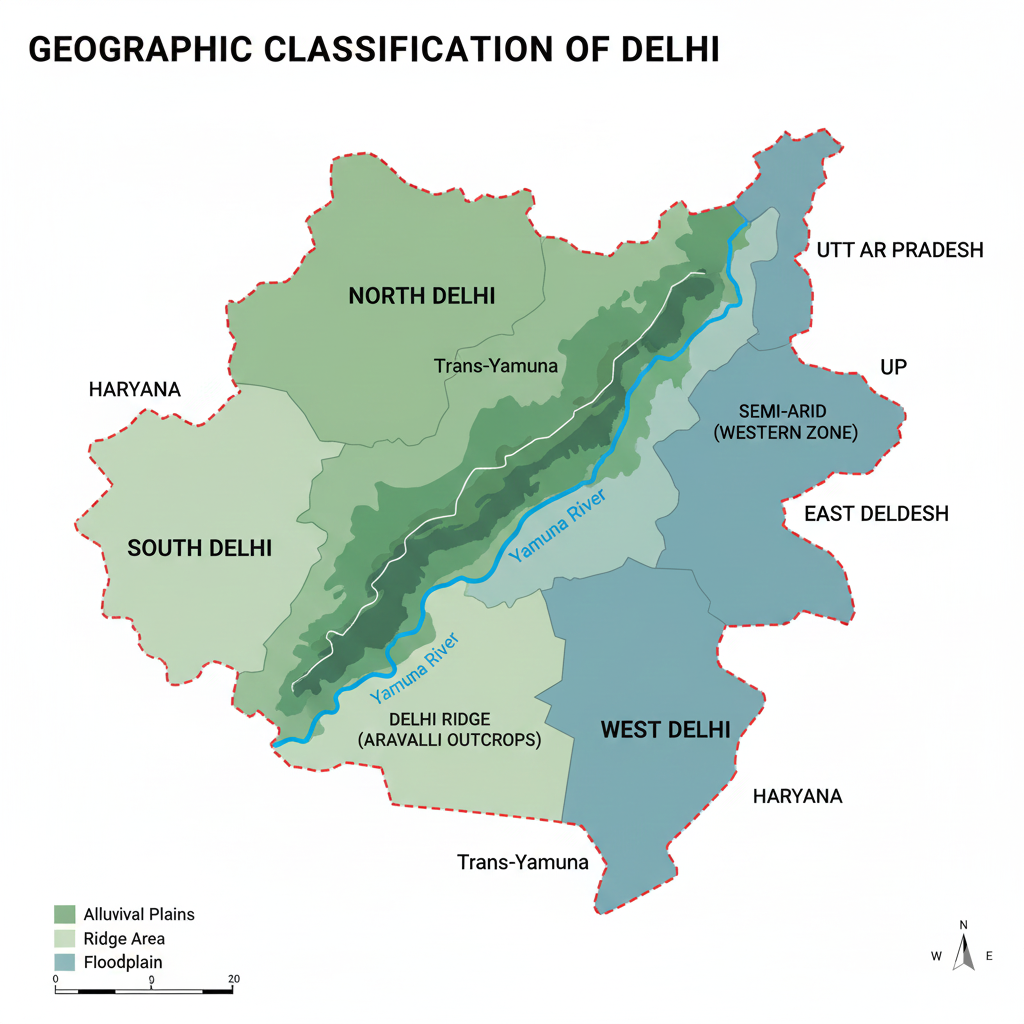
Location: Northern India, largely along the western banks of the Yamuna River.
Area: Approximately 1,484 sq km.
Boundaries: Bordered on the north, west and south by Haryana; to the east by Uttar Pradesh.
Climate & Seasons
- Climate: Semi-arid with large seasonal variation.
- Summer: April–June (often very hot).
- Monsoon: July–September (main rainy season).
- Winter: November–February (can be quite cold, especially at night).
3. Administrative Framework
Delhi has a unique administrative structure as the National Capital Territory (NCT). governance involves both the Central Government and the Delhi Government, each with specific powers.
State-like Status
Delhi is a Union Territory with a Legislative Assembly and a Chief Minister. The Lieutenant Governor is appointed by the Central Government and represents the Union.
Key Branches of Power
- Legislature: Delhi Legislative Assembly — handles many local laws (note: some subjects such as land and police fall under Central control).
- Executive: Chief Minister and Council of Ministers handle executive functions within delegated subjects.
- Judiciary: Delhi High Court adjudicates legal matters for the territory.
Districts
Delhi is administratively divided into 11 districts. Typical district-level officials include the District Magistrate (DM), Sub-Divisional Magistrate (SDM), Tehsildar and other officers.
| # | District | Typical Headquarters (example) |
|---|---|---|
| 1 | New Delhi | Kanhaiya Nagar (example) |
| 2 | Central Delhi | Daryaganj |
| 3 | North Delhi | Civil Lines |
| 4 | South Delhi | Saket |
| 5 | East Delhi | Shakarpur |
| 6 | West Delhi | Rajouri Garden |
| 7 | North West Delhi | Keshav Puram |
| 8 | South West Delhi | Dwarka |
| 9 | North East Delhi | Seelampur |
| 10 | South East Delhi | Defence Colony |
| 11 | Shahdara | Shahdara (Nand Nagri area) |
Police Administration
Delhi Police functions under the Ministry of Home Affairs (Central Government). The Commissioner of Police leads the force, which is organized into multiple police districts and stations.
Local Bodies
- Municipal Corporation of Delhi (MCD): Handles civic services such as sanitation, street lighting, parks and building permissions. In recent years, the three municipal corporations were reorganized and merged depending on administrative decisions.
- New Delhi Municipal Council (NDMC): Maintains the central areas including Rashtrapati Bhavan, Parliament Street and parts of Connaught Place.
- Delhi Cantonment Board: Administers cantonment areas and related civic services.
National Capital Region (NCR)
Delhi is the core of the National Capital Region (NCR), a planning region that includes neighbouring cities and districts across states to coordinate urbanisation, transport and resources.
Major NCR participants: Gurugram, Faridabad, Sonipat, Panipat (Haryana); Noida, Greater Noida, Ghaziabad, Meerut (Uttar Pradesh); Alwar, Bharatpur (Rajasthan).
4. Population & social structure
Population: Approximately 3 crore (30 million) as of 2024 estimates. Delhi is among the most densely populated regions in India.
Languages & Communities
Official languages: Hindi and English. Other commonly spoken languages include Punjabi, Urdu and Haryanvi.
Religion & Diversity
Delhi is religiously and ethnically diverse. Major religious communities include Hindus (majority), Muslims, Sikhs, Christians, Jains and Buddhists. People from almost every state of India live and work in Delhi, making it a multicultural metropolis.
5. Urban Development & Regional Classification
Delhi's urban landscape can be broadly seen in three parts:
Old Delhi
The historic core — Mughal-era monuments such as the Red Fort and Jama Masjid, narrow streets and traditional markets like Chandni Chowk.
New Delhi
The British-planned capital area with Rashtrapati Bhavan, Parliament House, Rajpath and India Gate. Architecturally and administratively distinct from older neighborhoods.
Expansion & Residential Areas
New residential and commercial developments include Dwarka, Rohini, Saket and Mayur Vihar. The NCR (Noida, Gurugram, Ghaziabad, Faridabad etc.) forms the extended metropolitan region.
6. Education & Institutions
Delhi is a national education hub with premier universities and research institutions.
- Universities: Delhi University (DU), Jawaharlal Nehru University (JNU), Jamia Millia Islamia, Indraprastha University.
- Technical & Medical Institutes: IIT Delhi, AIIMS (All India Institute of Medical Sciences), IIIT Delhi, NSIT and others.
7. Economy & Industry
Delhi's economy is largely service-driven, with strong contributions from banking, information technology, education, tourism and retail.
Key Economic Zones
- Commercial hubs: Connaught Place, Nehru Place, Karol Bagh and other markets.
- Industrial clusters: Narela, Okhla and Bawana.
- Tourism: Historical and religious sites, museums and modern cultural facilities attract domestic and international visitors.
8. Transportation & Infrastructure
Metro & Public Transport
The Delhi Metro is one of India's largest and most modern rapid transit systems, connecting the city with suburbs and neighbouring towns.
Roads, Rail & Air
- Major roads: Ring Road, Outer Ring Road, expressways and flyovers.
- Major railway stations: New Delhi, Old Delhi (Delhi Junction), Hazrat Nizamuddin, Anand Vihar.
- Airport: Indira Gandhi International Airport (IGI) — the primary international gateway.
9. Cultural Diversity
Delhi is a multicultural city where people from across India live and celebrate their traditions.
Festivals
Major festivals such as Diwali, Eid, Guruparv, Christmas, Holi and Lohri are celebrated widely across the city.
Food & Cuisine
Delhi's street food is world-famous — from chaat and parathas to chole-bhature and biryani. Food lanes and local markets are essential to Delhi's cultural experience.
10. Prominent Places & Attractions
Historic Monuments
- Red Fort
- Qutub Minar
- Humayun's Tomb
- Jama Masjid
Modern & Cultural Sites
- Akshardham Temple
- Lotus Temple
- India Gate
- Rashtrapati Bhavan
Museums & Markets
- National Museum, Rail Museum
- Markets: Sarojini Nagar, Chandni Chowk, Lajpat Nagar
Conclusion
Delhi is more than India's political capital. It is a city where history, culture, modernity and diversity meet. Its heritage, institutions, economic vitality and strategic importance make Delhi one of the world's significant metropolises.

Top Amazon Product
Discover this great product on Amazon — click below to view the latest price, key features, and customer reviews!
👉 View on Amazon(Amazon Affiliate Link – Thank you!)
Summary (Quick Facts)
| Administrative status | National Capital Territory (NCT) with Legislative Assembly |
|---|---|
| Districts | 11 |
| Police control | Delhi Police (Central Government, Ministry of Home Affairs) |
| Local bodies | MCD, NDMC, Cantonment Board |
| NCR | Includes cities from Haryana, Uttar Pradesh and Rajasthan |
3. Historical Classification of Delhi
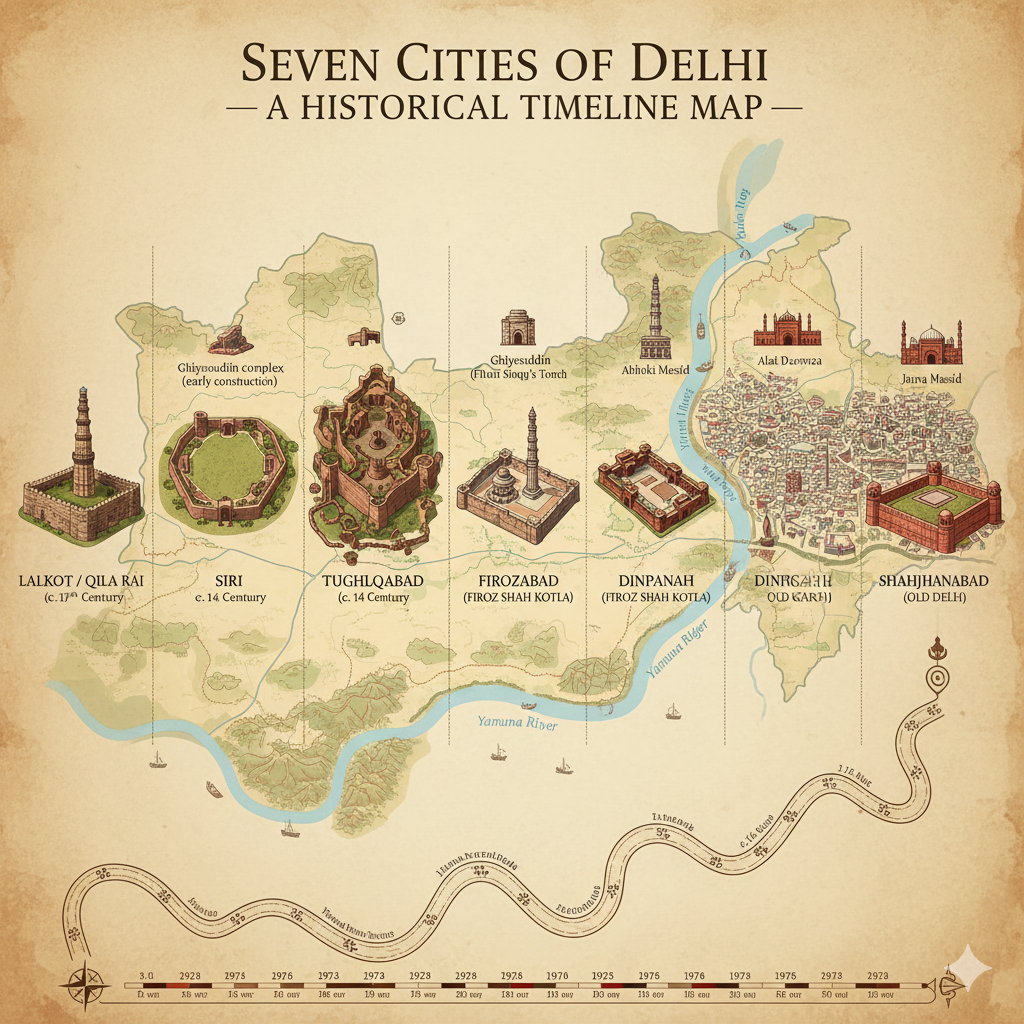
Delhi’s History is extremely rich, ancient and multi-layered. Since ancient times, Delhi has been a major centre of power in India. Historically, Delhi is classified into the “Seven Cities of Delhi” and the later development of Modern Delhi.
A. The Seven Historical Cities of Delhi
From the ancient period to the Mughal era, Delhi was established in seven major forms. These are known as the “Seven Cities of Delhi”.
| Order | Historical City | Founder | Timeline |
|---|---|---|---|
| 1 | Lalkot / Qila Rai Pithora | Tomar King Anangpal & Prithviraj Chauhan | 11th–12th Century |
| 2 | Siri | Alauddin Khilji | 1290s |
| 3 | Tughlaqabad | Ghiyasuddin Tughlaq | 1321 |
| 4 | Jahanpanah | Muhammad bin Tughlaq | 1327 |
| 5 | Firozabad (Firoz Shah Kotla) | Firoz Shah Tughlaq | 1354 |
| 6 | Dinpanah / Purana Qila | Humayun (Rebuilt by Sher Shah Suri) | 1530–1545 |
| 7 | Shahjahanabad | Shah Jahan | 1638–1649 |
Key Features of These Cities
- Lalkot: Delhi’s first major fort city, settled by the Tomars and expanded by Chauhans.
- Siri: Built for security against Mongol invasions.
- Tughlaqabad: A massive walled fort city, later abandoned.
- Jahanpanah: A protective region between Siri and Tughlaqabad.
- Firozabad: Built along the Yamuna by Firoz Shah Tughlaq.
- Dinpanah: Humayun’s city; rebuilt as Purana Qila by Sher Shah Suri.
- Shahjahanabad: Home to Red Fort and Jama Masjid; present-day Old Delhi.

Awesome Amazon Product
Discover this quality product available on Amazon — click below to view the latest price, features, and customer reviews!
👉 View on Amazon(Amazon Affiliate Link – Thank you!)
B. From Mughal Period to British Rule
Mughal Period (1526–1857)
- Delhi served multiple times as the Mughal capital.
- During Shah Jahan’s reign, political and cultural growth reached its peak.
British Period (1857–1947)
- After the Revolt of 1857, Delhi came under direct British rule.
- In 1911, the British shifted the capital from Calcutta to Delhi.
- New Delhi’s foundation was laid in 1911 and inaugurated in 1931.
C. Modern Delhi
1. New Delhi
The British-planned capital (Lutyens’ Delhi) designed by Edwin Lutyens & Herbert Baker, including Rashtrapati Bhavan, Parliament House, Kartavya Path (formerly Rajpath) and India Gate.
2. Development Period (1947–1990)
- Rapid expansion after independence.
- Refugee colonies, industrial areas, DDA housing schemes.
- Early urban infrastructure development.
3. Present Delhi (1990–Present)
- Expansion of the NCR region.
- Modern infrastructure: Metro, IGI Airport, expressways, flyovers.
- Increased urbanization, population growth and pollution.
D. Chronological Phases of Delhi’s History
| Period | Speciality |
|---|---|
| Ancient Period | Tomar & Chauhan dynasties; Lalkot |
| Medieval Period | Sultanate & Tughlaq era; Siri & Tughlaqabad |
| Mughal Period | Establishment of Shahjahanabad; cultural peak |
| British Period | Foundation of New Delhi; capital shift |
| Independent India | Development of New Delhi & NCR |
Summary
| Historical Cities | 7 (Lalkot to Shahjahanabad) |
|---|---|
| Main Eras | Sultanate, Tughlaq, Mughal, British |
| Modern Development | New Delhi, NCR, Metro, IGI Airport |

Top Amazon Product
Discover this quality product available on Amazon — click below to view the latest price, features, and customer reviews!
👉 View on Amazon(Amazon Affiliate Link – Thank you!)
References
- Government of NCT of Delhi. Official Statistics & Reports.
- Census of India (2021 & 2011 Data). Population and Urban–Rural Classification.
- Delhi Development Authority (DDA). Master Plan of Delhi.
- Archaeological Survey of India (ASI). Delhi Monuments & Historical Records.
- Ministry of Housing and Urban Affairs. NCR Regional Plan & Urbanisation Reports.
- Ministry of Statistics & Programme Implementation (MOSPI). GSDP & Economic Indicators.
- Delhi Transport Corporation & DMRC. Transport and Metro Data.
- India Meteorological Department (IMD). Climate and Weather Records.