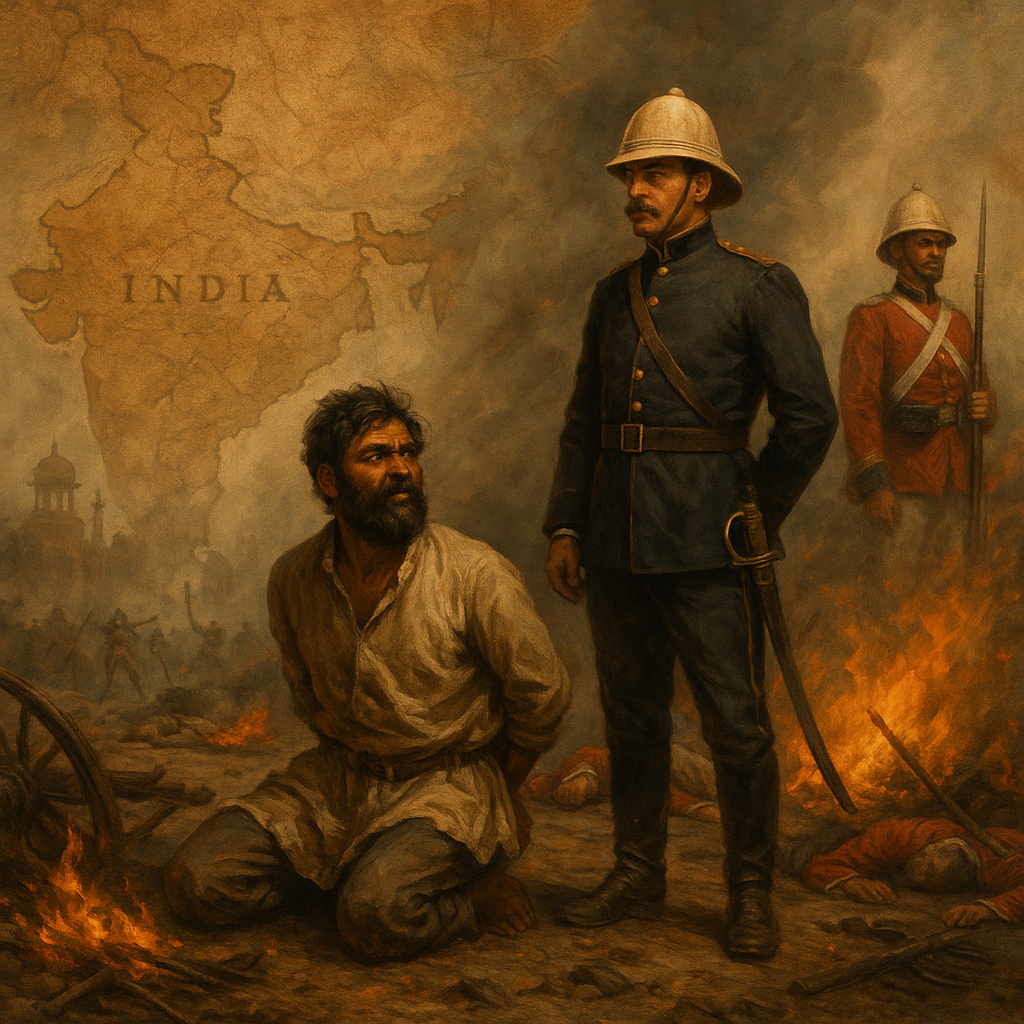
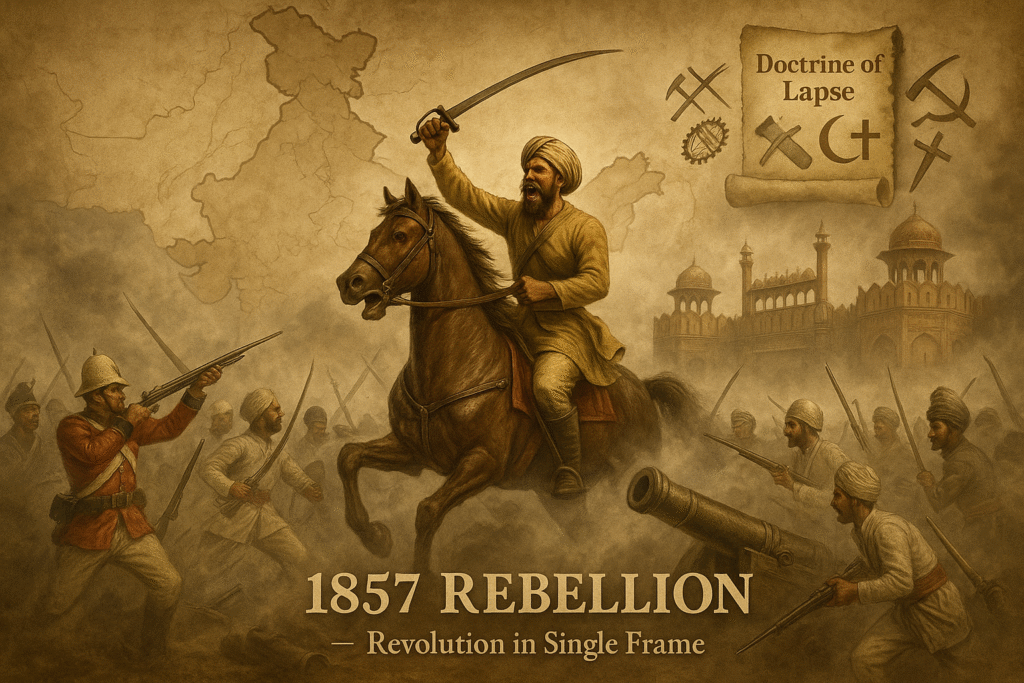
The Revolt of 1857 — India’s First Major Uprising Against Company Rule
The Revolt of 1857 was one of the most significant events in Indian history. Many historians refer to it as the First War of Independence, the Sepoy Mutiny, or simply the Revolt of 1857. It took the form of a wide-reaching, often coordinated uprising across different regions of India against the British East India Company.
1857 – First Freedom Combat, also known as the Revolt of 1857 and the First War of Independence, was one of the most significant events in Indian history. The 1857 – First Freedom Combat marked the first large-scale and organized uprising against British rule in India.
1. Background
Under British rule, Indian society, culture, religion, and politics suffered many oppressive changes. By 1857 widespread discontent had grown, and this pent-up anger erupted as the revolt.
2. Main Causes
Political Causes
- Doctrine of Lapse implemented by Lord Dalhousie — states without a direct heir were annexed by the East India Company.
- Humiliation of Mughal and Peshwa authorities — Bahadur Shah Zafar was displaced from real power; pension and status of claimants like Nana Sahib were affected.
Economic Causes
- Heavy taxation on peasants.
- Destruction of indigenous artisans and traders by British textile imports which devastated cottage industries.
- Landlords and talukdars had property taken away.
Social and Religious Causes
- Social reforms (such as measures against sati, child marriage, and restrictions on widow remarriage in some reforms) were perceived by some as attacks on Hindu religion and customs.
- Activities of Christian missionaries created fears of forced conversion.
- Interference in social and religious practices.
Dissent within the Army
- Indian soldiers (sepoys) faced discrimination in pay and promotion; they were also required to serve overseas, which caused resentment.
- Rumors spread in 1857 that the cartridges for the new Enfield rifles were greased with cow and pig fat — deeply offensive to Hindu and Muslim soldiers alike — which provoked widespread anger.

Amazing Amazon Product
Check out this highly rated product on Amazon! Click below to view the latest price, features, and customer reviews.
👉 View on Amazon(Amazon Affiliate Link – Thank you!)
3. The Beginning of the Revolt
The revolt began on 10 May 1857 in Meerut, when sepoys rose against their British officers. The uprising quickly spread to Delhi, where the sepoys declared Bahadur Shah Zafar as the Emperor of India.
4. Key Leaders and Regions
| Region | Leader |
|---|---|
| Delhi | Bahadur Shah Zafar |
| Jhansi | Rani Lakshmibai |
| Kanpur | Nana Sahib, Tatya Tope |
| Awadh (Oudh) | Begum Hazrat Mahal |
| Bihar | Kunwar Singh |
| Rohtak / Rohilkhand | Khan Bahadur Khan |
5. Major Events of the Revolt
- In Kanpur, Nana Sahib briefly established control before the British reasserted power.
- Rani Lakshmibai of Jhansi fought with extraordinary bravery but attained martyrdom at Gwalior in 1858.
- In Awadh, Begum Hazrat Mahal led the resistance on behalf of the deposed Nawab’s family.
- After fighting in Delhi, the British captured Bahadur Shah Zafar and later exiled him to Rangoon (present-day Yangon, Myanmar).
6. Reasons for Failure
- Lack of centralized organization — the revolt was largely uncoordinated and had no single unified command.
- Poor communication — the rebellion did not spread uniformly across regions.
- Indiscipline among some rebel fighters.
- British military superiority and modern arms.
- Support by some Indian princely states to the British, for example the Scindias, Holkars, and several Rajput rulers.
7. Outcomes
- The rule of the East India Company was abolished.
- The Government of India Act 1858 transferred control of India to the British Crown; India came under the direct rule of Queen Victoria.
- The ratio of Indian soldiers in the British army was reduced and the number of British troops was increased.
- The British became more cautious about interfering in religious and social matters (at least officially) to avoid further unrest.
8. Significance and Conclusion
Although the revolt failed militarily, it planted the seeds of nationalism and the desire for independence among Indians. It is widely regarded as the first organized large-scale effort in the long struggle for India’s freedom, and is honored as the First War of Independence in Indian historical memory.
Reflection — A Personal Note
Reading and translating this account reminded me how small events — a rumor about a rifle cartridge, a policy about succession, or a single act of injustice — can combine into a larger movement for justice. Studying 1857 taught me that courage and conviction can start powerful changes, even when immediate success is not achieved. As a writer and learner, I carry that lesson forward: context matters, leaders matter, and ordinary people shape history.
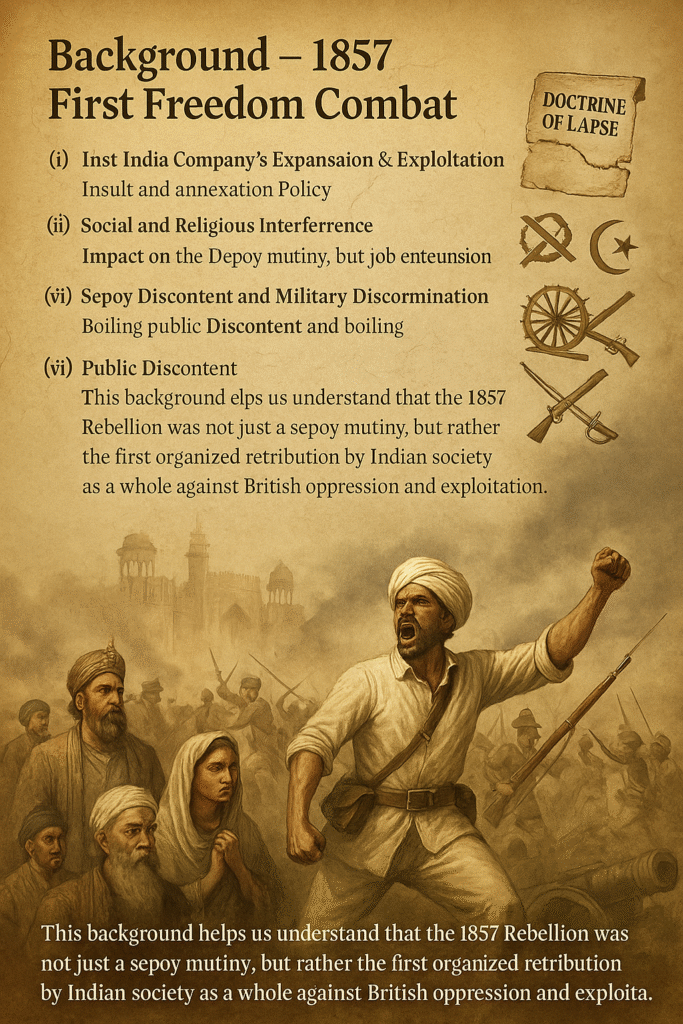
Background – The First War of Independence (1857)
The Revolt of 1857 was not an unexpected or sudden outbreak. Instead, it was the result of several decades of political, economic, social, religious, and military dissatisfaction. The policies introduced by the East India Company gradually created discontent among Indian citizens, soldiers, farmers, landlords, and rulers.
(i) Expansion and Exploitation by the East India Company
- After the Battles of Plassey (1757) and Buxar (1764), the East India Company took control of the administration in India.
- The company aimed purely at profit and had no intention of ensuring the welfare of Indians.
- Gradually, the company brought Indian princely states under its authority through military strength and clever policies.
(ii) Humiliation of Indian Princes and the Doctrine of Lapse
- Lord Dalhousie introduced the Doctrine of Lapse, under which states without a male heir were annexed by the company.
- States such as Jhansi, Satara, Nagpur, Jaitpur, Sambalpur, and others were merged into the British Empire, causing anger among local rulers and citizens.
- The Mughal emperor Bahadur Shah Zafar was insulted, and plans were made to remove him from the Red Fort and shift him to Humayun’s Tomb.
(iii) Social and Religious Interference
- The British introduced social reforms such as abolishing the practice of Sati, banning child marriage, and legalizing widow remarriage. Conservative groups saw these reforms as interference in religion.
- The activities of Christian missionaries, conversions, and the establishment of churches created concern among both Hindus and Muslims.
(iv) Impact on the Indian Economy
- Traditional industries such as textiles, metalwork, and handicrafts collapsed under the pressure of cheap British goods.
- Farmers were burdened with heavy taxes, forcing many into debt, and their lands were confiscated.
- Indian traders and artisans lost livelihood due to the flooding of the market with British products.
(v) Sepoy Dissatisfaction and Military Discrimination
- Indian soldiers faced discrimination in the British army — lower pay, fewer promotions, and harsher service conditions.
- Many sepoys opposed overseas deployment due to religious beliefs, yet they were forced to serve abroad.
- The news that the cartridges of the Enfield rifle were greased with cow and pig fat deeply hurt Hindu and Muslim soldiers, creating widespread resentment.

Great Amazon Product
Discover this useful and high-quality product available on Amazon. Click below to see the latest price, features, and reviews!
👉 View on Amazon(Amazon Affiliate Link – Thank you!)
(vi) Growing Public Discontent
- All sections of society — farmers, rulers, soldiers, artisans, religious leaders, and common citizens — were affected by the oppressive policies.
- This growing dissatisfaction finally erupted in Meerut when the sepoys rebelled, spreading rapidly and transforming into a large-scale uprising.
This background clearly shows that the Revolt of 1857 – First War of Independence was not merely a Sepoy Mutiny but the first organized and widespread resistance of Indian society against British oppression and exploitation. The political annexations, economic drain, social interference, and military grievances collectively created the conditions that led to this historic uprising.
👉 Conclusion
This background clearly shows that the 1857 revolt was not just a sepoy mutiny but the first organized resistance of Indian society against British oppression and exploitation.
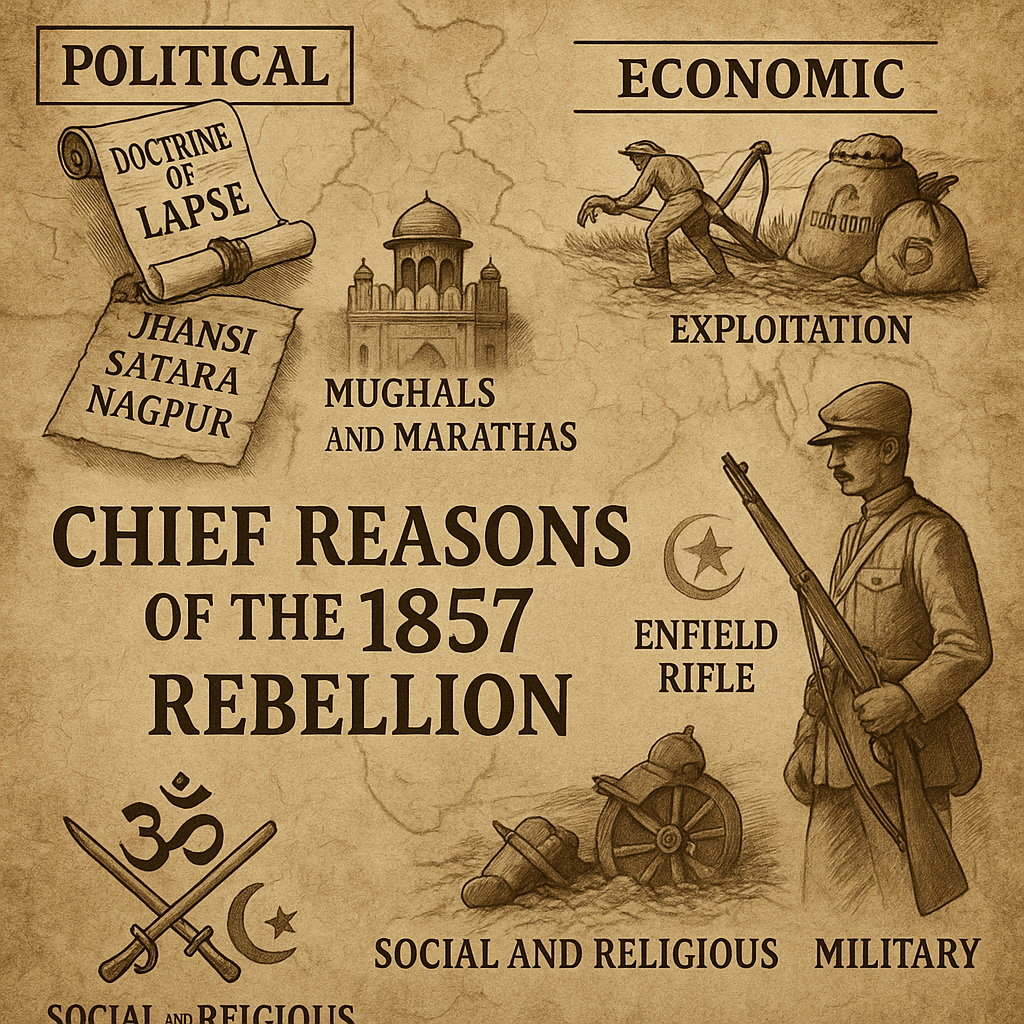
2. Main Causes – The First War of Independence (1857)
The Revolt of 1857 was the result of several deep-rooted causes. It was not merely a military revolt but had political, economic, social, religious, and military reasons behind it.
(i) Political Causes
- Doctrine of Lapse
- Humiliation of Indian Rulers
- There was a plan to remove Bahadur Shah Zafar from the Red Fort.
- Nana Sahib was denied recognition as Peshwa and also denied pension.
- Ending the Legacy of Mughal and Maratha Empires
- The British attempted to undermine the prestige of historic Indian dynasties.
(ii) Economic Causes
- Exploitation of Farmers
- High land revenue, cash rent system, and forced collection impoverished farmers.
- Confiscation of Landed Property
- The company seized land from many traditional landlords, causing discontent.
- Destruction of Artisans and Craftsmen
- Indian cottage industries collapsed under British machine-made goods.
- Commercial Exploitation
- India was turned into a supplier of raw materials and a market for British goods.
(iii) Social and Religious Causes
- Perceived Religious Interference
- Reforms like abolition of Sati and widow remarriage were viewed as attacks on religion.
- Activities of Christian Missionaries
- Conversion attempts, Bible teaching pressure, and establishment of churches created insecurity.
- Threat to Caste and Religion
- Forced overseas travel and European lifestyle adoption created fear of losing religious identity.
(iv) Military Causes
- Discrimination Against Indian Soldiers
- British soldiers were given higher status and better salary.
- Indian soldiers received lower wages and minimal promotion opportunities.
- Enfield Rifle Cartridge Issue
- The cartridge had to be bitten open, and rumors spread that it contained cow and pig fat.
- This hurt both Hindu and Muslim religious sentiments.
- Policy of Sending Soldiers Abroad
- Overseas travel was considered against religious beliefs, yet it was made compulsory.
(v) Immediate Cause
- On 29 March 1857, Mangal Pandey fired at a British officer in Barrackpore.
- On 10 May 1857, the open revolt began in Meerut, and soldiers marched towards Delhi.
Conclusion
The Revolt of 1857 was not just a military uprising; it represented the united voice of the Indian people against British exploitation and humiliation.
(i) Political Causes – In Detail
Political causes were among the most decisive triggers of the revolt. The expansionist policies of the East India Company, disrespect towards Indian rulers, and suppression of local authority filled many kings, nawabs, and common people with anger.
1. Doctrine of Lapse (Lord Dalhousie)
- Lord Dalhousie (1848–1856) implemented the policy: “If a ruler had no biological heir, the state would be annexed by the British.”
- This was against Indian tradition where an adopted son was considered a legal heir.
- States annexed under this policy included Jhansi, Satara, Nagpur, Jaitpur, Sambalpur, Udaipur etc.
2. Insult to Old Empires
- Mughal Empire:
- Bahadur Shah Zafar was humiliated.
- He was to be removed from the Red Fort.
- Maratha Empire:
- Nana Sahib was denied pension and the title of Peshwa.
3. Interference in Princely States
- British officials interfered in internal administration, revenue collection, and judicial matters of Indian states.
4. Growing Discontent Against British Rule
- Indian rulers felt their sovereignty was being systematically destroyed.
- People feared that their kingdom would be the next target of annexation.
Conclusion
Political causes united many Indian rulers. Their aim was not complete national freedom but to protect their authority, honour, and heritage from British dominance.
(ii) Economic Causes – In Detail
Economic causes played a crucial role in fuelling the revolt. The East India Company's policies were entirely exploitative, aimed at extracting maximum wealth from India.
1. Exploitation of Farmers
- Heavy land revenue burden.
- Taxes were compulsory even in famine or crop failure.
- Land settlements like Permanent Settlement, Ryotwari, and Mahalwari caused loss of land.
2. Confiscation of Land
- Traditional landlords were evicted for non-payment of revenue.
3. Destruction of Artisans
- Indian artisans were forced to compete with cheap British goods.
4. Control Over Trade and Industry
- India became a raw material supplier and a market for British products.
5. Unequal Economic Development
- All economic benefits went to the British.
Conclusion
British economic policies caused poverty and unemployment across India, contributing to large-scale anger and revolt.
(iii) Social and Religious Causes – In Detail
Social and religious causes were deeply connected with Indian identity, culture, and belief systems.
1. Feelings of Religious Interference
- Reforms like Sati prohibition, widow remarriage etc. were seen as attacks on tradition.
2. Rise of Missionary Activities
- Missionaries attempted conversions through schools and churches.
3. Change in Education System
- Traditional Gurukul and Madrasa systems were replaced by English education.
4. Pressure of Overseas Travel
- Foreign deployment was considered religiously polluting.
5. Cartridges with Animal Fat
- Cartridge controversy hurt Hindu and Muslim sentiments.
6. Social Discrimination
- Indians were treated as inferior in society and employment.
Conclusion
Social and religious fears played a major role in mobilizing Indian masses for the revolt.
(iv) Military Causes – In Detail
The revolt began as a military uprising. Indian sepoys suffered discrimination and humiliation in the British army.
1. Discrimination in the Army
- Lower salary and fewer promotions for Indian soldiers.
2. Ignoring Religious Beliefs
- Compulsory foreign service hurt religious sentiments.
3. Enfield Rifle Controversy
- Cartridges allegedly greased with cow and pig fat hurt religious sentiments of both communities.

Top Amazon Product
Check out this awesome product available on Amazon! Click below to view the latest price, features, and customer reviews.
👉 View on Amazon(Amazon Affiliate Link – Thank you!)
4. Caste-Based Issues
- High-caste soldiers were forced to break caste rules in army camps.
5. Early Signs of Revolt
- Mangal Pandey incident (29 March 1857).
- Meerut uprising (10 May 1857).
Conclusion
Military dissatisfaction played a central role in transforming anger into an armed uprising, leading to the nationwide revolt of 1857.
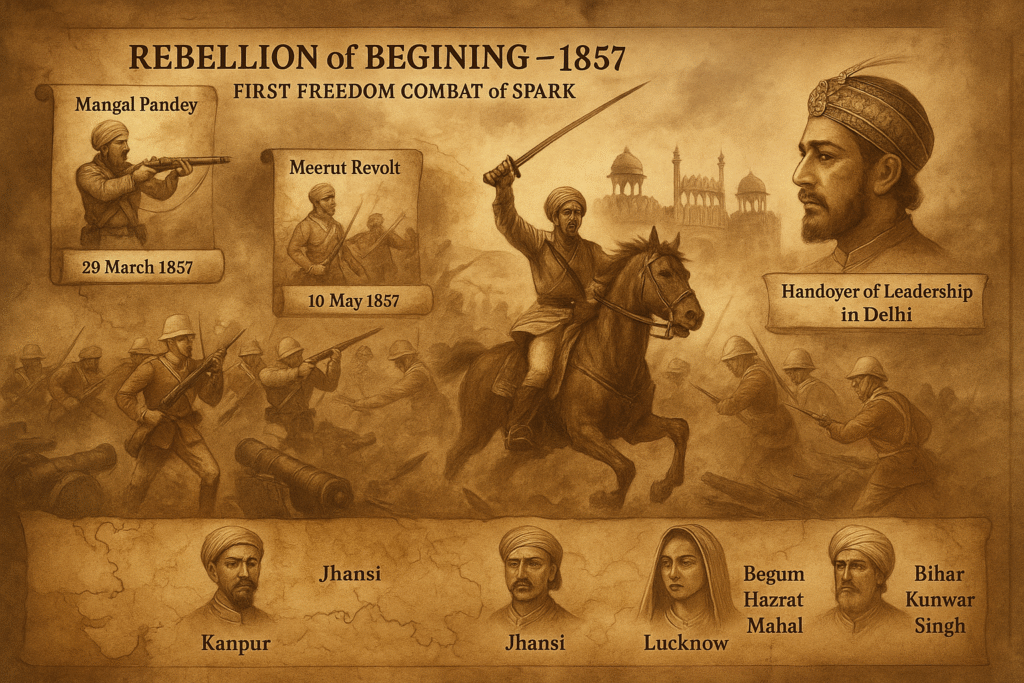
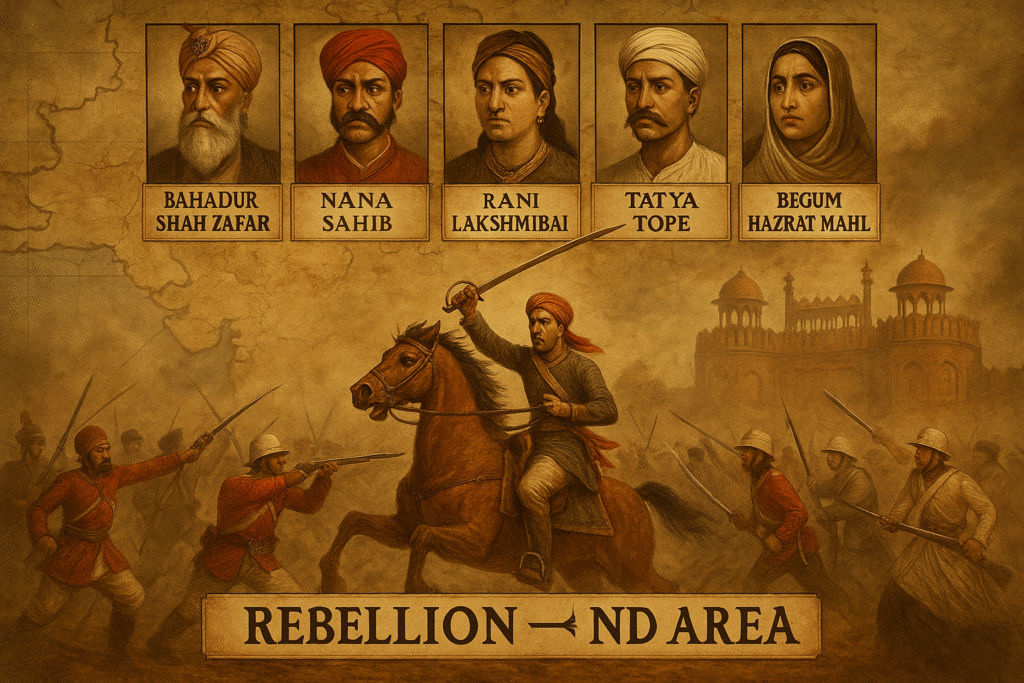
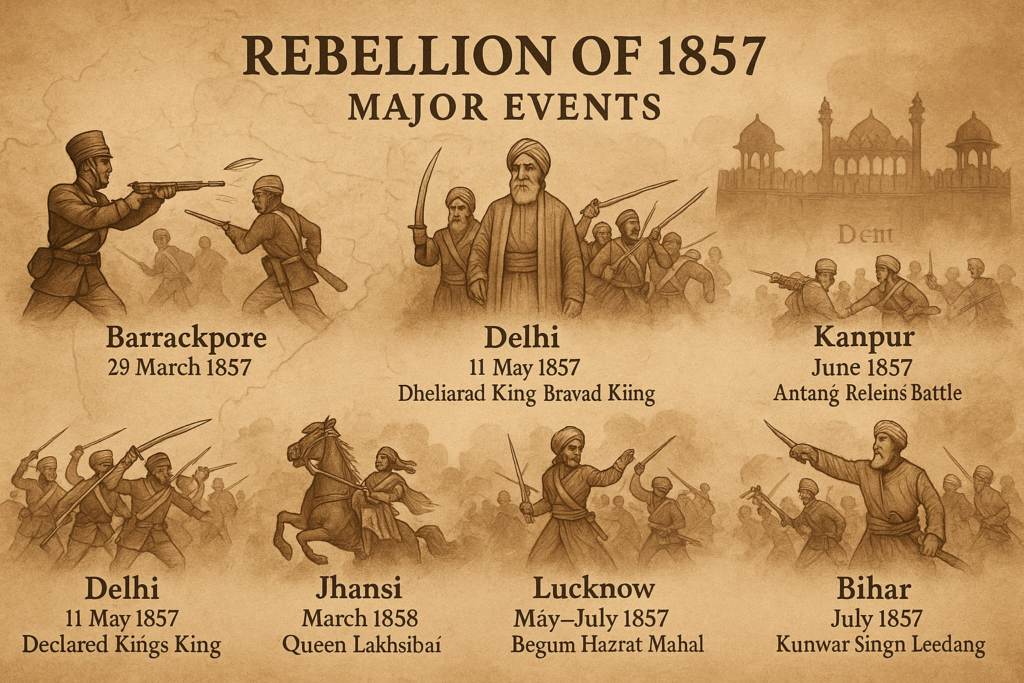
5. Major Events of the Revolt – The First War of Independence (1857)
The 1857 uprising was one of the most decisive events in Indian history. It spread across the country and witnessed several critical incidents that shaped the course and outcome of the struggle.
🔥 Chronological List of Major Events
1. Barrackpore Incident – 29 March 1857
- Mangal Pandey fired at a British officer, marking the beginning of the revolt.
- He was executed, which ignited rebellion across the country.
2. Meerut Rebellion – 10 May 1857
- 85 soldiers were punished for refusing to use greased cartridges.
- The revolt broke out; British officers were killed and prisons were broken open.
- The soldiers marched towards Delhi.
3. Capture of Delhi – 11 May 1857
- The rebel soldiers declared Bahadur Shah Zafar as the Emperor of India.
- Delhi became the main center of the revolt.
4. Kanpur Revolt – June 1857
- Led by Nana Sahib.
- The British surrendered, but were later killed at the Satichaura Ghat massacre.
- Tatya Tope took charge of military operations.
5. Battle of Jhansi – March–April 1858
- Rani Lakshmibai fought against the British to defend Jhansi.
- She fought along with Tatya Tope till Kalpi and Gwalior.
- She attained martyrdom on 17 June 1858.
6. Lucknow Revolt – May to July 1857
- Led by Begum Hazrat Mahal.
- The British Residency was besieged.
- The British were temporarily driven out of Lucknow.
7. Revolt in Bihar – July 1857
- Led by Kunwar Singh.
- Fought bravely in Arrah, Ballia, and Azamgarh.
- Despite old age, he defeated the British in several battles.
8. Revolt in Central India
- Tatya Tope adopted guerrilla warfare.
- Fought in Kalpi, Gwalior, Shivpuri, and nearby areas.
- He was captured and executed in April 1859.
🗓️ Summary Timeline Chart
| Date | Event |
|---|---|
| 29 March 1857 | Mangal Pandey’s Rebellion (Barrackpore) |
| 10 May 1857 | Revolt begins in Meerut |
| 11 May 1857 | Capture of Delhi, Bahadur Shah Zafar declared Emperor |
| June 1857 | Kanpur revolt, killing of British officers |
| March 1858 | Rani Lakshmibai’s battles |
| May–July 1857 | Siege of Lucknow |
| July 1857 | Kunwar Singh’s leadership in Bihar |
| April 1859 | Tatya Tope captured and executed |

Top Amazon Product
Check out this great product on Amazon — quality you can trust! Click below to view the latest price, features, and customer reviews.
👉 View on Amazon(Amazon Affiliate Link – Thank you!)
Conclusion
The Revolt of 1857 was not an isolated incident but a nationwide struggle. Its timeline and intensity varied across regions, yet the common aim was the same — to overthrow British rule. These major events laid the foundation for future freedom movements and awakened national consciousness in India.