
India In Economic Improvement (1991–2025)
Summary: A clear and structured review of India In Economic Improvement since 1991, covering reforms, impact, benefits, challenges, and current status up to 2025.
1. Introduction to India In Economic Improvement
India In Economic Improvement began in 1991 when the country faced a serious balance of payments crisis. The government introduced structural reforms based on liberalisation, privatisation, and globalisation (LPG model). These reforms opened the Indian economy to global markets and reduced excessive state control.
2. Background of India In Economic Improvement
The foundation of India In Economic Improvement was laid during macroeconomic instability in the early 1990s. Key problems included falling foreign exchange reserves, rising fiscal deficit, and slow industrial growth.
- Balance of Payments crisis
- High inflation and fiscal deficit
- Low productivity under licence-permit raj
- Dependence on IMF and World Bank assistance
3. Main Features of India In Economic Improvement
Liberalisation
- Removal of industrial licensing
- Reduction in import tariffs
- Market-determined exchange rate system
- Less government interference
Privatisation
- Disinvestment in public sector enterprises
- Private participation in key sectors
- Efficiency-driven reforms
Globalisation
- Encouragement of Foreign Direct Investment (FDI)
- Integration with WTO and global institutions
- Expansion of exports and global trade
4. Key Areas of Improvement
| Area | Main Improvements |
|---|---|
| Industrial Policy | New Industrial Policy 1991 encouraged competition and private investment. |
| Financial Sector | Banking reforms, entry of private banks, RBI regulatory strengthening. |
| Tax Reforms | Implementation of GST for unified taxation. |
| Infrastructure | Growth in roads, digital connectivity, logistics development. |
5. Benefits of India In Economic Improvement
- Higher GDP growth rates
- Rise in FDI inflows
- Expansion of IT and service sector
- Improved consumer choices
- Better global competitiveness
6. Challenges in India In Economic Improvement
- Urban-rural inequality
- Informal labour issues
- Agricultural distress
- Regional imbalance
- Income inequality concerns
7. India In Economic Improvement: Current Status (2014–2025)
- GST (2017) – Unified indirect tax system
- Make in India – Boost to manufacturing
- Digital India – Digital infrastructure expansion
- PLI Schemes – Manufacturing incentives
- Aatmanirbhar Bharat – Self-reliance focus
Recent years show continued momentum in India In Economic Improvement with emphasis on digital transformation, infrastructure growth, and supply-chain resilience.
8. Conclusion
India In Economic Improvement has transformed the country’s economic structure since 1991. While reforms delivered growth and global integration, future policy must focus on inclusive and sustainable development to ensure balanced progress.
1. Introduction
India’s economic reforms, initiated in 1991, marked a historic turning point. At that time, the country was facing a deep economic crisis—foreign exchange reserves were nearly exhausted, and the Balance of Payments situation had become extremely unstable. In response, the government adopted a three-tier policy of Liberalization, Privatization, and Globalization (LPG).
The purpose of these reforms was to transform the Indian economy from a highly controlled structure into a competitive, open, and market-based system. This shift influenced not only the economic framework but also brought significant social and political impact.
Through this introduction, we aim to understand why economic reforms were needed, what their structure was, and in which direction they pushed India’s economy.
2. Economic Reforms: Background
The economic reforms introduced by India in 1991 were driven by several deep and serious challenges. The economy was going through an intense crisis, forcing the government to take bold and urgent steps.
(i) Heavy Foreign Debt and Balance of Payments Crisis
India’s burden of foreign debt had risen sharply, and foreign exchange reserves had fallen to dangerously low levels. By July 1991, India had barely enough reserves to pay for two weeks of essential imports.
(ii) High Fiscal Deficit
Government expenditure was increasing rapidly while revenue growth was weak. In 1990–91, the fiscal deficit reached 8.4% of GDP, worsening inflation and creating economic instability.
(iii) Licence Raj and Excessive Government Control
From 1947 to 1991, the Indian economy operated largely under the “Licence Raj.” Setting up, expanding, or even operating industries required multiple government clearances. This excessive control slowed the growth of the private sector and restricted innovation.
(iv) Global Pressure and Role of IMF & World Bank
In 1991, India sought financial assistance from the IMF and World Bank. In return, these institutions recommended structural reforms and liberalisation measures. This compelled the government to redesign its economic policies.
(v) Rise in Oil Prices and Gulf War Impact
The Gulf War (1990–91) led to a sharp rise in crude oil prices, which significantly increased India’s import bill. This deepened the foreign exchange crisis further.
(vi) Declining Economic Growth
Towards the end of the 1980s, India's growth rate began to slow down. Industrial and agricultural progress stagnated, unemployment rose, and poverty-related concerns worsened.
All these reasons combined forced the government to acknowledge that the old, restrictive policy framework could no longer support the nation’s progress.
In this situation, under the leadership of Prime Minister P.V. Narasimha Rao and Finance Minister Dr. Manmohan Singh, the New Economic Policy (NEP) 1991 was implemented—creating a historic transformation in India’s economic journey.
3. economic reforms: Main Features
The economic reforms introduced in India since 1991 aimed to reduce excessive government control, strengthen market forces, and integrate India with the global economy. These reforms are popularly known as the LPG Policy, i.e., Liberalisation, Privatisation, and Globalisation.
Below is a detailed explanation of these three major components:
(i) Liberalisation
Liberalisation refers to removing unnecessary controls, restrictions, and regulations imposed by the government so that the private sector can operate with more freedom.
Main Steps:
- Abolition of the industrial licensing system (except for a few sensitive industries).
- Relaxation in the Foreign Exchange Regulation Act (FERA).
- Interest rates made market-determined instead of government-regulated.
- Ending price controls on many commodities.
- Reforms in the banking and insurance sectors.
Detailed Key Aspects
1. Liberalisation in the Industrial Sector
- Industrial licensing removed for all but 18 industries.
- Government permission no longer required for most new industries.
- Regional restrictions removed—private industries could be set up anywhere.
2. Trade Liberalisation
- Simplification of import–export licensing.
- Relaxation in foreign exchange regulations.
- Reduction in import duties.
- Establishment of Export Processing Zones (EPZs).
3. Financial Sector Liberalisation
- Interest rates became market-based.
- Permission given to private and foreign banks to operate in India.
- Greater autonomy granted to the Reserve Bank of India (RBI).
- Higher transparency introduced in the stock and capital markets.
4. Relaxation in Price Controls
- Prices of many goods (e.g., petroleum products, fertilizers, steel) became market-driven.
- Government subsidies gradually reduced.
5. Growth in Technology & Service Sector
- Opening of IT, telecommunications, and insurance sectors for private companies.
- Issuing licences to private telecom companies.
Benefits of Liberalisation:
- Higher industrial growth rate.
- Improved investment climate.
- Entry of foreign companies and technology transfer.
- More competition and greater choice for consumers.
Challenges:
- Uneven development—major benefits concentrated in big cities.
- Risk of monopoly by large private firms.
- Weaker social security for vulnerable groups.
Conclusion: Liberalisation opened India’s closed economy to the global market, accelerating growth and creating new opportunities, though social and regional imbalances also emerged.
(ii) Privatisation
Privatisation means transferring ownership or management of government-run industries, services, or institutions to the private sector, or allowing private investment in these areas. The goal is to improve efficiency, reduce government burden, and promote competition.
Main Objectives of Privatisation:
- Improve efficiency and accountability of public enterprises.
- Reduce financial burden on the government.
- Increase competition.
- Benefit from private-sector innovation and efficiency.
Key Measures:
1. Disinvestment
- Selling government equity in public sector companies.
- Examples: BPCL, Air India, Maruti Udyog, VSNL.
- Creation of the Department of Disinvestment (now DIPAM).
2. Reduction of Government Control
- Private companies allowed in sectors such as telecom, aviation, power, insurance, and banking.
- Example: Earlier telecom was limited to BSNL/MTNL; later private firms like Airtel and Jio entered.
3. Public-Private Partnership (PPP)
- Adoption of PPP models in infrastructure, transport, education, and healthcare.
- Government and private companies jointly contribute.
4. Shutdown or Sale of Loss-Making PSUs
- Loss-incurring public sector enterprises were closed or sold.
- Helped reduce unnecessary government expenditure.
Benefits of Privatisation:
- Higher efficiency and productivity.
- Better services for consumers.
- Boost in innovation due to competition.
- Government can focus more on welfare functions.
- Increase in foreign investment.
Challenges & Criticism:
- Fear of job insecurity and layoffs.
- Concerns about exploitation in essential services.
- Debate regarding selling national assets at low prices.
- Threat of monopolies by large corporates.
- Ethical concerns in sectors like education and healthcare.
Conclusion: Privatisation improved service quality, efficiency, and competition but must be balanced with social justice, employment security, and protection of public interest.
(iii) Globalisation
Globalisation means integrating a country’s economy, culture, capital, trade, and information systems with the rest of the world. Under the 1991 reforms, India opened its economy to global markets, leading to increased foreign investment, technology adoption, and international trade.
Main Objectives of Globalisation:
- Attract foreign capital and technology.
- Make Indian industries competitive globally.
- Promote exports.
- Reduce barriers to international business.
- Participate in global innovation and development.
Key Steps:
1. Expansion of Foreign Direct Investment (FDI)
- Many sectors opened for up to 100% FDI (e.g., automobiles, telecom, insurance, retail).
- Access to global technology and capital.
- India became an attractive destination for investors.
2. Trade Reforms
- Reduction of import duties and removal of quotas.
- Establishment of Export Processing Zones.
- Tax incentives and facilities for exporters.
- Campaigns like “Make in India” boosted global demand.
3. Integration with global institutions
- India joined the World Trade Organization (WTO) in 1995.
- Adopted global trade norms.
- Followed structural reform guidelines from IMF and World Bank.
4. Entry of Multinational Companies (MNCs)
- Foreign companies began manufacturing and investing in India.
- Consumers gained access to global brands and better products.
- Modern management practices and technology entered India.
5. Growth in Communication & IT
- Expansion of internet, mobile, and digital services.
- India became a global hub for IT and BPO services.
Benefits of Globalisation:
- Increase in foreign investment and capital flow.
- New employment opportunities, especially in IT and services.
- Access to global technology and innovation.
- More choices and better quality for consumers.
- Indian companies like Tata, Infosys, and Reliance expanded globally.
Challenges & Negative Effects:
- Threat to local industries due to foreign competition.
- Cultural influence of Western lifestyles.
- Uneven development—urban areas benefited more.
- Increased dependency on foreign companies.
- Environmental pressure due to rapid industrialisation.
Conclusion: Globalisation transformed India from a closed economy into a competitive player on the world stage. While growth accelerated, it is essential to ensure that globalisation is inclusive, balanced, and sustainable for all sections of society.
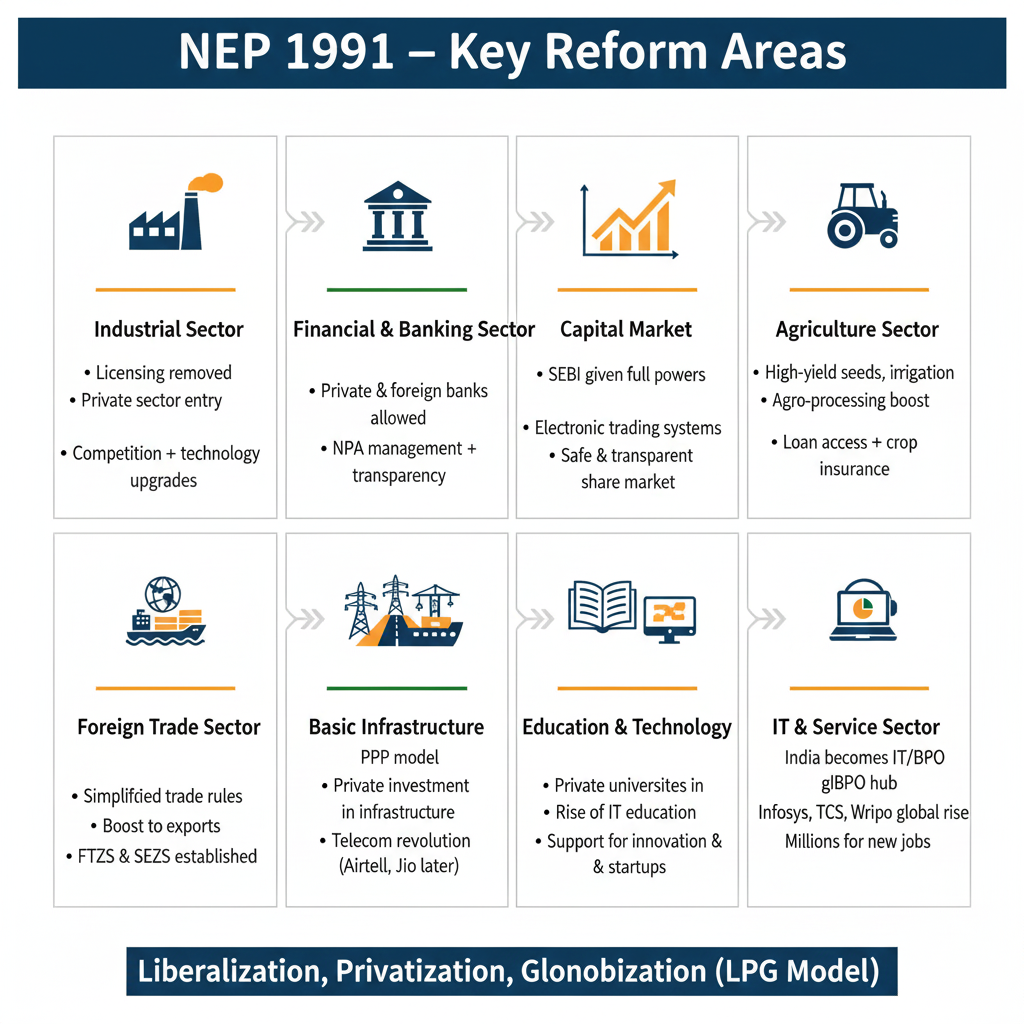
4. Chief Areas of Improvement
Under the New Economic Policy of 1991, the Government of India introduced comprehensive reforms in various sectors to accelerate economic growth. The objective was to enhance efficiency, attract investment, promote competition, and align the economic system with global standards.
Below is a detailed description of the major areas where reforms were implemented:
(i) Improvements in the Industrial Sector
- Relaxation of industrial licensing; most industries no longer required licences.
- Private sector allowed entry into previously restricted sectors.
- Reduction in government control led to increased investment and production.
- Improved product quality due to competition and technological upgrades.
(ii) Improvements in the Financial and Banking Sector
- Interest rates made market-based instead of government-regulated.
- Permission granted to private and foreign banks to operate in India.
- Reforms introduced to reduce and manage Non-Performing Assets (NPAs).
- Amendments to the Banking Regulation Act increased transparency and accountability.
(iii) Improvements in the Capital Market
- SEBI (Securities and Exchange Board of India) was given more regulatory powers.
- Share markets made more transparent, regulated, and safe for investors.
- Electronic trading systems were introduced, increasing investor convenience.
(iv) Improvements in the Agriculture Sector
- Promotion of advanced seeds, fertilizers, irrigation technologies, and mechanization.
- Subsidies and facilities introduced to encourage agricultural exports.
- Boost to agro-processing and industries linked to agriculture.
- Improved loan access and crop insurance schemes for farmers.
(v) Improvements in the Foreign Trade Sector
- Simplification and transparency in import–export licensing systems.
- A shift in foreign trade policy to boost exports.
- Establishment of Free Trade Zones (FTZs) and Special Economic Zones (SEZs).
(vi) Improvements in Basic Infrastructure
- Encouragement of private investment in roads, railways, ports, power, and telecommunications.
- Promotion of Public-Private Partnership (PPP) models.
- Revolution in telecom and internet services with the entry of brands like Jio and Airtel.
(vii) Improvements in Education and Technology
- Recognition and expansion of private universities and institutions.
- Boost to IT and computer education.
- Support for technology startups and innovation.
(viii) Improvements in the IT and Service Sector
- India emerged as a global leader in IT and BPO services.
- Companies like Infosys, TCS, and Wipro gained significant international recognition.
- Creation of millions of employment opportunities.
Conclusion: Reforms across these sectors not only accelerated India’s economic growth but also strengthened its global position. However, ensuring that the benefits of these reforms reach all sections of society remains an ongoing challenge.
5. Benefits of economic reforms
Since the introduction of liberalisation, privatisation, and globalisation in 1991, India has witnessed numerous positive transformations. These reforms helped the economy transition toward a faster-growing, more competitive structure.
1. Higher Economic Growth Rate
- India’s GDP growth rate increased significantly after the reforms.
- While growth in the 1980s was around 3–4%, post-reform growth reached 6–8%.
2. Increase in Foreign Investment (FDI & FII)
- Liberalisation and globalisation attracted large foreign investments.
- This brought capital, technology, and new job opportunities.
3. Expansion of the Private Sector
- As the role of the public sector reduced, private companies expanded rapidly.
- Brands like Tata, Reliance, Infosys, and Wipro became globally recognised.
4. Rapid Growth in the Services Sector
- Major growth in IT, telecom, banking, tourism, and other services.
- The services sector now contributes more than 50% to India’s GDP.
5. New Employment Opportunities
- Millions of jobs created in IT, BPO, retail, telecom, and other sectors.
- Both rural and urban employment options increased.
6. Benefits to Consumers
- Greater competition made goods and services more affordable and higher in quality.
- Consumers gained access to a wider variety of brands and products.
7. Growth in Technology and Managerial Efficiency
- Entry of foreign companies brought new technologies and modern management practices.
- Improved productivity and quality across industries.
8. Strengthening India’s Position in the Global Market
- Indian companies began competing globally.
- Exports increased, especially in services and IT.
9. Improvement in Infrastructure
- Investments in roads, airports, power, ports, and logistics increased through PPP models.
- Enhanced availability of basic facilities.
10. Boost to Entrepreneurship
- Removal of licence requirements and simplified policies encouraged startups.
- Today, India has emerged as a major global startup hub.
Conclusion: Economic reforms transformed India into a more self-reliant, competitive, and globally connected economy. They not only accelerated economic growth but also improved social development and living standards across the country.
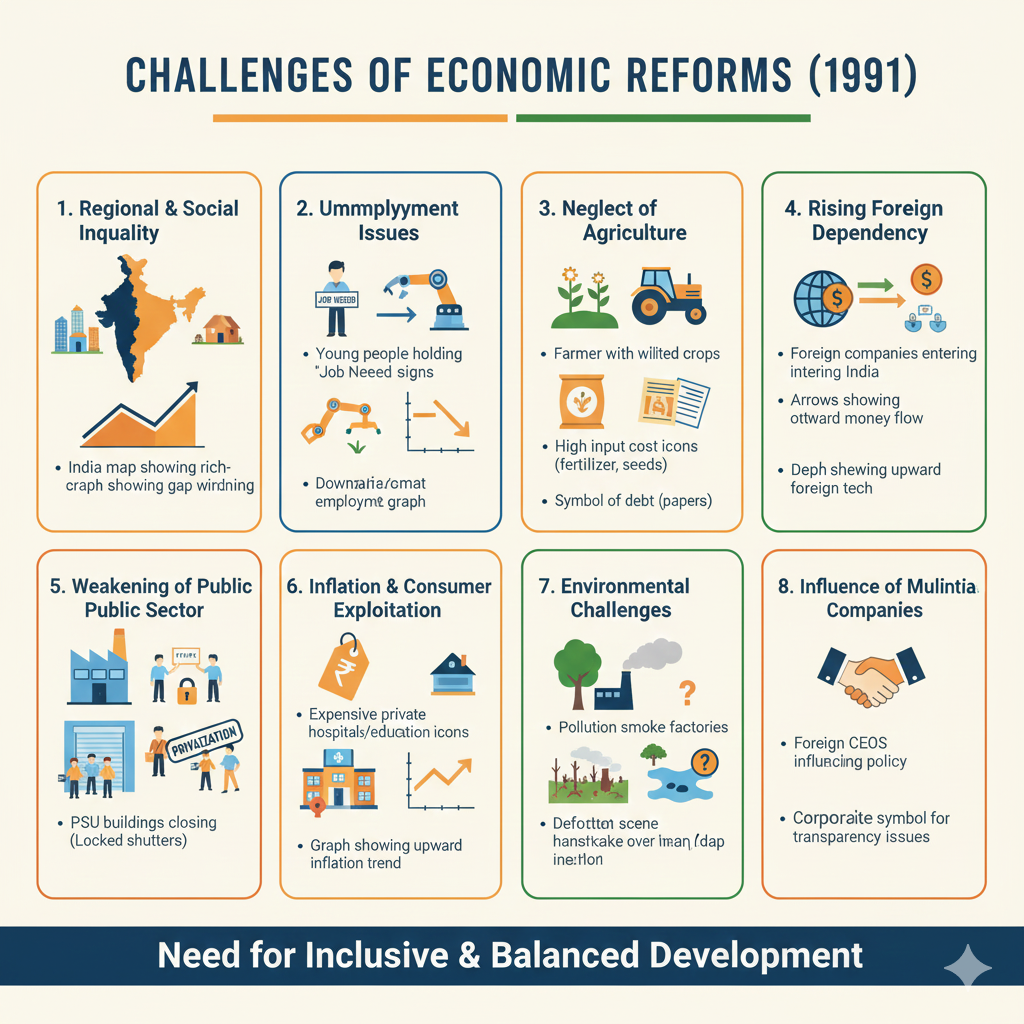
6. Challenges in India In Economic Improvement
While India In Economic Improvement gained momentum after the 1991 reforms, it also brought several structural challenges and inequalities. Some sections benefited significantly, while others lagged behind. Therefore, it is important to evaluate both the limitations and side effects of these reforms.
1. Regional and Social Inequality
- Most economic benefits were concentrated in urban and wealthy areas.
- Rural, backward, and tribal regions did not receive expected benefits.
- Lower and middle-income groups continued to face long-standing problems.
2. Unemployment Issues
- Despite reforms, employment generation was slow, especially in the organised sector.
- Technology-based industries reduced the need for manual labour.
- Youth unemployment became a major concern.
3. Neglect of the Agriculture Sector
- economic reforms focused mainly on industrial and service sectors.
- Agriculture growth remained limited, affecting farmer incomes.
- Issues such as debt, rising input costs, and farmer distress increased.
4. Rising Foreign Dependency
- Globalisation increased dependence on foreign capital, technology, and companies.
- This raised concerns about long-term economic sovereignty.
5. Weakening of the Public Sector
- Privatisation led to closure or sale of several public sector undertakings.
- Job security reduced, affecting social welfare.
- Some sectors faced risks of private monopolies.
6. inflation and Consumer Exploitation
- In some cases, companies charged excessively in the name of competition.
- Privatisation in key sectors (education, health, transport) increased prices.
- This made essential services less affordable for low-income groups.
7. Environmental Challenges
- Industrialisation and urbanisation increased pollution and deforestation.
- Environmental protection was often neglected in the race for development.
8. Influence of Multinational Companies
- In some sectors, foreign companies began influencing domestic policies.
- This raised concerns about transparency and democratic decision-making.
Conclusion: Although India In Economic Improvement modernised the nation’s economy, it also resulted in inequalities, unemployment concerns, agricultural stress, and environmental pressures. Balanced and inclusive policies are essential to ensure long-term sustainable development.
7. India In Economic Improvement: Current Status (2014–2025)
After 2014, the Government of India accelerated structural reforms to strengthen India In Economic Improvement and build a self-reliant, globally competitive economy. These reforms significantly improved business policies, investment climate, digital infrastructure, and labour regulations.
(i) Implementation of Goods and Services Tax (GST)
- GST was implemented in 2017, creating a unified indirect tax system.
- Earlier, multiple state and central taxes complicated trade and increased costs.
- GST transformed India into a single national market.
(ii) Digitalisation and the Digital India Campaign
- Promotion of e-governance, digital payments, and online services.
- UPI and digital platforms boosted cashless transactions.
- Technology access expanded to small businesses and rural areas.
(iii) Labour Reforms
- Multiple labour laws consolidated into Labour Codes (2020).
- Simplified compliance procedures to attract investment.
- Focus on worker safety and industrial flexibility.
(iv) Make in India Initiative
- Strengthened manufacturing capacity.
- Encouraged domestic and foreign investment.
- Growth in electronics, defence, and automobile sectors.
(v) Startup India and Innovation Support
- Tax benefits and financial assistance for startups.
- Promotion of research and innovation ecosystem.
- India emerged as a major startup hub globally.
(vi) Infrastructure Development
- Rapid expansion of highways, railways, and airports.
- Smart City initiatives launched.
- Growth in renewable and clean energy sectors.
(vii) Liberalisation of Foreign Investment
- Higher FDI limits in defence, retail, and media.
- Improved ease of doing business rankings.
(viii) Agriculture Reform Attempts
- Efforts to modernise agricultural marketing.
- Focus on technology adoption and market access.
Conclusion: Between 2014 and 2025, India In Economic Improvement entered a new phase driven by tax reforms, digital transformation, manufacturing incentives, and infrastructure expansion. Continued policy balance is required to ensure equitable growth.
8. Final Conclusion on India In Economic Improvement
The reforms initiated in 1991 reshaped the trajectory of India In Economic Improvement and positioned the country on the global economic stage. Liberalisation, privatisation, and global integration accelerated growth and investment.
However, long-term success depends on addressing inequality, unemployment, agricultural sustainability, and environmental protection. Inclusive and balanced strategies will determine the future strength of India In Economic Improvement.
With sustained reforms and responsible governance, India can strengthen its position as a major global economic power.
Frequently Asked Questions (FAQs)
1. What are India's economic reforms?
India's economic reforms refer to the structural changes introduced in 1991 under the New Economic Policy (NEP). These reforms were based on Liberalisation, Privatisation, and Globalisation (LPG) to modernize the economy, encourage private investment, and integrate India with the global market.
2. Why were economic reforms introduced in India in 1991?
Economic reforms were introduced due to a severe Balance of Payments (BoP) crisis, high fiscal deficit, low foreign exchange reserves, rising inflation, and the inefficiencies of the Licence Raj system. These challenges made structural reforms necessary.
3. What are the three pillars of the LPG reforms?
The three pillars of the LPG reforms are Liberalisation (reducing government controls), Privatisation (increasing private sector participation), and Globalisation (integrating India's economy with global markets).
4. What are the major benefits of India's economic reforms?
The reforms led to higher GDP growth, increased foreign direct investment (FDI), rapid expansion of the IT and service sectors, improved infrastructure, greater consumer choice, higher exports, and enhanced global competitiveness.
5. What are the major challenges of India's economic reforms?
Major challenges include income and regional inequality, unemployment, agricultural distress, environmental concerns, urban-rural disparities, and increased dependence on global markets and foreign investment.
6. How have economic reforms transformed India since 2014?
Since 2014, reforms such as GST, Digital India, Make in India, Startup India, Production Linked Incentive (PLI) Schemes, infrastructure expansion, and Aatmanirbhar Bharat have accelerated economic modernization and improved the ease of doing business.
7. Why are India's economic reforms important for UPSC preparation?
Economic reforms are an important UPSC topic because they cover the New Economic Policy (1991), LPG reforms, macroeconomic development, public policy, economic growth, globalization, and contemporary government initiatives that frequently appear in the examination.
References
- Government of India Reports on economic reforms (1991–2025)
- Reserve Bank of India (RBI) Publications and Annual Reports
- Economic Survey of India – Various Years
- Ministry of Finance – New Economic Policy (1991)
- World Bank & IMF Data on India’s Economic Growth
- NITI Aayog Research Papers & Policy Notes
- WTO Reports on India’s Global Trade Participation