
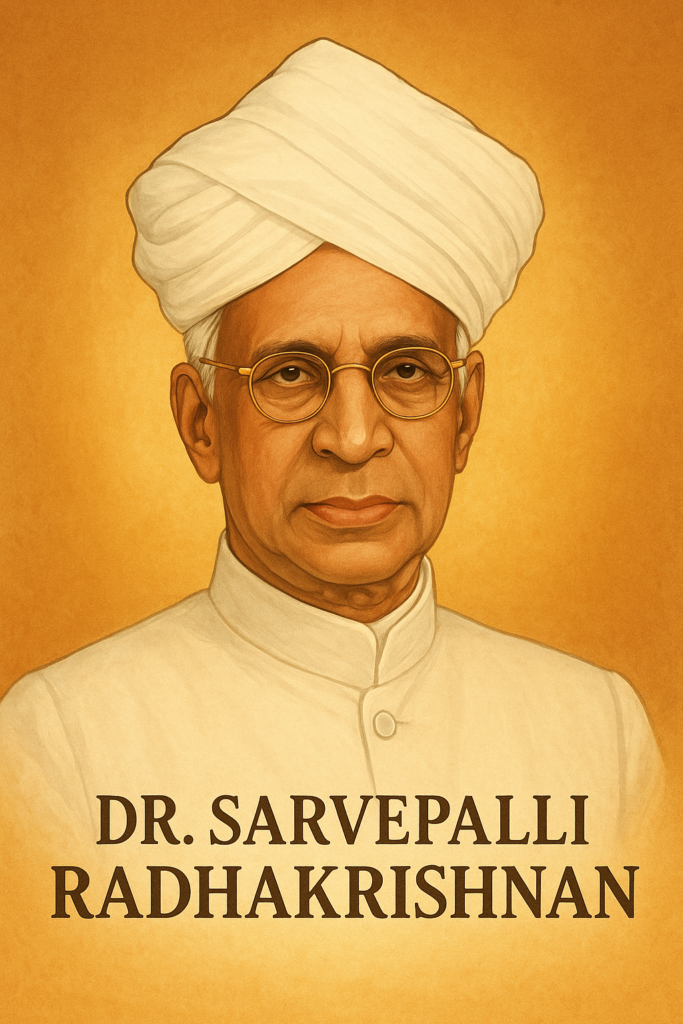
What makes a teacher truly महान? The answer lies in the life of Dr Sarvepalli Radhakrishnan — a philosopher, teacher, and India’s President.
His birthday is celebrated as Teacher’s Day, but his legacy goes far beyond that.
In this article, discover his inspiring journey, philosophy, and why he is still relevant today.
Biography of Dr. Sarvepalli Radhakrishnan
Dr. Sarvepalli Radhakrishnan — philosopher, teacher and statesman. Born 5 September 1888, Tiruttani. Died 17 April 1975, Chennai.
Dr. Sarvepalli Radhakrishnan was a distinguished Indian philosopher, teacher and politician whose life and work left a lasting impact on education, Indian philosophy and public life. He served as the first Vice President of India and later as the second President of India. Below is a detailed and inspiring account of his life, thoughts and legacy.
🛒 Buy Now on AmazonEarly life and education
Birth and family background
Date of birth: 5 September 1888
Place of birth: Tiruttani, Madras Presidency (now in Tamil Nadu)
Parents: Sarvepalli Veeraswami (father) and Seetamma (mother)
Dr. Radhakrishnan was born into a Telugu-speaking Brahmin family. Though the family was not financially affluent, they valued religion and education highly. His father worked as a government measurer of land. Early exposure to religious centres such as Tiruttani and Tirupati influenced his spiritual and philosophical outlook.
Childhood and schooling
Radhakrishnan's childhood was marked by simplicity, a calm temperament and a thirst for knowledge. His early schooling took place in Tiruttani and Tirupati. Later he attended the Hermannsburg Evangelical Lutheran Mission School in Vellore.
Higher education and early hardship
He completed his graduation and post-graduation in philosophy at Madras Christian College, Chennai. He chose philosophy after being introduced to philosophical books by a relative. He earned his Bachelor’s degree in 1906 and his Master’s degree in 1908. During his studies he often borrowed books because of limited finances, yet he consistently secured top marks.
Teaching and philosophical life
Dr. Radhakrishnan was celebrated as an exceptional teacher and a profound scholar of Indian philosophy, particularly Vedanta. His teaching style, scholarship and clarity of thought made him widely respected both in India and abroad.
Academic roles and international influence
He represented Indian thought at Presidency College, Madras, and later taught at Oxford University. Through lectures, books and translations, he introduced the Western world to Indian philosophical traditions, especially Advaita Vedanta.
Major works
- The Philosophy of Rabindranath Tagore
- Indian Philosophy (in two parts)
- The Principal Upanishads
- Eastern Religions and Western Thought
Radhakrishnan believed that religion and philosophy should be applied practically in life and that ethical education was central to individual and social growth.
Political life and public service
Vice President and President
First Vice President of India: 1952–1962
Second President of India: 1962–1967
Even during his political career, Dr. Radhakrishnan remained committed to education and moral values. He was widely regarded as a leader of integrity, moral stature and inspirational vision.
Respect for teachers & legacy
When his students and friends asked for permission to celebrate his birthday on 5 September, Dr. Radhakrishnan replied:
“If you want to celebrate my birthday, celebrate it as Teacher’s Day.”
Since that suggestion, India celebrates 5 September as Teacher’s Day, a tribute to the teaching profession and to the values he embodied.
Honours and international work
- Bharat Ratna: Awarded India’s highest civilian honour in 1954.
- Knight Bachelor: He had received this British title earlier (which he gave up after India’s independence).
- UNESCO: Associated with international educational and cultural work, contributing to global understanding of Indian thought.
Family and personal life
Radhakrishnan married Sivakamu Ammal in 1904 when he was sixteen. The couple had five daughters and one son. Their son, Dr. Sarvepalli Gopal, went on to become a noted historian.
Death
Date of death: 17 April 1975
Place of death: Chennai (then Madras)
Conclusion
Dr. Sarvepalli Radhakrishnan was more than a teacher — he was a living example of Indian culture, spirituality and intellectual depth. His emphasis on moral education, clarity of thought and respectful public service continues to inspire students, teachers and citizens. His life shows that determination, humility and dedication to learning can lead to extraordinary achievement.
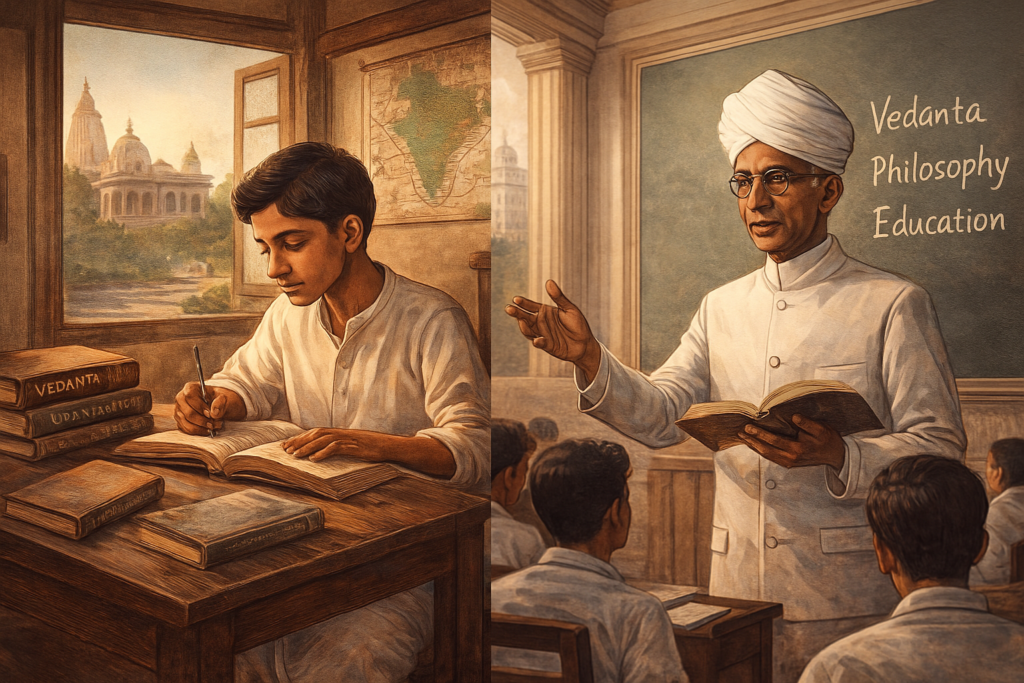
Dr. Sarvepalli Radhakrishnan’s Education
Dr. Sarvepalli Radhakrishnan’s life as an educator is extremely inspiring. He achieved remarkable accomplishments in the field of education despite difficult circumstances. His deep passion and curiosity for knowledge shaped his intellectual development and later helped him become a great teacher, philosopher, and national leader.
Elementary Education
Primary Education
- Received primary education at local schools in Tiruttani and Tirupati.
- Later studied at the Hermannsburg Evangelical Lutheran Mission School in Vellore.
- He was extremely brilliant in studies and consistently secured high marks.
- From childhood, he was influenced by religious texts and philosophy, especially Vedanta and the Bhagavad Gita.
Secondary and Higher Education
Vijayawada Colleges
- He studied here for some time before moving to Madras.
Madras Christian College (Chennai)
- This phase became the turning point of his education.
- He chose Philosophy as his major subject—by chance—because the books given by a relative contained philosophical writings.
- He obtained his Bachelor’s degree (BA) in 1906 and Master’s degree (MA) in 1908.
- He scored exceptionally well and became one of the best students of the college.
Challenges During Education
- Due to financial limitations, he often borrowed books from friends to study.
- He relied on scholarships and student assistance to complete his education.
- Despite hardships, his determination to learn never weakened.
Inspirational Aspects of His Education
He believed that “True education is not merely the acquisition of information; it is a means of building character and developing the ability to think.”
He studied both Indian and Western philosophy deeply and played a major role in connecting the two schools of thought.
Conclusion
Dr. Sarvepalli Radhakrishnan’s education became the foundation of his personal success. He transformed education into a medium of social service and nation-building. His life teaches us that strong determination can overcome all challenges.
Dr. Sarvepalli Radhakrishnan’s Teaching Career
Dr. Sarvepalli Radhakrishnan’s teaching career is inspiring, influential, and holds a proud place in Indian educational history. He was a remarkable teacher, thinker, and philosopher who saw education as a means of moral and social development.
Beginning of Teaching Career
- In 1909, he began his teaching career as a Lecturer of Philosophy at Madras Presidency College.
- He taught with impressive clarity—his lectures combined logic, knowledge, and emotion.
Major Educational Institutions Where He Worked
Madras Presidency College (1909–1918)
He started his teaching journey here.
Mysore University (1918–1921)
He became Professor of Philosophy and generated deep interest in Indian philosophy among students.
University of Calcutta (1921–1931)
He served as Professor of Philosophy. His lectures were so popular that students came from distant places to attend them.
Oxford University, England
- In 1936, he was appointed as the Professor of “Eastern religions and Ethics.”
- He became the first Indian to hold this prestigious position.
- He represented Indian philosophy and culture with great distinction.
Characteristics of His Teaching Style
- He not only taught but also inspired students to think deeply.
- He believed that “Education is not merely imparting information but a process of thinking and improving life.”
- His teaching was interactive, thoughtful, and inspiring.
His Attitude Towards Teachers
He often said: “A good teacher inspires students to ask questions, think, and make independent decisions.”
When his students wanted to celebrate his birthday, he said:
“Instead of celebrating my birthday, celebrate it as Teacher’s Day.”
Since then, 5 September is celebrated as Teachers’ Day across India.
His Views on Education
- The purpose of education is not just obtaining degrees but building character and preparing responsible citizens.
- He supported the integration of Indian cultural values with Western educational methods.
Conclusion
Dr. Sarvepalli Radhakrishnan’s teaching career was not only about imparting knowledge, but also about shaping national character. Even today, he is remembered as the “Ideal Teacher.”
Dr. Sarvepalli Radhakrishnan’s Philosophical Life
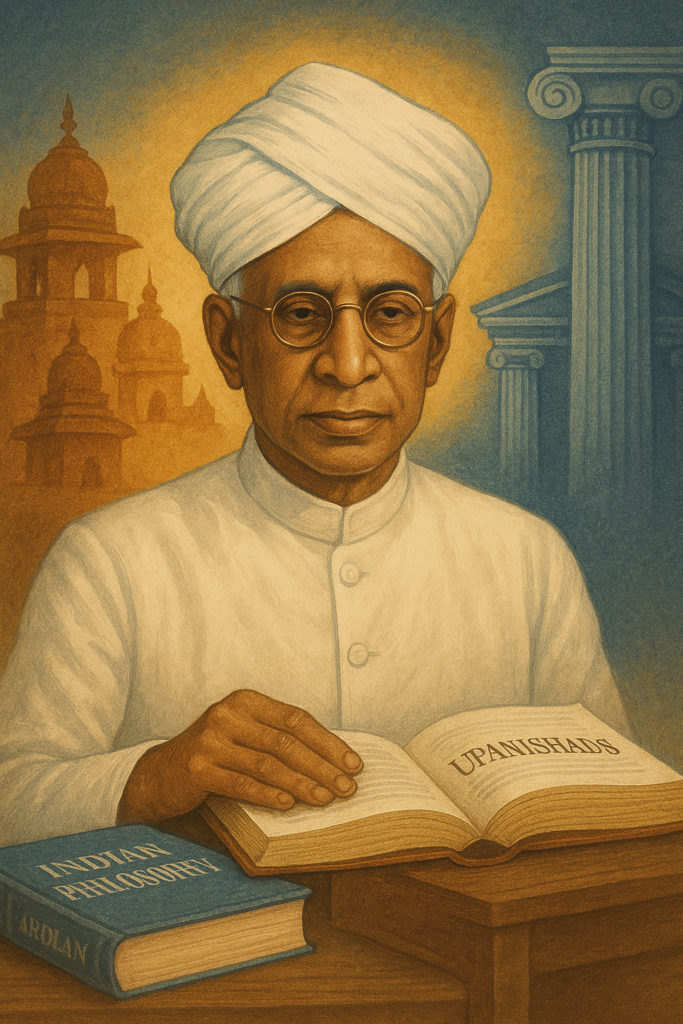
Dr. Sarvepalli Radhakrishnan’s philosophical life was the foundation of his entire personality. He was not only a deep thinker and scholar, but he also elevated Indian philosophy on the world stage. He presented Indian spiritual thought with equal respect as Western ideologies and proved that India’s cultural and intellectual heritage is globally significant.
🛒 Buy Now on AmazonBeginning of Philosophical Life
Radhakrishnan developed an inclination towards philosophy during his student life at Madras Christian College. He studied “Indian Philosophy” extensively and was especially influenced by Advaita Vedanta.
Main Philosophical Ideas
1. Support of Advaita Vedanta
- He was a strong supporter of the Advaita Vedanta propagated by Adi Shankaracharya.
- He believed that “There is no difference between Brahman (Ultimate Truth) and Atman.”
- According to him, the ultimate goal of human life is self-realization and experiencing oneness with the Brahman.
2. religion and Morality
- He considered religion a lived experience rather than a mere ritual tradition.
- He wrote: “Religion is not talking about God, it is experiencing God.”
- He believed in equality, tolerance, and spiritual unity among all religions.
3. Coordination of East and West
- He served as a bridge between Eastern (Indian) and Western (European) philosophy.
- He introduced Indian philosophical ideas to the West and proved that Indian philosophy is rational, practical, and universal.
4. Humanism and Spirituality
- He believed that true education and true philosophy make a human being morally better.
- He taught that spirituality, morality, and human love are the core of real philosophy.
Major Philosophical Works (Books)
- Indian Philosophy (Vol I & II)
- The Philosophy of Rabindranath Tagore
- The Hindu View of Life
- An Idealistic View of Life
- Eastern Religions and Western Thought
- The Principal Upanishads
These works brought Indian philosophy into a modern and global context.
Famous Quotes on Philosophy
- “Knowledge gives us power, love gives us perfection.”
- “A man becomes great only when he starts listening to the voice of his soul.”
- “Knowing the truth is religion; and following it is the purpose of life.”
Philosophical Contributions and Influence
- He showed the world that Indian philosophy offers practical guidance for living a meaningful life.
- He brought philosophy out of academic walls and connected it with life, society, and morality.
- He is remembered as a “Philosopher President” whose ideas had depth and practicality.
Conclusion
Dr. Radhakrishnan’s philosophical life reflected dedication, contemplation, and spirituality. He gave global prestige to Indian philosophy and proved that the power of ideas is the true strength of a nation.
Dr. Sarvepalli Radhakrishnan’s Political Life
Dr. Sarvepalli Radhakrishnan’s political life was an extension of his philosophical and teaching principles. He viewed politics as a means of service and morality, not a pursuit of power. With his scholarship, simplicity, and integrity, he gave a new direction to Indian politics. Although his political career was shorter than his academic and philosophical journey, its impact was profound.
Entry into Politics
He entered active politics after India’s independence. Before taking constitutional roles, he also represented India internationally as a diplomat.
Important Political Roles
1. Representation in UNESCO (1946)
- He served as India’s representative to UNESCO.
- He played a key role in global discussions on education, culture, and humanity.
2. Indian Ambassador to the Soviet Union (1949–1952)
- He strengthened Indo-Soviet relations during a crucial post-independence period.
- This diplomatic role helped India gain recognition in world politics.
3. First Vice President of India (1952–1962)
- He became the first Vice President of India.
- As the Chairman of the Rajya Sabha, he maintained dignity, depth, and discipline in parliamentary debates.
4. Second President of India (1962–1967)
- He succeeded Dr. Rajendra Prasad as President.
- His tenure witnessed major challenges such as:
- India–China War (1962)
- Indo–Pak War (1965)
- He inspired the nation to remain united, patient, and morally strong during crises.
Political Style and Principles
- He lived as a philosopher even in politics—supporting peace, wisdom, and morality.
- He remained above party politics and always prioritized national interest.
- He believed: “There must be morality in politics; otherwise it becomes destructive.”
- He firmly supported education, secularism, and democratic values.
Emphasis on Education and Moral Values
As President, he consistently advocated for strengthening India’s education system. He called teachers the real nation builders and described education as the foundation of national character.
An Inspirational Incident
When his students wanted to celebrate his birthday on 5 September, he said:
“Instead of celebrating my birthday, I would be proud if you celebrate it as Teacher’s Day.”
This is why 5 September is celebrated as Teacher’s Day throughout India.
Conclusion
Dr. Sarvepalli Radhakrishnan upheld morality, simplicity, and national service even at the highest office of the country. He remains a moral ideal in Indian political history.
Frequently Asked Questions (FAQs)
1. Who was Dr. Sarvepalli Radhakrishnan?
Dr. Sarvepalli Radhakrishnan was a renowned Indian philosopher, teacher, educationist, and statesman. He served as the first Vice President of India (1952–1962) and the second President of India (1962–1967).
2. Why is Dr. Sarvepalli Radhakrishnan famous?
He is famous for his outstanding contributions to philosophy, education, and public service. His efforts to promote Indian philosophy worldwide and his lifelong dedication to teaching made him one of India's greatest intellectuals.
3. Why is Teachers' Day celebrated on 5 September in India?
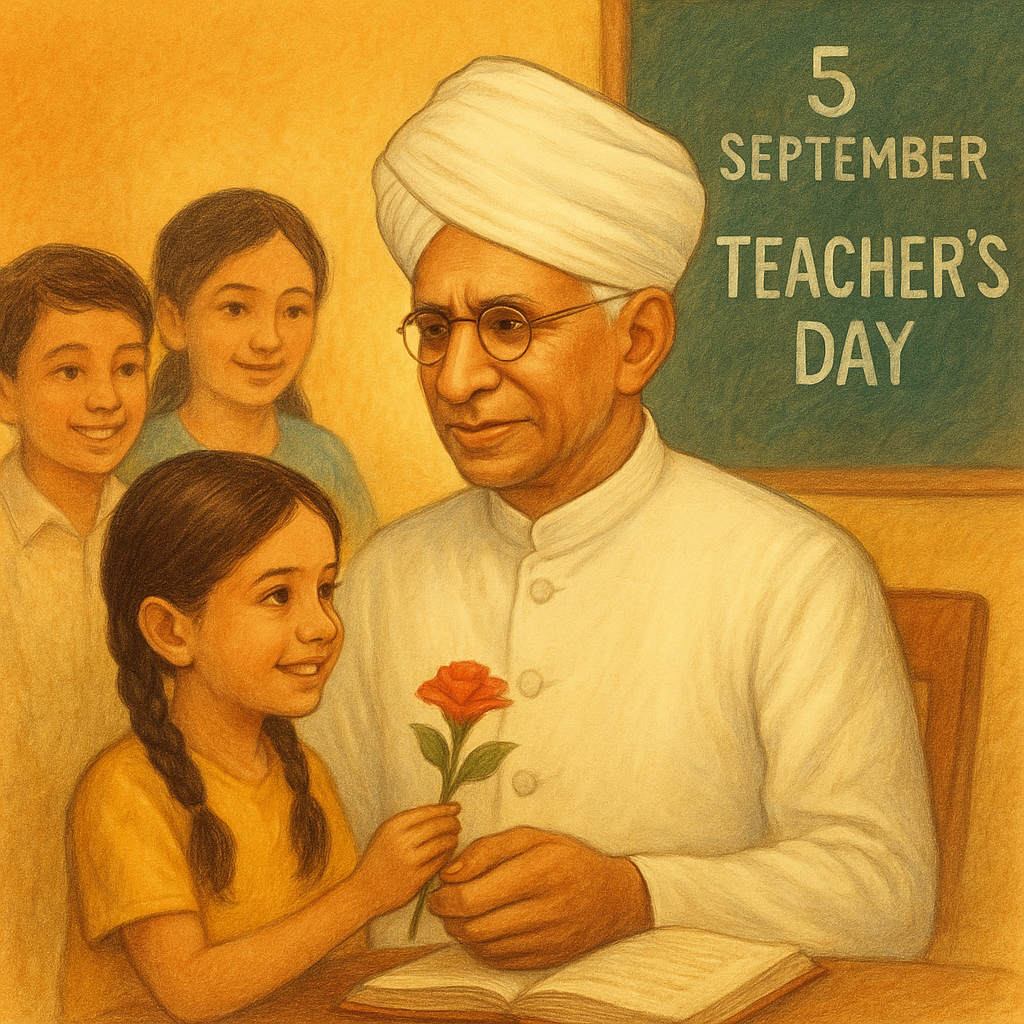
Teachers' Day is celebrated on 5 September to mark the birth anniversary of Dr. Sarvepalli Radhakrishnan. When his students wished to celebrate his birthday, he requested that the day be observed as Teachers' Day to honour all teachers.
4. What were the major philosophical ideas of Dr. Sarvepalli Radhakrishnan?
He promoted Advaita Vedanta, emphasized moral education, religious harmony, spirituality, and believed that education should develop character, wisdom, and independent thinking.
5. Which books were written by Dr. Sarvepalli Radhakrishnan?
His famous works include Indian Philosophy, The Hindu View of Life, An Idealistic View of Life, Eastern Religions and Western Thought, and The Principal Upanishads.
6. Which awards and honours did Dr. Sarvepalli Radhakrishnan receive?
He received the Bharat Ratna in 1954, India's highest civilian honour. He also received numerous honorary doctorates and international recognitions for his contributions to philosophy and education.
7. When did Dr. Sarvepalli Radhakrishnan pass away?
Dr. Sarvepalli Radhakrishnan passed away on 17 April 1975 in Chennai. His legacy continues through Teachers' Day celebrations and his enduring contributions to education and philosophy.
Respect for Teachers
Dr. Sarvepalli Radhakrishnan had immense respect and reverence for teachers. He believed that a teacher is not just a giver of information, but a guide of the nation, a character builder, and a carrier of culture. Throughout his life, he expressed the dignity, role, and importance of teachers not only through words but also through his actions.
🛒 Buy Now on AmazonRespect for Teachers – In His Views
“True teachers are those who inspire us to think, not just to think what they themselves think.”
He saw teachers as motivating forces who create independent thinking in students.
“Teachers are the soul of the nation.”
He believed that the influence of teachers shapes the direction and character of a society.
“The purpose of education is not only to impart knowledge but also to awaken the great qualities hidden within a person, and this work can only be done by a teacher.”
5 September – Beginning of Teachers’ Day
In 1962, when he became the President of India, some students and friends asked to celebrate his birthday (5 September). He humbly replied:
“If you want to celebrate my birthday, celebrate it as Teacher’s Day.”
Since then, every year 5 September is celebrated as Teachers' Day in India, in memory of Dr. Radhakrishnan's deep respect for teachers.
His Contributions Toward Teachers
- He placed the role of teachers at the center of the education system.
- He believed a teacher should not be just a job-holder, but someone who guides society and students.
- He advocated improving the economic, social, and moral conditions of teachers.
Examples of His Respect for Teachers
- Even as President, he considered himself a teacher first and a politician later.
- Every Teachers' Day, he addressed teachers across India, inspiring them.
- Throughout his life, he emphasised giving teachers the respect they truly deserve.
Conclusion
Dr. Sarvepalli Radhakrishnan not only became famous as a great teacher, but through his thoughts and actions, he inspired the entire teaching community. Teachers' Day in India stands as a reminder that a teacher holds the highest position in society.
Honours and Respect
Dr. Sarvepalli Radhakrishnan received many honours in India and around the world for his unique contributions as a philosopher, educationist, and national leader. His life and work elevated education, philosophy, and moral politics, earning him global recognition.
Major Honours and Titles
1. Bharat Ratna (1954)
- India's highest civilian honour.
- Awarded for his exceptional contributions to education and philosophy.
- He became the first educationist to receive this honour.
2. Knighthood (1931)
- The British government conferred upon him the title "Knighthood".
- Title received: Sir Sarvepalli Radhakrishnan
- After independence, he discontinued the use of this title.
3. Honorary Degree from the University of Oxford
- Oxford University awarded him an honorary doctorate for his work in philosophy.
- He also served as Professor of "Eastern Religions and Ethics" at Oxford.
Honours Received from Abroad
- He received honorary degrees and awards from numerous universities, institutes, and international organisations.
- His work at UNESCO and his role in global philosophical dialogue earned him international admiration.
Teachers' Day – A Symbol of Honour
- In recognition of his respect for teachers, 5 September (his birthday) is celebrated in India as Teachers' Day.
- This honour serves as an inspiration and symbol of pride for the entire teaching community.
Institutions and Awards Named After Him
- Many universities and institutions have named academic chairs, buildings, and centres after him.
- The Government of India and various state governments present awards in his name in the fields of education and philosophy.
- Dr. Sarvepalli Radhakrishnan National Teacher Award
- Radhakrishnan Fellowship (Indian Council of Philosophical Research)
Postage Stamps and Commemorative Coins
- The Government of India has issued postage stamps and commemorative coins in his honour.
- These symbols represent him as an ideology and inspiration, not just an individual.
Conclusion
The honours received by Dr. Sarvepalli Radhakrishnan reflect his depth of thought, dedication to education, and ethical living. Even today, he is respected as an ideal and a global source of inspiration.