
India Foreign Policy 2026 has become one of the hottest topics in global geopolitics today.
👉 Is India really on the path to becoming a global superpower?
👉 How is India balancing relations between China and the United States?
👉 What strategy will shape India’s global role in the coming years?
In this article, we will explore India’s Foreign Policy 2026 in depth — covering its strategy, challenges, global relations, and future roadmap.
📌 Table of Contents
What is India’s Foreign Policy?
India’s foreign policy refers to the strategies, principles, and guidelines through which India manages its relations with other countries and international organizations. Its primary goal is to safeguard national interests, ensure security, promote economic growth, and strengthen India’s global position.
history">Historical Background
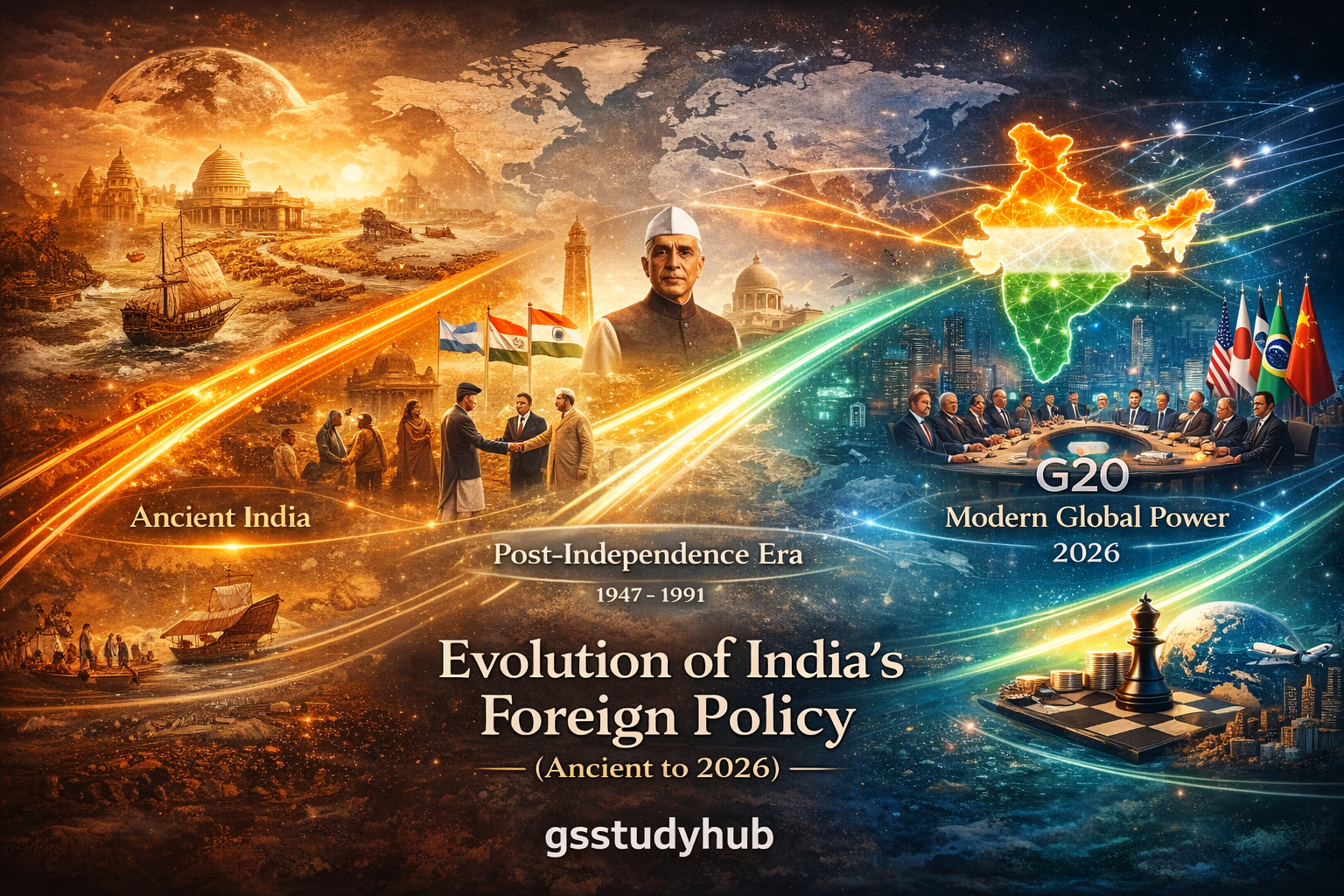
India’s foreign policy has evolved from ancient diplomacy and cultural exchange to a modern, strategic global approach. After independence in 1947, India adopted Non-Alignment and later shifted toward a more pragmatic and multi-dimensional strategy.
India’s Foreign Policy 2026
In 2026, India follows a multi-alignment strategy, balancing relations with global powers like the United States, China, and Russia while maintaining strategic autonomy and protecting national interests.
Key Objectives
- Ensuring national security
- Promoting economic growth
- Enhancing global influence
- Maintaining strategic autonomy
- Strengthening regional relations
Relations with Major Countries
India maintains strategic relations with major global powers including the United States, Russia, China, Japan, and the European Union, focusing on trade, defense, and technology cooperation.
Role in Global Organizations
India plays an active role in organizations such as the United Nations, G20, BRICS, SCO, and WTO, contributing to global governance, economic stability, and peacekeeping.
Challenges
- Border tensions with China
- Relations with Pakistan
- Global geopolitical rivalries
- Economic uncertainty
- energy security concerns
Future of India’s Foreign Policy
India is expected to emerge as a major global power with strong economic growth, technological advancement, and strategic global partnerships.
Conclusion
India’s foreign policy is dynamic, strategic, and future-oriented, positioning the country as a key player in shaping the global order.
Frequently Asked Questions (FAQ)
1. What is India’s Foreign Policy?
It refers to how India manages its international relations to protect national interests.
2. What are the main objectives?
Security, economic growth, and global influence.
3. What are key challenges?
Border disputes, geopolitical tensions, and economic risks.
What is India’s Foreign Policy?
India Foreign Policy 2026 is one of the most important topics in today’s global geopolitics, shaping India’s strategy, security, and global leadership role.
India’s foreign policy refers to the set of strategies, principles, and guidelines through which India manages its relations with other coUNtries and international organizations. Its primary aim is to safeguard national interests, ensure security, promote economic growth, and strengthen India’s position on the global stage.
Through its foreign policy, India engages in diplomatic, economic, strategic, and cultural interactions with other nations. This includes trade agreements, defense cooperation, participation in international forums, and contributions to global issues such as climate change, Terrorism, and peacekeeping.
👉 Want to explore India’s global strategy? Read our detailed guide on India Foreign Policy Explained .
Historically, India’s foreign policy has been guided by principles like Non-Alignment, Panchsheel (Five Principles of Peaceful Coexistence), and peaceful diplomacy. In recent years, India has adopted a more pragmatic and multi-dimensional approach to respond effectively to changing global dynamics.
In simple terms, India’s foreign policy determines how India interacts with the world, protects its national interests, and plays its role in international politics.
history">Historical BackgroUNd of India’s Foreign Policy
India’s foreign policy has evolved through a long historical process, deeply rooted in its ancient civilization, colonial experience, and the freedom struggle. Over time, India has shaped its external relations according to changing global dynamics while maintaining its core principles.
In ancient times, India was known for its extensive trade networks, cultural exchanges, and diplomatic contacts with different regions of the world. The idea of “Vasudhaiva Kutumbakam” (the world is one family) formed the philosophical foundation of India’s worldview, which later influenced its foreign policy approach.
During the colonial period under British rule, India did not have an independent foreign policy, as all international decisions were controlled by the British government. However, this period helped Indian leaders understand global politics and laid the foundation for an independent foreign policy after independence.
After gaining independence in 1947, India began to develop its own foreign policy under the leadership of Jawaharlal Nehru. India adopted the policy of Non-Alignment, aiming to remain independent of major power blocs during the Cold War.
A major milestone in India’s foreign policy was the Panchsheel Agreement (1954), which outlined key principles such as mutual respect for sovereignty, non-aggression, non-interference, equality, and peaceful coexistence.
During the Cold War Period (1947–1991), India maintained a balanced and independent stance, while also supporting global peace, decolonization, and the rights of developing countries.
After 1991 economic liberalization, India’s foreign policy underwent significant changes. The country increased its engagement with the global economy, strengthened relations with Western nations, and introduced the Look East Policy, later evolved into the Act East Policy.
In the 21st century, India’s foreign policy has become more proactive, pragmatic, and multi-dimensional. India has built strong relations with major powers such as the United States, Russia, China, and the European Union, while enhancing its role in global governance.
Overall, the historical evolution of India’s foreign policy reflects a continuous process of adaptation, where India has preserved its core values while responding to modern global challenges and emerging as a significant global power.
India’s Foreign Policy in 2026
In 2026, India’s foreign policy has become more dynamic, pragmatic, and multi-dimensional than ever before. Amid a rapidly changing global environment and increasing geopolitical competition, India is adapting its strategy to safeguard national interests while enhancing its global influence.
The current world order is UNdergoing major transformations, including the U.S.–China rivalry, the Russia–Ukraine conflict, the rising importance of the Indo-Pacific region, and shifting global supply chains. In this complex environment, India follows a policy of strategic autonomy, balancing relations with major global powers.
A key feature of India’s foreign policy in 2026 is multi-alignment — engaging with multiple countries and alliances based on national interests. India works closely with the United States, Japan, and Australia through the QUAD, while also maintaining ties with Russia and China via platforms like BRICS and the Shanghai Cooperation Organisation (SCO).
Under the Neighbourhood First Policy, India is strengthening relations with neighboring countries such as Nepal, Bhutan, Bangladesh, Sri Lanka, and the Maldives. Additionally, through the Act East Policy, India is expanding its economic and strategic engagement with Southeast Asia.
India is also emerging as a strong voice of the Global South, raising key issues like climate change, food security, energy security, and development financing on international platforms.
From a security perspective, India is enhancing its defense partnerships, focusing on border security, and promoting global cooperation against Terrorism. It is also actively engaging in emerging domains such as cybersecurity, space, and maritime security.
Economic diplomacy has become a central pillar of India’s foreign policy. The country is focusing on attracting investments, boosting exports, and collaborating in advanced sectors like artificial intelligence, semiconductors, and green energy.
Despite its growing influence, India faces challenges such as border tensions with China, regional instability, global Economic uncertainty, and energy security concerns. However, India continues to pursue a balanced and forward-looking approach.
In conclusion, India’s foreign policy in 2026 reflects a strong, flexible, and future-oriented strategy, positioning the country as a major global power.
India Foreign Policy 2026: Key Objectives
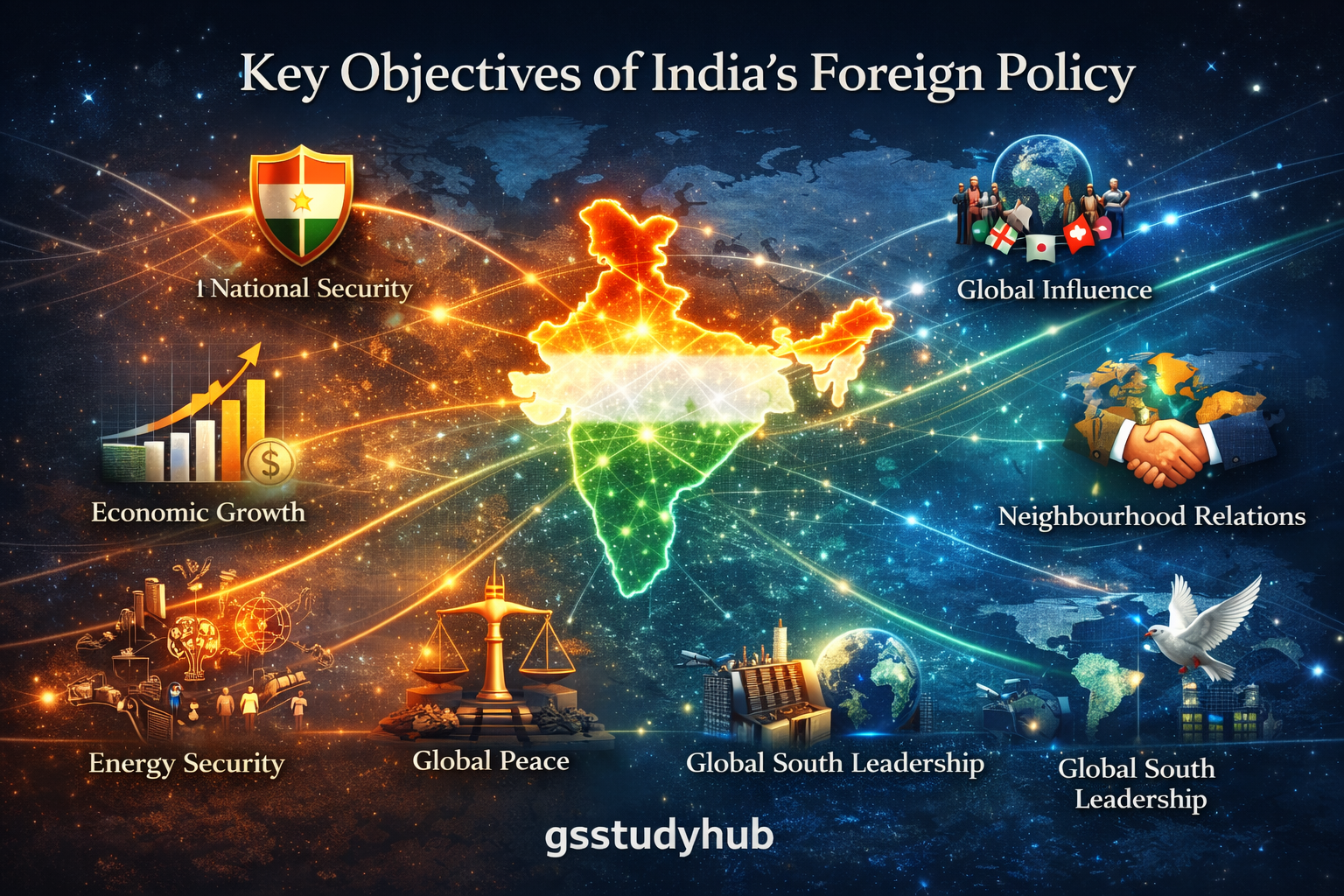
The primary aim of India Foreign Policy 2026 is to protect its national interests and strengthen its position in the global arena. Over time, India has refined its objectives to respond effectively to changing international dynamics and emerging global challenges.
-
Ensuring national security:
India focuses on safeguarding its sovereignty, territorial integrity, and internal security. This includes stable relations with neighbors, peaceful conflict resolution, and cooperation against Terrorism. -
Promoting economic growth:
India aims to boost its economy through global trade, foreign investment, and technological collaboration while increasing exports and attracting capital. -
Enhancing Global Influence:
India seeks a stronger role in global institutions such as the United Nations, G20, and BRICS to influence international decision-making. -
Strengthening Relations with Neighbors:
UNder the Neighbourhood First Policy, India promotes stable and cooperative regional relationships. -
Maintaining Strategic Autonomy:
India follows an independent foreign policy, avoiding alignment with any single power bloc while maintaining flexibility. -
Promoting global peace and Stability:
India supports diplomacy, peaceful coexistence, and conflict resolution through dialogue. -
Ensuring Energy and Resource Security:
India works to secure reliable energy supplies through international partnerships. -
Leading the Global South:
India represents developing nations by addressing issues like climate change, poverty, and sustainable development. -
Expanding Technological and Strategic Cooperation:
India promotes collaboration in advanced sectors such as defense, innovation, and emerging technologies.
In conclusion, these objectives guide India’s foreign policy toward becoming a secure, prosperous, and influential global power.
India’s Relations with Major CoUNtries
👉 Learn more about India’s global partnerships in our analysis of India–US Strategic Partnership 2026 .
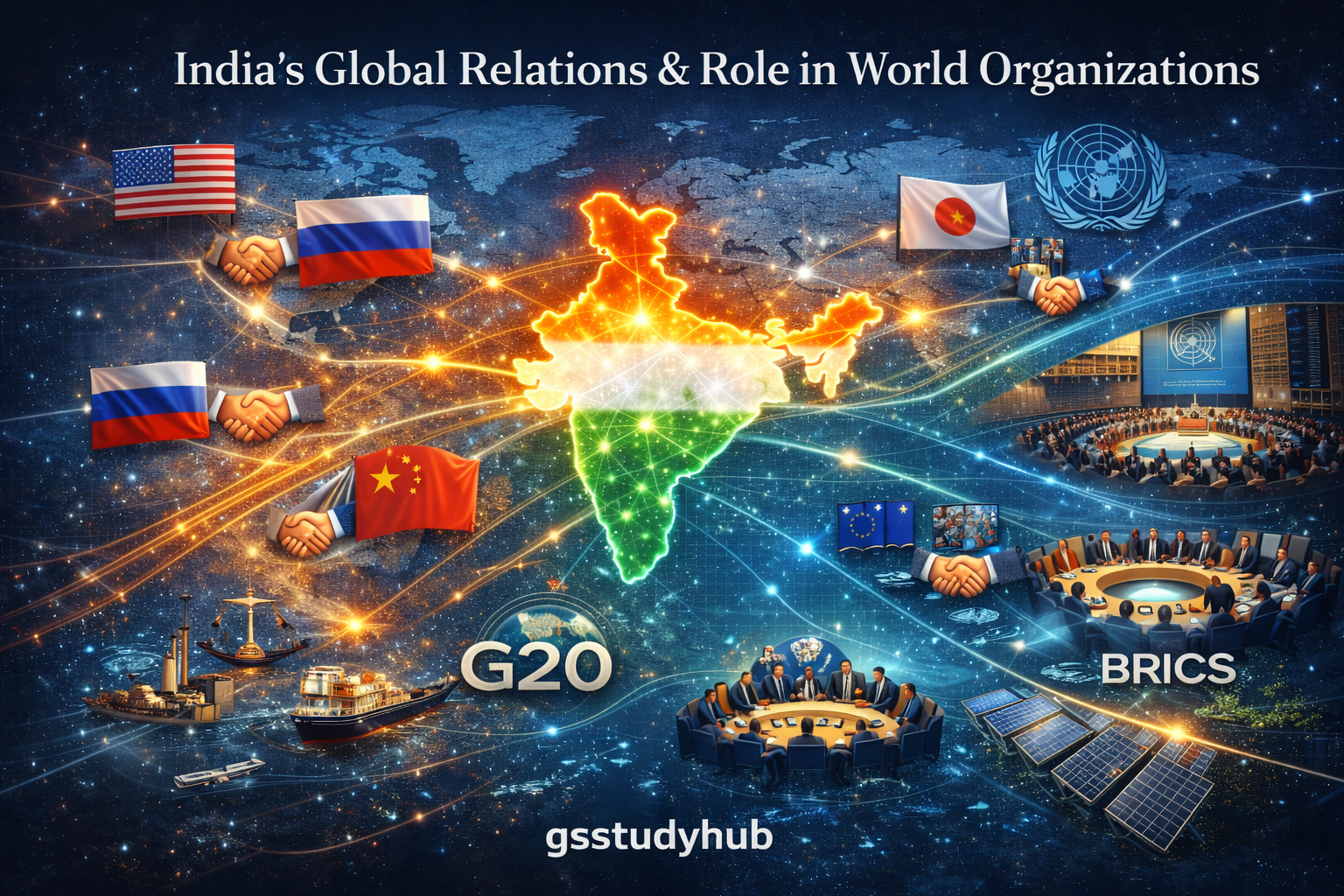
A key aspect of India Foreign Policy 2026 is its relations with major global and regional powers. India follows a balanced, pragmatic, and strategic approach to manage its global partnerships.
-
Relations with the United States:
India–U.S. relations have strengthened significantly in defense, trade, technology, and the Indo-Pacific region. Cooperation through QUAD has deepened strategic ties. -
Relations with Russia:
Russia remains a long-standing partner, especially in defense, energy, and nuclear cooperation. -
Relations with China:
India–China relations are complex, involving both economic cooperation and challenges like border disputes and strategic competition. -
Relations with Japan:
India and Japan share strong ties in infrastructure, investment, and Indo-Pacific strategy. -
Relations with the European Union (EU):
India–EU relations focus on trade, climate change, investment, and technology partnerships. -
Relations with Neighboring Countries:
Under the Neighbourhood First Policy, India strengthens ties with Nepal, Bhutan, Bangladesh, Sri Lanka, and the Maldives. -
Relations with Middle Eastern Countries:
The Middle East is crucial for India’s energy security, with strong ties to Saudi Arabia, UAE, and Qatar. -
Relations with Africa and Latin America:
India is expanding cooperation in trade, education, healthcare, and development projects.
In summary, India maintains balanced and multi-dimensional global relations, helping it emerge as a major and influential global power.
👉 Explore geopolitical tensions in the Middle East in our analysis on Israel–Middle East Conflict Explained .
India’s Role in Global Organizations
India Foreign Policy 2026 focuses on balancing global power dynamics while strengthening economic and strategic partnerships.
India plays an active, responsible, and influential role in global organizations. Through these platforms, India not only safeguards its national interests but also contributes to global peace, development, and cooperation.
-
United Nations (UN):
India contributes significantly to global peacekeeping and is one of the largest contributors to UN missions. It also aspires to become a permanent member of the UN Security Council (UNSC). -
G20:
India plays a key role in addressing global economic stability, digital economy, development, and climate change. -
BRICS:
Through BRICS, India promotes cooperation among emerging economies and supports global economic balance. -
Shanghai Cooperation Organisation (SCO):
India contributes to regional security, counter-Terrorism, and economic cooperation in Central Asia. -
World Trade Organization (WTO):
India advocates for fair trade policies and represents the interests of developing countries. -
IMF and World Bank:
India supports global financial stability, poverty reduction, and sustainable development initiatives. -
International Solar Alliance (ISA):
India leads efforts to promote solar energy and combat climate change globally. -
Voice of the Global South:
India represents developing nations by raising issues such as climate justice, inclusive growth, and global cooperation.
In conclusion, India’s role in global organizations is multi-dimensional and impactful, positioning the country as a responsible global power.
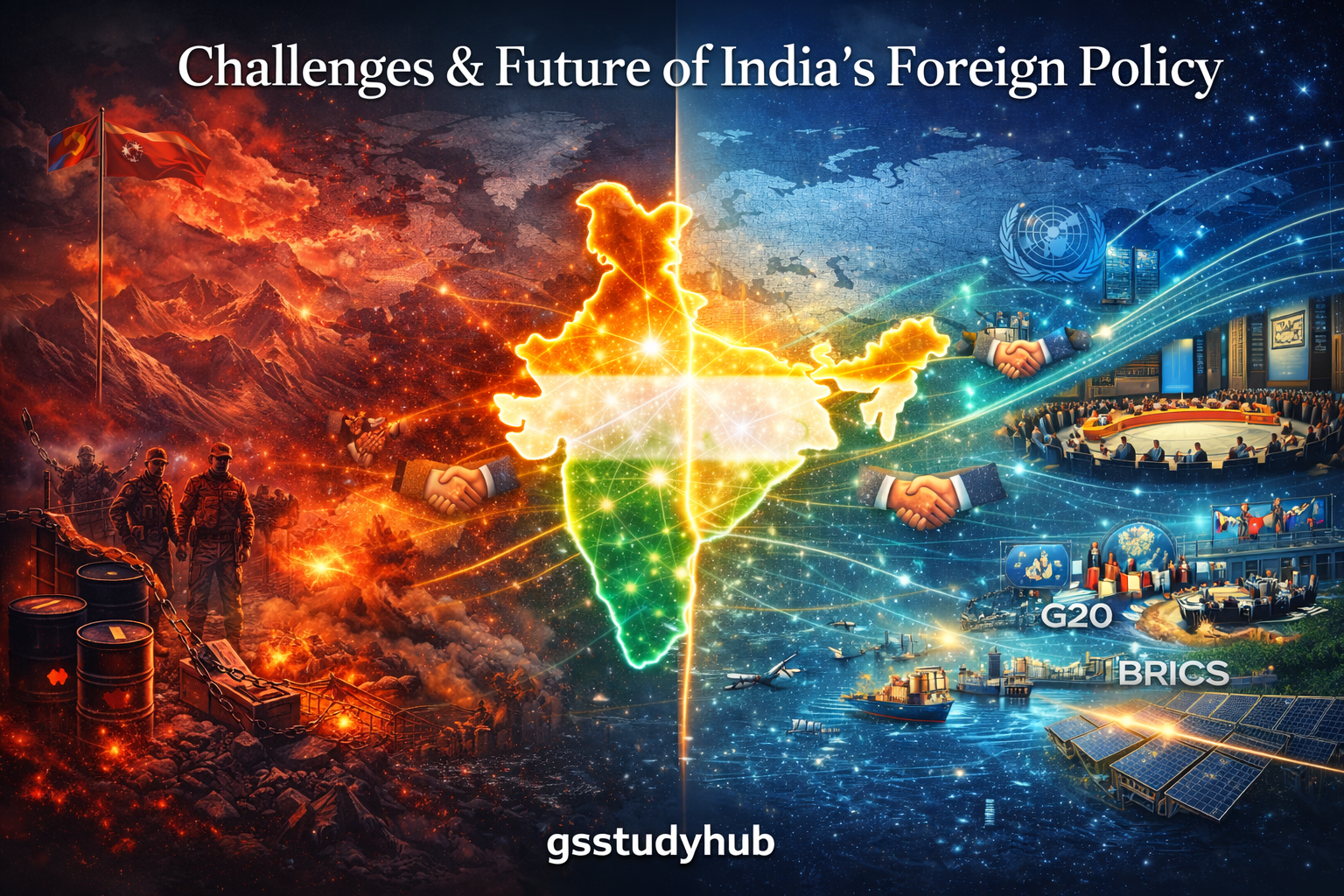
Challenges in India’s Foreign Policy
While India Foreign Policy 2026 is broad and influential, it faces several complex challenges. In a rapidly changing global environment marked by geopolitical tensions and economic UNcertainties, India must adopt a balanced and strategic approach to safeguard its interests.
-
Border Disputes with China:
Ongoing tensions along the Line of Actual Control (LAC), military standoffs, and strategic rivalry pose serious security and diplomatic challenges. -
Relations with Pakistan and Terrorism:
India–Pakistan relations remain strained due to cross-border terrorism, political instability, and lack of trust. -
regional instability:
Economic crises, political instability, and internal conflicts in South Asia impact India’s security and diplomacy. -
Global Power Rivalries:
Balancing relations amid U.S.–China rivalry and Russia–West tensions is a major strategic challenge. -
Economic and Trade Challenges:
Global slowdowns, supply chain disruptions, and trade competition affect India’s economic diplomacy. -
energy security:
Dependence on imports makes India vulnerable to geopolitical tensions, especially in the Middle East. -
Cybersecurity and Emerging Technologies:
Threats related to cybersecurity, AI, and space technology are becoming key concerns. -
climate change and Global Pressure:
Balancing development with environmental commitments remains a major challenge. -
Limited Representation in global institutions:
Lack of permanent membership in the UN Security Council (UNSC) limits India’s influence in global decision-making.
In conclusion, despite these challenges, India continues to adopt a strategic, balanced, and forward-looking approach to strengthen its global position.
👉 UNderstand rising global tensions in this article on World War 3 Chances in 2026 .
Future of India’s Foreign Policy
The future of India Foreign Policy 2026 is expected to be dynamic, strategic, and opportUNity-driven. With rapid global changes, technological advancements, and shifting power dynamics, India is steadily moving toward becoming a leading global power.
-
Emergence as a Global Power:
India is expected to become a major economic and strategic power, driven by its growing economy, young population, and technological progress. -
Multi-Alignment and Strategic Balance:
India will continue its policy of multi-alignment, maintaining balanced relations with multiple global powers. -
Increasing Role in the Indo-Pacific Region:
The Indo-Pacific will remain a key geopolitical region, where India will expand its strategic and security presence. -
Focus on Economic Diplomacy:
India will emphasize trade, investment, and technology partnerships through initiatives like Make in India and Digital India. -
Leadership of the Global South:
India will strengthen its role as a representative of developing nations, addressing global issues like climate change and inequality. -
Strengthening Defense and Security Cooperation:
India will enhance defense capabilities and expand cooperation in maritime security and cybersecurity. -
Technology and Innovation Partnerships:
India will collaborate globally in sectors like AI, semiconductors, space technology, and digital infrastructure. -
Greater Role in global institutions:
India will push for permanent membership in the UN Security Council (UNSC) and greater influence in global governance. -
Opportunities Alongside Challenges:
Despite challenges like geopolitical tensions and Economic uncertainty, India has strong opportunities to expand its global influence.
In conclusion, the future of India’s foreign policy is strong, flexible, and forward-looking, positioning the country as a key force in shaping the global order.
👉 Stay updated with the latest developments in Current Affairs April 2026 .
Conclusion
India Foreign Policy 2026 reflects a dynamic, multi-dimensional, and forward-looking approach focused on balancing global power dynamics while strengthening economic and strategic partnerships.
India’s foreign policy is built on the core objective of protecting national interests while enhancing its global influence and leadership. Over time, India has adapted to changing international dynamics, emerging as a key player on the global stage.
Historically rooted in principles such as Non-Alignment and peaceful coexistence, India’s foreign policy has evolved into a pragmatic and result-oriented framework. The concept of strategic autonomy allows India to balance relations with major global powers effectively.
In 2026, India is not only a regional power but also an emerging global leader. Its participation in global platforms like QUAD, BRICS, G20, and the United Nations highlights its expanding influence.
Despite facing challenges such as border disputes, geopolitical tensions, Economic uncertainty, and energy security issues, India continues to navigate these complexities through strong diplomacy and strategic resilience.
Looking ahead, India’s foreign policy is expected to become more innovative, influential, and leadership-driven. As a rising voice of the Global South, India has the potential to shape a more balanced and inclusive global order.
In conclusion, India’s foreign policy serves as a foUNdation for its security, development, and global leadership, paving the way for its emergence as a responsible and powerful global nation.
Frequently Asked Questions (FAQ)
1. What is India’s Foreign Policy?
India’s foreign policy refers to the strategies and principles through which India manages its relations with other coUNtries and international organizations to protect its national interests.
2. What are the main objectives of India’s foreign policy?
The main objectives include ensuring national security, promoting economic growth, enhancing global influence, and maintaining international peace and stability.
3. What are the core principles of India’s foreign policy?
India’s foreign policy is based on principles such as Non-Alignment, Panchsheel, peaceful coexistence, and strategic autonomy.
4. What are the key features of India’s foreign policy in 2026?
In 2026, India’s foreign policy is multi-dimensional, pragmatic, and balanced, with a focus on multi-alignment, economic diplomacy, and global leadership.
5. Which Global Organizations is India a member of?
India is a member of major global organizations such as the United Nations (UN), G20, BRICS, Shanghai Cooperation Organisation (SCO), and World Trade Organization (WTO).
6. What are the major challenges in India’s foreign policy?
Key challenges include border disputes with China, tensions with Pakistan, global power rivalries, economic uncertainties, and energy security concerns.
7. What is India’s “Neighbourhood First Policy”?
It is a policy focused on strengthening relations with neighboring countries to promote regional peace, stability, and cooperation.
8. What is the future of India’s foreign policy?
The future of India’s foreign policy is strong, flexible, and opportunity-driven, with India expected to emerge as a major global power.
References
- Ministry of External Affairs, Government of India – https://mea.gov.in/
- United Nations (UN) – https://www.un.org/
- G20 Official Portal – https://www.g20.org/
- BRICS Official Website – https://www.brics2024.gov.ru/
- World Trade Organization (WTO) – https://www.wto.org/
- International Monetary Fund (IMF) – https://www.imf.org/
- World Bank – https://www.worldbank.org/
- Academic Sources – Books, journals, and research papers on India’s Foreign Policy
- News Sources – The Hindu, Indian Express, BBC, and other reputed media outlets