
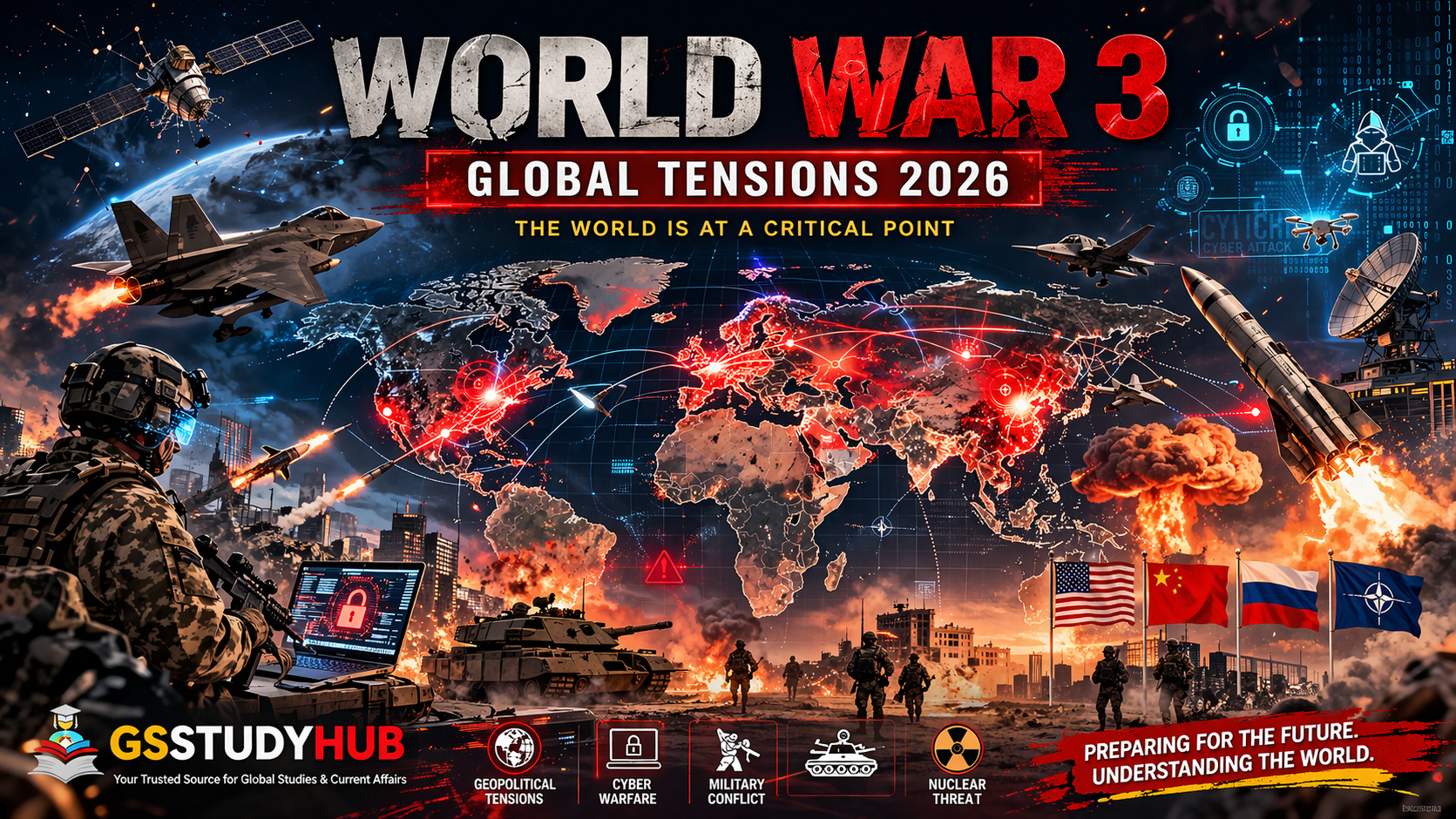
World War 3 Chances in 2026 is one of the most searched and debated topics today.
👉 Is a global war really coming?
👉 Will Nuclear weapons be USed?
👉 How will it impact India and the world?
In this article, we break down the real risk of World War 3, global tensions, nuclear threats, and future possibilities based on current geopolitical trends.
📌 Table of Contents
What are the chances of World War 3?
The chances of World War 3 in 2026 are generally considered low to medium, but they cannot be completely ignored. The risk depends on several ongoing geopolitical tensions and how global powers respond to them.
Currently, major flashpoints include the Russia–Ukraine war, the China–Taiwan Issue, and rising instability in the Middle East. These conflicts increase global UNcertainty, but they are still largely regional and controlled.
At the same time, strong factors are preventing a global war:
- Nuclear deterrence: The fear of mutual destruction discourages direct war between major powers
- Economic interdependence: Countries are connected through trade, making war extremely costly
- Diplomatic efforts: International organizations and negotiations help reduce tensions
However, the risk could increase if:
- ⚠️ A direct conflict occurs between major powers like the United States, China, or RUSsia
- ⚠️ Nuclear weapons are used in any conflict
- ⚠️ Regional wars escalate into global alliances
In conclusion, while World War 3 is not an immediate threat, it remains a possible long-term risk depending on future global developments and geopolitical decisions.
What is World War 3?
World War 3 chances in 2026 are widely discUSsed due to rising global tensions, nuclear threats, and geopolitical conflicts. Many people are asking whether a global war is really possible.
World War 3 refers to a hypothetical large-scale global conflict involving multiple powerful nations across continents. UNlike regional wars, it would impact the entire world — including politics, economy, security, and daily life.
Historically, the world has experienced two major global wars — World War I (1914–1918) and World War II (1939–1945). A potential World War 3 would be far more dangerous due to Advanced Technology and Nuclear weapons.
🌍 Key Characteristics of World War 3
- Global Participation: Major powers like the United States, China, and Russia could be involved.
- Multi-Domain Warfare: War would extend beyond land, air, and sea into cyber and space domains.
- Advanced Technology: Use of AI, drones, hypersonic missiles, and automated weapons.
- Nuclear Threat: Possible use of nuclear weapons leading to massive destruction.
- Economic Disruption: Global trade, supply chains, and economies would collapse.
- Humanitarian Crisis: Refugee crises, food shortages, and infrastructure damage worldwide.
⚔️ How World War 3 Would Be Different
Unlike previous wars, World War 3 would be driven by technology and global connectivity:
- 💻 Cyber Warfare: Attacks on banking, power grids, and communication systems.
- 🤖 AI Warfare: Autonomous weapons increasing speed and scale of conflict.
- 🛰️ Space Warfare: Satellites becoming strategic targets.
- 📱 Information Warfare: Propaganda, fake news, and digital influence campaigns.
📊 Why It Is Trending in 2026
Recent conflicts such as the Russia–Ukraine war, U.S.–China rivalry, and instability in the Middle East have increased global concerns about a possible world war.
However, rising tensions do not always lead to war. Most countries still prioritize diplomacy, economic stability, and global cooperation.
📌 Key Takeaway
World War 3 remains a potential scenario, not an immediate reality. While risks exist, global diplomacy and cooperation continue to play a crucial role in preventing such a catastrophic conflict.
👉 Want detailed insights on the ongoing conflict?
⚔️ Read Full Russia–Ukraine War AnalysisUSes">Global Tensions in 2026 (Main Causes)
In 2026, multiple geopolitical tensions are shaping global politics and increasing the risk of large-scale conflict. While these may not directly trigger World War 3, they are creating instability across key regions.
⚔️ Russia–Ukraine war
The Russia–Ukraine conflict, ongoing since 2022, continues to impact global stability and involves indirect participation from major powers.
- Western coUNtries (USA & Europe) support Ukraine
- Russia sees NATO expansion as a strategic threat
- Direct NATO involvement could escalate the conflict globally
🇨🇳 China–Taiwan Issue
The China–Taiwan tension remains one of the most dangerous flashpoints in global geopolitics.
- China is increasing military pressure around Taiwan
- The United States supports Taiwan’s security
- A conflict could involve multiple global powers
🔥 Middle East Crisis
The Middle East continues to be a highly unstable region due to political, religious, and energy-related conflicts.
- Rising tensions between Iran and Israel
- Conflicts over oil routes and energy control
- Instability affecting global energy markets
👉 Read detailed analysis: Middle East Geopolitics 2026
❄️ Cold War 2.0
A new era of global competition, often called Cold War 2.0, is emerging.
- Strategic rivalry between USA, China, and Russia
- Economic competition instead of direct war
- Use of sanctions, trade wars, and political pressure
💻 Cyber and Technological Warfare
Modern conflicts increasingly rely on technology and cyber power.
- Cyber attacks on infrastructure and financial systems
- Use of AI, drones, and advanced weapons
- Competition for control over data and digital technologies
📊 Key Takeaway
Global tensions in 2026 are complex and interconnected. While they may not immediately lead to World War 3, unresolved conflicts and rising competition between major powers continue to increase global risk.
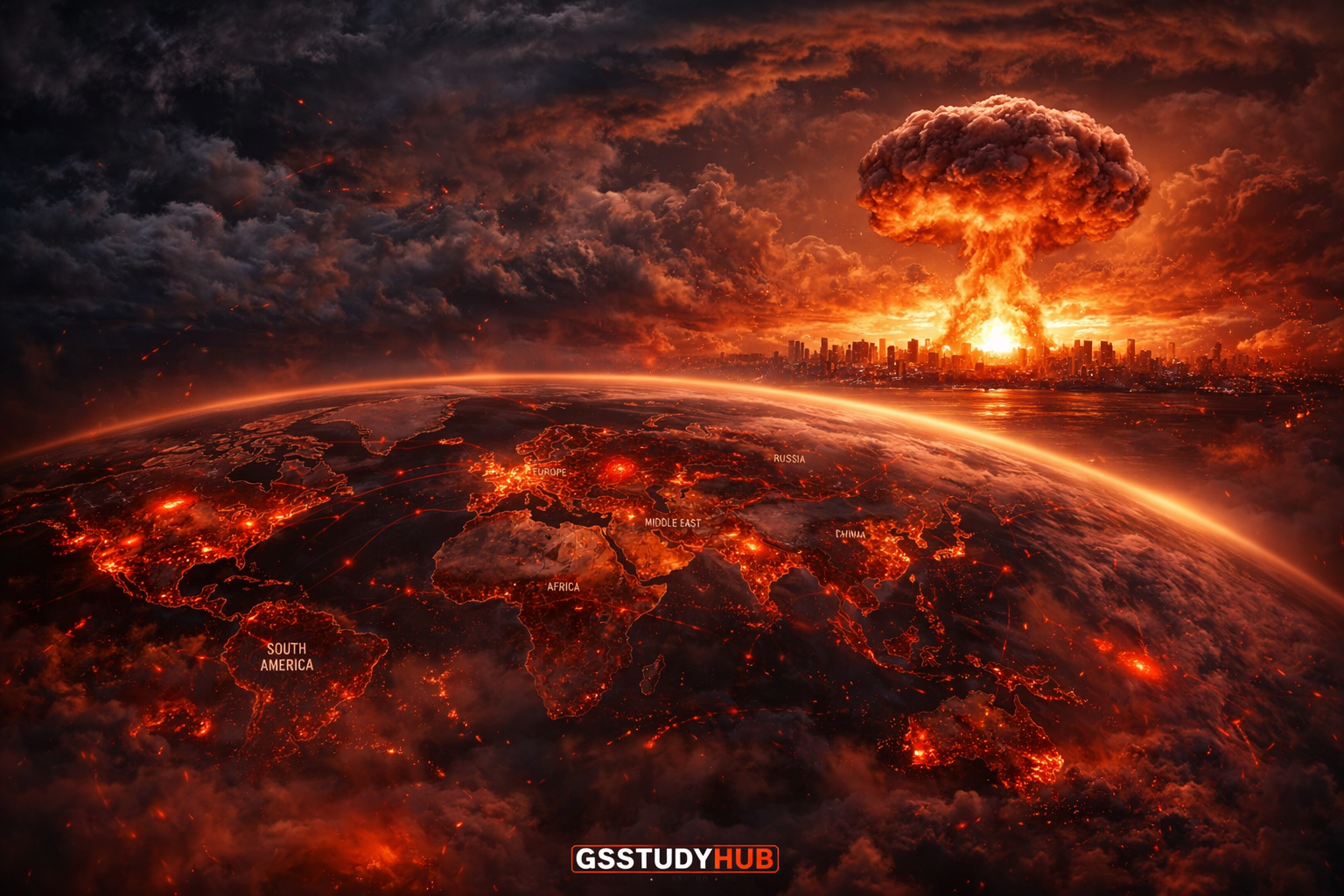
☢️ Threat of Nuclear War
Nuclear weapons are the most destructive form of military power. If USed in a global conflict, their impact would extend far beyond borders, affecting human civilization, environment, and the global economy.
⚠️ Why Nuclear War is Extremely Dangerous
- ☢️ Mass Casualties: Millions of deaths within minutes
- 🌍 Environmental Damage: Radiation and long-term climate impact
- 🌾 Food Crisis: Destruction of agriculture and global supply chains
- 🏙️ Urban Destruction: Entire cities could be wiped out
🌐 Nuclear-Armed CoUNtries
The major countries possessing nuclear weapons include:
- United States (USA)
- Russia
- China
- India
- Pakistan
- France
- United Kingdom (UK)
- North Korea
🧠 What is Mutually Assured Destruction (MAD)?
Mutually Assured Destruction (MAD) is a doctrine where if one nuclear power launches an attack, the other will retaliate with equal or greater force, leading to total destruction of both sides.
- 👉 This concept acts as a deterrent against nuclear war
- 👉 Nuclear weapons are used only as a last-resort option
📊 Risk of Nuclear War in 2026
Despite rising global tensions, the probability of nuclear war in 2026 remains low.
- ✔️ Major powers prefer diplomacy over direct conflict
- ✔️ Consequences are too catastrophic for any nation
- ✔️ Global institutions work to maintain peace and stability
📌 Key Takeaway
The threat of nuclear war exists, but due to its devastating and irreversible consequences, world powers actively avoid it. While risks remain, the chances of nuclear conflict in the near future are relatively low.
👉 Want to UNderstand India–China tensions?
🌏 Explore India–China Relations StrategyWill World War 3 happen in 2026?
World War 3 is UNlikely in 2026 due to Nuclear deterrence, Global trade dependency, and diplomatic efforts. However, rising tensions keep the risk alive.
This is one of the most searched questions today. The answer depends on global tensions, political decisions, and evolving geopolitical situations.
🌍 Current Scenario
Several conflicts are ongoing, including the Russia–Ukraine war, China–Taiwan tensions, and instability in the Middle East. However, none have escalated into a full-scale global war.
- ✔️ Most conflicts remain regional
- ✔️ Major powers avoid direct confrontation
- ✔️ Diplomatic efforts are ongoing
📊 What Do Experts Say?
- 👉 Probability of World War 3 is low to medium
- 👉 Proxy wars may increase
- 👉 Economic and tech competition will intensify
⚠️ Possible Triggers of World War 3
- ☢️ USe of Nuclear weapons
- ⚔️ Direct war between NATO and Russia
- 🇨🇳 Conflict over Taiwan with US involvement
- 🔥 Large-scale Middle East war
🧠 Why the Chances Are Still Low
- 💰 Countries want to avoid economic collapse
- ☢️ Nuclear deterrence prevents escalation
- 🌐 Global trade interdependence
- 🤝 Role of International organizations
📈 Future Trends
- 💻 Rise of cyber warfare
- 🤖 Increased use of AI and drones
- ⚔️ More proxy conflicts instead of global war
📌 Key Takeaway
World War 3 remains a possible but unlikely scenario in 2026. While global tensions exist, major powers prefer diplomacy, economic stability, and strategic balance over large-scale war.
👉 Final Insight: World War 3 is a possibility, but its immediate chances in 2026 remain very low.
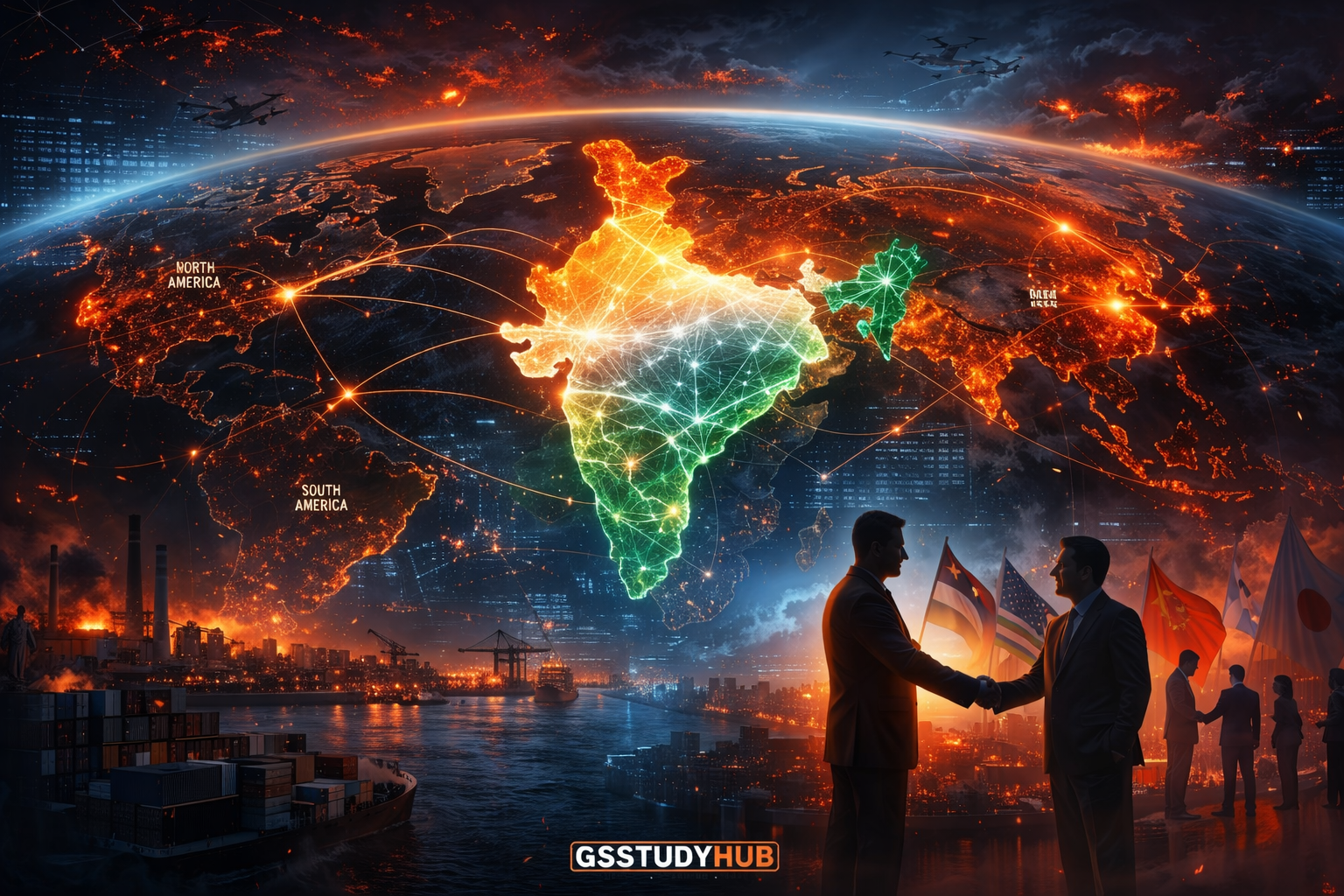
India">🇮🇳 Impact on India
If World War 3 occurs, its impact on India would be significant across economy, trade, and national security. Despite India’s balanced foreign policy, a global conflict would still create major challenges.
⚠️ Possible Negative Impacts
- ⛽ Rising Oil Prices: Conflicts in the Middle East could disrupt supply, increasing fuel costs in India
- 📉 Economic Slowdown: Decline in Global trade may affect India’s GDP growth
- 📦 Supply Chain Disruptions: Imports and exports could be heavily impacted
- 💰 Inflation Increase: Prices of essential goods may rise significantly
- 🛡️ Security Challenges: Border tensions and defense spending could increase
✅ Possible Positive Impacts
- 🏭 Manufacturing Hub OpportUNity: Global companies may shift from China to India
- 🌍 Stronger Diplomatic Role: India could act as a neutral global mediator
- 📈 New Trade Opportunities: Export demand may increase in certain sectors
- 🔋 Boost to Atmanirbhar Bharat: FocUS on local production and innovation
🧠 India’s Strategy in Crisis
India follows a policy of Strategic Autonomy, allowing it to maintain flexibility and prioritize national interests.
- 🤝 Maintaining balanced relations with major global powers
- 🛡️ Strengthening defense and border security
- 📊 Ensuring economic stability and resilience
- 🌐 Active role in global platforms like UN and G20
👉 Also read: India Foreign Policy 2026 Strategy
📌 Key Takeaway
A global conflict like World War 3 would bring both challenges and opportunities for India. With the right strategy, India can minimize risks and even strengthen its position globally.
👉 Final Insight: While the impact of a global war on India could be serious, a smart and balanced strategy can convert challenges into long-term opportunities.
NATO is rapidly strengthening its eastern flank in response to rising tensions in Europe. From military deployments to advanced defense strategies, this region has become a key center of global security concerns.
👉 Want full analysis?
🔎 Read NATO Strategy in Eastern Europe (Full Analysis)📊 Reality Check (Most Important)
World War 3 in 2026 is widely discUSsed, but it is important to separate facts from fear. Social media and news often amplify risks, while the actual situation is more balanced.
🔍 What is the Real Situation?
- ✔️ Not every global tension leads to a world war
- ✔️ Media and social platforms can exaggerate fear
- ✔️ Major powers avoid direct large-scale conflict
💰 Economic Reality
Today’s world is highly economically interconnected, making war extremely costly:
- 📉 Massive economic losses for all nations
- 🌐 Disruption of Global trade and supply chains
- 🏭 Shutdown of industries and businesses
☢️ Nuclear deterrence
Nuclear weapons act as a powerful deterrent against global war.
- 👉 One nuclear strike would trigger retaliation
- 👉 This leads to Mutually Assured Destruction (MAD)
- 👉 Therefore, coUNtries avoid nuclear escalation
🤝 Role of diplomacy
Diplomacy remains the strongest tool for maintaining global peace.
- 🌐 Organizations like UN and G20 promote dialogue
- 🤝 Conflicts are resolved through negotiations
- ⚖️ Agreements help prevent escalation
📈 Future Trends
- 💻 Rise of cyber warfare
- 🤖 Increased use of AI and drones
- ⚔️ Growth of proxy conflicts
📌 Key Takeaway
The reality is that while the fear of World War 3 exists, the immediate risk in 2026 is relatively low. However, ongoing global tensions should not be ignored.
👉 Final Insight: Accurate information matters more than fear — World War 3 is a possible but not immediate threat in today’s world.
USion">Conclusion: World War 3 Chances in 2026
World War 3 chances in 2026 remain low, but the risk cannot be completely ignored. Rising geopolitical tensions, regional conflicts, and technological warfare continue to create UNcertainty in the global system.
At the same time, factors such as Economic interdependence, Nuclear deterrence, and active diplomacy play a crucial role in preventing a large-scale global war.
For countries like India and other major powers, the focus remains on stability, strategic partnerships, and avoiding direct confrontation. While regional conflicts may continue, a full-scale World War Is still unlikely in the near future.
👉 Want to understand rising India–China tensions? Read our detailed analysis: India–China Relations Strategy
📌 Final Takeaway
World War 3 remains a possible but not immediate threat. Staying informed and understanding global developments is essential to assess future risks and opportunities.
📚 References
- UNited Nations (UN) – Official reports and publications on global peace and security
- International News Agencies – BBC, Al Jazeera, Reuters (global conflict and geopolitics coverage)
- World Bank & International Monetary Fund (IMF) – Economic reports and global financial analysis
- Strategic & Defense Research Institutions – Policy papers and military analysis
- Government Websites – Official press releases and foreign policy statements
- Academic Research Papers – Studies on geopolitics and international relations
- Expert Analysis – Interviews and insights from global policy analysts and researchers
Note: This article is based on credible sources and current global developments. It is intended for informational and educational purposes only.