
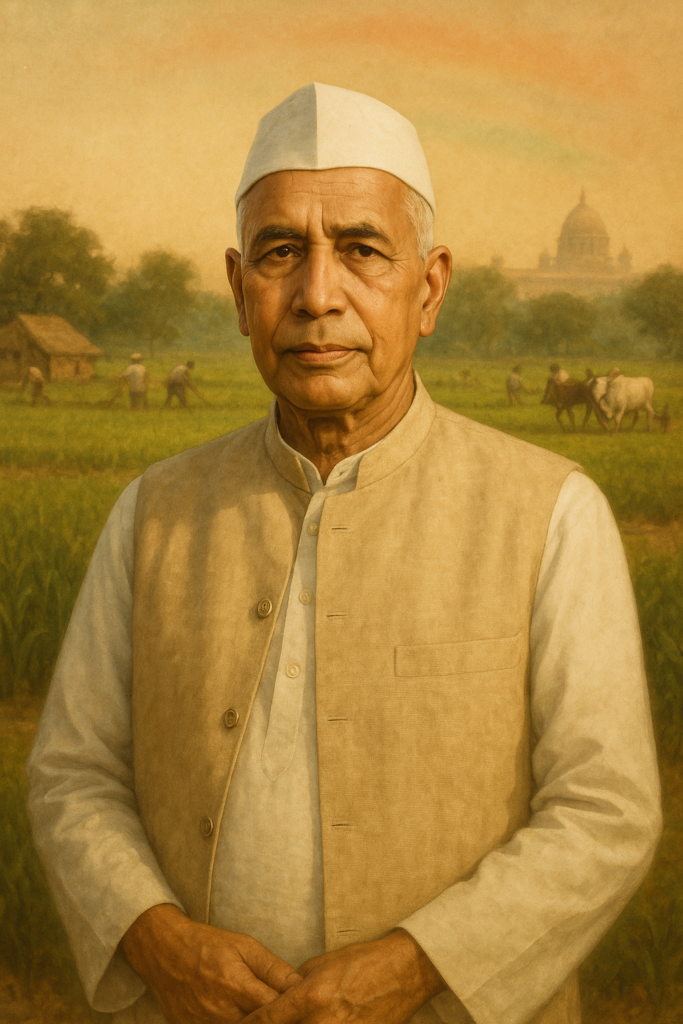
Biography of Shri Charan Singh
Shri Charan Singh was a renowned freedom fighter, social worker, farmer leader, and politician of India. He became the fifth Prime Minister of India and is especially known for protecting the interests of farmers.
🛒 Buy Now on AmazonEarly Life
Full Name: Chaudhary Charan Singh
Born: 23 December 1902
Place of Birth: Noorpur village, Tehsil Hapur, District Meerut (now Hapur district, Uttar Pradesh)
Family Background: Belonged to an ordinary farmer family.
Education
- Obtained a law degree (LLB).
- Received education from Meerut and Agra Universities.
- After completing his education, he began practicing law.
Political Life
- Joined the Congress Party in 1929.
- Actively participated in the freedom struggle against British rule and was jailed several times.
- Elected to the Uttar Pradesh Legislative Assembly for the first time in 1937.
- Played a key role in drafting farmer-centric laws such as the Zamindari Abolition Act.
Prime Ministership
Tenure: 28 July 1979 to 14 January 1980
He became the Prime Minister after the split of the Janata Party. Although his tenure was short, his policies strongly supported farmers’ welfare and rural development.
Major Contributions and Characteristics
- Widely known as the “Messiah of Farmers.”
- Worked tirelessly to strengthen rural India and agriculture.
- Never took decisions favouring industrialists; always supported rural and poor communities.
Death
Died: 29 May 1987
Every year, Kisan Diwas (Farmers’ Day) is celebrated on 23 December in his honour.
Conclusion
Chaudhary Charan Singh was a leader who dedicated his life to the welfare of farmers and rural India. He is remembered as a symbol of honesty, simplicity, and relentless struggle.
Early Life of Chaudhary Charan Singh
Chaudhary Charan Singh was an epoch-making figure in Indian politics, who devoted his entire life to the service of farmers, labourers, and the poor. His early life was full of struggle, simplicity, and inspiration. Born into a humble farmer family, he rose to become the Prime Minister of India through sheer hard work, education, and perseverance.
Birth and Family Background
He was born on 23 December 1902 in Noorpur village of Meerut district (now Hapur district), Uttar Pradesh, in a simple Jat farmer family. His father, Mir Singh, and mother, Netra Kaur, were religious, hardworking, and value-oriented individuals. The values Charan Singh imbibed from them shaped his entire political journey.
Childhood and Life Values
Charan Singh witnessed closely the hardships of farmers—how they never received fair rewards for their labour and how the poor lived with limited dignity in society. These early experiences sowed the seeds of social justice in his mind.
Honesty, self-reliance, and discipline held special importance in his life. He was intelligent, hardworking, and excelled in academics despite financial hardships.
Elementary Education
He received his primary education in his village school, where he performed exceptionally well. Afterward, he moved to Meerut for higher schooling, earned scholarships, and continued his studies with dedication, often studying late at night by lantern light.
Higher Education
He completed his graduation (BA) from Agra University and later studied law (LLB) at Meerut College. During this period, he developed strong views against injustice and social inequality. He believed that law could be a powerful tool to serve the poor and exploited.
Legal Career and Social Concerns
After completing his law degree, Charan Singh began practicing in Meerut. However, he was not motivated by financial gain—he fought cases free of charge for poor farmers and labourers.
His philosophy was clear: “If the lowest section of society does not receive justice, society cannot remain balanced.”
Association with the Freedom Movement
A turning point in his life came in 1929 when he joined the independence movement under Mahatma Gandhi’s leadership. As a member of the Indian National Congress, he actively participated in movements like the Salt Satyagraha and Quit India Movement, and was jailed several times.
He travelled across villages, mobilizing people against British rule with his powerful speeches and inspiring them to fight for independence.
Social Thoughts and Attitudes
The struggles he witnessed early in life shaped his deep and practical social outlook. He believed the true strength of India lies in its villages and farmers. Influenced by Mahatma Gandhi, Swami Vivekananda, and Dayananda Saraswati, Charan Singh strongly advocated for Gram Swaraj and rural empowerment.
Impact of Early Life on His Political Career
The poverty, inequality, and struggles Charan Singh witnessed shaped every political decision he took—whether it was abolishing the zamindari system, introducing agricultural reforms, or strengthening the rural economy.
He fought throughout his life to uplift farmers and rural India, earning titles such as “Farmer Leader of India” and “Messiah of Farmers.”
Conclusion
The early life of Chaudhary Charan Singh is truly inspirational. His journey teaches us that with dedication, education, discipline, and a desire to serve society, any individual—no matter how humble his background—can achieve great heights.
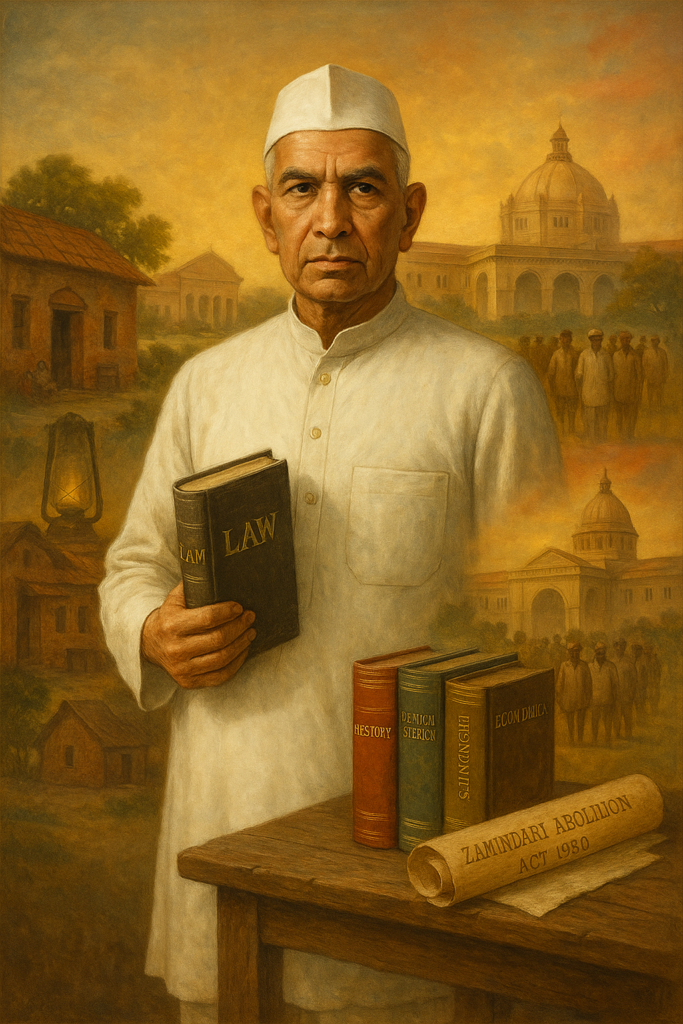
Education of Chaudhary Charan Singh
🛒 Buy Now on AmazonThe educational journey of Chaudhary Charan Singh played a crucial role in shaping his personality. Despite being born into a simple farmer family, he achieved remarkable academic success and proved that hard work, determination, and perseverance can lead anyone to great heights.
Primary Education
Charan Singh began his early education in his village, Noorpur, where he attended a local primary school. Educational facilities in rural areas were extremely limited at that time, yet his parents understood the importance of learning and encouraged him to study.
The school lacked basic infrastructure and proper teaching materials, but Charan Singh remained focused on his studies. From a young age, he was known as a brilliant, disciplined, and hardworking student.
Secondary Education
After completing primary education, he moved to Meerut for further studies. Although he initially faced challenges adapting from a rural to an urban environment, he never gave up.
He was so committed to learning that he walked several kilometers to school every day. Despite financial difficulties at home, he continued his education without interruption.
He performed exceptionally well in his secondary examinations and earned a scholarship, which paved the way for his higher education.
Higher Education (College Life)
After completing his schooling, Charan Singh took admission in Meerut College, one of the region’s most prestigious institutions at the time. He completed his B.A. (Graduation) from there.
During his graduation, he developed a strong interest in subjects like History, Political Science, and Economics—subjects that later shaped his political thinking and leadership style.
Law Studies (LL.B.)
After earning his B.A., he pursued law from Agra University (now Dr. Bhimrao Ambedkar University) and completed his LL.B. degree.
During his law education, he gained deep insights into the social, economic, and legal inequalities prevalent in Indian society. His focus was especially on the rights of farmers, labourers, and marginalized communities.
He excelled academically and was widely respected among teachers and students for his discipline and intellect.
Impact of Education
The education of Chaudhary Charan Singh shaped his worldview, which was strongly people-centric, farmer-friendly, and rooted in social justice.
His academic background enabled him to understand India’s social and political conditions deeply. He implemented legal and political principles not only theoretically but at the grassroots level.
His writings, such as “India’s Poverty and Its Solution” and “Abolition of Zamindari”, reflect his intellectual depth and understanding of society.
Conclusion
Chaudhary Charan Singh’s educational journey is an inspiring example of how an ordinary rural boy became a remarkable thinker and national leader. Education not only made him a successful lawyer and politician but also helped him become the voice of millions of farmers and the poor. His life teaches us that education is the true power behind social service, justice, and leadership.
Political Life of Chaudhary Charan Singh
The political life of Chaudhary Charan Singh is a defining chapter in Indian political history. He earned recognition not only as a skilled politician but also as a farmer leader, policy planner, and proponent of transparency in governance. His politics always revolved around the empowerment of farmers, labourers, and rural India. His political career spanned nearly five decades, during which he held several key positions and transformed the nation’s political landscape.
Entry into Politics (1929)
In 1929, Chaudhary Charan Singh joined the Indian National Congress. The Freedom Movement was gaining momentum, and he was deeply inspired by Mahatma Gandhi’s principles. Under Gandhiji’s leadership, he actively participated in the struggle for India’s independence.
Contribution to the Freedom Struggle
- Participated in the Salt Satyagraha in 1930 and was imprisoned for the first time.
- Played an active role in the Quit India Movement in 1940 and 1942 and was imprisoned again.
- Travelled to villages, motivating people to rise against British rule and contributed significantly to making the freedom movement a mass movement.
Elected as MLA for the First Time (1937)
In 1937, Charan Singh was elected to the United Provinces (now Uttar Pradesh) Legislative Assembly from the Chhaprauli constituency. He went on to become an MLA multiple times, gradually increasing his influence in state politics.
His powerful speeches, commitment to justice, and support for farmers made him extremely popular among the masses.
Zamindari Abolition
Chaudhary Charan Singh played a groundbreaking role in the abolition of the zamindari system in Uttar Pradesh.
He was instrumental in drafting and implementing the Zamindari Abolition Act of 1950, which granted land ownership rights to farmers and freed them from exploitation by landlords. This is regarded as one of his greatest legislative achievements.
Chief Minister of Uttar Pradesh
He served as the Chief Minister of Uttar Pradesh twice:
- First Term: 3 April 1967 – 25 February 1968
- Second Term: 18 February 1970 – 1 October 1970
As Chief Minister, he introduced many farmer-oriented reforms, strengthened administrative transparency, and took firm steps to reduce corruption.
Separation from Congress and Formation of New Parties
Due to ideological differences with Indira Gandhi, Charan Singh left the Congress. He founded the Bharatiya Kranti Dal (BKD), and later formed the Lok Dal. He also played a major role in unifying the opposition and contributed to the formation of the Janata Party.
Role in the Central Government
After the Janata Party came to power in 1977, Charan Singh served as the Home Minister and later as the Deputy Prime Minister of India. He worked tirelessly to simplify administration and make governance more accountable.
Prime Minister of India (1979–1980)
On 28 July 1979, Chaudhary Charan Singh became the fifth Prime Minister of India. His government was in a minority and lacked Congress support, so he remained in office for only 170 days (until 14 January 1980).
Despite the short tenure, he introduced several measures aimed at improving the economic condition of farmers. However, political instability prevented long-term implementation.
Work as Prime Minister
- Focused on farmer debt relief, fair pricing for agricultural produce, and rural development.
- Promoted policies centered on rural India rather than industrial interests.
- Advocated strongly against the dominance of industrial houses.
Retirement and Final Years
Even after stepping down as Prime Minister, he remained active in the Lok Dal and opposition politics. By 1984, due to declining health, he gradually withdrew from public life.
Death
Chaudhary Charan Singh passed away on 29 May 1987. In his memory, India celebrates Farmers’ Day (Kisan Diwas) every year on 23 December.
Conclusion
The political life of Chaudhary Charan Singh reflects the journey of a true representative of the people, especially farmers. He never considered power his goal; instead, he saw it as a medium of service. His principles, honesty, and unwavering commitment to the welfare of rural India continue to inspire leaders and citizens across the country.
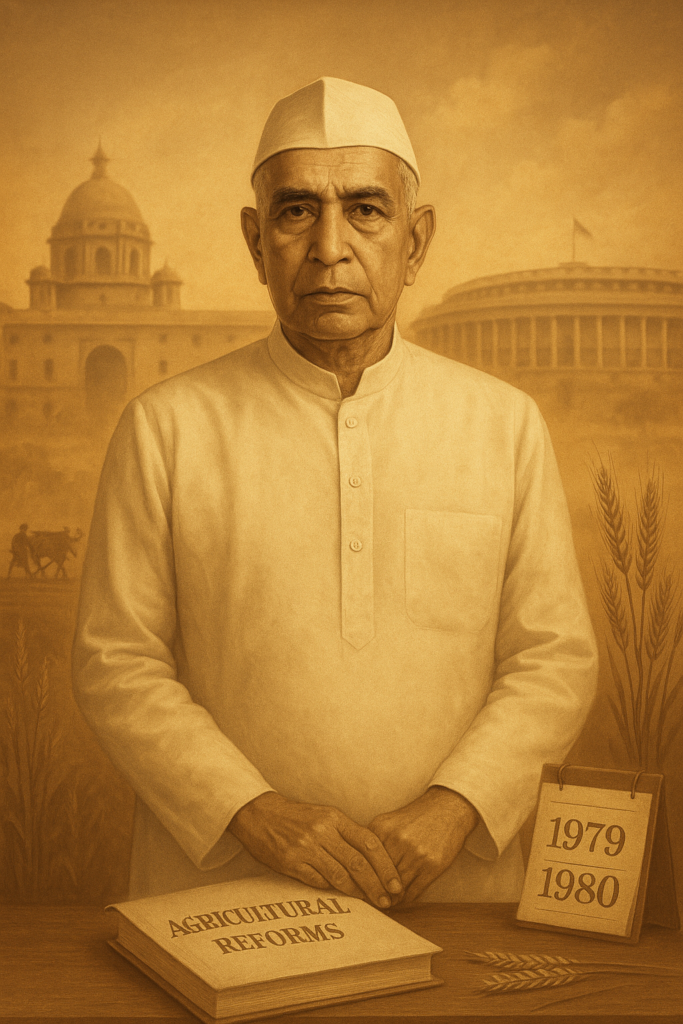
Chaudhary Charan Singh’s Tenure as Prime Minister (1979–1980)
Even though Chaudhary Charan Singh’s tenure as Prime Minister was very short (about 170 days), it remains an important and widely discussed phase in Indian political History. He became a Prime Minister who not only represented the voice of farmers but also used power solely for public service, never for personal benefit. His honesty, principles, and commitment to farmers gave him a distinct place among national leaders.
🛒 Buy Now on AmazonBackground of Becoming Prime Minister
After the defeat of Indira Gandhi in 1977, the Janata Party formed the government. Charan Singh served as the Home Minister and Deputy Prime Minister, but internal conflicts within the Janata Party soon intensified—especially between Morarji Desai and Charan Singh.
Eventually, Morarji Desai resigned, and amidst political instability, on 28 July 1979, President Neelam Sanjiva Reddy appointed Chaudhary Charan Singh as the fifth Prime Minister of India.
Oath of Office
- Date of Swearing-in: 28 July 1979
- President: Neelam Sanjiva Reddy
- Tenure: 28 July 1979 to 14 January 1980 (about 5.5 months)
He assumed office at a time when the nation was experiencing intense political instability.
Congress Support and Withdrawal
Charan Singh became Prime Minister with outside support from the Congress (Indira Gandhi faction). However, shortly after he took office, Congress withdrew its support without any clear reason.
As a result, Charan Singh had to resign on 20 August 1979 before he could prove his majority in the Lok Sabha. The President allowed him to continue as the caretaker Prime Minister until the next government was formed.
Key Features of His Tenure
1. Farmer-Centric Schemes
His primary focus was improving the economic condition of farmers, agricultural loan relief, and ensuring fair prices for agricultural produce. Although time was short, he proposed several policy reforms aimed at strengthening the agricultural sector.
2. Reduction in Government Expenditure
He emphasized reducing unnecessary government expenditure and making administration more efficient, transparent, and accountable.
3. Ethics-Driven Politics
He refused to compromise on principles for the sake of remaining in power. His immediate resignation after losing majority support is considered a rare example of moral courage in Indian politics.
His Political Views
Charan Singh strongly believed that “The soul of India resides in its villages.” He argued that India could not progress unless rural India became strong. His ideology was farmer-centric, socialist in orientation, and based on ethical political conduct.
Resignation and Elections
After Congress withdrew support, Charan Singh could not prove majority in Parliament and resigned. Fresh general elections were held in January 1980, which brought Indira Gandhi back to power with a massive majority.
Importance of His Tenure
- He is the first and only Prime Minister who never faced a confidence vote and resigned without proving majority.
- His resignation became a symbol of moral courage and dedication to constitutional values.
Conclusion
Although Chaudhary Charan Singh’s tenure as Prime Minister was short, his honesty, principles, and farmer-friendly policies made him known as the “Prime Minister of Principles.” He taught the country that the purpose of political power is service, not self-interest.
Contribution and Characteristics of Chaudhary Charan Singh
Chaudhary Charan Singh was a powerful voice for farmers, labourers, and rural India. His policies, ideas, and actions remain highly relevant even today in the context of India’s social and economic development.
Major Contributions
1. Champion of Farmers
He consistently protected the interests of farmers and believed that in an agriculture-dependent nation like India, farmers must be the center of economic policies.
- Advocated minimum support price (MSP)
- Promoted cheaper agricultural loans
- Strengthened irrigation facilities and land reforms
- Worked to free farmers from exploitation by middlemen and moneylenders
2. Abolition of the Zamindari System
As Revenue Minister of Uttar Pradesh, he played a historic role in drafting and implementing the Zamindari Abolition Act of 1950. This law transformed the lives of thousands of farmers by granting them ownership rights and freedom from landlord exploitation.
3. Agriculture-Based Policy Making
Charan Singh believed that agricultural development must precede industrial development. He emphasized improving rural infrastructure—roads, electricity, education, healthcare—before focusing on urban expansion.
4. Politics Based on Principles
He never compromised on ethics for power. When Congress withdrew support, he resigned without hesitation, reflecting exceptional moral integrity.
5. Formation of Political Parties
Due to ideological differences with Congress, he formed the Bharatiya Kranti Dal (BKD). Later, he established the Lok Dal, a farmer-centric political party that strongly highlighted rural issues on the national platform.
6. A Thoughtful Writer
Charan Singh authored several important books that provided deep insights into India’s economic problems and rural challenges. His major works include:
- “India’s Economic Policy – The Gandhian Blueprint”
- “India’s Poverty and Its Solution”
- “Abolition of Zamindari”
Key Characteristics
1. Farmer Leader
He is remembered as the “Farmer Leader of India,” representing rural voices from Parliament to grassroots movements.
2. Honesty and Simplicity
His lifestyle was simple, honest, and disciplined. He was never associated with corruption or showmanship, earning respect from all segments of society.
3. Symbol of Moral Politics
He considered politics a mode of service, not a means of power. Opportunism had no place in his political philosophy.
4. Deep Intellectual Insight
He was a thoughtful, analytical leader who examined policies through a socio-cultural lens. His decisions always considered how policies would impact farmers and villages.
5. Commitment to rural development
He firmly believed that “the soul of India resides in the villages.” His policies consistently focused on the development of farmers, labourers, and rural communities.
Honours and Legacy
- India celebrates Farmers’ Day (Kisan Diwas) every year on 23 December in his honour.
- Many institutions, schemes, and roads are named after him.
- Farmer organizations and political groups still consider him a guiding inspiration.
Conclusion
Chaudhary Charan Singh was not only a politician but a true representative of the people and a guardian of farmers’ rights. His life teaches us that politics should be a means of service, not a game of power. His ideas and policies remain as relevant today as they were during his lifetime, providing strong guidance for the future of India.
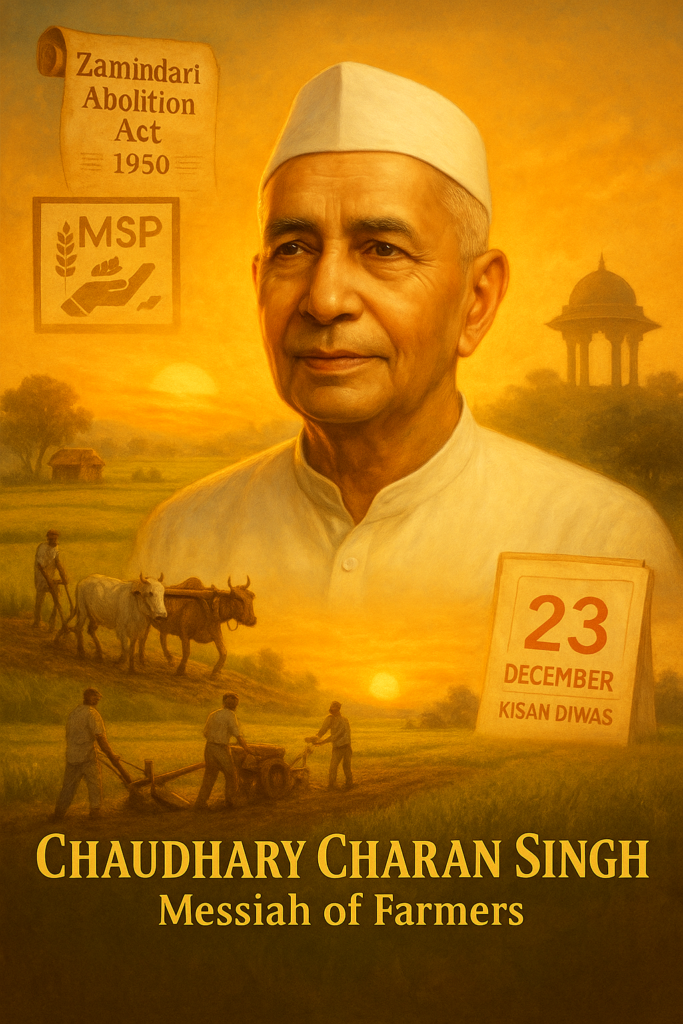
Chaudhary Charan Singh: Messiah of Farmers
🛒 Buy Now on AmazonChaudhary Charan Singh is known as the “Messiah of Farmers” in India because he dedicated his entire political life to protecting the rights, welfare, and empowerment of farmers. He was the first Prime Minister who placed villages and farmers at the centre of national policy, giving them dignity, voice, and rightful representation.
Deep Understanding of Farmer Life
Charan Singh belonged to a farmer family and had experienced the struggles of agriculture since childhood. He believed that farmers not only needed land but also security, respect, and opportunities. He always referred to farmers as the “backbone of India” and emphasized that the nation could progress only when its farmers were strong.
Major Works and Initiatives in the Interest of Farmers
1. Zamindari Abolition Act 1950
His greatest contribution was the abolition of the zamindari system in Uttar Pradesh. This revolutionary law gave land ownership rights to farmers and freed them from exploitation.
2. Priority to Agriculture
Charan Singh argued that agricultural development must come before industrial development. His policies focused on:
- Irrigation
- Agricultural loans
- Fair pricing for produce
- Agricultural research and technology
3. Minimum Support Price (MSP)
He emphasized the need for a reliable Minimum Support Price system so that farmers could receive fair prices for their crops.
4. Separate Political Identity for Farmers
He founded Lok Dal, giving farmers a strong political platform to raise their issues directly in Parliament.
Establishment of Farmers’ Day
In honour of Chaudhary Charan Singh, the Government of India declared 23 December (his birthday) as National Farmers’ Day (Kisan Diwas). The day is celebrated nationwide every year.
Ideology of Chaudhary Charan Singh
Charan Singh believed:
“India’s development is incomplete until its farmers are free from debt and exploitation.”
He believed that true self-reliance begins with the self-reliance of farmers through education, health, and economic security. His political views were deeply inspired by Mahatma Gandhi’s vision of rural Swaraj.
Why Is He Called the “Messiah of Farmers”?
- He treated farmers not as a vote bank but as the foundation of India.
- His policies and political struggles centred around farmers’ welfare.
- He never supported urban or industrialist-centric politics.
Why Do Farmers Remember Him Even Today?
- He gave farmers respect, identity, and political voice.
- His reforms still shape rural India.
- In every farmer movement, his name remains the first symbol of leadership.
Conclusion
In the true sense, Chaudhary Charan Singh was the “Messiah of Farmers.” His simplicity, principled politics, and lifelong dedication to villages and farmers continue to inspire generations. He was not only a politician but a thinker who believed that “Agriculture must be at the heart of India.”
Death of Chaudhary Charan Singh
Chaudhary Charan Singh, revered as the “Messiah of Farmers,” passed away on 29 May 1987 in New Delhi at the age of 85.
Cause of Death
His death was due to chronic illnesses and age-related health complications. In the last years of his life, he had withdrawn from active politics due to deteriorating health.
Funeral
His funeral was held in New Delhi with full state honours. Thousands of farmers, supporters, political leaders, and citizens attended to pay their respects. Leaders from all political parties participated, reflecting his universal respect and popularity.
Memorial Sites
A memorial named Kisan Ghat has been built in Delhi in his honour. It symbolizes his lifelong struggle for farmers. Every year on 23 December (Farmers’ Day), people gather here to pay tribute.
Legacy After Death
- His ideas continue to shape India’s agricultural policies and farmer movements.
- His son Chaudhary Ajit Singh and grandson Jayant Chaudhary have carried forward his political ideology.
Conclusion
Chaudhary Charan Singh may have left this world, but his thoughts, struggles, and farmer-centric ideology remain alive. His death marked the end of an era, but his vision continues to inspire millions in India.
23 December: Farmers’ Day (Kisan Diwas)
Every year on 23 December, India celebrates National Farmers’ Day (Kisan Diwas). This day commemorates the birth anniversary of Chaudhary Charan Singh, the fifth Prime Minister of India and the greatest champion of farmers.
Purpose of Celebrating Kisan Diwas
- To honour the contribution of farmers
- To address agricultural challenges
- To create awareness about farmer welfare
- To make society and government accountable toward agriculture
When and How Did Kisan Diwas Start?
In 2001, the Government of India declared 23 December as National Farmers’ Day. This date was chosen because Charan Singh was the foremost leader and guardian of farmers’ rights.
What Happens on Farmers’ Day?
- Awareness camps for farmers
- Workshops on modern agricultural techniques
- Award ceremonies for outstanding farmers
- Agricultural fairs and exhibitions
- Speech competitions in schools and colleges
Why Is Charan Singh’s Contribution Important?
- He abolished the zamindari system.
- He gave land ownership rights to farmers.
- His reforms financially empowered rural India.
He often said:
“Without farmers, India’s development is only a dream.”
Importance of Kisan Diwas Today
In modern times, when issues like agrarian crisis, debt, climate change, and MSP are widely discussed, Kisan Diwas reminds us to rethink these challenges and find solutions. It emphasizes that the welfare of farmers must be India’s top priority.
Conclusion
23 December—Kisan Diwas—is not just a celebration but a symbol of gratitude to farmers and a tribute to Chaudhary Charan Singh. It reminds us that India’s strength lies in the hands of those who toil in the fields.
Conclusion
Chaudhary Charan Singh was a great leader who devoted his entire life to farmers, workers, and rural India. He was not just a principled politician but a deep thinker, honest administrator, and a true representative of the people.
His greatest strength was his ability to understand the real needs of agrarian society and transform them into practical policies—whether it was abolishing the zamindari system, protecting farmers’ rights, or launching rural development schemes.
His life teaches us that politics is a sacred responsibility of public service, not merely a path to power. His moral values, simplicity, and farmer-centric approach continue to guide India even today.
Farmers’ Day (23 December), celebrated every year in his memory, is a living tribute to his ideology and reminds us that the true strength of India lies in its farmers. Chaudhary Charan Singh will always be remembered as the “Messiah of Farmers,” “Voice of the Villages,” and a “Symbol of Moral Politics.”
Frequently Asked Questions (FAQs)
1. who was Chaudhary Charan Singh?
Chaudhary Charan Singh was an Indian freedom fighter, farmer leader, statesman, and the fifth Prime Minister of India. He is widely remembered for his lifelong commitment to the welfare of farmers and rural development.
2. Why is Chaudhary Charan Singh called the "Messiah of Farmers"?
Chaudhary Charan Singh earned the title "Messiah of Farmers" because he introduced farmer-friendly policies, played a key role in abolishing the zamindari system, and consistently worked to improve the economic and social conditions of rural India.
3. What were the major contributions of Chaudhary Charan Singh?
His major contributions include the Zamindari Abolition Act, promotion of agricultural reforms, support for fair crop prices, rural development initiatives, and strengthening the political voice of farmers through farmer-centric policies.
4. How long did Chaudhary Charan Singh serve as Prime Minister?
Chaudhary Charan Singh served as the fifth Prime Minister of India from 28 July 1979 to 14 January 1980. Although his tenure was short, he remained committed to policies benefiting farmers and rural communities.
5. Why is National Farmers' Day celebrated on 23 December?
National Farmers' Day (Kisan Diwas) is celebrated every year on 23 December to commemorate the birth anniversary of Chaudhary Charan Singh and to honor his remarkable contributions to Indian agriculture and farmers' welfare.
6. What was Chaudhary Charan Singh's role in the Freedom Movement?
Chaudhary Charan Singh actively participated in the Indian freedom movement by joining the Indian National Congress, taking part in the Salt Satyagraha and Quit India Movement, and facing imprisonment several times for opposing British rule.
7. Why is Chaudhary Charan Singh important for UPSC and competitive exams?
Chaudhary Charan Singh is an important topic for UPSC, SSC, State PCS, and other competitive exams because of his role in the freedom struggle, land reforms, agricultural policies, rural development, and his tenure as Prime Minister of India.
References
- Government of India – National Farmers’ Day (Kisan Diwas) Notifications
- Lok Sabha Secretariat – Biographical Sketch of Chaudhary Charan Singh
- Ministry of Agriculture & Farmers Welfare – Policy Documents and Farmer Reforms
- “Abolition of Zamindari” – Chaudhary Charan Singh (Book)
- “India’s Poverty and Its Solution” – Chaudhary Charan Singh (Book)
- Historical Reports on the Zamindari Abolition Act, 1950 (Uttar Pradesh)
- Newspaper Archives & Public Speeches of Chaudhary Charan Singh