
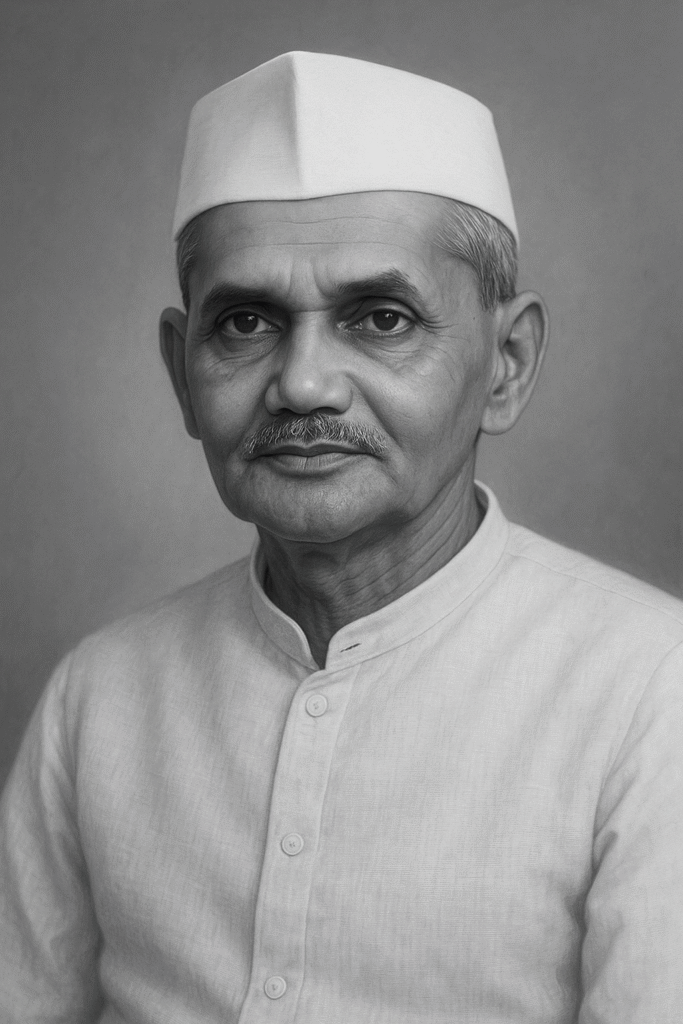
Who Was Lal Bahadur Shastri?
Lal Bahadur Shastri was the second Prime Minister of India who served from 1964 to 1966. He is known for his honesty, simple lifestyle, leadership during the Indo-Pak War of 1965, and the slogan “Jai Jawan, Jai Kisan.” He was posthumously awarded the Bharat Ratna in 1966.
Biography of Shri Lal Bahadur Shastri
Introduction
Lal Bahadur Shastri, India’s second Prime Minister, is remembered for his honesty, simplicity, and fearless leadership during the Indo-Pak War of 1965. His historic slogan “Jai Jawan, Jai Kisan” inspired both soldiers and farmers and became a symbol of national UNity. For UPSC aspirants, Shastri Ji’s life is highly important because it covers modern Indian history, ethics, governance, agriculture, and post-independence India.
Early Life
Lal Bahadur Shastri was born on 2 October 1904 in Mughalsarai (now Pandit Deen Dayal Upadhyay Nagar) in Uttar Pradesh. His father’s name was Sharda Prasad Srivastava, who initially worked as a school teacher and later as a clerk in the revenue department. His mother’s name was Ramdulari Devi.
Shastri ji lost his father when he was only one and a half years old. After this tragedy, he was raised at his maternal grandparents’ home in Mirzapur. From childhood, he was known for his simplicity, honesty, and strong determination.
Education
Shastri ji studied at Harishchandra High School in Varanasi. Deeply influenced by the national movement, he joined the Indian National Congress in 1920. Motivated by Gandhiji’s Non-Cooperation Movement, he left his formal education to participate actively.
Later, he completed his graduation from Kashi Vidyapeeth, where he was awarded the title “Shastri,” meaning “scholar.” He proudly kept this title as a permanent part of his name.
Contribution to the Freedom Struggle
Lal Bahadur Shastri ji played an active and courageous role in India’s freedom movement. He participated in several major movements led by Mahatma Gandhi:
Major Movements
- Non-Cooperation Movement (1920)
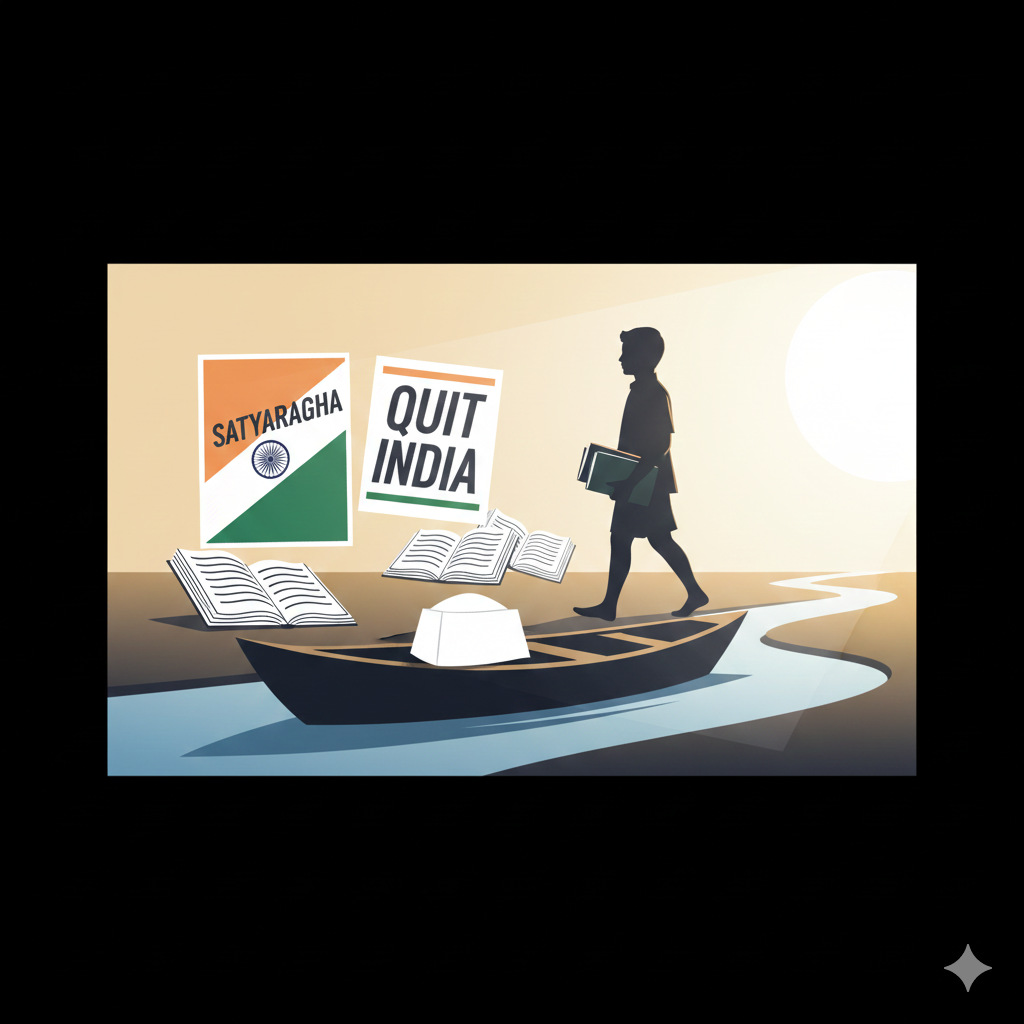
- Salt Satyagraha (1930)
- Quit India Movement (1942)
He was imprisoned multiple times for his participation and became known as a true patriot dedicated to India’s independence.
Political Life After Independence
Roles and Responsibilities
After independence, Shastri ji held several key positions:
1. Ministerial Roles in Uttar Pradesh
He served as both the Transport Minister and the Home Minister of Uttar Pradesh.
2. Railway Minister in Central Government
In 1951, he became India’s Railway Minister. After a major train accident, he resigned, taking full moral responsibility—an act that reflected his honesty, integrity, and accountability.
3. Prime Minister of India
After the death of Pandit Jawaharlal Nehru in 1964, Lal Bahadur Shastri became the second Prime Minister of India.
Major Achievements as Prime Minister
“Jai Jawan, Jai Kisan”
Shastri ji coined the historic slogan “Jai Jawan, Jai Kisan”, highlighting the importance of the soldiers and farmers who form the backbone of the nation.
Indo-Pak War of 1965
During the 1965 war with Pakistan, Shastri ji displayed exceptional courage and leadership. He boosted the morale of the Indian Army and united the nation during a critical period.
Promotion of the Green Revolution
He strongly supported the Green Revolution to help India become self-sufficient in food production, laying the foundation for long-term agricultural growth.
Death
Lal Bahadur Shastri passed away on 11 January 1966 in Tashkent (now in Uzbekistan), shortly after signing the India-Pakistan Peace Agreement, widely known as the Tashkent Agreement. His sudden death remains surrounded by mystery, raising questions even today.
Awards and Honors
In recognition of his immense contributions, he was posthumously awarded Bharat Ratna, India’s highest civilian honor.
Conclusion
Lal Bahadur Shastri ji was a true patriot, an honest statesman, and a leader of exceptional character. His life teaches us the values of simplicity, integrity, and dedication to duty. His iconic slogan, “Jai Jawan, Jai Kisan”, continues to motivate the nation even today.
Lal Bahadur Shastri UPSC Quick Facts
| Particular | Details |
|---|---|
| Full Name | Lal Bahadur Shastri |
| Born | 2 October 1904 |
| Birth Place | Mughalsarai, Uttar Pradesh |
| Prime Minister Tenure | 1964 – 1966 |
| Famous Slogan | Jai Jawan Jai Kisan |
| Major War | Indo-Pak War 1965 |
| Award | Bharat Ratna (Posthumous) |
| Died | 11 January 1966, Tashkent |
Early Life, Education and Freedom Struggle of Shri Lal Bahadur Shastri
Early Life of Shri Lal Bahadur Shastri
Lal Bahadur Shastri was born on 2 October 1904 in Mughalsarai, Uttar Pradesh, which is now known as Pandit Deen Dayal Upadhyay Nagar. He was born into a simple Brahmin family. His father, Sharda Prasad Srivastava, was an honest school teacher and later worked as a clerk in government service. His mother, Ramdulari Devi, was a religious and cultured woman.
Shastri ji’s life was filled with challenges from childhood. When he was just one and a half years old, his father passed away. After this tragic event, his mother took him to her maternal home in Mirzapur, where he was brought up. Despite financial struggles, his mother left no stone UNturned in giving him strong values and good education.
From childhood, Shastri ji was known to be honest, disciplined, humble and simple in nature. Despite his modest appearance, his thoughts and conduct were exceptionally high. He never believed in lying and always preferred truth and honesty. From an early age, he had a strong inclination toward patriotism and social service.
He completed his early education in Mughalsarai and Mirzapur. Due to the lack of money, he walked several kilometres every day to reach school, sometimes even crossing the Ganga river by boat. His dedication and hard work towards studies were evident from a young age.
When he reached Class 11, Mahatma Gandhi had launched the Non-Cooperation Movement across the country. Inspired by Gandhiji’s call, Shastri ji left his studies midway and joined the freedom struggle, raising his voice against British rule.
Later, he joined the famous institute Kashi Vidyapeeth, Varanasi, where he completed his studies and earned the title of “Shastri”. He added this title to his name, becoming widely known as Lal Bahadur Shastri.
Key Points (In Brief)
- Born: 2 October 1904, Mughalsarai (Uttar Pradesh)
- Parents: Ramdulari Devi and Sharda Prasad Srivastava
- Childhood: Financial struggle, father died early
- Education: Mirzapur and Varanasi; “Shastri” degree from Kashi Vidyapeeth
- Inspiration: Deeply influenced by Mahatma Gandhi
- Ideals: Truth, honesty, simplicity and service
Education of Shri Lal Bahadur Shastri
Lal Bahadur Shastri’s educational journey was filled with struggle yet full of inspiration. Although he belonged to a simple family with limited resources, his determination and passion for education were remarkable. He pursued studies even in difficult circumstances, preparing himself for a meaningful role in nation-building.
Elementary Education
Shastri ji’s early education began in Mughalsarai and Mirzapur. After his father’s death, he accompanied his mother to Mirzapur and joined a local school there. Due to the lack of transportation, he often walked long distances and crossed the river Ganga by boat to attend school.
He was a brilliant, disciplined, and honest student. Although financially weak, he was filled with curiosity and a deep hunger for knowledge. Along with academics, he gave great importance to moral values.
Secondary Education
Later, Shastri ji enrolled at Harishchandra High School, Varanasi, where he studied until Class 10. During this time, the Non-Cooperation Movement (1920) led by Mahatma Gandhi had begun. Gandhiji appealed to the countrymen to boycott British institutions. Inspired by patriotism, the 16-year-old Shastri left school and joined the movement.
Education at Kashi Vidyapeeth
Kashi Vidyapeeth, Varanasi, was established as an indigenous educational institution inspired by the spirit of Swadeshi and nationalism. Shastri ji took admission there and completed his graduation.
At Kashi Vidyapeeth, he studied political science, philosophy, history, and Sanskrit. Here he not only gained academic knowledge but also imbibed the values of patriotism, sacrifice, service, simplicity, and leadership.
After completing his graduation, he was awarded the title “Shastri”, traditionally given to scholars of Sanskrit. He adopted the title permanently, becoming known as Lal Bahadur Shastri.
Characteristics of His Educational Journey
- Strong passion for education, with continuous effort despite difficulties
- Deep influence of Gandhian philosophy
- Faith in indigenous education systems
- Placed morality, simplicity, and discipline above academic achievement
- Believed education should be a means of national service, not just a path to a job
Conclusion: Lal Bahadur Shastri’s education became the foundation of his personality. Along with academics, he gained invaluable lessons in ethics, patriotism, and character that shaped him into a visionary leader.
Contribution of Shri Lal Bahadur Shastri in the Freedom Struggle
Lal Bahadur Shastri’s contribution to India’s freedom struggle was extraordinary. He was a selfless, courageous, and patriotic freedom fighter Who dedicated his entire life to the nation. His sacrifices and leadership strengthened the foundation of the independence movement.
Inspiration from Mahatma Gandhi
Shastri ji was deeply inspired by Mahatma Gandhi’s principles of Swadeshi, truth, and non-violence. When Gandhiji launched the Non-Cooperation Movement in 1920, the young Shastri courageously decided to leave school and join the movement.
Participation in Major Movements
1. Non-Cooperation Movement (1920)
- Shastri ji actively participated in the movement against British rule.
- He boycotted colonial educational institutions.
- He was jailed for the first time but remained undeterred.
2. Salt Satyagraha (1930)
- He supported Gandhiji’s Dandi March and helped organise protests in Varanasi.
- He openly violated the salt laws.
- He was arrested and sentenced to two and a half years in prison.
3. Quit India Movement (1942)
- On 8 August 1942, Gandhiji gave the slogan “Do or Die.”
- Shastri ji led underground activities and motivated youth to join the struggle.
- He was again arrested and spent another two and a half years in prison.
Prison Life and Organisational Capacity
Shastri ji spent nearly nine years in prison during the freedom struggle. While in jail, he devoted himself to self-study, reading the Vedas, Upanishads, Gita, and western political philosophy. He turned the prison into a centre of learning and introspection.
Spirit of Service to the Nation
Shastri ji never supported violence, nor did he desire fame or power. His only goal was the complete independence of India and dedicated public service.
Other Significant Contributions
- Inspired by Lokmanya Tilak, Gandhiji, and Pandit Jawaharlal Nehru.
- Organised and motivated young freedom fighters.
- Became an active and committed worker of the Indian National Congress.
Conclusion: Lal Bahadur Shastri’s role in the freedom movement extended far beyond participation. He was an ideal revolutionary, a true patriot, and a peaceful warrior. His sacrifices and leadership contributed significantly to India’s independence.
Political Life of Shri Lal Bahadur Shastri
The political life of Lal Bahadur Shastri was a symbol of honesty, simplicity, dedication and service. The values he learned during the freedom struggle were the same values he practised in independent India. He believed politics was not a medium of power but a sacred path of public service.
Entry into Politics
After actively participating in the freedom movement, Shastri ji officially began his political journey with the Indian National Congress. He became a close associate of prominent leaders such as Mahatma Gandhi, Pandit Jawaharlal Nehru and Sardar Patel. He served as a loyal, hardworking and responsible worker within the organisation.
Political Role in Uttar Pradesh
After India's independence in 1947, Lal Bahadur Shastri became a minister in the Uttar Pradesh government. He served as the Minister of Police and Minister of Transport.
As Minister of Transport
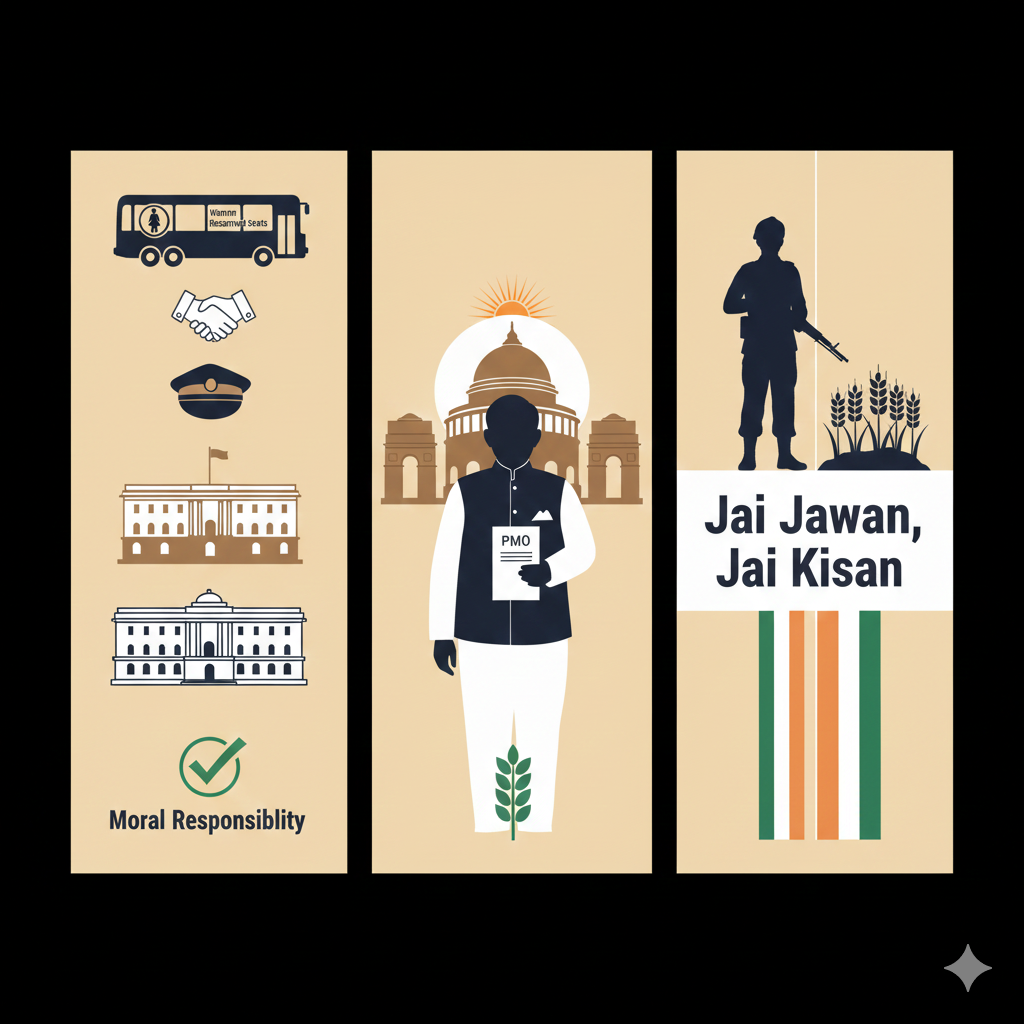
- He became the first minister to reserve seats for women in buses.
- He implemented several reforms to make public transport systematic and accessible.
As Home Minister
- He worked on improving and reforming the police department.
- He strengthened trust between the public and the police.
Contribution to the Central Government
In 1951, Pandit Jawaharlal Nehru called Shastri ji to the central government and entrusted him with several major ministries.
Key Ministries Held
1. Railway Minister (1951–1956)
- Expanded the railway network and ensured affordable travel for common people.
- Resigned on moral groUNds after a railway accident — a powerful example of integrity.
2. Other Key Portfolios
- Home Minister (Interim)
- Minister of Transport and Communications
- Minister of Commerce and Industry
In every ministry, he demonstrated reformist thinking and excellent administrative ability.
Nehru’s Trusted Associate
- Shastri ji was one of the closest and most trusted associates of Prime Minister Nehru.
- He was often regarded as a “troubleshooter” due to his calm and composed decision-making.
Prime Minister of India (1964–1966)
After the death of Pandit Jawaharlal Nehru on 27 May 1964, Lal Bahadur Shastri became the second Prime Minister of India on 9 June 1964.
Major Achievements as Prime Minister
1. “Jai Jawan, Jai Kisan”
In 1965, during the war with Pakistan and the food crisis, Shastri ji gave the historic slogan “Jai Jawan, Jai Kisan”. It boosted the morale of both soldiers and farmers — the backbone of the nation.
2. Leadership in the Indo-Pak War (1965)
When Pakistan attacked India, Shastri ji displayed exceptional courage and decisive leadership. The Indian Army responded strongly and effectively under his guidance. After the war, he signed the Tashkent Agreement, a major step toward peace.
3. Tackling the Food Crisis
- India was facing a severe food shortage during his tenure.
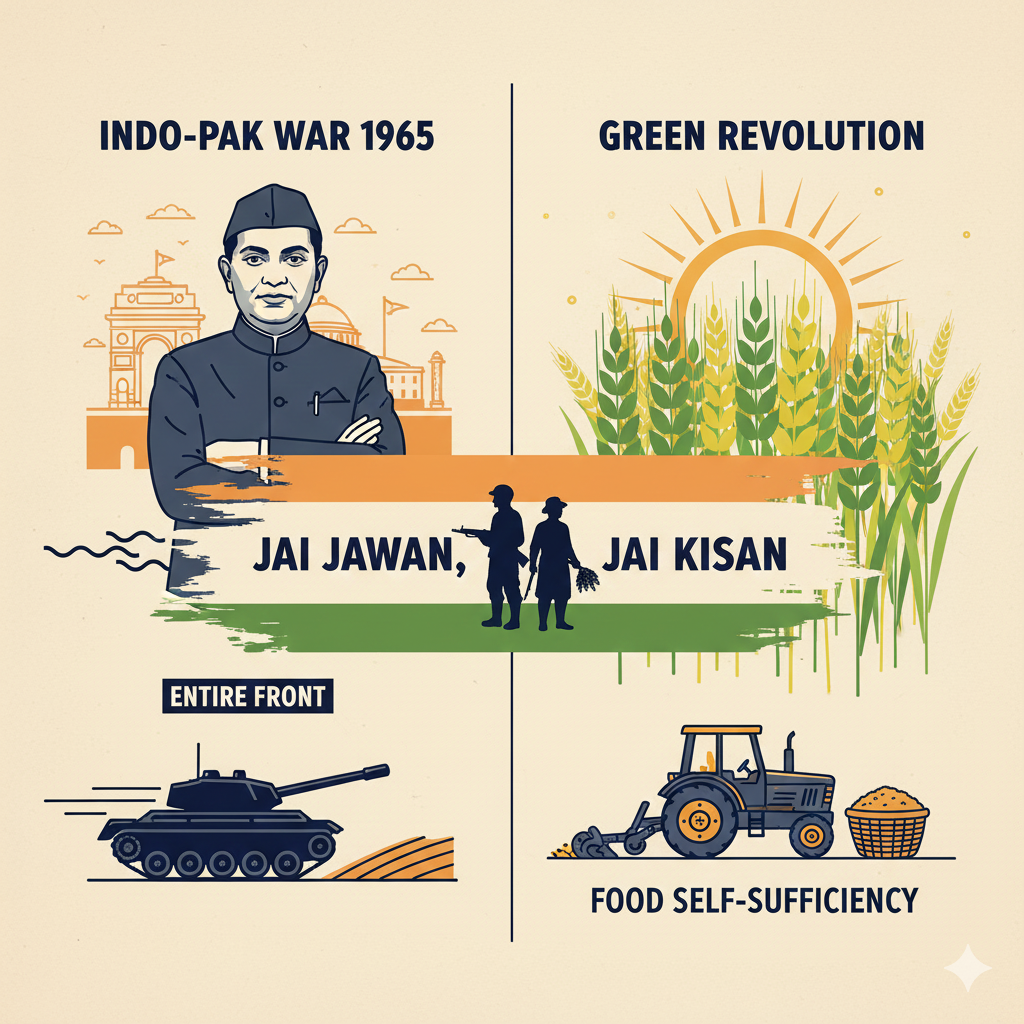
- He encouraged the Green Revolution, which made India self-sufficient in food production.
- He appealed to citizens to observe voluntary fasting once a week — a practice he followed himself.
Demise and Legacy
Shastri ji passed away on 11 January 1966 in Tashkent (Uzbekistan), shortly after signing the peace agreement. His sudden death remains a mystery even today.
He was posthumously awarded the Bharat Ratna.
Conclusion: The political life of Lal Bahadur Shastri is an ideal example of how simplicity, integrity and service-oriented leadership can guide a nation. His honesty, humility and perseverance continue to inspire Indian politics.
Major Achievements of Shri Lal Bahadur Shastri as Prime Minister
Shri Lal Bahadur Shastri served as the second Prime Minister of India from 1964 to 1966. Although his tenure was short, it was historically impactful. His courage, vision, honesty and policy firmness strengthened India during internal and external crises.
1. The Historic Slogan: “Jai Jawan, Jai Kisan”
- Given during the Indo-Pak war of 1965.
- Honoured soldiers and farmers equally.
- Awakened nationalism and encouraged self-reliance.
2. Leadership in the Indo-Pak War (1965)
- Pakistan launched attacks, especially targeting Kashmir.
- Shastri ji showed fearless and decisive leadership.
- The Indian Army pushed Pakistani forces back and advanced towards Lahore.
3. The Tashkent Agreement
- Signed in January 1966 to restore peace between India and Pakistan.
- Shastri ji’s commitment to peace was appreciated globally.
- Sadly, he passed away shortly after signing the agreement.
4. Tackling the Food Crisis & Green Revolution
- India faced a severe food shortage during his tenure.
- He encouraged scientists like Dr. M.S. Swaminathan.
- Laid the foundation of the Green Revolution.
- Promoted voluntary fasting to save food resources.
5. Simplicity & Ethical Leadership
- Lived a simple life even as Prime Minister.
- Never misused his position or privileges.
- Set examples of moral responsibility, such as resigning as Railway Minister.
6. Strengthening National Unity & Discipline
- Appealed for unity during national crises.
- Provided moral and emotional strength to the nation.
7. Administrative Reforms
- Promoted transparency in government functioning.
- Expected ministers and officials to work with integrity.
Conclusion: Though short, Shastri ji’s tenure as Prime Minister was transformative. He provided direction to the nation in times of crisis and proved that true leadership is defined by character, not position.
“Jai Jawan, Jai Kisan” – A Historic Slogan
“Jai Jawan, Jai Kisan” is not just a slogan — it is a symbol of India's self-respect, resilience and patriotism. Coined by Shri Lal Bahadur Shastri, it honoured the two pillars of the nation: soldiers and farmers.
When and Why Was the Slogan Given?
The slogan was given during the Indo-Pak War of 1965. At that time, India was facing two challenges:
- External: War with Pakistan
- Internal: Food shortage and famine-like conditions
Shastri ji gave this powerful slogan to motivate the nation:
“Jai Jawan, Jai Kisan” – Hail the Soldier, Hail the Farmer
Meaning of the Slogan
“Jai Jawan”
Recognises the sacrifices of soldiers Who protect India’s borders day and night.
“Jai Kisan”
Honours farmers who provide food to the nation and form the backbone of India’s economy.
The slogan beautifully connects national security with food security.
Social and Political Impact
- United people across caste and class.
- Boosted the morale of soldiers.
- Gave respect and pride to farmers.
- Inspired the Green Revolution in India.
Relevance in Today’s Context
- Still important during national security challenges.
- Reminds us of the significance of farmers when food crises arise.
Conclusion: “Jai Jawan, Jai Kisan” has become a national mantra. It reflects Shastri ji’s patriotism, simplicity and farsightedness. This slogan continues to live in the hearts of every Indian.
Contribution of Shri Lal Bahadur Shastri in Indo-Pak War 1965
During the Indo-Pak War of 1965, Prime Minister Lal Bahadur Shastri demonstrated remarkable leadership, strong willpower and deep patriotism. The war was a major political, military and diplomatic challenge for India, and Shastri ji led the nation with calmness, courage and determination.
BackgroUNd of the War
- In 1965, Pakistan launched Operation Gibraltar to infiltrate Kashmir.
- The objective was to incite rebellion in the Kashmir Valley and destabilize India.
- India strongly protested and ordered the military to give a firm response.
Shastri Ji’s Response
Firm and Bold Decisions
Shastri ji declared:
“If Pakistan thinks it can fight only in Kashmir, it is mistaken. We will respond on the entire front.”
- He allowed the Indian Army to respond not only in Kashmir, but also across the border.
- Under his command, India attacked strategic areas like Lahore and Sialkot.
Political and Military Unity
- He provided complete freedom and full political support to the Army, Navy and Air Force.
- The Indian Army advanced rapidly and reached the outskirts of Lahore.
Self-Reliance and Public Sensitivity
- Despite a severe food crisis, he appealed to the public for sacrifice and unity.
- He personally followed a simple lifestyle to inspire the nation.
Declaration of “Jai Jawan, Jai Kisan”
During the war and the food crisis, Shastri ji gave the historic slogan:
“Jai Jawan, Jai Kisan”
- It boosted the morale of soldiers and farmers.
- It ignited a wave of patriotism, discipline and confidence across the nation.
Result of the War
- The Indian Army achieved a decisive strategic advantage.
- After 22 days of intense conflict, the UN intervened and a ceasefire was announced.
- India preserved its territorial integrity and foiled Pakistan’s infiltration plan.
Tashkent Agreement
- In January 1966, Shastri ji met Pakistan’s President General Ayub Khan in Tashkent (Soviet Union).
- The discussions led to the Tashkent Agreement, aimed at restoring peace.
- On the night of 11 January 1966, Shastri ji passed away suddenly in Tashkent — a mystery even today.
Conclusion
During the Indo-Pak War of 1965, Lal Bahadur Shastri proved that strong, decisive leadership can coexist with simplicity and humility. His strategic vision, trust in the armed forces, and devotion to the nation brought India not only military victory but also national pride.
Green Revolution
The Green Revolution was a historic turning point in India’s agricultural history. It freed India from hunger, famine and dependency on grain imports, helping the nation achieve self-sufficiency in food production. Along with scientists and policymakers, Prime Minister Lal Bahadur Shastri played a crucial role in shaping its policies and inspiring farmers.
Meaning of Green Revolution
The Green Revolution refers to:
The rapid increase in food grain production through new technology, improved seeds, chemical fertilizers, pesticides and modern irrigation methods.
When and Why Did the Green Revolution Begin?
Background
- In the early 1960s, India faced a severe food crisis.
- The country depended heavily on foreign aid, such as U.S. wheat under the PL-480 program.
- Floods, droughts and traditional farming methods caused low production.
The Need for a Solution
Scientists and policymakers realised that only advanced agricultural techniques could overcome the crisis. This led to the beginning of the Green Revolution.
Initiation and Leadership
Principal Scientist
- Dr. M.S. Swaminathan is considered the “Father of the Green Revolution in India.”
- He introduced High Yielding Varieties (HYV) of wheat developed by american scientist Norman Borlaug.
Political Advocacy
- Lal Bahadur Shastri motivated farmers through the slogan “Jai Jawan, Jai Kisan.”
- He promoted technological innovation and self-reliance in agriculture.
Main Components of the Green Revolution
- HYV (High Yielding Variety) seeds
- Use of chemical fertilizers and pesticides
- Modern irrigation systems (canals, tube wells, etc.)
- Agricultural mechanisation (tractors, harvesters, etc.)
- Government support and agricultural loans
- Minimum Support Price (MSP) system
Impact of the Green Revolution
Positive Effects
| Area | Achievement |
|---|---|
| Food Grain Production | Wheat and rice production increased significantly |
| Self-Reliance | India became self-sufficient in food grains |
| Farmer Income | Income of many farmers increased |
| Employment | Boost to agro-based industries |
| Hunger Reduction | Famine-like conditions drastically reduced |
Negative Effects
| Area | Problem |
|---|---|
| Regional Inequality | Punjab, Haryana and Western UP benefitted the most |
| Natural Resources | Overexploitation of groundwater |
| Soil Fertility | Loss due to excessive chemical use |
| Health | Impact of pesticide overuse |
Current Importance
Today, when India faces climate change and agrarian distress, a new sustainable green revolution is needed. Emphasis must now be on organic farming, water conservation and natural farming.
Conclusion
The Green Revolution transformed India from a hunger-stricken nation into a food-surplus exporter. It was not just a technological movement but also a symbol of national pride and self-reliance. The vision of leaders like Lal Bahadur Shastri and the dedication of scientists made this agricultural miracle possible.
FAQs on Lal Bahadur Shastri
1. Why is Lal Bahadur Shastri important for UPSC?
Lal Bahadur Shastri is important for UPSC because of his role in the freedom struggle, Indo-Pak War 1965, Green Revolution, and ethical leadership.
2. What is the famous slogan of Lal Bahadur Shastri?
His famous slogan was “Jai Jawan, Jai Kisan,” which honored soldiers and farmers.
3. When did Lal Bahadur Shastri become Prime Minister?
Lal Bahadur Shastri became the second Prime Minister of India in 1964 after Jawaharlal Nehru’s death.
4. What was the cause of Lal Bahadur Shastri’s death?
Officially, Lal Bahadur Shastri died due to a heart attack in Tashkent on 11 January 1966, though many controversies still exist.
5. Which award was given to Lal Bahadur Shastri?
He was posthumously awarded the Bharat Ratna, India’s highest civilian award, in 1966.
6. What was Lal Bahadur Shastri’s role in the Green Revolution?
He encouraged agricultural reforms and supported policies that laid the foundation for the Green Revolution in India.
7. What lessons can UPSC aspirants learn from Lal Bahadur Shastri?
UPSC aspirants can learn honesty, simplicity, ethical governance, leadership, and dedication to national service from Lal Bahadur Shastri.
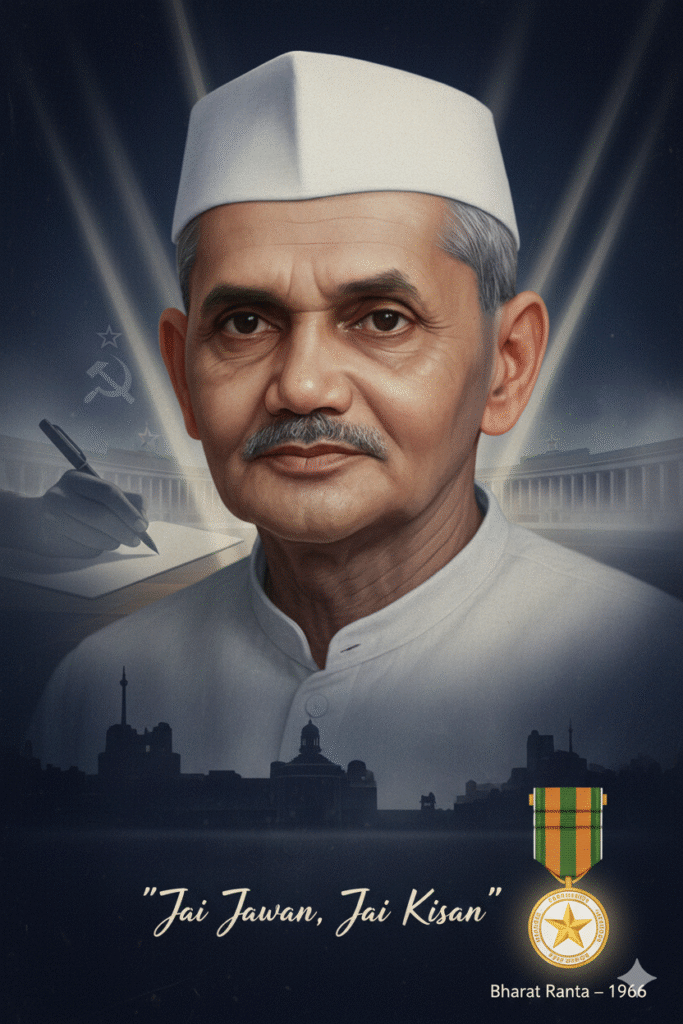
Death of Lal Bahadur Shastri – A Mysterious Event
Shri Lal Bahadur Shastri, the second Prime Minister of India, was known as an honest, simple and determined leader. His sudden death on 11 January 1966 shocked not only India but the entire world. Even today, his death remains surroUNded by mystery, raising many unanswered questions.
Circumstances of His Death
After the Indo-Pak War of 1965, efforts were made to establish peace between the two nations. A peace conference was held in Tashkent, Soviet Union, under the mediation of Soviet leader Alexei Kosygin. Prime Minister Lal Bahadur Shastri and Pakistan’s President General Ayub Khan participated in the discussions.
Tashkent Agreement
- The Tashkent Agreement was signed on 10 January 1966 between India and Pakistan.
- Both countries agreed to a ceasefire, withdrawal of troops and restoration of normal relations.
- A few hours after signing the agreement, Shastri ji died suddenly at 1:32 AM—officially reported as a heart attack.
Questions Raised on His Death
Several unusual circumstances led to suspicion:
- No post-mortem was conducted—highly unusual for a national leader.
- According to his family, there were blue marks, burn marks and injuries on his body—suggesting possible poisoning.
- Government secrecy: Many official files related to Shastri’s death remain classified even today.
- Rumours of poisoning through food or tea prepared by a Russian cook were never properly investigated.
Doubts of Family and Public
- His wife, Lalita Shastri, and his sons openly said they did not believe it was “just a heart attack.”
- Numerous RTI applications and investigation demands have been raised, but no conclusive findings have been made public.
Impact of His Demise
- The country was shocked by the sudden loss of a beloved leader.
- After Shastri ji’s death, Indira Gandhi became the third Prime Minister of India.
- His image of honesty, simplicity and patriotism became immortal.
Conclusion
The death of Lal Bahadur Shastri remains one of the greatest mysteries in Indian political history. Though his loss was irreparable, his patriotism, integrity and leadership continue to inspire millions. His unforgettable slogan:
“Jai Jawan, Jai Kisan”
still echoes in the hearts of every Indian.
Lal Bahadur Shastri – Awards and Honours
Lal Bahadur Shastri was a symbol of honesty, simplicity and dedication. His contribution to politics, agriculture and national security earned him great respect and numerous honours.
National Awards and Honours
1. Bharat Ratna – 1966
The Bharat Ratna, India’s highest civilian honour, was awarded to him posthumously in 1966. He received this award for his extraordinary service to the nation, his leadership during the Indo-Pak War and his remarkable contribution to national development.
2. Honour for Agricultural Reforms
- Shastri ji promoted agricultural reforms and encouraged the start of the Green Revolution.
- These efforts helped India become self-sufficient in food grain production.
- For his visionary role in agriculture, he earned enormous respect nationwide.
Global Honours
1. Recognition from the Soviet Union
- The Soviet Union appreciated Shastri ji’s role in the Tashkent Agreement.
- He was honoured for promoting peace, stability and India’s sovereignty.
2. International Respect
- Countries across the world admired his simplicity, self-reliance and leadership.
- He emerged as a respected representative of India on the global stage.
Honouring His Policies and Slogan
“Jai Jawan, Jai Kisan” – A National Tribute
- The slogan reflects his patriotism and deep respect for soldiers and farmers.
- His message helped strengthen national unity and pride.
Social Reforms and National Integration
- Shastri ji worked for the upliftment of farmers, labourers and weaker sections.
- He promoted equality and harmony, discouraging religious and social discrimination.
Other Honours
- Praised and respected by the Indian National Congress.
- Admired by the general public for his leadership, simplicity and moral character.
Conclusion
The awards and honours received by Lal Bahadur Shastri reflect the greatness of his service and his selfless dedication to India. His Bharat Ratna is a symbol of the nation’s gratitude for his lifelong sacrifice and leadership.
Conclusion of Lal Bahadur Shastri
The life of Lal Bahadur Shastri was a shining example of dedication, simplicity and honesty. He was not only a great Prime Minister but also an inspirational leader Whose policies and ideals continue to guide the nation.
Simplicity and Honesty
Shastri ji lived a life free from luxury, extravagance and corruption. Even as Prime Minister, he personally ensured that no unnecessary expenditure was made. His lifestyle was simple, modest and inspiring.
Dedication to the Nation
- He worked tirelessly for soldiers, farmers and labourers.
- “Jai Jawan, Jai Kisan” reflects his love for the people of India.
- He honoured the bravery of Indian soldiers in the 1965 Indo-Pak War and helped protect India’s sovereignty.
Leadership and Vision
- He promoted agricultural self-sufficiency through the Green Revolution.
- His policies strengthened India’s unity, economy and food security.
- He believed deeply in self-reliance and national integrity.
Demise and Mystery
His sudden death in Tashkent on 11 January 1966 remains a mystery. Though the cause is still debated, his demise was a tremendous loss to the nation.
Final Conclusion
Lal Bahadur Shastri’s life represents patriotism, simplicity, humility and unwavering dedication. His leadership proved that extraordinary achievements can be made through honesty and moral strength. Under his guidance, India achieved military success and took major steps toward food self-sufficiency.
His spirit lives on in the timeless slogan:
“Jai Jawan, Jai Kisan”
This message continues to inspire India’s defence and agricultural sectors and will remain a guiding light for generations.
References
- Government of India Archives
- Lal Bahadur Shastri National Memorial
- Lok Sabha Secretariat – Prime Ministers of India
- Ministry of External Affairs – Indo-Pak Relations (1965)
- Indian CoUNcil of Agricultural Research – Green Revolution Reports
- Public Records on Tashkent Agreement, 1966
- Books: “Lal Bahadur Shastri: A Life of Truth” “The Tashkent Files – Historical Documents”
Frequently Asked Questions (FAQs)
1. Who was Lal Bahadur Shastri?
Lal Bahadur Shastri was the second Prime Minister of India, serving from 1964 to 1966. He was widely respected for his honesty, simplicity, and strong leadership during the Indo-Pak War of 1965.
2. Why is Lal Bahadur Shastri famous?
Lal Bahadur Shastri is best known for giving the slogan "Jai Jawan, Jai Kisan," leading India during the 1965 Indo-Pak War, promoting the Green Revolution, and setting an example of ethical and responsible leadership.
3. What is the meaning of "Jai Jawan, Jai Kisan"?
"Jai Jawan, Jai Kisan" means "Hail the Soldier, Hail the Farmer." The slogan recognizes the vital contributions of soldiers in protecting the nation and farmers in ensuring food security.
4. What was Lal Bahadur Shastri's role in the Green Revolution?
Lal Bahadur Shastri encouraged agricultural reforms and supported policies that laid the foUNdation for the Green Revolution, helping India achieve self-sufficiency in food production.
5. How did Lal Bahadur Shastri die?
Lal Bahadur Shastri died on 11 January 1966 in Tashkent, shortly after signing the Tashkent Agreement. The official cause of death was a heart attack, although his death remains a subject of public debate.
6. Which award was given to Lal Bahadur Shastri?
Lal Bahadur Shastri was posthumously awarded the Bharat Ratna, India's highest civilian award, in 1966 for his outstanding service to the nation.
7. Why is Lal Bahadur Shastri important for UPSC preparation?
Lal Bahadur Shastri is an important topic for UPSC because of his role in India's freedom struggle, ethical governance, the Indo-Pak War of 1965, the Green Revolution, and post-independence political history.