
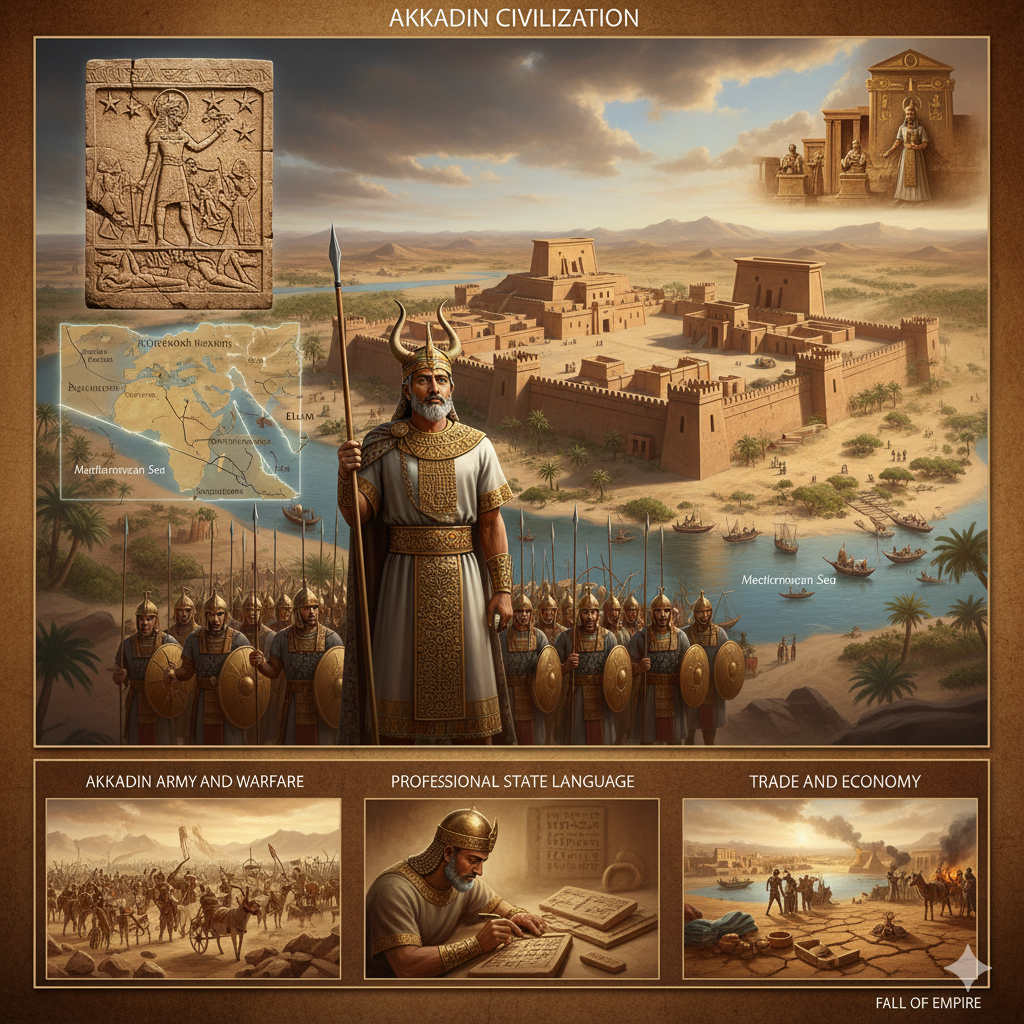
Akkadian Civilization: History, Characteristics and Importance
The Akkadian Civilization was the first consolidated imperial civilization of ancient Mesopotamia. This civilization flourished from around 2334 BC to 2154 BC and was founded by the king Sargon the Great. The Akkadians succeeded the Sumerian civilization, and their culture, language and administrative system had a profound influence on later civilizations such as the Babylonian and Assyrian empires.
1. The Rise of the Akkadian Civilization
a) Historical Background
- The Akkadian Empire was established by Sargon the Great around 2334 BC.
- Sargon the Great conquered the Sumerian city-states and created a unified empire.
- He made a city called Akkad his capital, which has not yet been conclusively discovered archaeologically.
b) Geographical Location
- This civilization was settled in Mesopotamia (present-day Iraq), between the Tigris and Euphrates rivers.
- The fertile land was suitable for agriculture, and the rivers and canals were important for trade and communication.
2. Main Features of the Akkadian Civilization
a) System of Governance
- The Akkadian state was based on a strong monarchical system.
- The king was considered the representative of the gods.
- The administrative system was well-organised, and the taxation system was systematic.
- The empire was divided into provinces, ruled by local governors appointed by the king.
b) Language and Script
- The main language of the Akkadian civilization was Akkadian, which belonged to the Semitic language family.
- This language was written in cuneiform script, which the Akkadians adopted and adapted from the Sumerians.
- The Akkadian language later became the dominant written and administrative language in the Babylonian and Assyrian civilizations as well.
c) Art and Architecture
- During the Akkadian period, sculpture and architecture developed significantly.
- The famous artifact “Victory Stele of Naram-Sin” is a prime example of Akkadian artistic achievement.
- Temples, palaces and other grand structures were built, reflecting the power and prestige of the empire.
d) Religion and Religious Beliefs
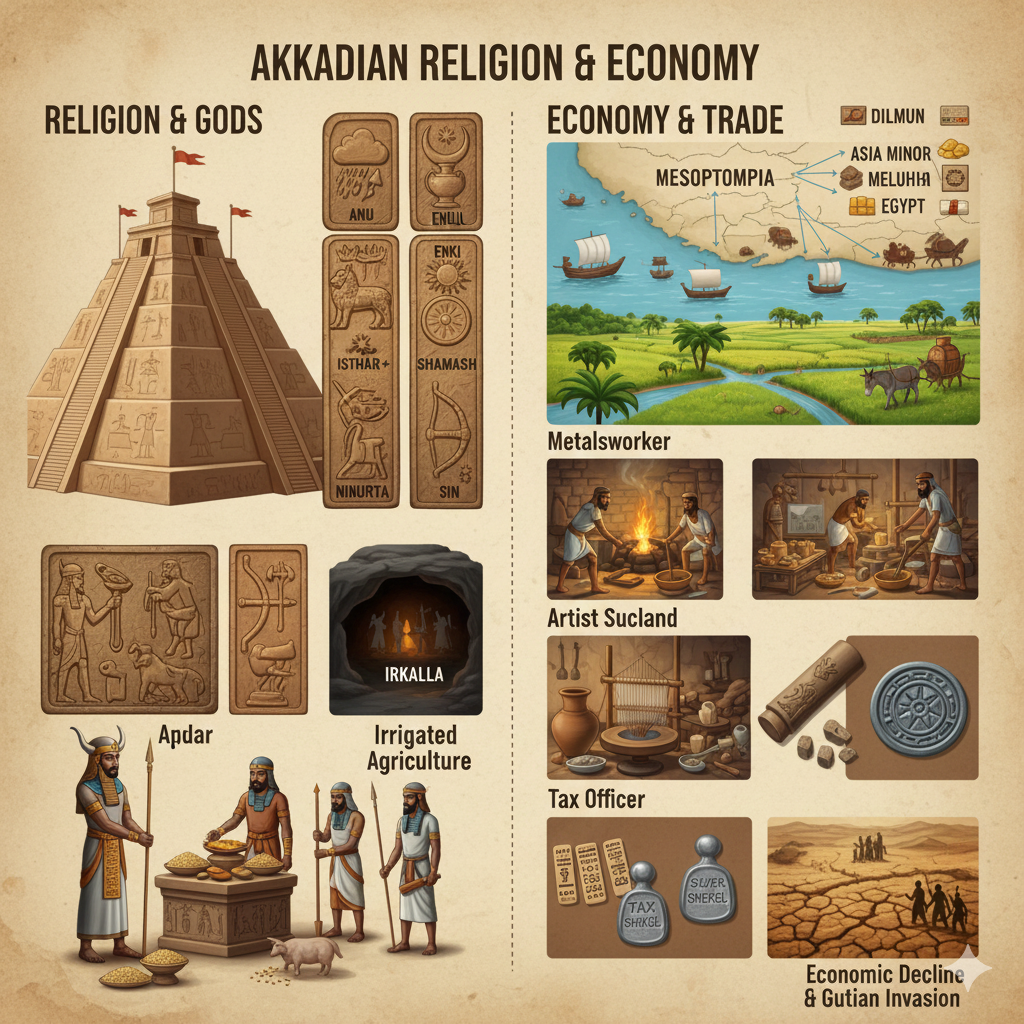
- The Akkadian civilization followed polytheism, worshipping many gods.
- Main deities included Enlil, Inanna, Shamash and Marduk.
- The king was worshipped and honoured as the representative of the gods on earth.
e) Economy and Trade
- Agriculture was the main economic activity, and crops such as barley, wheat and dates were cultivated.
- Trade was well developed. Akkadian merchants traded with regions such as Iran, India, Egypt and Asia Minor.
- In trade, copper, gold, silver, wood and stone were among the most important commodities.
3. The Decline of the Early Akkadian Civilization
a) Internal Causes
- The empire had become very large, making administrative control difficult.
- Internal rebellions and conflicts in the provinces began to increase.
- Weak successors were unable to maintain the same level of central authority as the earlier great rulers.
b) External Invasion
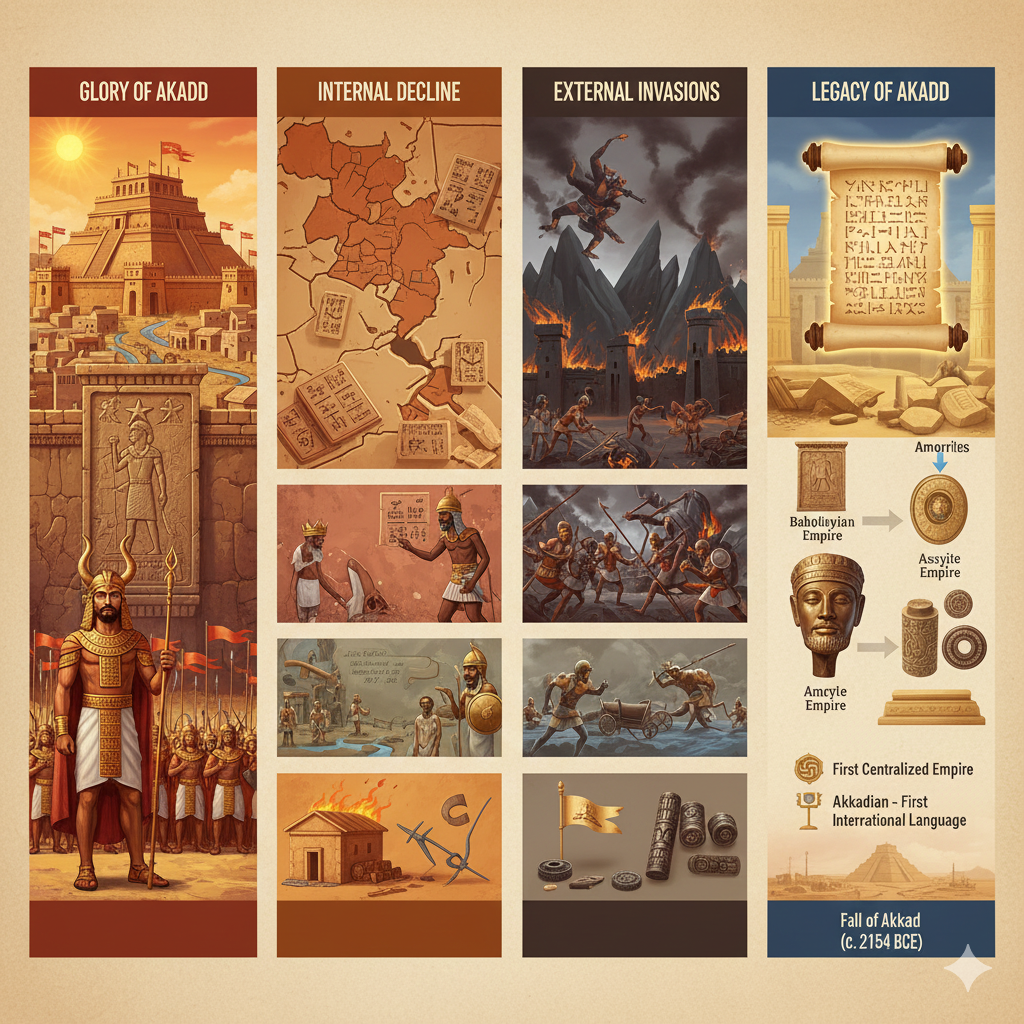
- The Akkadian Empire came under attack by the Gutian tribes from the Zagros Mountains.
- These invasions gradually weakened the empire’s political and military structure.
- Around 2154 BC, the Gutians effectively ended Akkadian imperial rule in Mesopotamia.
4. The Importance of the Akkadian Civilization
- It is often regarded as the world’s first true empire, presenting a new model of centralized administration.
- The Akkadian language later gave rise to the Babylonian and Assyrian variants of Akkadian.
- This civilization influenced many later empires in administrative, military and cultural terms.
Conclusion
The Akkadian civilization was one of the most influential and powerful civilizations of the ancient world. This empire, founded by Sargon the Great, holds an important place not only in the history of Mesopotamia but in the history of the entire world. Its administrative system, language, art and culture deeply influenced many future civilizations. Although this civilization ended with the invasion of the Gutians, its legacy lived on for centuries through later Mesopotamian empires.
History of the Akkadian Civilization
The Akkadian Civilization is considered the world’s first imperial civilization, which established a powerful empire in Mesopotamia (present-day Iraq) and ruled roughly from 2334 BC to 2154 BC. The empire was founded by Sargon the Great, who unified the Sumerian city-states to create a strong central authority. The Akkadian civilization emerged as a link between the Sumerian and Babylonian civilizations and became famous for its administrative efficiency, military conquests, language and cultural influence.
1. The Rise of the Akkadian Civilization (Detailed)
a) Sargon the Great and the Founding of the Empire
- Sargon the Great established the Akkadian Empire around 2334 BC.
- He began his career in a minor position in the court of King Ur-Zababa of Kish.
- Gradually, he rose to power as a strong military leader and started conquering Sumerian cities.
- He took control of major cities such as Ur, Uruk, Lagash and Nippur.
- Eventually, he defeated the Sumerian king Lugal-Zagezi and brought the whole region under his control.
b) Capital – Akkad
- Sargon the Great made the city of Akkad his capital, located between the Tigris and Euphrates rivers.
- This city became a prosperous and advanced trading and administrative centre.
- However, the exact archaeological remains of Akkad have not yet been definitively identified.
c) Expansion of the Empire
- Sargon extended the Akkadian Empire west to the Mediterranean Sea, north to Asia Minor (present-day Turkey), and east to Elam (present-day Iran).
- He organised a strong army composed of professional soldiers and trained cavalry units.
- Throughout the empire, he developed roads, reservoirs and trade routes, which strengthened commerce and communication.
2. The Golden Age of the Akkadian Empire
a) Administrative Set-up
- The Akkadian Empire developed a centralized system of governance.
- The empire was divided into various provinces, each governed by officials loyal to the king.
- A well-organised administrative structure managed tax collection, army organisation and long-distance trade.
b) Military Power and Conquests
- After Sargon, his sons Rimush and then Manishtushu ruled the empire.
- Later, Naram-Sin (2254–2218 BC) took power and strengthened the empire further.
- Naram-Sin declared himself “King of the Four Quarters”, symbolising rule over the whole known world.
- He expanded the empire towards Elam, Syria and Anatolia.
- Naram-Sin was one of the first rulers in Mesopotamian history to declare himself a god.
c) Economic and Cultural Prosperity
- Agriculture, trade and craft industries flourished during the Akkadian Golden Age.
- Akkadian merchants travelled for trade to regions such as the Indus Valley (in present-day India and Pakistan), Egypt, Iran and Asia Minor.
- Great works of art and architecture were produced; the famous “Victory Stele of Naram-Sin” is a key example.
- The Akkadian language became the official administrative language throughout Mesopotamia.
3. The Fall of the Akkadian Empire
a) Internal Conflicts and Administrative Weakness
- Naram-Sin was succeeded by his son Shar-Kali-Sharri (2217–2193 BC), who struggled to maintain control.
- The central administration weakened, and rebellions began to occur in different provinces.
- Internal political instability reduced the empire’s ability to respond to external threats.
b) Gutian Invasion
- Around 2154 BC, the Gutians, a people from the Zagros Mountains, attacked Akkad.
- They defeated the Akkadian army and devastated the capital city.
- Continuous Gutian pressure contributed significantly to the final collapse of the Akkadian Empire.
c) Climate Change and Famine
- Scientific research suggests that this period also witnessed severe drought and climate change.
- These environmental changes damaged agriculture and reduced food production.
- Water sources dried up, famine spread and the population suffered greatly.
- This ecological crisis further weakened the empire and made it an easy target for external invaders.
4. The Legacy of the Akkadian Civilization
a) Language and Script
- The Akkadian language became the first widely used state language of Mesopotamia.
- Later Babylonian and Assyrian civilizations adopted and adapted the Akkadian language.
- The language continued to be written in cuneiform script on clay tablets.
b) Administrative and Military Traditions
- Later civilizations, such as the Babylonian and Assyrian empires, adopted the Akkadian administrative system and many of its military strategies.
- The concept of a centralized government, provincial division and a standing army later appeared in other great empires, including the Persian and Roman empires.
c) Art and Culture
- Important achievements in sculpture and architecture during the Akkadian period were continued and refined in the Assyrian and Babylonian civilizations.
- Artifacts such as Naram-Sin’s victory stele are still studied by historians and archaeologists to understand ancient imperial ideology and art.
Final Conclusion
The Akkadian Civilization, often called the world’s first imperial civilization, not only achieved a high level of military and administrative efficiency but also made significant contributions to language, art and culture. The leadership of Sargon the Great, the military successes of Naram-Sin and the widespread use of the Akkadian language were defining features of this civilization. Although it was eventually destroyed by a combination of Gutian invasions and climate change, its legacy continued for centuries in the form of the Babylonian and Assyrian civilizations and in the broader imperial traditions of the ancient Near East.
Frequently Asked Questions (FAQ) about the Akkadian Civilization

Popular Amazon Product
Highly rated and popular product with strong customer feedback. Click below to check the latest price, deals & availability on Amazon.
👉 View on AmazonQ1. What was the Akkadian Civilization?
The Akkadian Civilization was the first major imperial state of ancient Mesopotamia. It was founded by Sargon the Great around 2334 BC and united the Sumerian city-states under a single central authority. The empire played a key role in politics, administration, language and culture in the ancient Near East.
Q2. Where was the Akkadian Empire located?
The Akkadian Empire was located in Mesopotamia, in present-day Iraq, between the Tigris and Euphrates rivers. Its territory extended at various times towards the Mediterranean Sea, Asia Minor (modern Turkey), Elam (modern Iran) and regions connected with the Indus Valley and Egypt through trade.
Q3. Who was Sargon the Great and why is he important?
Sargon the Great was the founder of the Akkadian Empire. He rose from a minor position in the city of Kish to become a powerful military leader. By conquering cities such as Ur, Uruk and Lagash, he created one of the first large centralized empires in history and set a model for later imperial rulers.
Q4. What language did the Akkadians speak?
The Akkadians spoke the Akkadian language, a Semitic language written in cuneiform script. It later became the main written and administrative language of Mesopotamia and was used in both Babylonian and Assyrian civilizations for many centuries.
Q5. How did the Akkadian Empire decline?
The decline of the Akkadian Empire was caused by internal rebellions, weak administration, invasions by Gutian tribes from the Zagros Mountains and severe climate change that led to drought and famine. These combined pressures gradually weakened the empire and finally brought it to an end around 2154 BC.
Q6. Why is the Akkadian Civilization important today?
The Akkadian Civilization is important because it introduced new models of imperial rule, centralized administration and large-scale military organisation. Its language, art and political ideas influenced later empires in Mesopotamia and beyond. Studying Akkad helps us understand how the first great empires in human history were formed, managed and remembered.
The Rise of the Akkadian Civilization
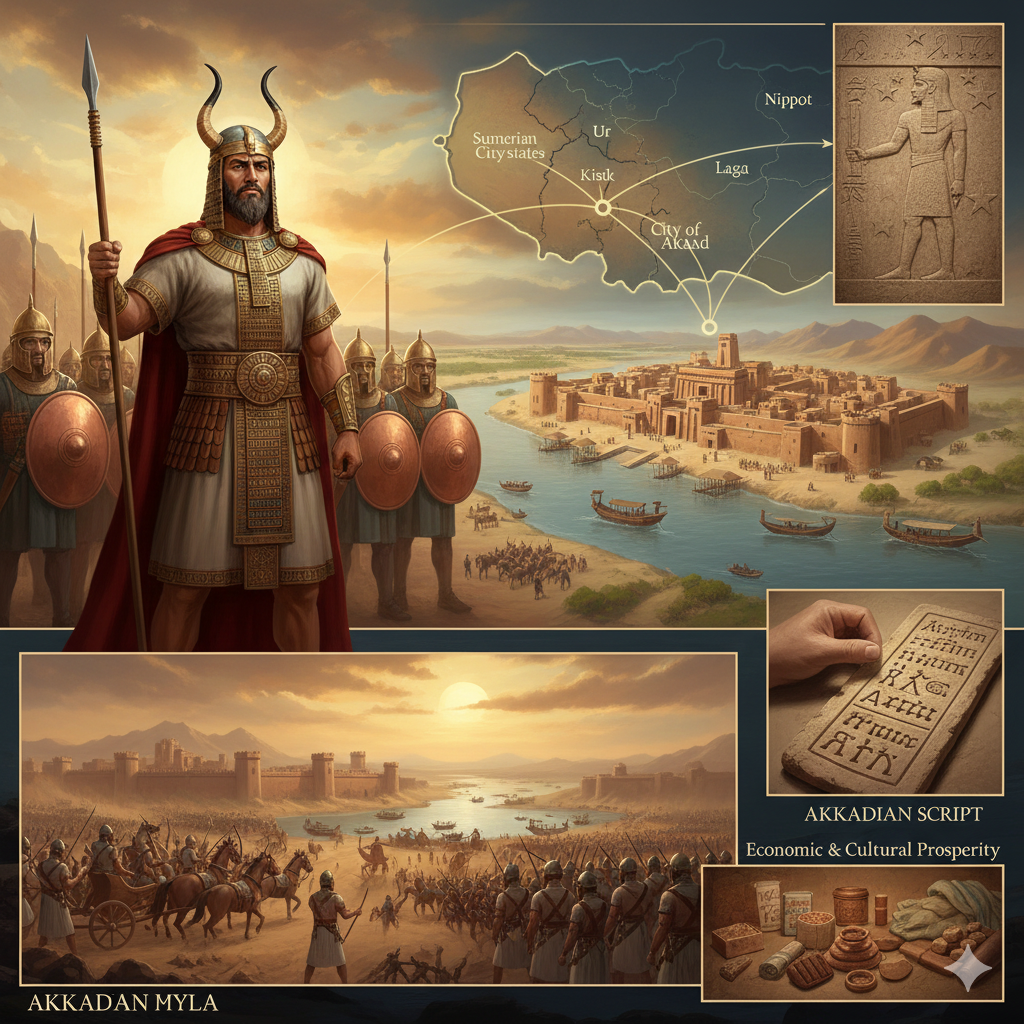
The rise of the Akkadian Civilization began around 2334 BC when Sargon the Great established the first empire in history by uniting various Mesopotamian city-states. Prior to this, the region was divided into independent Sumerian city-states that often engaged in conflict. Using his military and administrative skills, Sargon conquered these states and unified them. He established a capital named Akkad and laid the foundation of a centralized empire.
1. The Situation Before the Akkadian Civilization
a) Dominance of the Sumerian City-States
- Before the rise of the Akkadians, the Sumerian Civilization dominated Mesopotamia.
- The region consisted of independent city-states such as Ur, Uruk, Kish, Lagash, and Nippur.
- Continuous conflicts among these city-states prevented political stability.
b) The Rise of Sargon the Great
- Sargon the Great was born in the city of Kish.
- He initially served as an official in the court of the Kish king Ur-Zababa.
- Through military brilliance, he began conquering Sumerian kingdoms and expanding his influence.
2. Establishment of the Akkadian Empire
a) Conquest of the Sumerian City-States
- Sargon first took control of Kish.
- He then defeated major city-states such as Ur, Uruk, Lagash, and Nippur.
- Finally, he defeated the Sumerian king Lugal-Zagezi and took control of all Mesopotamia.
b) Establishment of the Capital City of Akkad
- Sargon made Akkad the capital of his empire.
- Akkad became a prosperous trading and cultural hub.
- The city served as the center of trade, administration, and military activities.
c) Expansion of the Empire
- Sargon expanded the empire north to Asia Minor (modern Turkey), west to the Mediterranean Sea, and east to Elam (modern Iran).
- He developed a strong and permanent army, which became the foundation of political stability.
3. Characteristics of the Akkadian Empire
a) Centralised Administration
- Sargon established a highly centralized administrative system.
- The empire was divided into provinces, each governed by officials appointed by the king.
- The tax system and legal framework became more streamlined.
b) Development of Language and Script
- The main language of the empire was Akkadian, which later became the official language of the Babylonian and Assyrian empires.
- For writing, the Akkadians adopted the cuneiform script from the Sumerians.
c) Economic Prosperity
- Trade and agriculture flourished.
- Major trading partners included the Indus Valley Civilization (India), Egypt, Iran, and Asia Minor.
- Important traded items included copper, gold, silver, wood, and stone.

Top Rated Amazon Product
Popular and well-reviewed product with excellent user feedback. Check the latest price, deals & availability on Amazon.
👉 View on Amazon4. Influence of the Akkadian Civilization
- Sargon the Great introduced the concept of a unified empire that inspired future civilizations.
- The Akkadian language and administrative model influenced the Babylonian and Assyrian empires.
- The civilization made remarkable contributions to art, literature, and architecture.
Conclusion
The rise of the Akkadian Civilization marked the emergence of the world’s first empire. Sargon the Great unified the Sumerian city-states and created a strong administrative, military, and cultural foundation. The establishment of Akkad as a capital and the commercial prosperity of the empire made this civilization historically significant. It later inspired the development of the Babylonian and Assyrian civilizations.
Historical Background of the Akkadian Civilization
a) Origins
The Akkadian Civilization (2334–2154 BC) emerged after the decline of the Sumerian city-states. Sargon the Great unified the scattered states and established the first well-organized empire in history.
1. Geographical Location of Mesopotamia
- Mesopotamia included parts of present-day Iraq, Syria, and Turkey.
- It lay between the Tigris and Euphrates rivers, earning the title “Land Between Two Rivers”.
- The fertile land encouraged the growth of many ancient civilizations.
2. Sumerian Civilization and the City-State System
- Before the Akkadians, the Sumerians were the dominant civilization.
- They were divided into city-states such as Kish, Ur, Uruk, Nippur, and Lagash.
- political instability and conflicts among them gave the Akkadians an advantage.
3. The Rise of Sargon the Great
- Sargon initially served under Ur-Zababa, king of Kish.
- He conquered various Sumerian cities through military campaigns.
- By defeating Lugal-Zagezi, he unified Mesopotamia and founded the Akkadian Empire in 2334 BC.
4. Influence of Akkadian Language and Culture
- The Akkadian language belonged to the Semitic family and differed from Sumerian.
- It later became the official language of the Babylonian and Assyrian civilizations.
- Cuneiform script continued to be used, inherited from Sumerian tradition.
5. Expansion and Influence of the Akkadian Empire
- The empire extended across Mesopotamia to Syria, Asia Minor, and Persia.
- Sargon organized administration, taxation, and military systems.
- His successors, especially Naram-Sin, further strengthened the empire.
Conclusion
The historical background of the Akkadian Civilization reflects the instability of early Mesopotamian city-states and the strategic brilliance of Sargon the Great. The Akkadians built the world’s first organized empire and contributed significantly to administration, language, culture, and imperial Governance. Their legacy continued in the Babylonian and Assyrian civilizations.
Frequently Asked Questions (FAQ)
1. who founded the Akkadian Empire?
Sargon the Great founded the Akkadian Empire around 2334 BC by unifying the Sumerian city-states.
2. What was the capital of the Akkadian Empire?
The capital city was Akkad, which became a major center of trade and administration.
3. Why is the Akkadian Civilization important?
It was the world’s first empire and influenced later civilizations such as Babylon and Assyria in administration, language, and culture.
4. Which script did the Akkadians use?
The Akkadians used the cuneiform script, adopted from the Sumerians.
5. How far did the Akkadian Empire expand?
The empire stretched from Mesopotamia to Syria, Asia Minor, and Persia under Sargon and Naram-Sin.
(b) Geographical Location
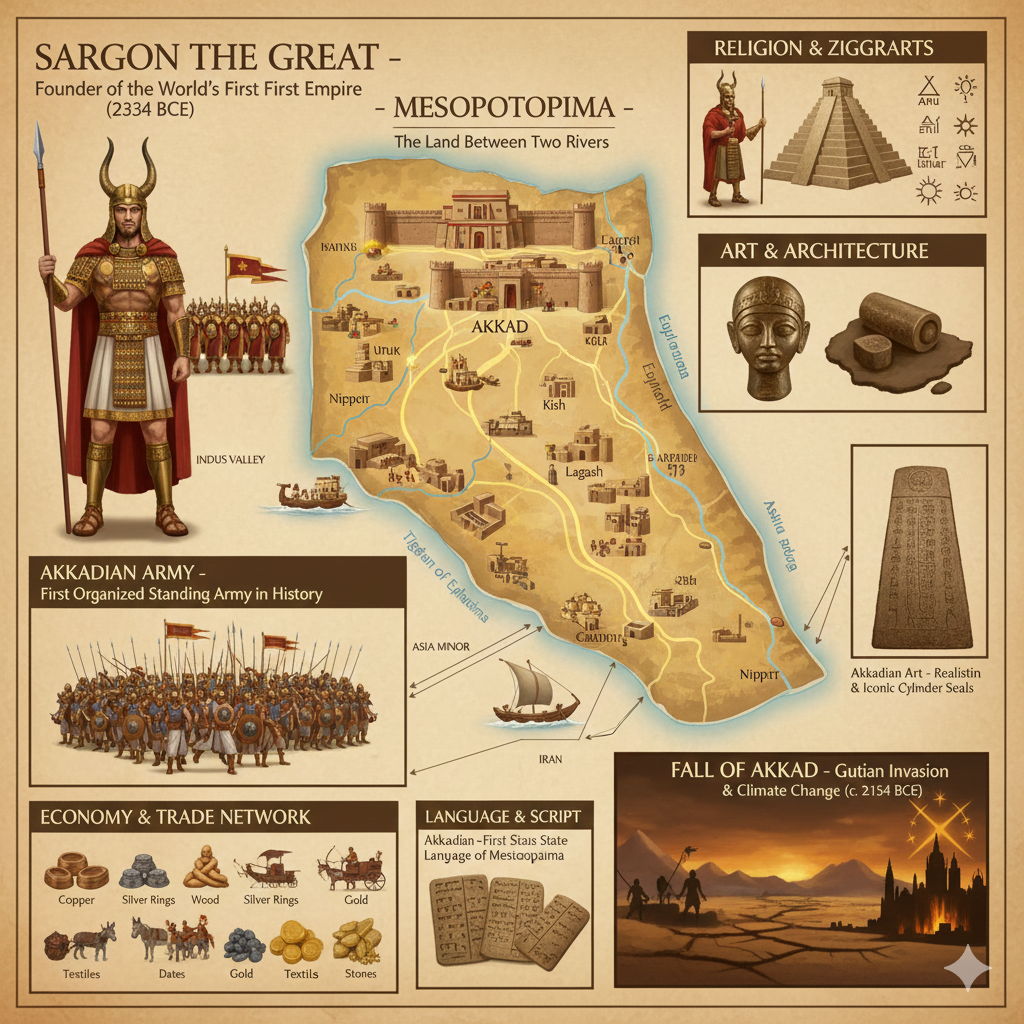
The Akkadian Civilization developed in ancient Mesopotamia, which today includes parts of Iraq, Syria, and Turkey. This region lay between the Tigris and Euphrates rivers and is called “Mesopotamia”. The fertile soil and abundant water sources made it the “birthplace of civilization”, as some of the world’s oldest civilizations originated here.
1. Geographical Features
(a) Importance of the Tigris and Euphrates Rivers
- The rivers were the lifeline of the region, supporting agriculture and trade.
- Annual floods fertilized the land, helping agriculture flourish.
- Water transport strengthened trade and communication.
(b) Regional Division of Mesopotamia
Mesopotamia was generally divided into two major parts:
- Northern Mesopotamia (Akkad) – A semi-arid region with grasslands suitable for animal husbandry.
- Southern Mesopotamia (Sumer) – A fertile region with highly developed agriculture.
(c) Capital of Akkad
- Sargon the Great established his capital in a city named Akkad.
- The exact location remains unknown, but historians believe it was near modern Baghdad (Iraq).
- Akkad became the administrative and commercial center of the empire.
2. Climate and Environment
- The climate of Mesopotamia was hot and dry with extremely warm summers and cold winters.
- Low rainfall required the development of advanced irrigation systems, which the Akkadians mastered.
- Lack of natural resources like wood, metal, and stone led to active trade with nearby regions.
3. Natural Resources and Trade
- Soil: Fertile soil allowed cultivation of wheat, barley, and dates.
- Water Resources: Rivers supported irrigation canals and reservoirs.
- Mineral Resources: Metals like copper, silver, and gold were limited; hence imported.
- trade routes: Akkadians traded with India (Indus Valley), Egypt, Iran, and Asia Minor.
4. Strategic Importance
- Mesopotamia lay on major trade routes connecting Asia, Europe, and Africa.
- Many powerful civilizations fought for control of this region due to its economic and military value.
- The Akkadian Empire turned Mesopotamia into a strong permanent administrative center.
Conclusion
The geographical location of the Akkadian Civilization played a major role in its prosperity. Situated between the Tigris and Euphrates rivers, the region supported agriculture, trade, and military expansion. Although limited in natural resources, the Akkadians compensated through extensive trade. Due to its strategic position, Mesopotamia became one of the most influential regions in ancient world history.
Main Features of the Akkadian Civilization
The Akkadian Civilization flourished from 2334 BC to 2154 BC and became the first major empire of ancient Mesopotamia. It was founded by Sargon the Great, who unified the Sumerian city-states and established a centralized political system. The Akkadian Empire contributed significantly to political, social, cultural, military, and economic development.
1. Administrative and Political System
(a) The World’s First Empire
- The Akkadian Empire was the world’s first centralized empire ruling over a vast region.
- It extended from Asia Minor (Turkey) in the north to the Mediterranean Sea in the west and Persia (Iran) in the east.
(b) Centralised Governance
- Sargon created a centralized administrative system dividing the empire into provinces.
- Each province was governed by officials appointed by the king.
- Governors managed tax collection, military supervision, and law enforcement.
(c) Military Power
- The Akkadian Empire had an organized and permanent army developed by Sargon.
- This army consisted of professional soldiers trained for expansion and defense.
- The Akkadians were among the earliest users of shields, bows, arrows, and organized battle formations.
2. Language and Script
(a) Akkadian Language
- The primary language was Akkadian, part of the Semitic language family.
- It gradually replaced the Sumerian language and became dominant in the Babylonian and Assyrian empires.
(b) Cuneiform Script
- The Akkadians adopted and modified the Sumerian cuneiform script.
- The script was used to write state records, trade documents, and religious texts.

Top Rated Amazon Product
Trusted product with excellent reviews and user satisfaction. Click below to check the latest price, offers & availability on Amazon.
👉 View on Amazon3. Economic and Trade System
(a) Development of Agriculture
- The region’s fertility supported large-scale agriculture.
- Main crops included wheat, barley, dates, and pulses.
- Advanced irrigation systems with canals and reservoirs were constructed.
(b) Trade Relations
Trade formed the backbone of the Akkadian economy. They imported and exported goods from distant regions:
- Indus Valley Civilization – textiles and precious stones.
- Egypt – wood and precious metals.
- Iran & Asia Minor – copper and silver.
4. Religious and Cultural Characteristics
(a) Polytheism
The Akkadians worshipped many gods and goddesses:
- Anu – God of the sky
- Enlil – God of wind and storms
- Inanna / Ishtar – Goddess of love and war
- Shamash – Sun god and guardian of justice
(b) Construction of Temples and Ziggurats
- Large multi-storey temples called ziggurats were built.
- Ziggurats were made of mud brick and were considered the dwelling places of gods.
5. Art and Architecture
(a) Sculpture and Architecture
- Akkadian art focused on realism, expressing lifelike human emotions.
- Famous artworks include:
- Bronze statue of Sargon the Great
- Victory Stele of Naram-Sin
- Cylindrical seals used for administrative authentication
6. Fall of the Akkadian Empire
(a) Internal Rebellion and Administrative Decline
- After Sargon’s death, instability increased.
- Weak rulers and administrative collapse led to rebellions.
(b) External Invasion
- The Gutian hill tribes invaded around 2154 BC.
- They destroyed Akkadian authority, leading to the empire’s downfall.
- Later, the Neo-Sumerian Renaissance began in the region.
Conclusion
The Akkadian Civilization contributed immensely to world History by establishing the first organized empire, creating an efficient administration, building a strong military, and forming extensive trade networks. Its language, script, art, and religious traditions influenced the later Babylonian and Assyrian civilizations. Although the empire fell due to internal and external pressures, its impact continued for centuries.
(a) System of Governance
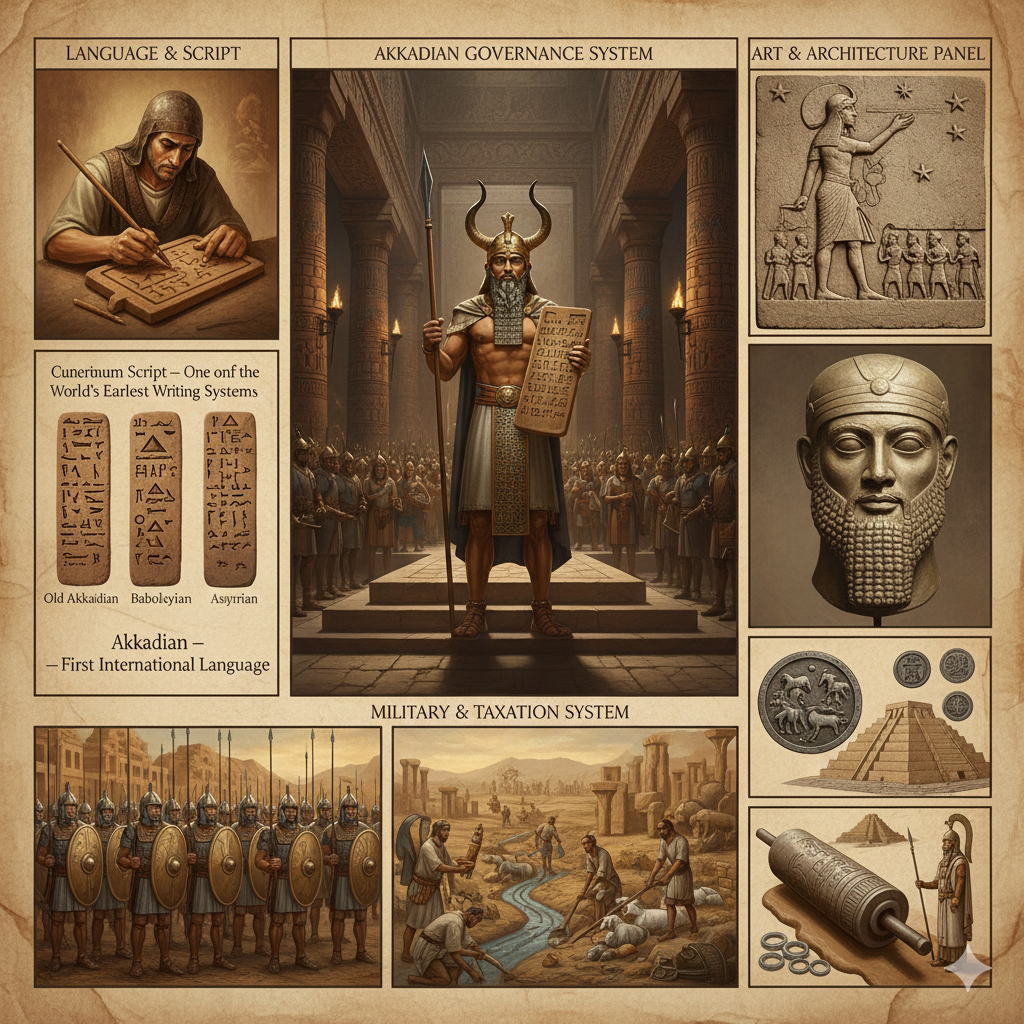
The Akkadian Civilization was the world’s first centralized empire, developed under Sargon the Great. This system included an efficient administrative structure, an organized military force, and a well-regulated tax system. The governance model was based on an autocratic monarchy supported by administrative reforms that enabled smooth functioning.
1. Absolute Monarchy
- The Akkadian Empire was based on a monarchical system in which the king held absolute power.
- The king was considered the representative of the gods, giving his authority a divine foundation.
- The king acted as the administrative head, military commander-in-chief, chief justice, and supreme religious authority.
Administrative Policies of Sargon the Great
- Sargon ended the city-state system and established a unified empire.
- He divided the empire into administrative provinces for efficient governance.
- Each province had governors (Ensi or Ishakku) appointed by the king to collect taxes and maintain law and order.
2. Administrative Organisation
(a) Partition of the Empire
- The empire was divided into provinces (administrative regions).
- Each province was overseen by a governor (Ensi or Ishakku) appointed by the king.
(b) Role of Governors
Governors were responsible for:
- Tax Collection: Implementing agricultural, trade, and labour taxes.
- Military Control: Managing provincial military units for security.
- Law and Order: Overseeing judicial matters and enforcing local laws.
- Irrigation & Public Works: Maintaining canals, reservoirs, and water systems.
3. Military System
(a) Organised and Standing Army
- The Akkadians developed the world’s first professional standing army.
- The army was directly controlled by the king.
- Soldiers received regular salaries and facilities.
(b) Military Strategy and Weapons
- Weapons included shields, bows and arrows, spears, and chariots.
- The Phalanx formation was used for organized battlefield attacks.
- Under Sargon, the army expanded the empire across Sumer, Syria, Asia Minor, and Persia.
4. Taxation & Economy
(a) Tax System
- Agricultural Tax: Farmers contributed a portion of their produce.
- Trade Tax: Merchants paid taxes on income from trade.
- Labor Tax (Corvée): Citizens provided labour for public works or military service.
(b) Business & Resource Management
- Akkadian rulers protected trade routes and promoted commerce.
- Trade Partners:
- Indus Valley Civilization – gold, precious stones, spices
- Egypt – wood and metals
- Iran & Asia Minor – copper and silver
5. Judicial System
(a) Law and Justice
- The Akkadians followed unwritten laws supplemented by royal decrees and religious codes.
- Legal authority rested with kings, governors, and city-state judges.
(b) Penal System
- Punishments included fines, exile, imprisonment, and corporal penalties.
- Trade contracts and loan agreements were important legal documents.
6. Religious Administration
(a) Relation Between King and Religion
- The king was believed to be the earthly representative of the gods.
- He, along with high priests, performed major religious rituals.
(b) Management of Temples and Ziggurats
- Temples were managed by priests and religious officials.
- They received donations and grain taxes, making them economically powerful.
7. Characteristics of the Akkadian System of Government
| Speciality | Description |
|---|---|
| Type of Governance | Centralized Monarchy |
| Administrative Divisions | Empire divided into provinces |
| Army | Standing army with new weapons & tactics |
| Tax System | Agricultural, trade, and labour taxes |
| Justice System | Royal decrees, harsh punishments, contract-based law |
| Religious Administration | King considered divine representative |
Conclusion
The Akkadian system of governance was a combination of monarchy, military strength, taxation, judicial administration, and religious authority. Sargon the Great created a strong and organized empire through his administrative and military strategies, paving the way for future Babylonian and Assyrian empires.
(b) Language and Script
The language and script of the Akkadian Civilization hold immense historical importance. The Akkadian language, one of the world’s oldest Semitic languages, later formed the basis of the Babylonian and Assyrian languages. The Akkadians used a modified version of the Sumerian cuneiform script for writing.
1. Akkadian Language
(a) Origin and Development
- Akkadian belonged to the Semitic language family, related to modern Arabic and Hebrew.
- The earliest evidence dates to around 2400 BC.
- The language replaced Sumerian as the dominant medium of communication across Mesopotamia.
(b) Major Forms of the Akkadian Language
- Old Akkadian (2500–2000 BCE): Used during the reign of Sargon the Great.
- Babylonian & Assyrian: Developed from Akkadian after 2000 BCE.
2. Script: Cuneiform
(a) Sumerian Influence & Use
- Akkadians adopted the Sumerian cuneiform script.
- The script consisted of wedge-shaped markings made on clay tablets.
- Akkadian scribes added phonetic symbols to suit their language.
(b) Features of the Script
- Combination of pictographic and phonetic symbols.
- Written from right to left.
- Used more than 600 symbols.
- Written using a pointed stylus on wet clay tablets.
3. Use of Language and Script
(a) Administrative Documents
- Used for royal orders, tax records, and military reports.
- Examples include tablets with orders from Sargon the Great and proclamations of Naram-Sin.
(b) Religious Texts & Literature
- Used for hymns, rituals, and mythological texts.
- Famous works include the Epic of Gilgamesh and Enuma Elish.
(c) Trade & Diplomacy
- Trade contracts and treaties were written in Akkadian.
- Used as a communication medium between distant regions.
4. Influence of Language and Script
(a) International Language Status
- Akkadian spread across Southern Mesopotamia, Syria, Asia Minor, and Persia.
- It became the diplomatic language of its time.
(b) Evolution into Babylonian & Assyrian
- Akkadian eventually developed into the Babylonian and Assyrian languages.
- The cuneiform script remained in use throughout these empires.
5. Decline of the Akkadian Language & Script
(a) Influence of Aramaic
- After 1000 BC, Aramaic became widespread and replaced Akkadian.
(b) End of the Cuneiform Script
- With the rise of Aramaic and Phoenician scripts, cuneiform declined.
- By 500 BC, cuneiform had almost completely disappeared.
Conclusion
The Akkadian language and cuneiform script played a crucial role in administration, literature, and religious traditions. Akkadian became the world’s first international language, and cuneiform one of the earliest writing systems. Though later replaced by Aramaic, their influence shaped the Babylonian and Assyrian civilizations.
(c) Art and Architecture
The Akkadian Civilization produced remarkable achievements in art and architecture. This period emphasized realistic sculpture, detailed engravings, and monumental structures that depicted war, political authority, and religious beliefs.
1. Characteristics of Akkadian Art
- Emphasis on realism and detailed expressions.
- Rulers were depicted as heroic or divine beings.
- Relief sculptures illustrated war and conquest.
- Metal statues, cylinder seals, and inscriptions were widely used.
2. Major Artistic Achievements
(a) Sculpture
1. Victory Stele of Naram-Sin
- The most famous example of Akkadian art.
- Portrays King Naram-Sin as a godlike figure climbing a mountain.
- Depicts defeated enemies and divine stars representing gods.
2. Bronze Head of Sargon the Great
- Found in Nineveh, made of bronze.
- Shows the king with powerful and regal features.
- A masterpiece of Akkadian metalwork.
3. Cylinder Seals
- Small cylindrical objects with engraved images and text.
- Used for administrative and commercial authentication.
- Depicted kings, gods, and hunting or ritual scenes.
3. Architecture
(a) Temples & Ziggurats
- Religious architecture was highly developed.
- Ziggurats were multi-storey brick temples with stairways.
- Example: Ziggurat of Akkad (believed to be one of the earliest).
(b) Palaces & Fortresses
- Massive fortresses were built for administration and defense.
- Thick walls protected against invasions.
- Palaces included wall paintings and detailed carvings.
4. Materials Used
- Brick & Clay: Mud bricks for buildings.
- Bronze & Copper: For statues and weapons.
- Stone: Limestone and sandstone for sculptures.
Top Rated Amazon Product
Highly reviewed and trusted product with great customer feedback. Check the latest price, offers & availability on Amazon.
👉 View on Amazon5. Influence of Akkadian Art
- Greatly influenced Babylonian and Assyrian art.
- Later rulers adopted Akkadian styles of relief carvings.
- Ziggurat construction continued in later civilizations.
- The emphasis on realism shaped future Mesopotamian art.
Conclusion
Akkadian art and architecture expressed political power, religious devotion, and military achievements. Their sculptures, ziggurats, inscriptions, and cylinder seals demonstrated exceptional creativity and technical expertise. These artistic traditions deeply influenced later civilizations, including Babylon, Assyria, and Persia.
(d) Religion and Religious Beliefs
The Akkadian Civilization was mainly polytheistic, worshipping many gods. Akkadian religion was strongly influenced by Sumerian traditions but evolved its own distinct identity. The Akkadians introduced new gods, political symbolism, and the concept that kings were the earthly representatives of the gods. They believed their victories and rule were granted through divine blessings.
1. Main Religious Features
- Polytheism: The Akkadians worshipped multiple gods.
- Deification of Kings: Some rulers were worshipped as gods.
- Construction of Temples and Ziggurats: Grand religious structures were built for worship.
- Rituals and Sacrifices: Animal sacrifices and offerings were part of rituals.
- Afterlife Beliefs: souls were believed to enter a dark underworld after death.
2. Akkadian Gods and Their Characteristics
| God | Role and Characteristics |
|---|---|
| Anu | God of heaven; ruler of major deities |
| Enlil | God of air and earth; controller of fate |
| Enki | God of water, wisdom, and magic |
| Inanna/Ishtar | Goddess of love, fertility, and war |
| Shamash | Sun god and god of justice |
| Sin | Moon god |
| Marduk | Later became supreme god in Babylon |
| Ninurta | God of war and agriculture |
| Dumuzid/Tammuz | God of fertility and animal husbandry |
(a) Inanna/Ishtar – Goddess of Love and War
- One of the most important deities of the Akkadian pantheon.
- Represented love, fertility, power, and warfare.
- Often depicted with lions and stars.
- Her most famous temple was the Temple of Ishtar.
(b) Shamash – God of the Sun and Justice
- Symbol of justice, truth, and prophecy.
- Kings and priests sought his blessings before decisions.
(c) Enlil – Powerful Storm God
- God of storms, wind, and divine authority.
- Main temple located in Nippur.
- Worshipped before military campaigns.
3. Religious Places and Temples
(a) Ziggurats – Sacred Towers
- Massive, stepped temple structures used for worship.
- Built to place gods “closer to the heavens”.
- “Ziggurat of Akkad” was among the most famous.
(b) Temples
- Large temples were built for major gods.
- Priests performed rituals and sacrifices.
- Temples contained statues, altars, and holy chambers.
4. Religious Rituals and Traditions
(a) Sacrifices
- Animal and food offerings were made to please the gods.
(b) Festivals
- Many festivals were dedicated to different gods.
- The most important was the Akitu Festival (New Year festival) celebrated for Marduk.
(c) Divination & Astrology
- Akkadians believed in predicting the future through sacrifices, stars, and dreams.
5. Afterlife Beliefs
- Strongly influenced by Sumerian beliefs.
- The soul was believed to enter a dark underworld called Irkalla.
- The afterlife was not seen as a place of happiness.
6. Relationship Between Religion and Politics
- Kings were considered representatives of the gods on earth.
- They maintained temples and performed rituals to justify their authority.
- Naram-Sin was the first Akkadian king to declare himself a god.
Conclusion
Akkadian religion was a polytheistic system shaped by Sumerian traditions but enriched with new ideas. The belief in divine kingship and elaborate rituals influenced later Babylonian and Assyrian religions. It played a major role in shaping the cultural and political identity of Mesopotamia.
(e) Economy and Trade
The Akkadian Civilization had a well-organized economy based on agriculture, trade, animal husbandry, and various crafts. As one of the earliest imperial powers, it developed a centralized economic system, secured trade routes, and expanded commercial networks across Mesopotamia and beyond.
1. Agriculture and Production
- Main Crops: Barley, wheat, dates, vegetables, sesame.
- Irrigation: Canals, dams, and reservoirs improved farming.
- Tools: Use of ploughs and domestic animals for cultivation.
- Taxation: Farmers paid taxes in grain and produce.
(a) Irrigation System
- Construction of artificial reservoirs and canal networks.
- Systems for flood control and drainage were developed.
- Crop rotation maintained soil fertility.
2. Industry and Craftsmanship
- Metallurgy: Weapons, jewelry, and statues made from bronze, copper, and gold.
- Pottery: Pottery and artistic decorative items produced.
- Textiles: Wool and linen used for clothing.
- Construction: Craftsmen built temples, palaces, and public structures.
3. Trade and Commerce
(a) Major Trade Routes
- Trade extended from Mesopotamia to Arabia, India, Egypt, and Asia Minor.
- Both land and water routes were used.
- Major centers: Akkad, Ur, Nippur.
(b) Imports and Exports

Top Rated Amazon Product
Highly rated and well-reviewed product with strong customer feedback. Check the latest price, deals & availability on Amazon.
👉 View on Amazon| Imports | Exports |
|---|---|
| Copper | Grains |
| Tin | Clothing & Textiles |
| Silver & Gold | Pottery |
| Precious Stones | Weapons & Tools |
| Wood | Statues & Decorative Items |
(c) Trading Partners
- Dilmun (Bahrain & Kuwait) – copper, wood
- Magan (Oman & UAE) – copper, shipbuilding materials
- Meluhha (Indus Valley) – precious stones, pearls
- Elam (Iran) – metals & textiles
4. Currency and Exchange System
- A barter system was commonly used for transactions.
- Silver acted as a standard medium of exchange.
- The shekel was used as a unit of weight.
- Trade records were written on clay tablets.
5. Taxation System
- Taxes collected from farmers, traders, and craftsmen.
- Taxes used for military campaigns, temple construction, and administrative functions.
- Special officers were appointed for tax collection.
6. Transport and Trade Routes
(a) Water Transport
- Rivers (Tigris & Euphrates) were key trade routes.
- Boats and ships were used for transporting goods.
- The Persian Gulf enabled maritime trade.
(b) Land Transport
- Carts and donkeys were used for transporting goods.
- Military posts were built to protect trade routes.
7. Collapse of the Economy
- Constant wars and invasions weakened trade.
- Severe drought and Climate Change reduced agricultural output.
- Administrative weakness affected tax collection and economic stability.
Conclusion
The Akkadian economy was built on agriculture, trade, and crafts. Their extensive trade routes and organized tax system strengthened the empire, but later political instability and environmental challenges led to economic decline. Despite this, the Akkadian economic model deeply influenced the Babylonian and Assyrian civilizations.

Top Rated Amazon Product
Highly rated and trusted product with strong customer feedback. Check the latest price & availability on Amazon.
👉 View on AmazonReferences
- Kramer, Samuel Noah. History Begins at Sumer. University of Pennsylvania Press.
- Roux, Georges. Ancient Iraq. Penguin Books.
- Van De Mieroop, Marc. A History of the Ancient Near East. Wiley-Blackwell.
- British Museum – Akkadian Artifacts and Cuneiform Records.
- Metropolitan Museum of Art – Naram-Sin Victory Stele Collections.
- University of Chicago – Oriental Institute: Mesopotamian Archaeology.
- Encyclopaedia Britannica – Akkadian Empire Overview.
- Cambridge Ancient History – Early Empires of Mesopotamia.