
United Nations (UN): History, Organs, Functions and Importance
The United Nations (UN) is a global organization established on 24 October 1945 after the Second World War. Its main objectives are to maintain international peace and security, promote cooperation between countries, and protect human rights. Over the decades, the UN has become a platform where nations come together to solve global problems and build a better future for humanity.
Establishment and History of the United Nations
The establishment of the United Nations is directly linked with the destruction caused by the Second World War (1939–1945). After this war, the world suffered a huge loss of life and property. To prevent such devastation in the future, there was a need for an organization that could ensure peace and security at the global level.
Before the UN, there was an organization called the League of Nations, but it failed to stop the Second World War. This failure highlighted the need for a stronger and more effective international body.
Charter of the United Nations
For the establishment of the United Nations, the United Nations Charter (UN Charter) was signed by 50 countries on 26 June 1945 in San Francisco, USA. The Charter formally came into force on 24 October 1945. That is why every year, 24 October is celebrated as United Nations Day.
Objectives of the United Nations
The UN Charter states the following as its main objectives:
- Maintaining international peace and security
- Promoting friendship among nations
- Encouraging social progress and improving living standards
- Protecting human rights and fundamental freedoms
- Addressing economic, social, cultural, and humanitarian problems
Main Organs of the United Nations
The United Nations has six main organs, each with a specific role and responsibility.
1. Security Council
The Security Council is the most powerful organ of the United Nations. Its main function is to maintain international peace and security.
It consists of 15 member countries, including 5 permanent members:
- United States of America
- Russia
- China
- France
- United Kingdom
These 5 countries have veto power, which means they can block any resolution even if all other members support it.
2. General Assembly
The General Assembly is the largest organ of the United Nations. It includes all 193 member countries.
The General Assembly meets every year in September in New York. In this organ, each country has one vote, and all member states have equal voting rights.
It discusses important global issues such as peace, development, climate, and human rights, and passes resolutions (though most of them are not legally binding).
3. International Court of Justice (ICJ)
The International Court of Justice (ICJ) is also known as the World Court.
Its headquarters are located in The Hague, Netherlands.
The ICJ settles legal disputes between countries and gives advisory opinions on legal questions referred to it by UN organs and specialized agencies.
4. Secretariat
The Secretariat is the administrative organ of the United Nations.
It is headed by the United Nations Secretary-General. The Secretary-General acts as the chief administrative officer of the organization and plays a key role in conflict resolution, peacekeeping, and diplomacy.
The current Secretary-General is António Guterres.
5. Economic and Social Council (ECOSOC)
The Economic and Social Council (ECOSOC) works on global economic, social, and developmental issues.
It addresses topics such as poverty alleviation, education, health, climate change, and sustainable development in coordination with various specialized agencies of the UN.
6. United Nations Trusteeship Council
The United Nations Trusteeship Council was created to oversee the administration of trust territories and help them move towards self-government or independence.
After most of these territories gained independence, the activity of the Trusteeship Council has become very limited and it is now largely inactive.
Key Agencies of the United Nations
The United Nations has several specialized agencies that work in different areas to support the core objectives of the UN.

Important UN Specialized Agencies and Their Functions
| Agency Name | Main Functions |
|---|---|
| UNICEF | Protecting children's rights and improving their health, education, and welfare. |
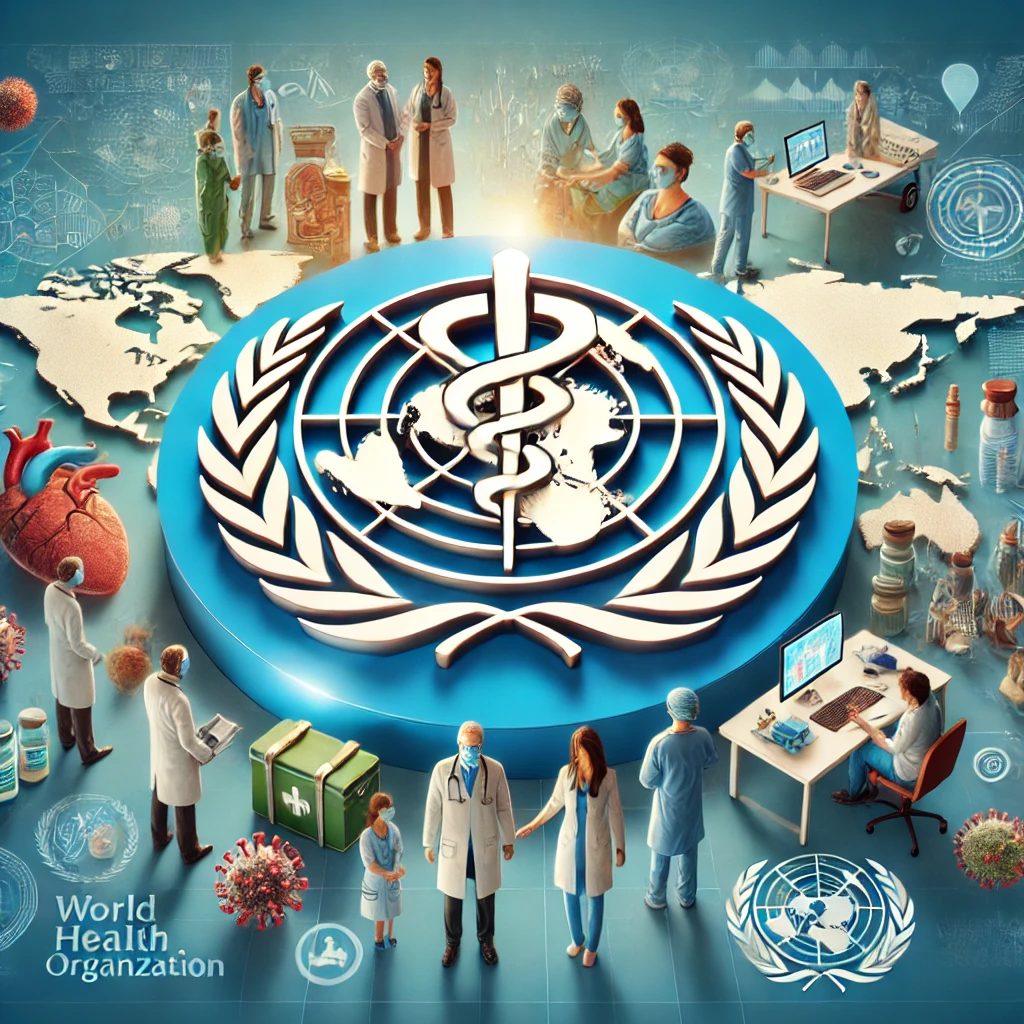
| WHO | Working on global health reforms and controlling diseases. |
| UNESCO | Promoting education, science, culture, and heritage protection. |
| IMF | Maintaining economic stability and providing financial assistance to countries. |
| World Bank | Reducing poverty and supporting economic development projects. |
| FAO (Food and Agriculture Organization) | Ensuring food security and improving agricultural practices. |
| UNHRC (United Nations Human Rights Council) | Protecting and promoting human rights across the world. |
Achievements of the United Nations
Since its establishment, the United Nations has made several important contributions to global peace, development, and human rights.
- Helped prevent the outbreak of another world war by providing a platform for dialogue and diplomacy.
- Launched various programs to reduce poverty and hunger in developing countries.
- Assisted and rehabilitated millions of refugees affected by wars and conflicts.
- Contributed to climate change awareness and environmental protection through global agreements.
- Promoted women's rights and gender equality through various conventions and initiatives.
Criticism of the United Nations
Despite its achievements, the United Nations also faces criticism on several grounds:
- The veto power of the 5 permanent members of the Security Council is often criticized because it can block important resolutions.
- Many times, the UN has failed to stop conflicts such as the Syrian war and the Rohingya crisis.
- There is a growing demand for reforms to allow more countries to participate fairly in global decision-making.
Conclusion
The United Nations is an important international organization that works for peace, security, human rights, and sustainable development. It has played a crucial role in resolving conflicts, supporting development, and promoting cooperation among nations.
However, to effectively deal with the complex challenges of the 21st century—including climate change, economic inequality, and new security threats—the UN needs structural and procedural reforms. A more representative, transparent, and responsive United Nations can better serve humanity and help build a more just and peaceful world.
Frequently Asked Questions (FAQ) about the United Nations
Q1. What is the United Nations (UN)?
The United Nations is an international organization founded in 1945 to promote peace, security, human rights, and cooperation among countries worldwide.
Q2. When was the United Nations established?
The United Nations was officially established on 24 October 1945, after the Second World War. This day is celebrated every year as United Nations Day.
Q3. How many member countries are there in the UN?
There are currently 193 member countries in the United Nations, all of which are represented in the General Assembly.
Q4. What are the main objectives of the United Nations?
The main objectives of the UN are to maintain international peace and security, promote friendly relations among nations, protect human rights, and support social and economic development.
Q5. What is the role of the UN Security Council?
The UN Security Council is responsible for maintaining international peace and security. It can impose sanctions, authorize peacekeeping missions, and, in extreme cases, approve the use of force.
Q6. Why is the United Nations criticized?
The UN is criticized for the veto power of the five permanent members of the Security Council, its limited effectiveness in some conflicts, and the need for reforms to make it more democratic and representative.
Related Articles You May Want to Link Internally
Suggested Internal Links
- Link the phrase "Second World War (1939–1945)" to /world-war-2-causes-and-consequences
- Link the phrase "League of Nations" to /league-of-nations-history
- Link the phrase "United Nations Charter" to /un-charter-principles
- Link the phrase "Security Council" to /un-security-council-structure
- Link the phrase "human rights" to /universal-declaration-of-human-rights-summary
- Link the phrase "sustainable development" to /sustainable-development-goals-sdgs
History of the United Nations (UN)
The United Nations (UN) was officially established on 24 October 1945 after the Second World War to promote international peace, security, and cooperation among nations. Although the formation of the UN took place in 1945, its foundation was laid much earlier through the efforts of the League of Nations, created after World War I to maintain global peace.
1. League of Nations – A Failed Attempt
World War I (1914–1918) and the Establishment of the League of Nations
After the First World War, the world realized the need for an international organization to maintain peace. In 1919, under the Treaty of Versailles, the League of Nations was established. Its main objective was to prevent conflicts and settle disputes through peaceful dialogue.
The headquarters of the League of Nations was in Geneva, Switzerland.
Failure of the League of Nations
- Major powers like the United States never became a member.
- Failed to stop the outbreak of the Second World War (1939–1945).
- Germany, Italy, and Japan violated laws and continued aggression.
- The organization weakened as World War II began.
2. Second World War and the Establishment of the United Nations
Impact of World War II (1939–1945)
World War II caused massive destruction and the loss of millions of lives. Countries realized the need for a stronger global organization that could ensure global peace and security. Several important meetings and agreements were held during this period, forming the foundation of the United Nations.
Major Events Leading to the Formation of the UN
(i) Atlantic Charter – 14 August 1941
This joint declaration was issued by British Prime Minister Winston Churchill and U.S. President Franklin D. Roosevelt. It emphasized self-determination and global peace. This was the first clear outline of the future United Nations.
(ii) Declaration of the United Nations – 1 January 1942
The U.S., U.K., Russia, China, and 22 other countries signed this declaration. The term "United Nations" was used for the first time. These nations pledged to work together against the Axis Powers — Germany, Italy, and Japan.
(iii) Moscow Conference – 1943
The U.S., U.K., Russia, and China agreed on the need to establish a new international organization.
(iv) Dumbarton Oaks Conference – 21 September 1944
Held in Washington DC, this meeting drafted the first outline of the UN Charter and finalized the structure of the organization.
(v) Yalta Conference – 4–11 February 1945
The U.S., U.K., and Russia agreed on giving veto power to the five permanent members of the Security Council — the U.S., U.K., Russia, China, and France.
(vi) San Francisco Conference – 25 April 1945
Representatives from 50 countries finalized the Charter of the United Nations. The UN was officially established on 24 October 1945, celebrated as United Nations Day.
3. Initial Composition of the UN
- Headquarters: New York, USA
- Founding Members: 51 countries
- First Secretary-General: Trygve Lie (Norway)
- Permanent Members: U.S., U.K., Russia, China, France
4. Expansion and Modern Role of the United Nations
1945–1990: UN During the Cold War
The world was divided into two major blocs:
- NATO Group: U.S. and Western countries
- Warsaw Pact: Soviet Union and communist countries
Although tension existed between these blocs, the UN played a crucial role in preventing a direct conflict.
1990–2024: The United Nations Today
- More active after the dissolution of the USSR in 1991
- Working on peacekeeping, counter-terrorism, climate action, and human rights
- Focus on Sustainable Development Goals (SDGs)
- Currently has 193 member countries
5. Achievements and Challenges of the United Nations
Major Achievements
- Prevented the outbreak of a Third World War
- Promoted global peace and conflict resolution
- Worked on poverty reduction and education
- Supported global health efforts (e.g., COVID-19 response)
- Took action on climate change

Major Challenges
- Excessive influence of powerful nations due to veto power
- Failure to stop conflicts like Syria and Afghanistan
- Difficulty dealing with global terrorism
Conclusion
The United Nations was founded in 1945 to ensure global peace and cooperation. Its creation involved several key events and agreements from the Atlantic Charter to the San Francisco Conference. Today, the UN plays a vital role in conflict prevention, international cooperation, and addressing global challenges. However, to remain effective in the 21st century, reforms are essential.
Frequently Asked Questions (FAQ)
Q1. When was the United Nations established?
The UN was officially established on 24 October 1945 after the Second World War.
Q2. How did the League of Nations contribute to the formation of the UN?
The League of Nations was the first major attempt to maintain world peace, but its failure during World War II showed the need for a stronger organization, which eventually became the United Nations.
Q3. How many founding members did the UN have?
The United Nations started with 51 founding member countries.
Q4. What are the major accomplishments of the United Nations?
Preventing a third world war, promoting peace, supporting education, human rights, global health, and working on climate change are among the major achievements of the UN.
Q5. What challenges does the United Nations face today?
Veto power imbalance, inability to stop some conflicts, and global terrorism are major challenges the UN continues to face.
Suggested Internal Links
- Link "World War I" to: /world-war-1-causes-and-effects
- Link "League of Nations" to: /league-of-nations-history
- Link "Second World War" to: /world-war-2-history
- Link "UN Charter" to: /un-charter-summary
- Link "Sustainable Development Goals (SDGs)" to: /sustainable-development-goals
- Link "Security Council" to: /un-security-council-structure
United Nations Charter & Purposes of the United Nations
The United Nations Charter (UN Charter) is the treaty on which the establishment of the United Nations was based. It acts as a constitutional document that defines the objectives, structure, and functioning of the United Nations.
Salient Features of the United Nations Charter
- Finalized on 26 June 1945 at the San Francisco Conference.
- Came into force on 24 October 1945 after ratification by required countries.
- Contains a Preamble and 111 Articles divided into 19 Chapters.
Preamble of the United Nations Charter
The Preamble outlines the core purpose and ideals of the UN. It begins with: "We, the peoples of the United Nations…"
Its key commitments include:
- Saving future generations from the scourge of war
- Promoting respect for human rights and fundamental freedoms
- Strengthening faith in Justice and international law
- Encouraging social progress and better living standards
- Ensuring global peace, security, and cooperation
Major Chapters and Articles of the United Nations Charter
1. Chapter I: Purposes and Principles (Articles 1–2)
The four major purposes of the United Nations include:
- Maintaining international peace and security
- Promoting friendly relations among nations
- Encouraging economic, social, cultural, and humanitarian cooperation
- Acting as a center for harmonizing the actions of nations
Member states must respect the principles of the UN and refrain from using force against any country.
2. Chapter II: Membership (Articles 3–6)
- Originally, 51 countries signed the Charter.
- Today, the UN has 193 member countries.
- Any peace-loving state can become a member if it follows the Charter.
- Membership may be suspended or expelled for violating UN principles.
3. Chapters III–XV: UN Principal Organs (Articles 7–91)
(i) General Assembly – Articles 9–22
- It is the main policy-making body of the UN.
- All member states have equal representation (one country = one vote).
- Approves the budget and admission of new members.
(ii) Security Council – Articles 23–32
- Responsible for maintaining international peace and security.
- Has 15 members: 5 permanent and 10 non-permanent (elected for 2 years).
- The 5 permanent members (US, UK, Russia, China, France) have veto power.
- Takes decisions on sanctions, war, peacekeeping missions, and conflict resolution.
(iii) Economic and Social Council (ECOSOC) – Articles 61–72
- Deals with global economic, social, cultural, and human rights matters.
- Has 54 members elected for 3-year terms.
- Coordinates with WHO, UNESCO, UNICEF, IMF, etc.
(iv) Trusteeship Council – Articles 75–91
This council supervised territories moving towards independence. After Palau gained independence in 1994, the council became inactive.
(v) International Court of Justice (ICJ) – Articles 92–96
- Known as the World Court.
- Located in The Hague, Netherlands.
- Resolves legal disputes between countries.
- Has 15 judges elected for 9 years.
(vi) Secretariat – Articles 97–101
- The administrative organ of the UN.
- Headed by the Secretary-General.
- Located at the UN Headquarters, New York.
- Secretary-General serves a 5-year term.
4. Chapters XVI–XVII: International Treaties & Law (Articles 102–105)
- All international treaties must be registered and published by the UN.
- The UN can take steps to implement global treaties.
5. Chapters XVIII–XIX: Amendments & Ratification (Articles 108–111)
- Amendments require approval from two-thirds of the General Assembly.
- At least 50 ratifications were needed for the Charter to come into force (achieved on 24 October 1945).
Conclusion: Importance of the UN Charter
The United Nations Charter forms the constitutional basis of global peace, security, cooperation, and human rights. It helps guide international relations and provides a framework for resolving global challenges.
Purposes of the United Nations
The UN was established on 24 October 1945 with the aim of maintaining world peace, enhancing international cooperation, and protecting human rights. These objectives are clearly defined in Article 1 of the UN Charter.
1. Maintaining International Peace and Security
What is this purpose?
The UN’s primary purpose is to ensure global peace and prevent wars. After the devastation of World War II, it became essential to avoid another global conflict.
How does the UN achieve this?
- Preventing wars and promoting dialogue
- Sending UN Peacekeeping Missions
- Using mediation and diplomacy
- Imposing sanctions to prevent terrorism and arms proliferation

✔ Easy to use and reliable
✔ Suitable for daily use
✔ Best choice for value for money
Examples:
- Intervention during the Korean War (1950–53)
- Peace efforts in the Israel–Palestine conflict
- Deployment of UN Peacekeeping Forces across the world
2. Developing Friendly Relations Among Nations
What is this purpose?
The UN aims to promote cooperation and friendship among countries to prevent conflicts.
How does the UN achieve this?
- Promoting dialogue and diplomacy
- Giving equal voting rights to all nations in the General Assembly
- Cooperation in culture, education, trade, and science
- Supporting decolonization efforts
Examples:
- Helping African nations gain independence in the 1960s
- Dialogue for India–Pakistan conflict resolution
- Support for the Non-Aligned Movement
3. Achieving International Cooperation and Solving Global Problems
What is this purpose?
The UN facilitates cooperation among nations to address social, economic, cultural, and humanitarian issues.
How does the UN achieve this?
- Working on poverty, hunger, health, education, and climate change
- Providing financial and developmental assistance
- Supporting developing countries
Examples:
- UNDP – Poverty eradication
- WHO – Global health and disease control
- UNICEF – Child rights and education
- UNEP – Combatting climate change
4. Promoting Human Rights and Fundamental Freedoms
What is this purpose?
One of the core objectives of the UN is to protect human rights worldwide.
How does the UN achieve this?
- Adopting the Universal Declaration of Human Rights (1948)
- Supporting women, children, and minority rights
- Helping refugees and war victims
- Preventing human trafficking and child labor
Examples:
- Ending apartheid in South Africa
- Assistance to Rohingya refugees
- Relief efforts in Syria and Afghanistan
5. Promoting Global Development & Sustainable Development Goals (SDGs)
What is this purpose?
The UN aims to eliminate poverty, hunger, illiteracy, and environmental crises while ensuring equal opportunities for all.
How does the UN achieve this?
- Launching the 17 Sustainable Development Goals (2015)
- Action on climate change
- Ensuring clean energy, water, food, health, and education
Examples:
- Paris Climate Agreement (2015)
- Clean Water and Sanitation initiatives
- Universal quality education programs
Summary Table of UN Objectives
| Objective | Description | Example |
|---|---|---|
| Maintaining peace and security | Preventing war and resolving disputes | UN Peacekeeping |
| Promoting friendship among nations | Building good relations between countries | India–Pakistan peace talks |
| Enhancing international cooperation | Poverty, health, education | WHO, UNICEF, UNDP |
| Protecting human rights | Equal rights for all people | UDHR, Human Rights Commission |
| Promoting global development | Poverty alleviation, environment protection | SDGs |
Final Conclusion
The United Nations works to promote world peace, security, cooperation, human rights, and sustainable development. Its objectives remain as relevant today as they were in 1945. However, reforms are required to make it more effective in addressing new global challenges.
Frequently Asked Questions (FAQ)
Q1. What is the UN Charter?
The UN Charter is the foundational treaty that defines the structure, functioning, and objectives of the United Nations.
Q2. When did the UN Charter come into force?
The UN Charter came into force on 24 October 1945.
Q3. How many chapters and articles are there in the UN Charter?
The Charter has 111 Articles divided into 19 Chapters.
Q4. What are the four main purposes of the UN?
Maintaining peace, promoting friendly relations, fostering cooperation, and protecting human rights.
Q5. How does the UN promote human rights?
Through UDHR (1948), conventions, refugee assistance, anti-trafficking measures, and humanitarian support.
Suggested Internal Links
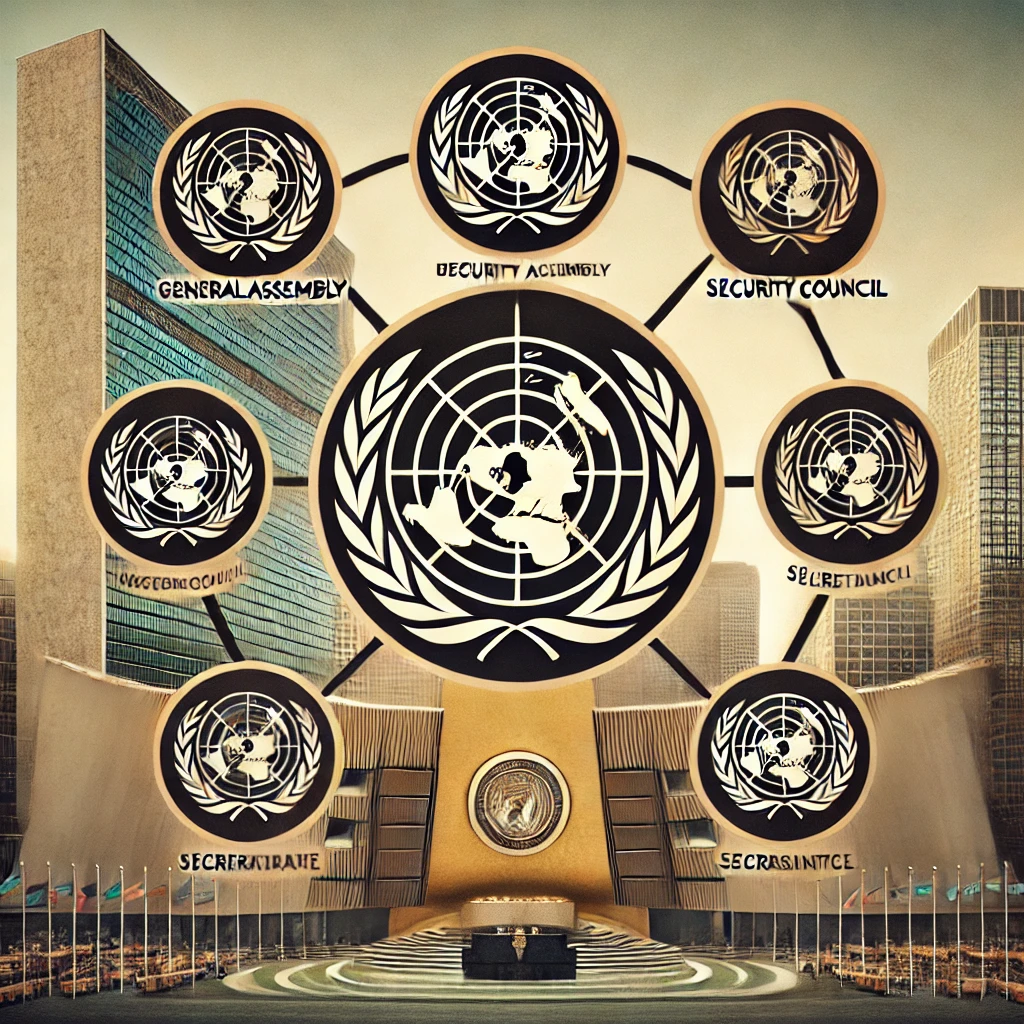
Principal Organs of the United Nations
The United Nations (UN) functions through six principal organs, as defined in Chapter III and Article 7 of the UN Charter. These organs collectively manage global peace, security, development, and international cooperation. Several specialized agencies also work under these organs.
Six Principal Organs of the United Nations
| Name of Organ | Main Functions | Headquarters |
|---|---|---|
| General Assembly | Policy-making, debate, budget approval | New York, USA |
| Security Council | Maintaining international peace and security | New York, USA |
| Economic and Social Council (ECOSOC) | Economic, social, and human rights issues | New York, USA |
| Trusteeship Council | Supervision of trust territories (now inactive) | New York, USA |
| International Court of Justice (ICJ) | Settlement of legal disputes | The Hague, Netherlands |
| Secretariat | Administrative functions, led by the Secretary-General | New York, USA |
1. General Assembly
Introduction
The General Assembly is often called the “Parliament of the United Nations”. All 193 member countries are represented here, and each country has one vote.
Main Functions
- Setting policies for the United Nations
- Approving the UN budget
- Recommending new member admissions
- Appointing the UN Secretary-General
- Discussing global issues including peace and security
Sessions
The General Assembly meets every year in September in New York.
Decision-Making
- Simple majority for normal decisions
- Two-thirds majority for important matters (peace, security, budget)
2. Security Council
Introduction
The Security Council is the most powerful organ of the United Nations. Its primary responsibility is maintaining international peace and security.
It has a total of 15 members:
- 5 Permanent Members – USA, Russia, China, France, UK
- 10 Non-Permanent Members – Elected for 2-year terms
Main Functions
- Preventing war and resolving conflicts
- Sending UN Peacekeeping Missions
- Imposing sanctions
- Recommending military action if necessary
Veto Power
The five permanent members can veto any proposal. If even one permanent member vetoes, the resolution fails—even if all others support it.
Decision-Making
- Minimum 9 out of 15 votes required
- No permanent member should use the veto
Examples
- US bypassed UNSC approval during the Iraq War (2003)
- Discussion on India’s permanent membership is ongoing
3. Economic and Social Council (ECOSOC)
Introduction
ECOSOC handles the UN’s work related to economic, social, cultural, and human rights issues. It consists of 54 members elected for 3 years.
Main Functions
- Promoting sustainable development
- Working on global health, education, and environment issues
- Coordinating with major UN agencies
Key Organizations ECOSOC Works With
- WHO
- UNICEF
- UNDP
- UNHCR
4. Trusteeship Council
Introduction
The Trusteeship Council was established to oversee territories that had not yet attained self-governance. After Palau became independent in 1994, the council became inactive.
5. International Court of Justice (ICJ)
Introduction
The ICJ, also known as the World Court, is the principal judicial organ of the UN. It is headquartered in The Hague, Netherlands.

✔ Easy to use for daily needs
✔ Value for money product
✔ Trusted choice on Amazon
Main Functions
- Settling legal disputes between nations
- Providing advisory opinions to the UN
- Interpreting international laws
Composition of Judges
The ICJ consists of 15 judges elected for 9 years.
Examples
- Kulbhushan Jadhav case (India vs. Pakistan)
- Ukraine vs. Russia hearings
6. Secretariat
Introduction
The Secretariat is the administrative organ of the United Nations. It is headed by the Secretary-General who serves a 5-year term.
Main Functions
- Managing all UN operations
- Overseeing peacekeeping missions
- Implementing decisions of the General Assembly and Security Council
Current Secretary-General
The present UN Secretary-General is António Guterres.
United Nations Security Council (UNSC)
Establishment
The UNSC was established on 24 October 1945 along with the formation of the United Nations. It is described in Chapter V of the UN Charter.
Headquarters
New York, USA
Composition of the UNSC
The UNSC has 15 members:
1. Permanent Members (P5)
- United States
- Russia
- China
- France
- United Kingdom
These members have veto power.
2. Non-Permanent Members (10 Countries)
- Elected by the General Assembly for a 2-year term
- Five new members are chosen every year
- Ensures regional balance
Main Functions of the UNSC
- Maintaining international peace and security
- Sending peacekeeping missions
- Authorizing military action
- Imposing economic and arms sanctions
- Taking actions against terrorism
Decision-Making
- At least 9 out of 15 votes needed
- No veto from any permanent member
Examples of Actions
- Peacekeeping in Congo, Sudan, Somalia, Syria
- Sanctions on North Korea for nuclear tests
- Military action against Iraq (1991) and Libya (2011)
India and the UNSC
1. India as a Non-Permanent Member
India has served as a temporary member 8 times (most recently in 2021–2022).
2. Demand for Permanent Membership
India is supported by the U.S., Russia, France, and the U.K., but China opposes India’s inclusion.
Conclusion
The six principal organs of the United Nations work collectively to promote global peace, security, justice, and development. Among them, the Security Council remains the most powerful and influential body. However, issues like veto power and permanent membership highlight the need for major reforms in the UN system.
Frequently Asked Questions (FAQ)
Q1. How many principal organs does the United Nations have?
The UN has six principal organs as defined in Article 7 of the UN Charter.
Q2. Which is the most powerful organ of the UN?
The Security Council is the most powerful organ due to its authority over peace, war, and veto power.
Q3. What is veto power?
Veto power is the authority of the five permanent members of the Security Council to block any resolution, even if all other members support it.
Q4. Why is the Trusteeship Council inactive?
It became inactive after the last trust territory (Palau) gained independence in 1994.
Q5. Why is India not a permanent member of the UN Security Council?
Although many major nations support India, China opposes its inclusion, preventing the required consensus.
Suggested Internal Links
United Nations Specialized Agencies
The United Nations (UN) is an international organization whose main goals are to promote global peace, security, human rights, and socio-economic development. To achieve these objectives effectively, the UN operates through several Specialized Agencies. These agencies work across sectors such as health, education, labor, agriculture, environment, industrial growth, trade, and financial stability.
Major Specialized Agencies of the United Nations and Their Functions
| Agency Name | Abbreviation | Year of Establishment | Headquarters | Main Functions |
|---|---|---|---|---|
| World Health Organization | WHO | 1948 | Geneva, Switzerland | Global health security |
| United Nations Children's Fund | UNICEF | 1946 | New York, USA | Child welfare and development |
| Food and Agriculture Organization | FAO | 1945 | Rome, Italy | food security and agricultural development |
| United Nations Educational, Scientific and Cultural Organization | UNESCO | 1945 | Paris, France | Education, science, cultural heritage protection |
| International Monetary Fund | IMF | 1944 | Washington D.C., USA | Global financial stability |
| World Bank Group | WBG | 1944 | Washington D.C., USA | Poverty alleviation & economic development |
| International Labour Organization | ILO | 1919 | Geneva, Switzerland | Labor rights & social security |
| International Civil Aviation Organization | ICAO | 1947 | Montreal, Canada | Regulation of global air navigation |
| World Intellectual Property Organization | WIPO | 1967 | Geneva, Switzerland | Protection of intellectual property rights |
| United Nations Industrial Development Organization | UNIDO | 1966 | Vienna, Austria | Industrial development & innovation |
| World Trade Organization | WTO | 1995 | Geneva, Switzerland | Regulation of international trade |
| International Maritime Organization | IMO | 1959 | London, UK | Global maritime safety & regulations |
| World Meteorological Organization | WMO | 1950 | Geneva, Switzerland | Climate and weather forecasting |
| International Telecommunication Union | ITU | 1865 | Geneva, Switzerland | Global telecommunications development |
1. World Health Organization (WHO)
Founded: 7 April 1948
Headquarters: Geneva, Switzerland
Main Functions
- Developing and implementing global health policies
- Preventing and controlling diseases
- Health research and development
- Responding to epidemics and health emergencies
Key Initiatives
- Guidelines and global response during the COVID-19 pandemic
- Disease eradication programs
- Global vaccination strategies
2. United Nations Children’s Fund (UNICEF)
Founded: 11 December 1946
Headquarters: New York, USA
Main Functions
- Protection of children's rights
- Education, nutrition, and healthcare services
- Elimination of child labor and exploitation
- Clean water and sanitation projects
- Emergency aid during disasters
✔ Easy to use for daily needs
✔ Good value for money
✔ Popular choice on Amazon
Key Initiatives
- Polio Eradication Campaign – Major role in eliminating polio
- Maternal & Child Nutrition Programme – Improving nutrition for mothers & infants
- “Better Start, Brighter Future” Campaign – Education & health support for children
3. Food and Agriculture Organization (FAO)
Founded: 16 October 1945
Headquarters: Rome, Italy
Main Functions
- Ensuring global food security
- Sustainable agriculture and resource conservation
- Supporting nations during famine and natural disasters
Key Initiatives
- Zero Hunger Programme
- Sustainable farming and climate-resilient agriculture
4. United Nations Educational, Scientific and Cultural Organization (UNESCO)
Founded: 16 November 1945
Headquarters: Paris, France
Main Functions
- Promoting global education
- Preservation of cultural heritage
- Encouraging scientific and technological progress
Key Initiatives
- Conservation of World Heritage Sites
- Global education programs
- Science and culture development campaigns
Conclusion
These specialized agencies of the United Nations play a crucial role in strengthening healthcare, education, trade, environment, industrial growth, food security, and global financial stability. Their continuous efforts help nations tackle global problems and contribute significantly to the welfare of humanity.
Impact of UN Agencies:
- Managing epidemics & global vaccination
- Improving education & cultural preservation
- Fighting hunger & water scarcity
- Improving global financial stability
Frequently Asked Questions (FAQ)
Q1. How many specialized agencies work under the United Nations?
The UN has 15 major specialized agencies that work on different global issues.
Q2. What is the role of WHO?
WHO works on global health security, disease control, and emergency responses.
Q3. Which UN agency works for children?
UNICEF works for child rights, education, nutrition, and protection.
Q4. What does UNESCO do?
UNESCO promotes education, culture, scientific progress, and preserves world heritage sites.
Q5. What is the function of the IMF?
The IMF maintains global financial stability and provides monetary assistance to countries.
Suggested Internal Links
✔ Easy to use for daily purpose
✔ Value for money product
✔ Trusted choice on Amazon
References
- United Nations Official Website – www.un.org
- World Health Organization (WHO) – www.who.int
- UNESCO Official Portal – www.unesco.org
- International Monetary Fund (IMF) – www.imf.org
- World Bank Group – www.worldbank.org
- Food and Agriculture Organization (FAO) – www.fao.org
- United Nations Human Rights Council (UNHRC) – www.ohchr.org
- UN Data & Statistical Reports – data.un.org