
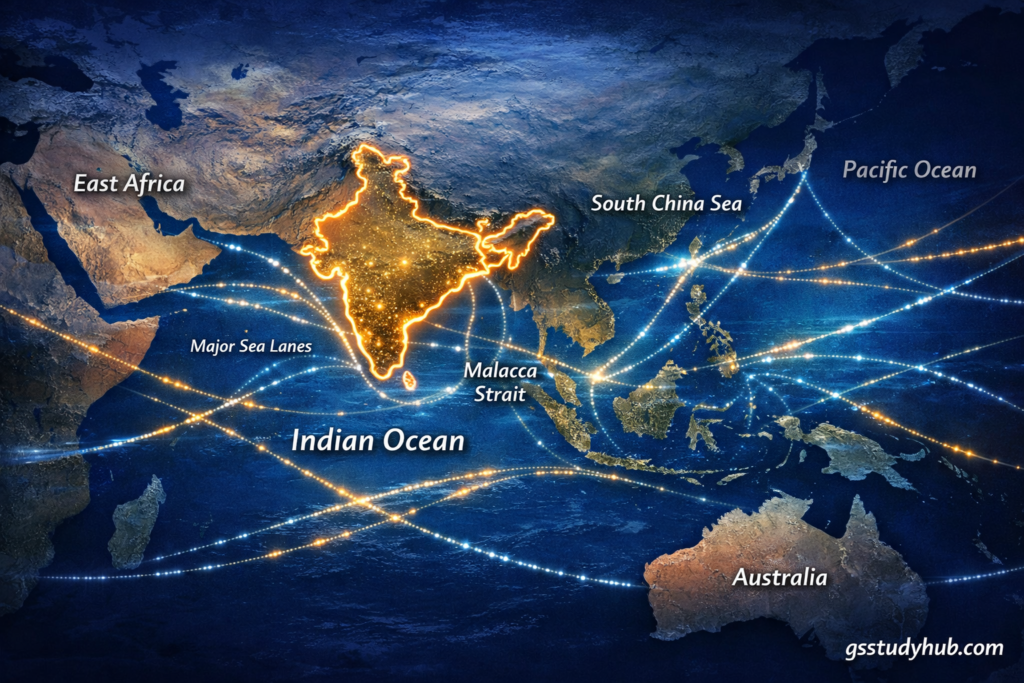
🌏 India’s Role in the Indo-Pacific Strategy The Oceanic Arena Shaping the 21st Century
India’s Role in the Indo-Pacific Strategy is shaping the future of maritime geopolitics in the 21st century.
🔥 Introduction – Where Global Power Meets the Sea
India’s Role in the Indo-Pacific Strategy: Strategic Vision and Maritime Power
The 21st century is not being shaped in silent conference rooms alone — it is being written across vast blue waters. At the heart of this unfolding geopolitical drama lies the Indo-Pacific region, a sweeping maritime expanse stretching from the eastern shores of Africa and the Indian Ocean to the western Pacific Ocean. This is not just a geographical expression; it is the strategic heartbeat of the modern world.
In today’s interconnected global order, oceans are no longer passive trade routes — they are vibrant arteries of power, prosperity, and competition. Over 60% of global GDP and nearly 90% of global trade flow through the sea lanes of the Indo-Pacific. Energy supplies, semiconductor shipments, rare earth minerals, and defense logistics all pass through these waters. Whoever safeguards these routes influences the rhythm of the global economy.
From the narrow chokepoint of the Malacca Strait to the contested waters of the South China Sea, from the energy-rich Arabian Sea to the vast strategic depth of the Pacific, the Indo-Pacific has become the grand chessboard of global power politics. It is here that alliances are forged, rivalries sharpened, and the balance of power constantly recalibrated.
🌊 The Indo-Pacific: A Geopolitical Superhighway
The Indo-Pacific is more than a maritime stretch; it is a geostrategic superhighway. Its sea lanes connect the manufacturing hubs of East Asia, the energy reserves of the Middle East, and the consumer markets of Europe and the Americas. Any disruption in these waters sends shockwaves across global markets.
In recent years, rising strategic competition — particularly between major powers — has transformed this region into a focal point of diplomatic engagement and military preparedness. Naval deployments, freedom of navigation operations, infrastructure investments, and Security Dialogues have all intensified. The Indo-Pacific is no longer peripheral — it is central to global stability.
🇮🇳 India: The Central Pillar of the Indo-Pacific
Amidst this dynamic maritime theatre stands India — geographically anchored at the heart of the Indian Ocean and strategically positioned along crucial sea lanes. India is not merely a participant in the Indo-Pacific discourse; it is emerging as a key pillar of stability and balance.
Nearly 90% of India’s trade by volume travels through sea routes. Energy imports, export markets, and maritime resources all depend on secure and open oceans. For India, therefore, the Indo-Pacific is not an abstract concept — it is a lifeline of economic growth and national security.
The Andaman and Nicobar Islands, located near the Malacca Strait, serve as a strategic watchtower over one of the world’s busiest maritime chokepoints. From the Arabian Sea to the Bay of Bengal, India’s naval presence reinforces maritime security, anti-piracy operations, and humanitarian assistance efforts.
⚓ Strategic Autonomy in a Competitive Ocean
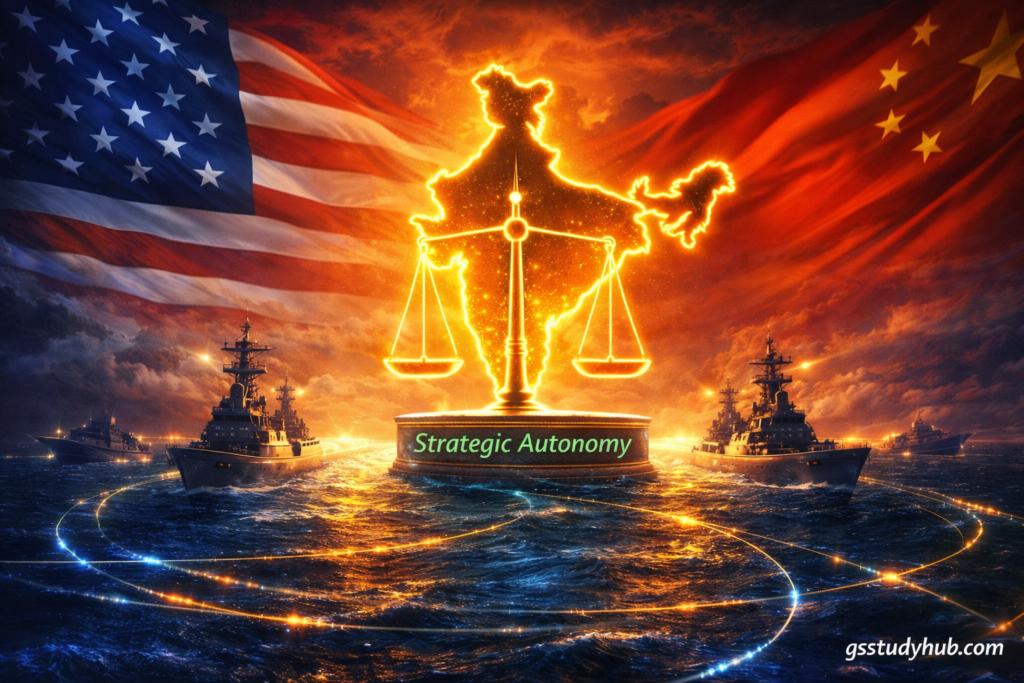
In an era of intensifying great power rivalry, India has adopted a policy of Strategic Autonomy — engaging with multiple partners while maintaining independent decision-making. Rather than aligning rigidly with any single bloc, India seeks cooperative frameworks that promote a free, open, inclusive, and rules-based Indo-Pacific.
Through multilateral engagements, security partnerships, and economic initiatives, India contributes to regional stability without compromising its sovereign interests. Its vision emphasizes dialogue over domination, connectivity over coercion, and cooperation over confrontation.
🌏 Economic Dynamism Meets Maritime Vision
As one of the fastest-growing major economies, India’s rising economic influence strengthens its Indo-Pacific role. Digital partnerships, blue economy initiatives, disaster relief missions, and infrastructure cooperation all reflect India’s evolving maritime outlook.
India’s maritime doctrine emphasizes “Security and Growth for All in the Region” — a principle that underscores shared prosperity and collective stability. This inclusive approach enhances India’s credibility as a responsible and dependable regional actor.
🚀 The Century of the Seas — And India at the Helm
If the 20th century was defined by industrial might, the 21st century is undeniably defined by maritime influence. Oceans now shape supply chains, strategic partnerships, and global security calculations.
In this evolving landscape, India stands not as a passive observer but as an active architect of regional balance. Its geography grants it relevance; its economy grants it strength; its diplomacy grants it trust.
The Indo-Pacific is the arena where the future of global order is being negotiated. And at the center of this oceanic transformation, India’s role is poised to grow — resilient, strategic, and visionary.
For a deeper understanding of multilateral cooperation in the region, read our detailed analysis on India’s Critical Role in QUAD and the Indo-Pacific Strategy , where we examine strategic coordination between India, the United States, Japan, and Australia.
🌏 The Concept of Indo-Pacific A Strategic Oceanic Vision Reshaping Global Power
🌊 Understanding the Birth of the Indo-Pacific Idea
Why India’s Role in the Indo-Pacific Strategy Matters in the 21st Century
The term “Indo-Pacific” is not merely a geographical label — it is a powerful strategic imagination that redefined how the world views the vast oceanic space connecting the Indian Ocean and the Pacific Ocean. This concept emerged as a bold diplomatic expression in 2007, when Japanese Prime Minister Shinzo Abe delivered his historic speech titled "Confluence of the Two Seas" in the Indian Parliament. In that moment, he envisioned the Indian and Pacific Oceans not as separate theatres, but as a single, integrated strategic continuum.
Abe’s vision was poetic yet profoundly strategic. He spoke of the two oceans merging as a dynamic arc of freedom and prosperity. What once appeared as distant maritime zones were suddenly seen as interconnected corridors of trade, security, diplomacy, and economic dynamism. The Indo-Pacific, therefore, became a bridge of civilizations, a corridor of commerce, and a theatre of power politics — all at once.
🌐 A Region Beyond geography
Geographically, the Indo-Pacific stretches from the eastern shores of Africa across the Indian Ocean, through Southeast Asia, and into the vast western Pacific Ocean. But strategically, it is far more expansive. It encompasses critical sea lanes, chokepoints like the Malacca Strait, energy transit routes, and bustling trade hubs that keep the global economy alive.
In the 21st century, oceans are not empty blue spaces — they are vibrant highways of globalization. Nearly 90% of global trade by volume moves through maritime routes, and a majority of that passes through Indo-Pacific waters. From oil tankers sailing from the Middle East to container ships carrying electronics from East Asia, the Indo-Pacific is the beating heart of international commerce.
⚓ Why the Concept Gained Strategic Importance
The Indo-Pacific concept gained momentum as global power dynamics began to shift. The rapid economic rise of China, the strategic recalibration of the United States, and the increasing maritime focus of regional powers created a new geopolitical reality. Traditional regional divisions like “Asia-Pacific” seemed insufficient to capture the interconnected nature of these evolving relationships.
Thus, the Indo-Pacific framework emerged as a broader, more inclusive strategic map. It recognized that developments in the Indian Ocean directly influence the Pacific, and vice versa. Piracy near the Horn of Africa, naval tensions in the South China Sea, or trade disruptions in Southeast Asia — all are interconnected threads in a single oceanic tapestry.
🌏 Major Powers in the Indo-Pacific
The Indo-Pacific region is shaped by the ambitions, strategies, and capabilities of several major powers. Each brings its own vision and priorities, creating a complex yet fascinating balance of influence.
🇮🇳 India
India sits at the geographic center of the Indian Ocean, making it a natural maritime pivot. With growing naval capabilities, expanding economic power, and a policy emphasizing “Security and Growth for All in the Region,” India envisions an open, inclusive, and stable Indo-Pacific. Its strategic autonomy allows it to engage with multiple partners while safeguarding national interests.
🇺🇸 United States
The United States views the Indo-Pacific as central to maintaining a rules-based international order. Through alliances, naval deployments, and freedom of navigation operations, the U.S. seeks to ensure that sea lanes remain open and international law is respected. Its Indo-Pacific Strategy emphasizes democracy, security cooperation, and economic resilience.
🇨🇳 China
China’s rise has profoundly influenced the Indo-Pacific narrative. Through large-scale infrastructure initiatives and expanding naval presence, China aims to secure trade routes and enhance its regional influence. Its assertive posture in certain maritime areas has intensified strategic competition, making the Indo-Pacific a focal point of global power rivalry.
🇯🇵 Japan
Japan was the intellectual architect of the Indo-Pacific idea. It promotes the vision of a “Free and Open Indo-Pacific,” focusing on connectivity, infrastructure development, maritime security, and democratic values. Japan’s diplomacy blends economic investment with strategic foresight.
🇦🇺 Australia
Australia, surrounded by the Pacific and Indian Oceans, plays a vital bridging role. It supports regional stability through defense partnerships, economic engagement, and participation in multilateral forums. Australia views the Indo-Pacific as essential to its national security and economic prosperity.
🚀 Indo-Pacific: The Defining Strategic Framework of Our Time
The Indo-Pacific concept has transformed from a visionary speech into the dominant strategic framework of the 21st century. It symbolizes interconnected destinies — where economic growth, maritime security, diplomatic cooperation, and strategic competition converge.
In essence, the Indo-Pacific is not just about oceans — it is about influence, connectivity, resilience, and the future balance of global power. As major powers navigate these vast waters, the concept continues to evolve, shaping policies and partnerships across continents.
The Indo-Pacific stands today as a vibrant, dynamic, and strategic oceanic arena — where the tides of history are rising, and the course of the century is being charted.
Learn how global power rivalries extend beyond the Indo-Pacific in Arctic Geopolitics, Energy, & Conflict — Full Analysis .
🌏 Importance of the Indo-Pacific for India India’s Strategic, Economic & Security Lifeline in the 21st Century
🌊 Introduction – Why the Indo-Pacific Matters Deeply to India
In the grand theatre of 21st-century geopolitics, the Indo-Pacific has emerged as the most dynamic, contested, and strategically vibrant region in the world. Stretching from the eastern coast of Africa across the Indian Ocean to the western Pacific, this vast maritime space is not merely a geographical expression — it is the strategic heartbeat of global commerce, security, and power politics.
For India, the Indo-Pacific is far more than a diplomatic concept. It is a lifeline of trade, a corridor of energy security, and a crucial arena of strategic balance. India’s geographic position at the center of the Indian Ocean grants it both opportunity and responsibility. As global power dynamics shift eastward, the Indo-Pacific has become central to India’s foreign policy vision and national security priorities.
🔹 (1) Strategic Importance
Nearly 90% of India’s trade by volume travels through maritime routes. This staggering figure highlights how deeply India’s prosperity is intertwined with secure and open seas. Any disruption in major sea lanes would directly affect India’s economy, supply chains, and energy access.
⚓ The Strait of Malacca – The Maritime Artery
The Strait of Malacca is one of the busiest and most critical maritime chokepoints in the world. It connects the Indian Ocean to the Pacific Ocean and serves as a gateway for trade between Asia, Europe, and beyond. A significant portion of India’s energy imports and commercial shipments pass through this narrow yet vital corridor. Its stability is therefore indispensable for India’s economic continuity.
🌊 The South China Sea – A Strategic Flashpoint
The South China Sea is rich in natural resources and is a crucial maritime transit zone. It has also become a focal point of global strategic competition. India supports a rules-based international order and freedom of navigation in these waters. Stability in this region ensures uninterrupted trade flows and balanced power dynamics.
🌅 The Arabian Sea – India’s Western Gateway
The Arabian Sea connects India to the energy-rich Middle East and the growing markets of Africa. A large share of India’s oil and gas imports flows through this route. Securing the Arabian Sea is therefore synonymous with safeguarding India’s energy security.
🏝 Andaman & Nicobar Islands – A Strategic Advantage
India’s Andaman and Nicobar Islands provide a significant strategic edge. Located close to the Strait of Malacca, they serve as a maritime watchtower. From this vantage point, India can monitor vital sea lanes and strengthen its naval presence. This geographic advantage enhances India’s capability to respond swiftly to emerging maritime challenges.
🔹 (2) Economic Importance
The Indo-Pacific region is the economic powerhouse of the world. More than 60% of global GDP originates here. Major economies such as China, Japan, South Korea, ASEAN nations, and India itself contribute to this immense economic dynamism.
For India, engagement in the Indo-Pacific opens doors to expanded trade partnerships, supply chain integration, technological collaboration, and infrastructure connectivity. A stable maritime environment ensures that commerce flows freely, strengthening India’s growth trajectory.
⛽ Energy Security – The Lifeline of Development
India imports a substantial portion of its oil and natural gas requirements. These energy shipments traverse Indo-Pacific sea routes before reaching Indian shores. Any instability along these routes would not only disrupt India’s energy supplies but also impact global energy markets.
Therefore, India views the Indo-Pacific as a foundation of economic resilience. Secure sea lanes translate directly into stable growth, investor confidence, and long-term prosperity.
🔹 (3) Security & balance of power
The Indo-Pacific is at the center of shifting global power equations. China’s expanding maritime footprint and initiatives such as the Belt and Road Initiative (BRI) have altered the strategic landscape of the region.
In response, India pursues a policy of strategic balance. Rather than confrontation, India emphasizes cooperation, inclusivity, and respect for international law. Its vision is for a free, open, and inclusive Indo-Pacific that benefits all nations.
🔍 Monitoring Developments in the South China Sea
India closely observes increasing military and infrastructural activities in the South China Sea. While avoiding direct confrontation, India advocates peaceful dispute resolution and freedom of navigation. Through naval exercises, maritime partnerships, and humanitarian missions, India reinforces its image as a reliable security provider.
By strengthening its naval capabilities and engaging in regional cooperation, India contributes to maintaining equilibrium in a region marked by competition and uncertainty.
🚀 Conclusion – India’s Rising Maritime Power
The Indo-Pacific is not simply a strategic arena for India — it is the stage upon which India’s future as a global power is unfolding. Its trade routes, energy corridors, and security frameworks directly shape India’s destiny.
Through maritime vigilance, economic engagement, and strategic balancing, India is emerging as a stable, responsible, and visionary maritime power. As the tides of the 21st century rise, India stands poised at the helm — charting a course toward prosperity, security, and global influence in the Indo-Pacific.
Understand how global geopolitical shifts influence regional strategies like Indo-Pacific in Global South vs West – New Cold War 2026 .
🌏 India’s Key Strategies in the Indo-Pacific Vision, Vigilance & Leadership in a Transforming Maritime Order
🌊 Introduction – From Participation to Strategic Leadership
In the evolving geopolitical landscape of the 21st century, India has not chosen to remain a passive observer. Instead, it has crafted bold, forward-looking, and multidimensional strategies to shape the Indo-Pacific’s future. As this vast maritime region becomes the epicenter of global trade, security competition, and technological rivalry, India’s approach reflects visionary diplomacy, maritime preparedness, and strategic balance.
India’s major Indo-Pacific strategies — the SAGAR Doctrine, the Act East Policy, and active participation in the quad — collectively define its maritime outlook. Together, these frameworks position India as a responsible, stabilizing, and influential power in the region.
🔹 (A) SAGAR Policy – Security and Growth for All in the Region
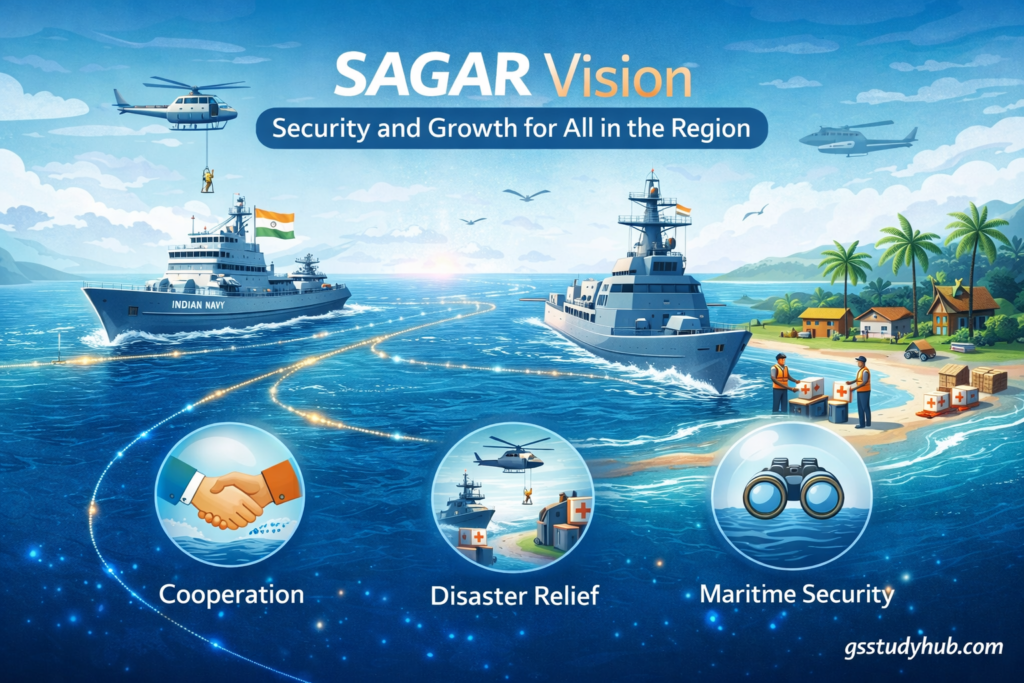
Announced in 2015, SAGAR (Security and Growth for All in the Region) represents India’s comprehensive maritime vision. More than a slogan, SAGAR embodies India’s commitment to ensuring that the Indo-Pacific remains secure, stable, and prosperous for all nations.
At its core, SAGAR emphasizes cooperation over confrontation, inclusivity over exclusivity, and shared growth over unilateral dominance. India recognizes that oceans are not territories of control, but shared spaces of connectivity and opportunity.
⚓ Key Dimensions of SAGAR
- Strengthening maritime security and naval coordination
- Combating piracy, trafficking, and illegal maritime activities
- Capacity building for small island and coastal nations
- humanitarian assistance and Disaster Relief (HADR) operations
India’s swift response during natural disasters in the Indian Ocean region has demonstrated its credibility as a reliable first responder. Through SAGAR, India reinforces its identity as a Net Security Provider, dedicated to collective well-being.
🔹 (B) Act East Policy – Expanding Horizons of Partnership
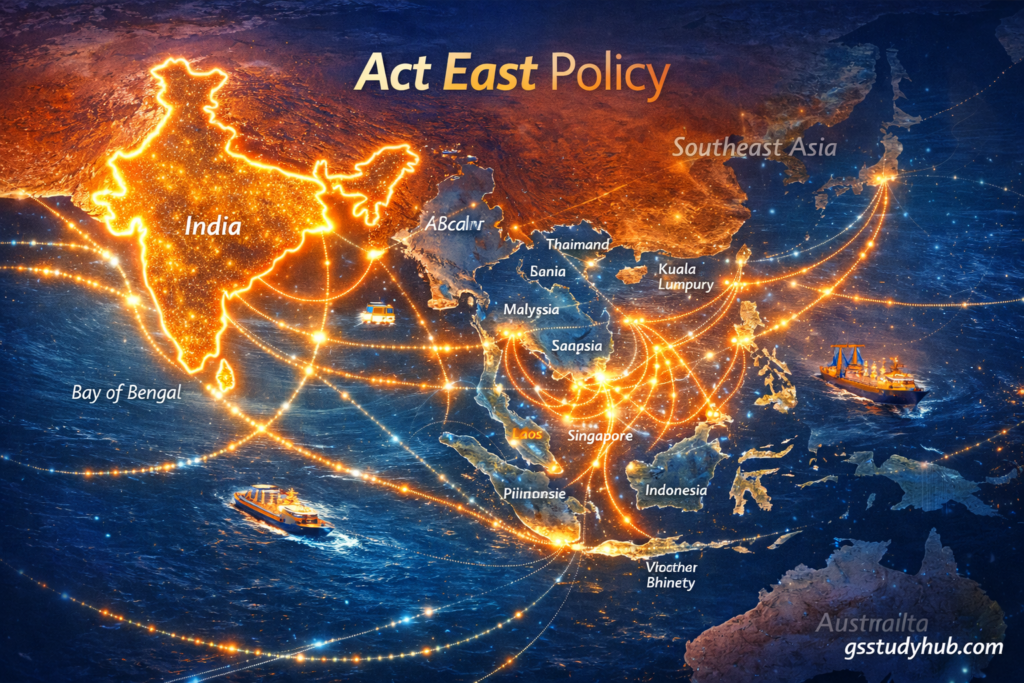
India’s Act East Policy, revitalized in 2014, represents a proactive shift from mere engagement to dynamic partnership with Southeast Asia. It strengthens economic, cultural, diplomatic, and strategic ties with ASEAN nations and beyond.
🌏 Cooperation with ASEAN
ASEAN stands at the geographic and strategic center of the Indo-Pacific. India has enhanced trade agreements, infrastructure connectivity, digital partnerships, and defense cooperation with ASEAN members. These efforts promote mutual growth and regional integration.
🚢 Maritime Connectivity & Trade Expansion
A critical pillar of Act East is strengthening maritime connectivity. Modernizing ports, ensuring secure sea lanes, and facilitating smoother trade flows empower India to integrate more deeply into regional supply chains.
Beyond economics, Act East revives centuries-old cultural and civilizational linkages between India and Southeast Asia. It blends historical bonds with contemporary strategy, creating a vibrant and resilient partnership network.
🔹 (C) India’s Role in the QUAD
India, along with the United States, Japan, and Australia, is a key member of the QUAD (Quadrilateral Security Dialogue).
The QUAD is not a formal military alliance; rather, it is a strategic platform for cooperation among like-minded democracies committed to maintaining a Free and Open Indo-Pacific.
🌊 Core Objectives of the QUAD
- Promoting a Free and Open Indo-Pacific
- Ensuring maritime security and freedom of navigation
- Coordinating disaster relief and humanitarian assistance
- Enhancing technological collaboration and resilient supply chains
Through joint naval exercises, infrastructure initiatives, vaccine diplomacy, and emerging technology cooperation, India contributes constructively to the QUAD’s agenda. It balances engagement with strategic autonomy, ensuring that cooperation strengthens — rather than constrains — its independent foreign policy.
🚀 Conclusion – A Confident Maritime Power in the Making
India’s Indo-Pacific strategies reflect clarity of purpose and maturity of vision. The SAGAR doctrine underscores its humanitarian and security commitments. The Act East Policy expands its economic and cultural influence. Participation in the QUAD enhances its strategic partnerships.
Together, these strategies project India as a balancer, collaborator, and visionary maritime leader. As the tides of global power shift across the Indo-Pacific, India stands poised — confident, capable, and committed — to shaping a stable and prosperous oceanic future.
Learn how the Taiwan Strait tensions could reshape Indo-Pacific dynamics in Taiwan Strait Crisis 2026 – Next Ukraine? .
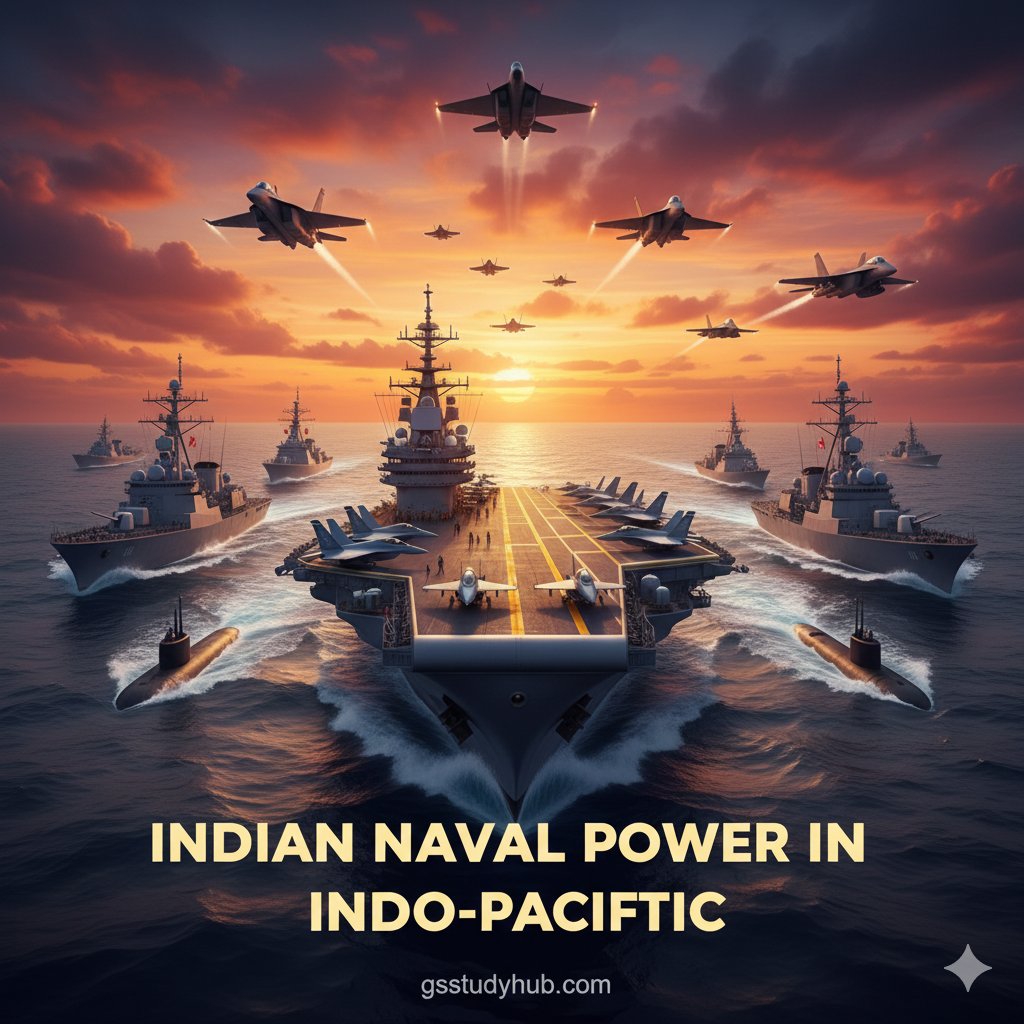
⚓ Naval Power and Defence Cooperation India’s Expanding Maritime Strength in the Indo-Pacific
🌊 Introduction – Oceans as the New Arena of Power
The 21st century is increasingly defined by maritime power. trade routes, energy corridors, undersea cables, and strategic chokepoints have transformed oceans into the central theatre of global geopolitics. In this dynamic environment, the Indo-Pacific has emerged as the most strategically significant maritime space in the world. At the heart of this vast oceanic arena stands India — confident, capable, and steadily rising as a responsible maritime power.
India’s naval strength and defence cooperation are not merely instruments of military capability; they are pillars of economic security, diplomatic credibility, and regional stability. Through regular naval patrols, multilateral exercises like Malabar, and strategic agreements such as LEMOA, India reinforces its commitment to a free, open, and secure Indo-Pacific.
🚢 Regular Naval Patrols in the Indo-Pacific
The Indian Navy maintains a steady and visible presence across the Indo-Pacific. From the Arabian Sea to the Strait of Malacca and beyond, Indian warships, submarines, and maritime patrol aircraft conduct regular surveillance and patrol missions. These deployments are not symbolic gestures; they are proactive measures to ensure maritime stability.
India’s patrols serve multiple strategic purposes:
- Safeguarding vital Sea Lines of Communication (SLOCs)
- Combating piracy, smuggling, and illegal maritime activities
- Ensuring freedom of navigation
- Providing rapid response in times of crisis
With nearly 90% of India’s trade flowing through sea routes, the Navy acts as a guardian of economic lifelines. Its constant vigilance transforms India into a credible Net Security Provider in the Indian Ocean region.
⚓ The Malabar Naval Exercise – Strength Through Partnership
The Malabar Naval Exercise stands as a shining example of India’s commitment to cooperative security. Conducted with key strategic partners, this high-level naval drill enhances interoperability, tactical coordination, and operational readiness.
Malabar showcases cutting-edge aircraft carriers, destroyers, submarines, and surveillance systems operating in seamless coordination. It reflects India’s growing maritime sophistication and its readiness to respond to complex security challenges.
🎯 Objectives of the Malabar Exercise
- Strengthening maritime domain awareness
- Practicing anti-submarine and anti-air warfare operations
- Enhancing joint operational coordination
- Improving disaster relief and humanitarian assistance cooperation
Beyond tactical drills, Malabar symbolizes trust and shared commitment. It demonstrates that India believes in collaborative security frameworks rather than unilateral dominance.
🤝 LEMOA – Expanding Strategic Reach with the United States
The Logistics Exchange Memorandum of Agreement (LEMOA) between India and the United States marked a historic milestone in defence cooperation. This agreement allows both countries’ armed forces to access each other’s military facilities for refueling, replenishment, and logistical support.
Through LEMOA, the Indian Navy gains enhanced operational endurance in distant waters. It enables sustained deployments across the Indo-Pacific without compromising efficiency. This agreement strengthens India’s global maritime mobility.
🌍 Benefits of LEMOA
- Facilitates long-range naval deployments
- Improves coordination during joint exercises
- Enhances rapid response in emergencies
- Builds deeper strategic trust
Importantly, LEMOA does not compromise India’s strategic autonomy. Instead, it reflects a pragmatic partnership rooted in mutual benefit and shared security interests.
🌏 Defence Cooperation – A Multilateral Outlook
India’s defence diplomacy extends beyond bilateral agreements. It actively participates in multilateral naval engagements, information-sharing networks, and capacity-building initiatives. These efforts enhance regional maritime resilience.
The Indian Navy is widely recognized for its swift humanitarian assistance during natural disasters in the Indian Ocean region. Such missions project India as a responsible and compassionate maritime power.
🚀 Conclusion – A Confident Maritime Guardian
India’s regular naval patrols, participation in Malabar exercises, and strategic cooperation under LEMOA collectively elevate its maritime stature. They reflect preparedness, partnership, and purpose.
In the vast blue expanse of the Indo-Pacific, India’s Navy stands as a steadfast sentinel — protecting trade routes, reinforcing partnerships, and upholding stability. As the tides of global power continue to shift, India emerges not merely as a participant, but as a confident maritime guardian shaping the future of the Indo-Pacific.
Understand how currency realignment is influencing global power structures in De-Dollarization 2026: Global Shift Explained .
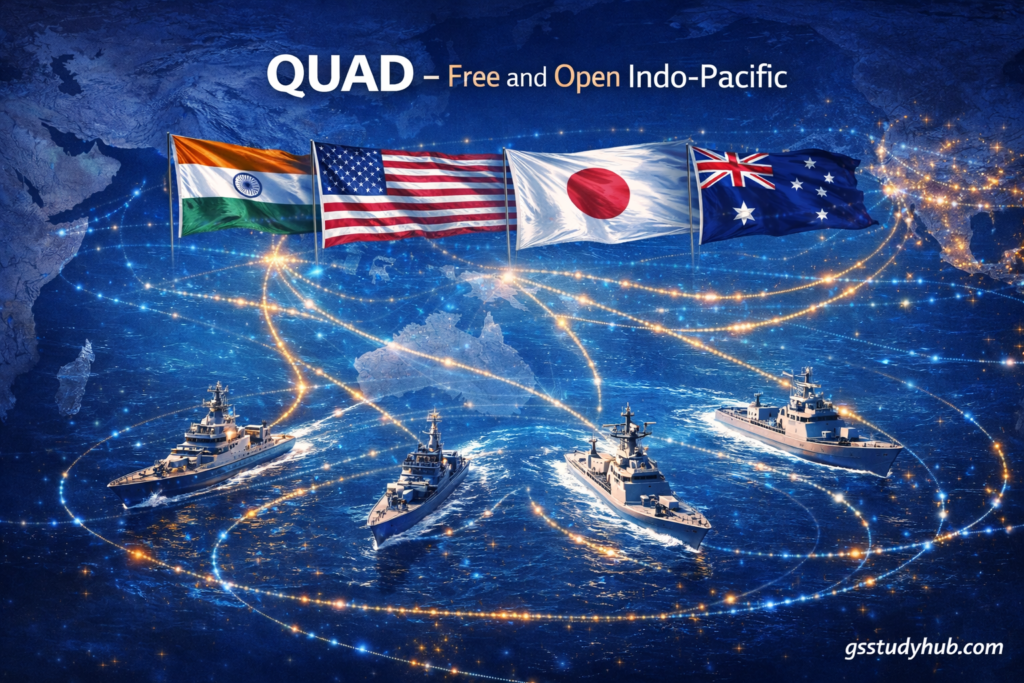
⚠️ Challenges in the Indo-Pacific Strategic Tests Before India in a Turbulent Maritime Order
🌊 Introduction – Where Opportunity Meets Uncertainty
The Indo-Pacific is often described as a region of immense promise — a vibrant maritime highway of trade, technology, and strategic partnerships. Yet, beneath its shimmering blue waters lies a complex web of rivalry, tension, and competition. For India, the Indo-Pacific is not only a landscape of opportunity but also a theatre of profound challenges. Balancing ambition with caution, growth with security, and cooperation with competition has become the defining test of India’s maritime strategy.
Four major challenges stand prominently before India: China’s expanding military presence, the South China Sea dispute, intensifying competition for influence in small island nations, and the persistent constraint of limited resources and defence budgets. Each of these factors adds layers of complexity to India’s Indo-Pacific engagement.
🔴 1. China’s Expanding Military Presence
One of the most significant challenges in the Indo-Pacific is China’s rapidly growing naval and military footprint. Over the past decade, China has dramatically expanded its navy, building aircraft carriers, advanced submarines, and modern destroyers capable of long-range deployment. Its presence now stretches from the Western Pacific to the Indian Ocean.
Through infrastructure investments and port development projects across the Indo-Pacific, China has enhanced its strategic reach. This expanding network of maritime facilities — often referred to in strategic discussions as a “string of pearls” — creates new geopolitical calculations for India.
For India, this evolving maritime environment requires heightened vigilance and calibrated response. While India avoids direct confrontation, it must continuously strengthen its naval capabilities to preserve balance and deter coercion.
🌊 2. The South China Sea Dispute
The South China Sea is among the most strategically sensitive maritime zones in the world. Rich in natural resources and traversed by vital trade routes, it has become a focal point of territorial disputes and military posturing.
Although India is not a direct claimant in the South China Sea, its economic and energy interests are deeply tied to the stability of this region. A substantial portion of India’s trade flows through these waters. Any escalation or disruption could ripple through India’s economy.
India’s position emphasizes freedom of navigation and respect for international law. However, maintaining this principled stance while navigating diplomatic sensitivities remains a delicate balancing act.
🏝 3. Competition for Influence in Small Island Nations
The Indo-Pacific is dotted with strategically located island nations — small in size, yet enormous in geopolitical significance. These nations often sit near vital sea lanes or chokepoints, making them valuable partners in maritime strategy.
Major powers are increasingly investing in these countries through infrastructure, development aid, and security partnerships. China’s financial outreach has expanded its footprint in several island nations, prompting India to intensify its own engagement.
For India, the challenge lies in offering sustainable, transparent, and mutually beneficial cooperation. This is not merely economic competition — it is a contest for strategic trust and long-term influence.
💰 4. Constraints of Resources and Budget
India’s ambitions in the Indo-Pacific are expansive, but resources are finite. Modernizing naval fleets, building aircraft carriers, acquiring submarines, and investing in maritime surveillance require significant financial commitment.
Simultaneously, India must allocate resources to land border security, domestic development, and social welfare priorities. Balancing these competing demands makes defence budgeting a complex exercise.
To overcome these constraints, India increasingly focuses on innovation, indigenous defence production, and strategic partnerships. Smart investments and technological modernization are key to maximizing capability within limited budgets.
🚀 Conclusion – Navigating Complexity with Confidence
The Indo-Pacific presents India with a paradox — vast opportunity intertwined with formidable challenge. China’s expanding presence, maritime disputes, geopolitical competition, and fiscal limitations collectively test India’s strategic resolve.
Yet India’s approach remains measured and forward-looking. By combining diplomacy with defence preparedness, cooperation with strategic autonomy, and ambition with prudence, India seeks to transform challenges into stepping stones.
In the shifting tides of the Indo-Pacific, India’s success will depend on its ability to navigate turbulence with resilience and clarity. The waves may be unpredictable, but India’s course is guided by balance, responsibility, and vision.
Explore how AI competition is reshaping global power in AI Arms Race – US & China Tech War .
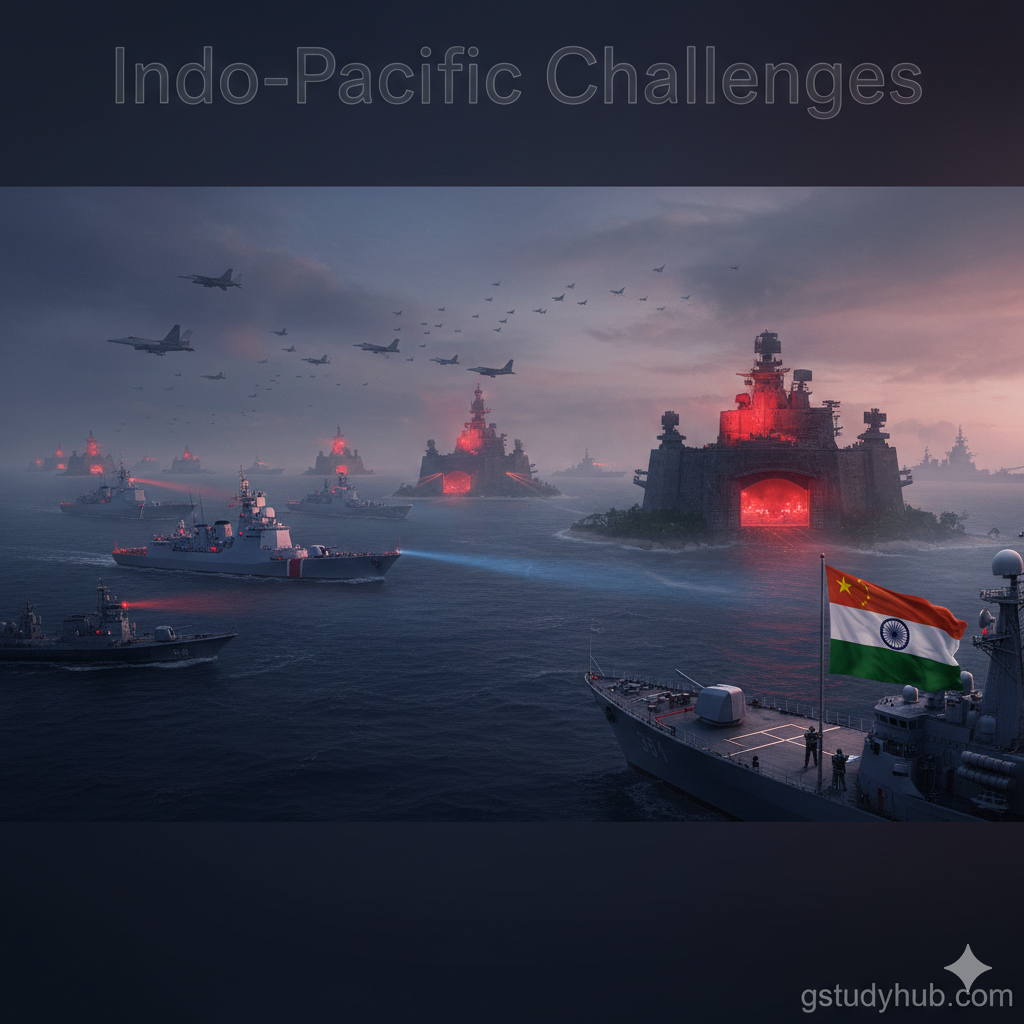
🌏 India’s Strategic Autonomy The Art of Balance in a Polarized World
🌊 Introduction – Neither Alignment nor Isolation
In the turbulent waters of 21st-century geopolitics, nations are often compelled to choose sides. Major powers compete fiercely, alliances deepen, and global tensions reshape international relations. Yet India has charted a distinctive path — a path defined not by rigid alignment or strategic isolation, but by Strategic Autonomy.
India is not a formal member of any military alliance. Instead, it follows a doctrine that allows it to maintain independent decision-making while nurturing balanced relationships with diverse global powers. This policy reflects confidence, maturity, and a deep understanding of its long-term national interests.
⚖️ What is Strategic Autonomy?
Strategic Autonomy means placing national interests at the center of foreign policy and retaining the freedom to take independent decisions without external pressure. It enables India to engage with multiple countries — sometimes even rivals — without being constrained by alliance obligations.
While the idea draws historical inspiration from India’s leadership in the Non-Aligned Movement during the Cold War, today’s Strategic Autonomy is far more dynamic. It is not passive neutrality; it is active multi-alignment — a carefully calibrated balancing act in a multipolar world.
🌐 Balancing in a Multipolar World
The global order today is no longer unipolar. The United States, China, the European Union, Russia, and emerging powers all shape the evolving balance of power. In such a fluid environment, strict alignment with any one bloc could limit India’s flexibility.
India’s approach can be summarized as: “Engage with all, align with none.” This strategy allows India to cooperate with Western democracies in technology and defence, maintain energy and security ties with Russia, and simultaneously pursue dialogue and competition with China.
🤝 Multi-Dimensional Partnerships
Strategic Autonomy empowers India to cultivate diverse partnerships across continents. It participates in forums such as the G20 and BRICS, while also engaging in initiatives like the quad in the Indo-Pacific.
India deepens defence cooperation with countries like the United States and France, yet preserves strong historical ties with Russia. It expands trade with ASEAN and Europe, while promoting regional cooperation in South Asia.
Such a wide diplomatic canvas enhances India’s image as a credible and independent global actor.
🌊 Strategic Autonomy in the Indo-Pacific
In the Indo-Pacific — a region marked by intense strategic rivalry — Strategic Autonomy becomes even more significant. India supports the vision of a Free and Open Indo-Pacific, but avoids forming exclusive military blocs.
By maintaining open channels with all stakeholders, India contributes to stability without escalating tensions. This balanced posture enhances its credibility as a responsible and stabilizing power.
💡 Advantages of Strategic Autonomy
- Independent foreign policy decision-making
- Diverse economic and defence partnerships
- Flexible response during crises
- Protection of core national interests
Strategic Autonomy allows India to navigate global crises — from geopolitical conflicts to economic disruptions — without being compelled to follow the agenda of any single power.
🚀 Conclusion – Mastering the Art of Balance
India’s Strategic Autonomy is not merely a diplomatic slogan; it is the cornerstone of its foreign policy philosophy. It reflects a confident nation capable of shaping its own destiny amid global uncertainty.
As the international system undergoes transformation, India’s balanced, pragmatic, and independent approach positions it as a visionary and stabilizing force in global affairs.
In a world divided by alliances and rivalries, India stands firm — charting its own course, guided by national interest, strategic clarity, and diplomatic resilience.
Discover how historical strategies inform modern geopolitics in Lessons from the Cold War for Today’s Geopolitics .
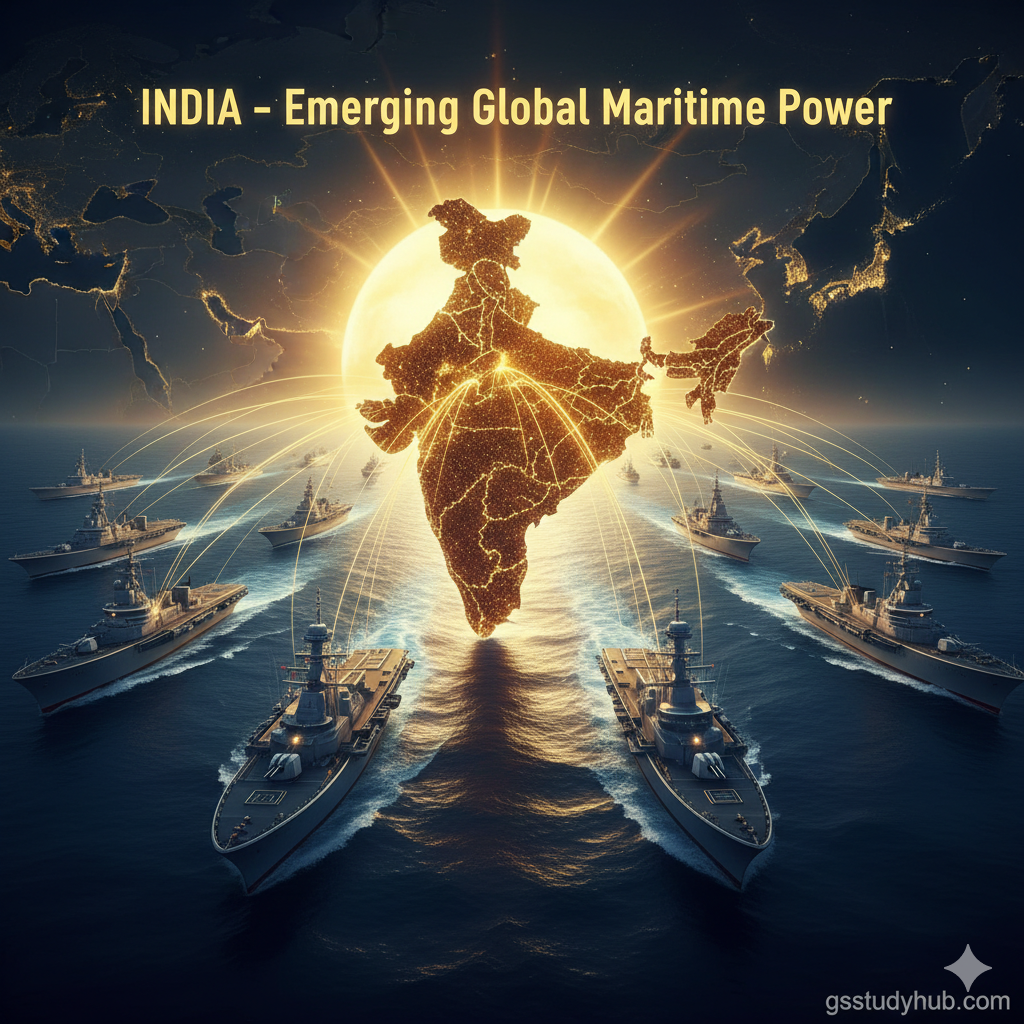
🌏 Conclusion – India’s Defining Role in the Indo-Pacific A Balancer, A Security Provider, A Rising Global Power
🌊 The Final Reflection – India at the Crossroads of Oceans and Opportunity
As the 21st century unfolds across the vast blue canvas of the Indo-Pacific, one truth becomes increasingly clear — India is no longer a peripheral player. It stands at the strategic crossroads of the Indian and Pacific Oceans, shaping conversations, influencing outcomes, and contributing to regional stability. India’s role in the Indo-Pacific Strategy is fundamentally that of a Balancer and a Net Security Provider.
In a region marked by intense great-power rivalry, shifting alliances, and maritime competition, India does not seek dominance. Instead, it seeks equilibrium. It does not impose security; it enables it. Through calibrated diplomacy, maritime vigilance, and multilateral cooperation, India works to ensure that the Indo-Pacific remains free, open, inclusive, and rules-based.
⚖️ India as a Strategic Balancer
The Indo-Pacific today resembles a complex geopolitical chessboard. Major powers expand influence, secure alliances, and assert maritime claims. Amid this turbulence, India plays the role of a steady and stabilizing balancer.
Rather than aligning rigidly with any single bloc, India adopts a nuanced strategy of engagement. It partners with like-minded democracies, engages constructively with regional powers, and advocates respect for international law. This balanced posture reduces polarization and promotes strategic stability.
India’s diplomatic language consistently emphasizes dialogue over confrontation, cooperation over coercion, and partnership over polarization. Such an approach enhances its credibility as a responsible power that seeks harmony, not hegemony.
🛡️ India as a Net Security Provider
Beyond balancing power dynamics, India contributes directly to regional security. Its naval patrols safeguard Sea Lines of Communication. Its humanitarian assistance missions deliver relief during cyclones, earthquakes, and crises. Its participation in joint exercises enhances interoperability and collective preparedness.
By responding swiftly to maritime emergencies and supporting smaller island nations, India demonstrates that security is not merely about military might — it is about responsibility and reliability. This commitment strengthens its identity as a guardian of regional stability.
📈 The Future – Why India’s Role Will Grow Even More Significant
💹 Rising Economic Power
India’s economic trajectory is one of the most compelling stories of the century. As one of the fastest-growing major economies, India is expanding its manufacturing base, strengthening digital infrastructure, and integrating into global supply chains.
A stronger economy translates into greater strategic influence. Economic resilience enhances India’s bargaining power in trade negotiations, regional partnerships, and infrastructure initiatives. In the Indo-Pacific, economic vitality reinforces geopolitical relevance.
⚓ Strengthening Naval Capability
India’s naval modernization is steadily transforming its maritime profile. New aircraft carriers, advanced submarines, maritime surveillance systems, and indigenous shipbuilding projects expand operational reach and deterrence capability.
A stronger navy enhances India’s ability to secure vital sea lanes, respond to crises, and project stability across the Indo-Pacific. Maritime preparedness ensures that India’s voice carries weight in regional Security Dialogues.
🌍 Expanding Diplomatic Influence
India’s diplomatic footprint is widening across continents. Through participation in global forums, climate initiatives, technology partnerships, and development cooperation programs, India’s influence continues to expand.
In the Indo-Pacific, this diplomatic outreach strengthens trust and builds durable partnerships. India is increasingly viewed not merely as a regional actor, but as a constructive voice in shaping the global order.
🌟 From Regional Power to Emerging Global Force
India’s evolution in the Indo-Pacific reflects a broader transformation. It is no longer confined to the label of a regional power. Its economic dynamism, maritime vigilance, and diplomatic engagement are elevating it to the status of an emerging global power.
The Indo-Pacific serves as the proving ground for this transformation. Here, India demonstrates its ability to balance competition with cooperation, to combine strength with responsibility, and to align national interests with regional stability.
As global power equations continue to shift, India’s steady rise offers a model of measured leadership and principled engagement. Its journey in the Indo-Pacific is not merely about strategy — it is about shaping the future architecture of global governance.
🚀 Final Words – Charting the Century Ahead
The Indo-Pacific is the defining arena of our time. And in this vast maritime expanse, India stands tall — as a balancer of power, a provider of security, and a beacon of strategic autonomy.
With growing economic strength, expanding naval capability, and deepening diplomatic influence, India’s role in the Indo-Pacific will only become more central and consequential.
The tides of history are shifting across the Indo-Pacific. And at the helm of this transformation, India is steadily carving its identity — not merely as a regional actor, but as a confident, visionary, and rising global power.
Understand how Western military strategies influence global power structures in NATO Strategy in Eastern Europe & Its Global Impact .
🌏 India’s Role in the Indo-Pacific Strategy – FAQ Guide Understanding India’s Maritime Vision & Strategic Influence
🌊 Introduction – Frequently Asked Questions About India in the Indo-Pacific
The Indo-Pacific has emerged as the defining geopolitical arena of the 21st century. Stretching from the eastern coast of Africa across the Indian Ocean to the western Pacific, this vast maritime corridor carries the lifeblood of global trade, energy supplies, and strategic competition. As one of the most influential powers in this region, India plays a dynamic and evolving role.
This FAQ section provides clear, insightful, and comprehensive answers about India’s role in the Indo-Pacific strategy, explaining its objectives, partnerships, challenges, and long-term vision.
❓ 1. What is the Indo-Pacific Strategy?
The Indo-Pacific Strategy refers to a geopolitical framework that connects the Indian and Pacific Oceans into a single strategic space. It emphasizes maritime security, economic connectivity, freedom of navigation, and a rules-based international order.
For India, the Indo-Pacific is not merely a geographic term; it is a vision of inclusive growth, balanced power, and shared prosperity.
❓ 2. Why is the Indo-Pacific Important for India?
Nearly 90% of India’s trade by volume travels via sea routes. Energy imports, export markets, and maritime resources depend on stable and open oceans.
The Indo-Pacific is therefore India’s economic lifeline and strategic frontier. Any instability in this region directly affects India’s growth, security, and global ambitions.
❓ 3. What Role Does India Play in the Indo-Pacific?
India plays the dual role of a Strategic Balancer and a Net Security Provider.
- Ensuring freedom of navigation
- Conducting naval patrols
- Providing humanitarian assistance
- Promoting regional cooperation
India’s approach emphasizes cooperation rather than confrontation.
❓ 4. What is India’s SAGAR Doctrine?
SAGAR stands for Security and Growth for All in the Region. Launched in 2015, it reflects India’s maritime vision of inclusive security and shared prosperity.
Through SAGAR, India supports capacity-building in smaller nations, maritime surveillance cooperation, and disaster relief missions.
❓ 5. How Does India Engage with the quad?
India is a member of the QUAD, alongside the United States, Japan, and Australia.
The QUAD promotes:
- Free and Open Indo-Pacific
- Maritime security cooperation
- Disaster response coordination
- Technological collaboration
However, India maintains Strategic Autonomy and is not part of any formal military alliance.
❓ 6. What Challenges Does India Face in the Indo-Pacific?
India navigates several complex challenges:
- China’s expanding military footprint
- South China Sea tensions
- Competition for influence in island nations
- Budget and resource limitations
Despite these challenges, India continues to pursue a balanced and proactive approach.
❓ 7. Is India a Regional or Global Power in the Indo-Pacific?
India is steadily transitioning from a regional maritime power to an emerging global force.
Its growing economy, strengthening navy, and expanding diplomatic reach are enhancing its influence far beyond South Asia.
❓ 8. What is the Future of India in the Indo-Pacific?
India’s future role in the Indo-Pacific will become even more significant due to:
- Rising economic strength
- Advanced naval modernization
- Expanded diplomatic partnerships
- Technological innovation and supply chain resilience
As global power equations shift, India’s balanced, inclusive, and visionary approach positions it as a stabilizing force in the region.
🚀 Final Takeaway
India’s role in the Indo-Pacific strategy is dynamic, multidimensional, and steadily expanding. It balances power, provides security, promotes cooperation, and safeguards maritime freedoms.
In this vast maritime theatre, India stands not merely as a participant — but as a visionary architect of regional stability and global partnership.
Strategic dynamics in the Indo-Pacific are deeply influenced by India–China relations — see our comprehensive article on India–China diplomatic strategy .
📚 References for “India’s Role in the Indo-Pacific Strategy” Authoritative Sources & Research Foundations
🌏 Why References Matter in Strategic Analysis
Any serious discussion on India’s role in the Indo-Pacific strategy must be supported by credible and authoritative sources. The Indo-Pacific is not merely a geographic idea — it is a living geopolitical framework shaped by official policy documents, diplomatic speeches, defence agreements, academic research, and multilateral declarations.
References strengthen the intellectual foundation of your article. They demonstrate analytical depth, academic credibility, and research authenticity. For students, researchers, bloggers, or policy analysts, a well-structured reference section transforms an article from opinion into informed analysis.
📘 1. Official Indian Government Documents
The most reliable references for India’s Indo-Pacific strategy come directly from official sources:
- Ministry of External Affairs (MEA), Government of India – Official speeches & policy briefs
- Prime Minister’s speeches at Shangri-La Dialogue (2018) – Vision for Indo-Pacific
- Indian Navy Maritime Security Strategy Documents
- SAGAR (Security and Growth for All in the Region) policy statements
These documents provide primary evidence of India’s official position, strategic intent, and diplomatic commitments.
📗 2. International Strategy Papers
To understand the broader geopolitical environment, references from global powers are essential:
- U.S. Indo-Pacific Strategy Report (Department of Defense)
- Japan’s Free and Open Indo-Pacific (FOIP) Vision Document
- Australia’s Defence White Paper
- ASEAN Outlook on the Indo-Pacific (AOIP)
These strategy papers help contextualize India’s role within a larger regional architecture.
📙 3. Academic Books & Scholarly Research
Scholarly works offer deep analytical insights into India’s evolving maritime role:
- Rory Medcalf – Indo-Pacific Empire
- David Brewster – Studies on India’s Indian Ocean strategy
- C. Raja Mohan – Research on India’s maritime diplomacy
- Journal articles from International Affairs, ORF, IDSA, and Carnegie India
Academic sources strengthen theoretical and strategic interpretations.
📕 4. Defence & Maritime Reports
For naval power and defence cooperation references:
- Indian Navy Annual Reports
- Malabar Naval Exercise official releases
- LEMOA Agreement summary documents
- Stockholm International Peace Research Institute (SIPRI) Defence Data
These provide statistical and operational evidence of India’s maritime capacity.
📓 5. Think Tank & Policy Institution Reports
Leading think tanks frequently publish Indo-Pacific analyses:
- Observer Research Foundation (ORF)
- Institute for Defence Studies and Analyses (IDSA)
- Brookings Institution
- Lowy Institute
- CSIS (Center for Strategic and International Studies)
These institutions provide balanced, data-driven insights into regional strategy.
📝 Sample Reference Format (APA Style)
Below is an example of how you can structure references in APA format:
Ministry of External Affairs. (2018). Prime Minister’s Keynote Address at Shangri-La Dialogue. Government of India.

Medcalf, R. (2020). Indo-Pacific Empire: China, America and the contest for the world's pivotal region. Manchester University Press.

Department of Defense. (2019). Indo-Pacific Strategy Report. U.S. Government.

Observer Research Foundation. (2022). India’s Indo-Pacific Vision: Strategic Imperatives.
🚀 Final Note – Building Credible Strategic Writing
When writing about India’s role in the Indo-Pacific strategy, your references should ideally include:
- At least 2 official government documents
- 2–3 academic or think tank sources
- 1 defence or maritime data source
- 1 multilateral regional document (ASEAN/quad)
Combining primary policy sources with scholarly analysis ensures your work is analytically strong, factually reliable, and academically credible.
In the rapidly evolving Indo-Pacific landscape, well-documented research is not just a formality — it is the foundation of informed global discourse.