
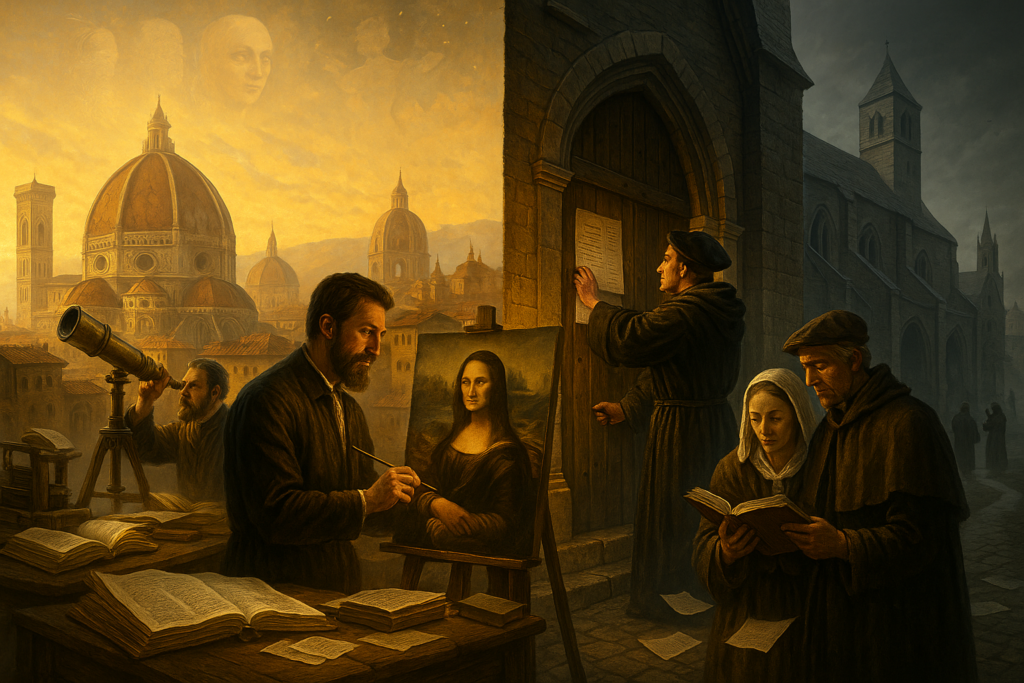
Renaissance and Reformation Movement
The Renaissance and the Reformation were two important historical movements that transformed Europe intellectually, culturally, socially, and religiously. Their influence continues even today, shaping modern science, democracy, human rights, and education.
1. Renaissance
The term Renaissance means “rebirth”. It was a cultural, intellectual, and artistic movement that spread across Europe between the 14th and 17th centuries. It began in Italy and later expanded to the rest of Europe.
Main Characteristics of the Renaissance
- Humanism: Focus on human abilities rather than medieval religious ideas.
- Revival of Arts and Literature: Artists like Leonardo da Vinci, Michelangelo, and Raphael depicted naturalism and human anatomy.
- Development of Science and Logic: Scientists like Copernicus, Galileo, Kepler, and Newton introduced new theories.
- Independent Thinking: People began questioning church superstitions and embraced logical and scientific views.
- Printing Revolution: Gutenberg’s printing press helped spread knowledge and education.
- Political Change: Ideas of freedom, democracy, and nationalism emerged.
Major Influences of the Renaissance
- Transition from medieval Europe to modern Europe.
- Progress in science, art, and literature.
- Decline in the influence of the church.
- Increase in discoveries and inventions.
- Growth of scientific and logical thinking.
2. Reformation Movement
The Reformation was a religious movement of the 16th century that opposed the corruption of the Catholic Church. It divided Christianity into Catholic and Protestant branches.
Reasons for the Reformation Movement
- Evils of the Catholic Church: Corruption, wealth accumulation, and immoral activities.
- Opposition to Indulgences: Selling forgiveness for money.
- New Interpretation of the Bible: People wanted to read and understand the Bible themselves.
- Support from Kings: Rulers supported reformers to reduce church power.
- Spread of Ideas: Printing helped people question the church.
Major Reformers and Their Ideas
- Martin Luther: Wrote the "95 Theses" in 1517 and founded Protestantism.
- John Calvin: Preached the Theory of Predestination.
- Huldrych Zwingli: Led reforms in Switzerland.
- King Henry VIII: Formed the Church of England and broke away from the Pope.
Effects of the Reformation Movement
- Decline in the power of the Catholic Church.
- Emergence of Protestantism.
- Strengthening of religious freedom.
- Foundation of democratic and secular states.
- Growth in education and intellectual awareness.
Conclusion
Both the Renaissance and the Reformation were crucial in transforming medieval Europe into modern Europe. The Renaissance promoted intellectual and cultural awakening, while the Reformation questioned the authority of the Church and supported religious freedom. Their impact is still visible today through scientific thinking, democracy, and human rights.
Renaissance and Its Impact Till Today
✔ Easy and convenient to use daily
✔ Excellent value for money
✔ Highly rated by users
The Renaissance was a cultural and intellectual movement that brought revolutionary changes in art, science, philosophy, literature, and politics. Its influence is still felt today in modern science, democratic values, and education.
1. Historical Perspective of the Renaissance
(i) Middle Ages (5th–14th Century)
- Europe was dominated by the Church.
- Science and reason were suppressed.
- Society followed the feudal system.
(ii) Beginning of the Renaissance (14th–17th Century)
- Began in Florence, Italy.
- Revived ancient Greek and Roman knowledge.
- Humanism encouraged scientific and artistic development.
2. Major Factors of the Renaissance
- Crusades and Islamic World Contact: New ideas in science and philosophy came from Arab scholars.
- Printing Revolution: Gutenberg’s invention spread education.
- Trade and Economy: Wealth increased intellectual development.
- Revival of Classical Texts: Works of Plato, Aristotle, and Socrates were adopted.
- New Scientific Discoveries: Copernicus, Galileo, and Newton challenged old beliefs.
3. Main Areas of the Renaissance
(i) Art
- Leonardo da Vinci’s “Mona Lisa” and “The Last Supper”.
- Michelangelo’s “David” and Sistine Chapel ceiling.
- Realistic art by Raphael and Titian.
(ii) Literature
- Dante: “Divine Comedy”.
- Chaucer: “Canterbury Tales”.
- Shakespeare: “Hamlet”, “Macbeth”, “Romeo and Juliet”.
(iii) Science and Astronomy
- Copernicus: Sun-centered solar system.
- Galileo: Telescope and modern astronomy.
- Newton: Theory of gravity.
(iv) Religion and Reformation
- Martin Luther began the Protestant Revolution.
- Church influence decreased; secularism spread.
4. Effects of the Renaissance Till Today
- Modern Science: Led to technology, medicine, and space exploration.
- Democracy and Human Rights: Inspired modern constitutions and freedoms.
- Education: Encouraged research and innovation.
- Art and Literature: Influenced modern creative fields.
- Religion and Society: Encouraged secularism and reduced superstition.
Conclusion
The Renaissance was an intellectual awakening that reshaped the world. Its influence on science, education, art, and politics continues to guide modern society. The movement strengthened scientific thinking, democracy, and human progress.
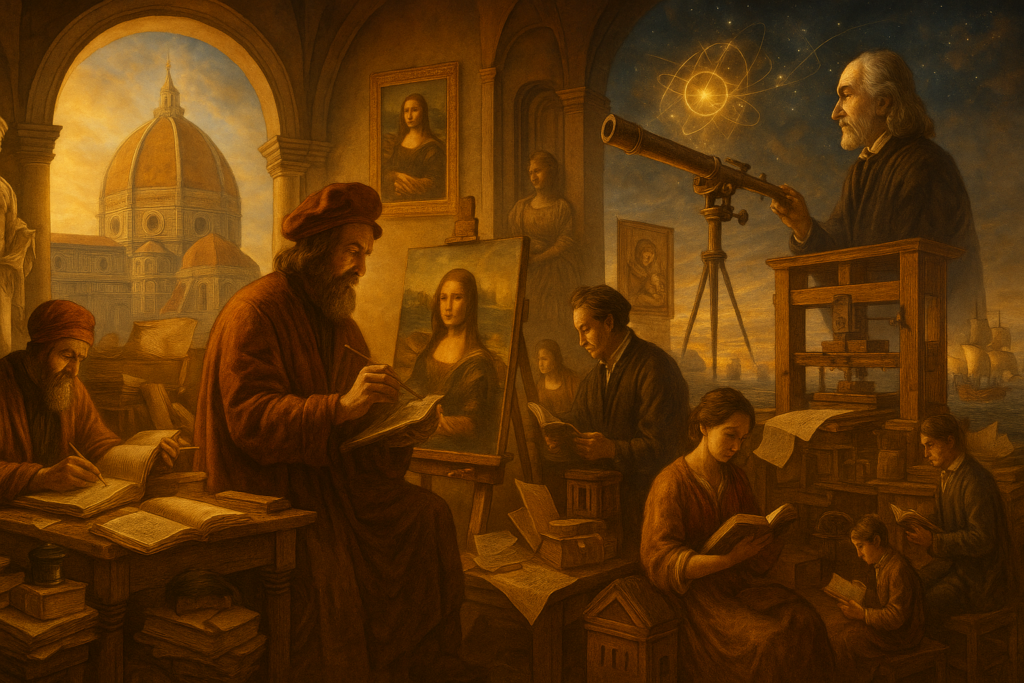
Main Characteristics of Renaissance
The Renaissance was a cultural, intellectual, and artistic revival that took place in Europe between the 14th and 17th centuries. During this period, important developments occurred in science, literature, art, philosophy, and politics. The following are the major characteristics of the Renaissance:
1. Humanism
- The Renaissance was based on humanism, placing man at the center of the universe.
- Medieval Christianity emphasized God and heaven, while the Renaissance highlighted human life and its potential.
- Man was seen as capable of shaping his own destiny through knowledge, art, reason, and freedom.
- Dante, Petrarch, and Erasmus promoted humanist ideas.
2. Rationalism and Scientific Thinking
- People began examining traditional religious beliefs using logic and science.
- The scientific method—observation, experimentation, and conclusion—became popular.
- Copernicus, Galileo, and Newton made revolutionary discoveries in astronomy and physics.
3. New Art and Architecture
- Renaissance art emphasized realism and natural beauty.
- Perspective technique introduced depth and a three-dimensional effect in paintings.
- Leonardo da Vinci, Michelangelo, Raphael, and Titian accurately depicted human anatomy and nature.
- Architecture revived Greek and Roman classical styles.
4. Criticism of Church and Religion
- The Church’s dominance during the Middle Ages was challenged.
- People opposed corruption and superstitions within the Church.
- Martin Luther’s Reformation movement led to the rise of Protestantism.
- secularism grew and the Church’s power weakened.
5. Printing Revolution
- Johannes Gutenberg invented the printing press in 1450.
- Books could be produced rapidly, helping spread knowledge and education.
- Common people gained access to the Bible and other texts, increasing religious awareness.
6. Individualism and Self-Progression
- The Renaissance encouraged independent thinking, creativity, and personal growth.
- Artists and scholars expressed personal thoughts and emotions in their works.
- Society moved toward individual freedom and away from rigid social structures.
7. Growth of Literature and Vernacular Languages
- Literature shifted from Latin to national languages such as Italian, English, Spanish, and French.
- Knowledge became accessible to the common people.
- Writers like Shakespeare, Dante, Chaucer, and Cervantes produced timeless works.
8. Age of Exploration and Discoveries
- New explorations expanded trade and cultural exchange.
- Columbus, Vasco da Gama, and Magellan discovered new lands and routes.
- European countries increased their global influence.
9. Political Changes
- The medieval feudal system declined and modern nation-states emerged.
- Machiavelli’s “The Prince” presented a realistic approach to governance.
- Democratic values began to develop and political philosophy evolved.
Conclusion
The characteristics of the Renaissance marked a milestone in human development. It pulled Europe out of medieval darkness and moved it toward modern science, art, literature, and politics. The impact of these ideas is visible even today, as the Renaissance laid the foundation for the modern world.
Major Influences of the Renaissance
The Renaissance was not just a cultural and intellectual movement—it shaped Europe and the world in profound ways. Its influence extended to art, literature, science, religion, politics, education, and society. Its effects are still evident in the modern era.
1. Influence on Art and Architecture
(i) Realism and the New Definition of Beauty
- Renaissance art emphasized realistic and accurate depictions.
- Artists used light, shadow, and depth to enhance beauty.
- Examples: Leonardo da Vinci’s “Mona Lisa” and Michelangelo’s “David”.
(ii) Perspective and New Techniques
- Perspective was used to create three-dimensional effects in paintings.
- Architecture revived Greek and Roman classical styles.
- Example: Florence Cathedral’s dome designed by Brunelleschi.
2. Influence on Literature and Language
(i) Development of National Languages
- Literature moved from Latin to Italian, English, French, and Spanish.
- This reached more people and promoted education.
- Example: Dante’s “Divine Comedy”.
(ii) Depiction of Human Emotions
- Literature emphasized human life, love, sorrow, happiness, and morality.
- Example: Shakespeare’s “Hamlet”, “Macbeth”, and “Romeo and Juliet”.
3. Impact on Science and Technology
(i) Beginning of the Scientific Revolution
- The Renaissance encouraged the scientific method and rational thinking.
- Church beliefs were questioned through evidence-based science.
(ii) Major Scientific Discoveries
- Copernicus: Proposed the heliocentric theory.
- Galileo: Improved the telescope and studied planetary motion.
- Newton: Introduced the theory of gravity.
- Kepler: Developed laws of planetary motion.
✔ Comfortable & easy use
✔ Great performance
✔ Excellent value for money
4. Influence on Religion and the Church
(i) Decrease in Church Power
- The Church’s authority was questioned and criticized.
- secularism increased during the period.
(ii) Beginning of the Reformation Movement
- Martin Luther’s “95 Theses” in 1517 initiated major reforms.
- Protestantism emerged and religious unity in Europe ended.
- The Catholic Church was forced to reform itself.
5. Impact on Education and Spread of Knowledge
(i) Printing Revolution
- Gutenberg’s printing press increased book production.
- Knowledge became accessible to common people.
(ii) Development of Universities and Institutions
- Many learning centers were established.
- Studies in science, mathematics, astronomy, and medicine expanded.
6. Impact on Discoveries and Global Connectivity
(i) Age of Exploration
- New territories were explored for trade and knowledge.
- Examples:
(ii) Beginning of Trade and Colonialism
- Europe’s prosperity increased through global trade.
- European colonies were established in Asia, Africa, and America.
- This changed global economy and culture.
7. Political Influence
(i) Rise of Nation-States
- The feudal system weakened, leading to the rise of nation-states.
- Rulers challenged the power of the Church.
- Example: Centralized rule in England and France.
(ii) Birth of Modern Political Ideologies
- Machiavelli’s “The Prince” promoted practical politics.
- Ideas of democracy, rights, and freedom strengthened.
8. Impact on Society and Culture
(i) Change in the Status of Women
- Women increasingly participated in art and education.
- A few educated women contributed to literature and philosophy.
(ii) Concept of human rights and Freedom
- Renaissance ideas later inspired the French Revolution.
- Freedom of expression and scientific thinking grew.
Conclusion
The Renaissance laid the foundation for the modern world. It influenced art, literature, science, religion, politics, and society. The scientific progress, democratic values, education systems, and global culture we see today are direct outcomes of the Renaissance. It ended the darkness of the Middle Ages and brought a new era of knowledge, creativity, and progress to humanity.
Reformation Movement
Detailed Description of the Reformation Movement
Introduction
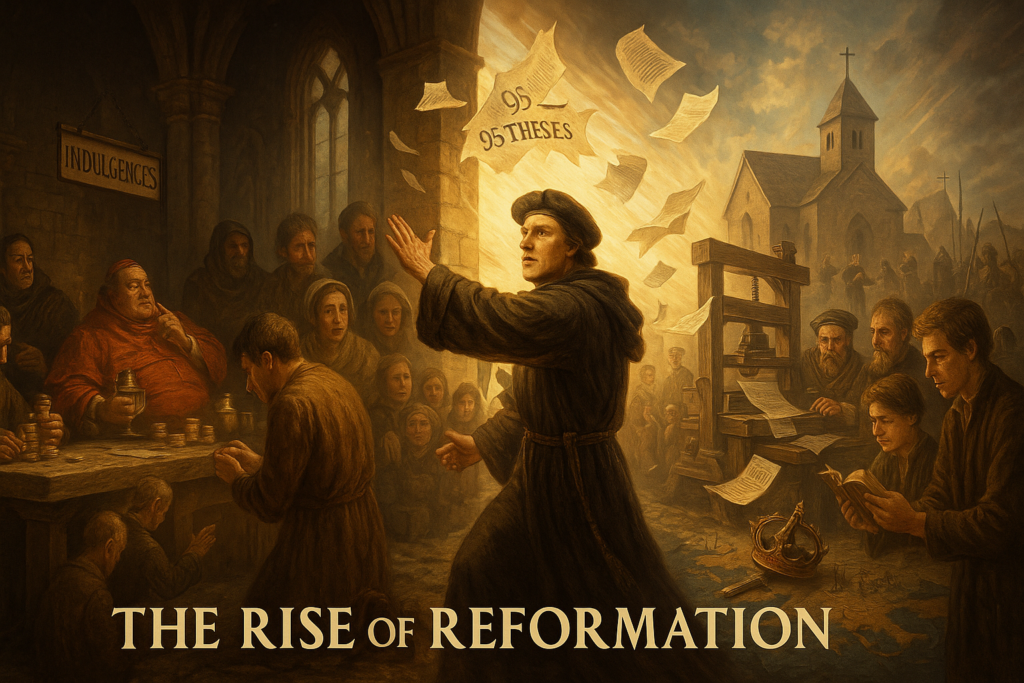
The Reformation was a religious, social, and political movement that took place in Europe in the 16th century. It emerged mainly in protest against the corruption, superstitions, and immoral activities of the Roman Catholic Church. This movement caused a major division in Christianity and led to the rise of Protestantism.
The movement began in 1517 when Martin Luther in Germany published his famous “95 Theses”, criticizing the policies of the Church. Gradually, the movement spread across Europe, and many reformers demanded fundamental changes in Church practices.
Reasons for the Reform Movement
1. Corrupt Policies and Immorality of the Church
- In the Middle Ages, the Roman Catholic Church had significant power and collected money through religious activities.
- The Pope and clergy lived luxurious lives while common people suffered in poverty.
- The Church introduced “Indulgences”, where forgiveness of sins could be purchased with money.
2. Printing Revolution and Spread of Knowledge
- Johannes Gutenberg’s printing press led to the rapid spread of information.
- The Bible and religious texts became accessible to common people.
- This encouraged people to question Church teachings.
3. Influence of Humanism and Renaissance
- The Renaissance promoted reason, science, and individual freedom.
- People began to understand Religion based on evidence and logic.
- This weakened the Church’s grip over society.
4. Opposition from National Rulers
- Many European rulers were troubled by the Church’s excessive power.
- The Church taxed rulers heavily, weakening their economies.
- Rulers supported reformers to free themselves from Church control.
Major Leaders of the Reform Movement and Their Ideas
1. Martin Luther – Germany
- Known as the father of the Reformation Movement.
- Published the “95 Theses” criticizing Church corruption.
- Preached that “faith alone is the path to salvation”.
- Translated the Bible into German to make it accessible to common people.
- His followers formed the Protestant denomination.
2. John Calvin – France & Switzerland
- Gave the theory of Predestination (people’s fate is pre-decided).
- Turned Geneva into a strong centre of Protestantism.
- His followers were known as Calvinists.

✔ Easy & convenient to use
✔ Excellent daily performance
✔ Trusted choice by buyers
3. Henry VIII – England
- Began the English Reformation in 1534.
- Separated from the Catholic Church and established the Church of England (Anglican Church).
- His reasons were partly religious and partly political and personal.
Major Effects of the Reform Movement
1. Rise of Protestantism
- The Reformation caused a split within the Church and created Protestantism.
- It spread to Germany, England, Switzerland, the Netherlands, and Scandinavia.
2. Decline in Power of the Church
- The Church’s authority weakened significantly.
- secularism gained ground and rulers strengthened their positions.
3. Education and Intellectual Development
- The Bible was translated into many languages, spreading religious awareness.
- Universities began teaching science, mathematics, and literature along with theology.
4. Religious Wars and Conflicts
- Many wars broke out between Catholic and Protestant rulers.
- The Thirty Years’ War (1618–1648) caused widespread destruction in Europe.
5. Growth of Modern Democracy and Freedom
- The movement promoted ideas of human rights, freedom, and democracy.
- It inspired later revolutions such as the French Revolution (1789).
Conclusion
The Reformation Movement transformed the religious, social, and political structure of Europe. It reduced the power of the Church, strengthened secular authority, promoted education and scientific thinking, and laid the foundation for modern Europe. The movement remains a key milestone in shaping Western civilization and Christianity.
Reasons for Reformation Movement
The Reformation Movement of the 16th century was driven by religious, political, social, economic, and intellectual factors. Renaissance thinking and the printing revolution accelerated this movement.
1. Religious Reasons
(i) Corruption of the Roman Catholic Church
- The Church became extremely powerful and corrupt.
- Pope and clergy lived luxurious lives while common people suffered.
- Church officials misused religious authority for wealth.
(ii) Selling of Indulgences
- People could “buy” forgiveness for sins through Indulgences.
- This became a major reason for public anger.
- Martin Luther strongly opposed it in his 95 Theses.
(iii) Strict Religious Policies
- The Church claimed only it could interpret the Bible correctly.
- Scientific or new ideas were punished as heresy.
2. Social Reasons
(i) Effect of Renaissance
- Renaissance encouraged humanism, logic, and scientific thinking.
- People began questioning Church practices.
(ii) Development of Humanism
- Humanism promoted individual rights and personal religious freedom.
- Church rules were against humanist values.
(iii) Rise of Educated Middle Class
- A new educated class opposed Church interference and heavy taxes.
- Merchants and bankers disliked Church restrictions on trade.
3. Political Reasons
(i) Conflict Between Rulers and the Church
- Rulers opposed the Church’s claim of superior power.
- They supported reformers to limit Church control.
(ii) Struggle of Henry VIII
- Henry VIII created the Anglican Church after the Pope refused annulment of his marriage.
(iii) Excessive Taxes
- The Church taxed rulers, farmers, and merchants heavily.
- This created widespread resentment.
4. Economic Reasons
(i) Enormous Wealth of the Church
- The Church was the richest institution in Europe.
- Heavy taxes and fees angered the general public.
(ii) Growth of Trade and Commerce
- The developing merchant class wanted economic freedom from Church control.
5. Intellectual and Scientific Reasons
(i) Printing Revolution
- Gutenberg’s printing press spread knowledge rapidly.
- People could now read the Bible themselves.
(ii) Scientific Revolution
- New scientific discoveries contradicted Church teachings.
- Copernicus proposed the heliocentric theory.
- Galileo was punished by the Church for supporting scientific truth.
Conclusion
The Reformation was not only a religious movement but the result of social, political, economic, and intellectual changes. It weakened the Church’s authority, established Protestantism, and promoted modern democratic ideas. The movement played a vital role in shaping modern Europe and remains one of the most significant events in world history.
Major Reformers and Their Ideas
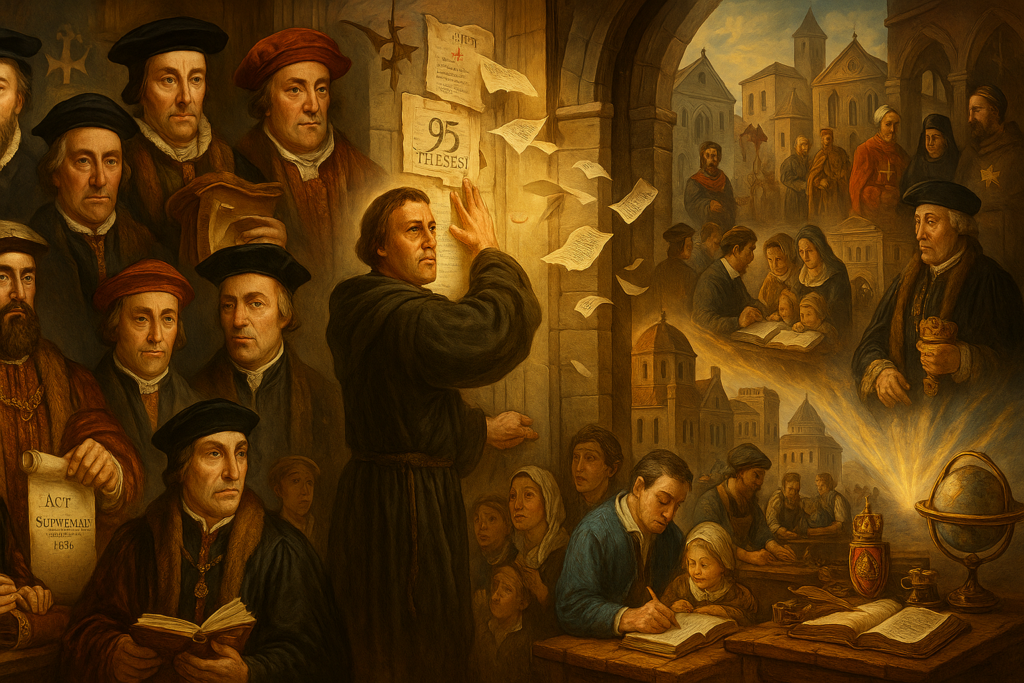
During the Reformation Movement, many prominent reformers raised their voices against the wrong policies of the Church and stressed the need for religious reform. They introduced new ideologies in Christianity and laid the foundation for Protestantism. Their ideas inspired religious, social, political, and intellectual revolutions.
1. Martin Luther – Germany
Main Ideas
- Considered the Father of the Reformation Movement.
- In 1517, he wrote the “95 Theses” criticizing the corruption of the Church.
- His central belief was “Salvation by Faith Alone”.
- Opposed the sale of Indulgences.
- Translated the Bible into German for common people.
- Rejected the supreme authority of the Pope and emphasized individual interpretation of the Scriptures.
Effects
- Laid the foundation of Protestantism.
- Led to the establishment of the Lutheran Church.
- Inspired political and social reforms in Europe.
2. John Calvin – Switzerland
Main Ideas
- Introduced the doctrine of Predestination.
- Believed that people's fate is predetermined.
- Opposed Church luxury and grandeur.
- Advocated Church leadership by elected representatives.
- Supported strict religious discipline.
Effects
- His followers were called Calvinists.
- Calvinism spread in Switzerland, France, Scotland, and the Netherlands.
- Inspired the development of capitalism and democracy.
3. Ulrich Zwingli – Switzerland
Main Ideas
- Opposed Church pomp, rituals, and idolatry.
- Believed Christianity should be based solely on the Bible.
- Removed music, paintings, and sculptures from churches.
- Supported marriage for priests.
Effects
- Promoted the Reformation Movement in Switzerland.
- His ideas influenced John Calvin.
4. John Knox – Scotland
Main Ideas
- Led the Protestant Reformation in Scotland.
- Founded the Scottish Presbyterian Church.
- Believed the Church should remain free from political control.
- Opposed the influence of the Roman Catholic Church.
Effects
- Strengthened the Presbyterian Church in Scotland.
- Boosted the Reformation Movement in Northern Europe.
5. Henry VIII – England
Main Ideas
- Demanded independence from the Roman Catholic Church.
- Passed the Act of Supremacy (1534) and formed the Church of England (Anglican Church).
- Rejected the authority of the Pope and declared himself the head of the Church.
Effects
- Ended the Church’s power in England.
- Protestantism strengthened in the region.
✔ Easy & convenient daily use
✔ Excellent value for money
✔ Trusted choice by customers
6. Erasmus – Netherlands
Main Ideas
- Supported reforms within the Church but opposed complete separation.
- Emphasized education and moral reform.
- Translated the Bible into Greek and Latin.
- Opposed Church fanaticism and superstition.
Effects
- His ideas inspired Martin Luther and other reformers.
- Was respected by both Catholics and Protestants.
Conclusion
The major reformers of the Reformation Movement played a crucial role in transforming the religious, social, and political landscape of Europe. Martin Luther, John Calvin, John Knox, Henry VIII, and others opposed the corrupt Church and established Protestantism. Their ideas promoted independent thinking, reduced Church authority, and contributed to the growth of modern democratic values.
Effects of the Reform Movement
The Reformation Movement of the 16th century brought profound religious, political, social, and economic changes in Europe. It weakened the Roman Catholic Church and led to the rise of Protestantism. Below are the major effects of this movement.
1. Religious Influence
(i) Establishment of Protestant Religion
- Protestantism emerged due to leaders like Luther and Calvin.
- Lutheranism – in Germany and Scandinavian nations.
- Calvinism – in Switzerland, France, and Scotland.
- Anglican Church – established in England by Henry VIII.
(ii) Decline in Power of the Roman Catholic Church
- The Church’s political and religious dominance weakened.
- The Catholic Church started the Counter-Reformation.
- The Jesuit Order was formed to restore discipline and morality.
(iii) Bible Translated into Vernacular Languages
- The Bible was translated into German, English, and French.
- Common people could now read religious texts independently.
- Church priests lost their monopoly over religious interpretation.
2. Social Impact
(i) Development of religious tolerance
- Religious tolerance increased gradually.
- The Peace of Westphalia (1648) promoted freedom of religion.
(ii) Increase in Education and Literacy
- Education spread widely as people wanted to read the Bible.
- New schools and universities were established.
- Scientific learning was encouraged.
(iii) Growth of Personal Freedom
- People gained the right to religious and intellectual freedom.
- Individual thinking and self-determination increased.
3. Political Influence
(i) Separation of Church and State
- The Church’s influence on political matters declined.
- Rulers established supremacy over religious institutions.
(ii) Rise of New Nation-States
- Weakened Church authority strengthened national unity.
- Countries like Germany, England, and Netherlands developed strong national identities.
(iii) Beginning of Religious Wars
- Conflicts erupted between Protestants and Catholics.
- The Thirty Years’ War (1618–1648) caused massive destruction.
4. Economic Impact
(i) Development of Capitalism
- Calvinism encouraged hard work, honesty, and discipline.
- Church restrictions on trade were reduced.
- Merchants gained economic independence.
(ii) Redistribution of Church Property
- Church lands were confiscated by rulers.
- Used for public and state development.
(iii) Rise of the Middle Class
- Business and educated classes gained more importance.
- Merchants and artisans gained financial freedom.
5. Scientific and Intellectual Impact
(i) Promotion of Scientific Revolution
- Removal of Church restrictions promoted scientific thinking.
- Scientists like Copernicus, Galileo, and Newton made major discoveries.
(ii) Development of Free Thought
- People began evaluating issues logically rather than blindly following religious authority.
(iii) Role of Printing Revolution
- Printing spread new religious ideas quickly.
- The Bible was printed on a large scale for public access.
6. Influence on Art and Literature
(i) Diversity in Themes
- Art no longer focused only on religion.
- Human emotions, nature, and scientific discoveries were depicted.
(ii) Growth of New Literary Movements
- Writers like Shakespeare and Cervantes emphasized human experiences.
Conclusion
The Reformation Movement gave a new direction to Europe. It brought changes in religion, society, politics, economy, and intellectual life. It promoted freedom of thought, religious tolerance, education, and scientific inquiry. Its impact can still be seen today, as it laid the foundation for the modern world based on democracy, individualism, and human rights.
References
✔ Convenient and easy to use
✔ Great performance with value
✔ Popular choice among buyers
- Smith, John. The Reformation in Europe. Oxford University Press, 2018.
- Johnson, Mark. history of Protestant Reforms. Cambridge University Press, 2015.
- Davis, William. Religious Changes in the 16th Century. Routledge, 2012.
- Encyclopedia Britannica. "Reformation." Accessed 2024.
- National Archives of Europe. “Martin Luther and the 95 Theses.” Accessed 2024.
- History.com Editors. "The Protestant Reformation." History Journal, 2023.