
🌍 Arctic Geopolitics: Will the Next 21st Century Energy War Begin Here?
Arctic Geopolitics is rapidly emerging as the next frontier of global energy competition. As ice melts, vast oil and natural gas reserves are becoming accessible, triggering strategic rivalry among major powers.If we examine the 20th century through the lens of energy politics, the Middle East stood at the center of global power struggles. Oil fields shaped empires, influenced wars, and determined the balance of power. Now, the 21st century is moving toward a new geopolitical chapter — and that chapter is called Arctic Geopolitics.
❄️ The Hidden Energy Treasure Beneath the Ice
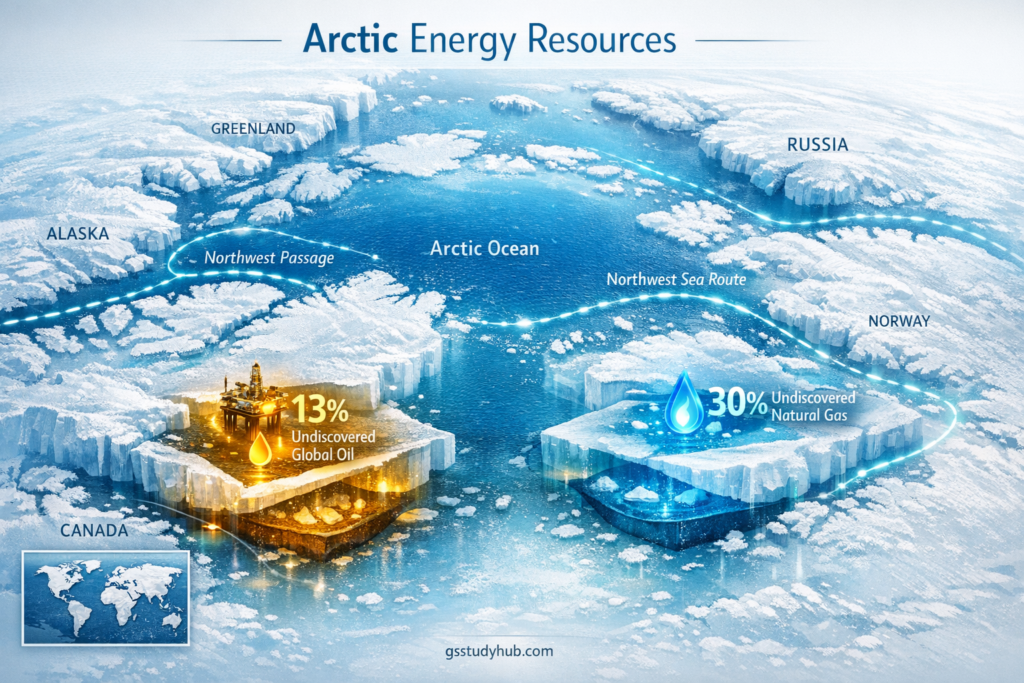
Due to climate change, Arctic ice is melting at an unprecedented speed. This is not only an environmental concern — it is also becoming a strategic opportunity. Scientific estimates suggest that the Arctic contains nearly 13% of the world’s undiscovered oil and 30% of its undiscovered natural gas. Additionally, rare earth elements found in the region are essential for modern technology, defense systems, and renewable energy industries.
As the ice recedes, access to these resources becomes easier. That is why major global powers are increasingly focusing their attention on the Arctic region.
🌐 Why Is Global Competition Increasing?
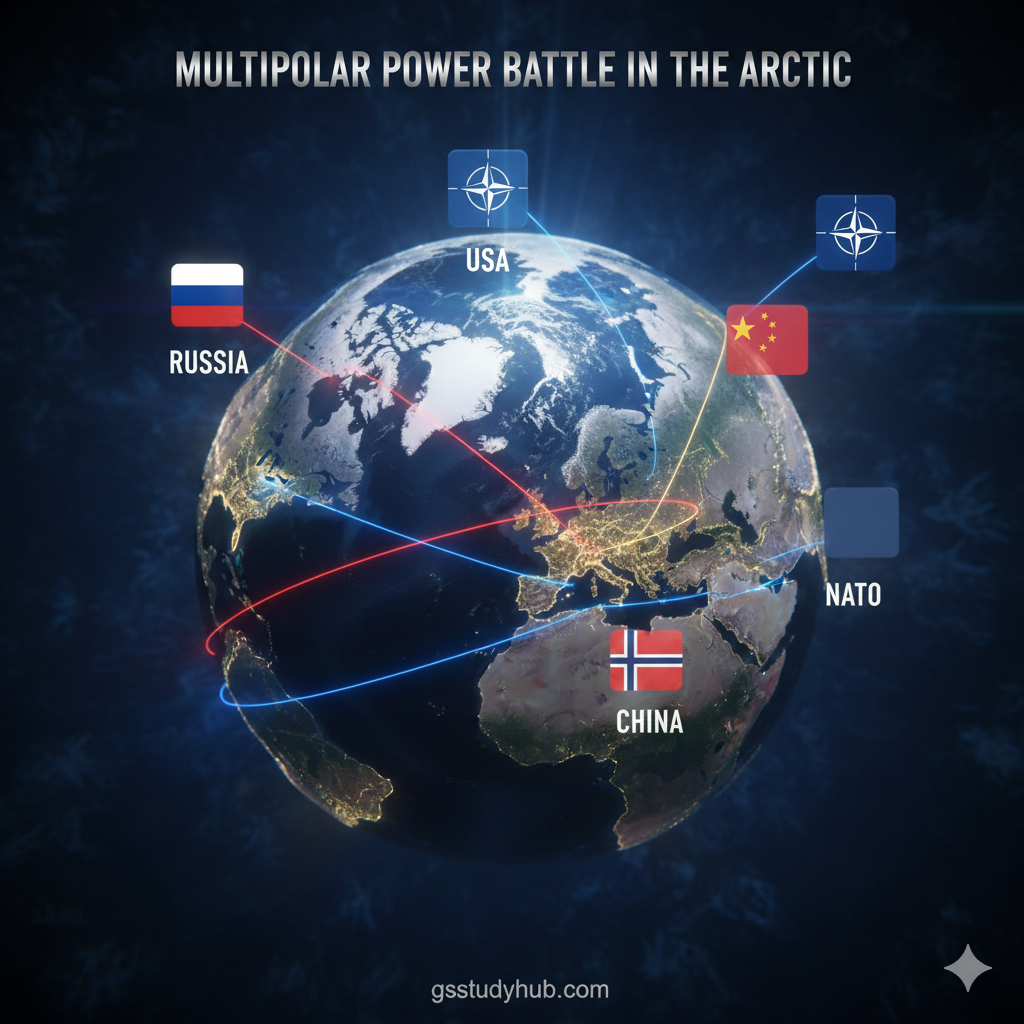
Countries like Russia, the United States, China, and nato members are strengthening their economic and military presence in the Arctic. This is not just a race for natural resources; it is a struggle for future energy security, control over new trade routes, and strategic dominance.
New maritime corridors such as the Northern Sea Route and the Northwest Passage could significantly reduce shipping distances between Asia and Europe. This transformation may reshape global trade patterns and supply chains.
⚡ Energy, Trade, and Military Balance
Arctic geopolitics goes beyond economics. The region is strategically important from a defense perspective as well. Russia has expanded its Arctic military bases, the United States is enhancing its strategic presence in Alaska, and NATO countries are conducting joint exercises in the High North.
China, describing itself as a “Near-Arctic State,” is increasing investments and scientific missions in the region. Its “Polar Silk Road” initiative could integrate the Arctic into future global economic networks.
🌍 Climate Change vs Energy Ambition
The Arctic plays a critical role in regulating Earth’s climate. Large-scale oil and gas extraction could accelerate global warming. Therefore, Arctic geopolitics represents not only a power struggle but also a debate between environmental sustainability and economic ambition.
🔎 Will the Arctic Become the Next Energy Battlefield?
The central question remains — will the Arctic become the new geopolitical battlefield of the 21st century?
History shows that wherever major energy resources exist, geopolitical competition follows. If nations prioritize cooperation, the Arctic could emerge as a model of shared governance and sustainable development. However, if rivalry dominates, this icy frontier may become the center of the next major global energy conflict.
Arctic Geopolitics will significantly influence the future of global politics, energy markets, and international relations. It is not merely a story about melting ice — it is a signal of the evolving global power structure.
The global race for resources is intensifying. To understand this transformation better, read our detailed analysis on energy transition secrets and global power shifts .
🌍 Why Arctic Matters? | Strategic Importance of the Arctic region
To understand Arctic Geopolitics, it is essential to examine
why the Arctic region is becoming increasingly important in global politics and energy strategy.
In the 21st century, as the world navigates
energy transitions, supply chain disruptions,
and rising geopolitical competition, the Arctic is no longer just a frozen frontier —
it is emerging as a strategic hub of global power.
❄️ How Much Resource Wealth Does the Arctic Hold?
According to the U.S. Geological Survey (USGS), the Arctic contains vast untapped energy reserves. Estimates suggest that the region holds:
- 🌡 13% of the world’s undiscovered oil
- 🔥 30% of undiscovered natural gas
- 💎 Rare Earth Elements and critical minerals
These figures highlight the Arctic’s immense potential in shaping future global energy markets. Beyond oil and gas, the region contains nickel, cobalt, lithium, and other critical minerals essential for electric vehicles, battery production, defense systems, and renewable energy technologies.
⚡ Why Is It Important for Energy Security?
Energy security has become a top priority for major economies. Nations that control energy resources often gain significant economic and geopolitical leverage. The Arctic’s reserves could diversify global energy supply sources and reduce dependence on traditional regions like the Middle East.
For Europe and Asia in particular, Arctic energy resources could provide alternative supply routes and strengthen long-term energy resilience. This explains why countries such as Russia, the United States, and others are increasing their strategic involvement in the region.
🚢 30–40% Reduction in Shipping Distance
The Arctic’s importance extends beyond energy. Melting ice has opened new maritime routes, including the Northern Sea Route and the Northwest Passage. These routes could reduce shipping distances between Asia and Europe by approximately 30–40%.
Shorter routes mean reduced transportation time, lower fuel consumption, and decreased shipping costs. This transformation could significantly reshape global trade networks and supply chains in the coming decades.
🌐 New trade routes and Geopolitical Influence
Control over new Arctic sea routes represents not only economic opportunity but also strategic power. Nations that dominate these corridors may gain leverage over international trade flows.
Russia has strengthened its control over the Northern Sea Route, the United States is expanding its Arctic infrastructure in Alaska, and China’s “Polar Silk Road” initiative aims to integrate the Arctic into broader global trade strategies.
🌍 Impact on Global Power Balance
The Arctic’s strategic significance goes far beyond resources and shipping lanes. It has the potential to reshape the global balance of power. Increased resource extraction, military presence, and economic investments could alter energy markets and influence international relations.
When we ask, “Why Arctic Matters?”, the answer becomes clear: the region stands at the intersection of energy security, trade efficiency, military strategy, and climate governance.
Conclusion: The Arctic is not merely a frozen landscape — it is an emerging epicenter of 21st-century energy politics and global strategy.
As global geopolitical dynamics shift, it’s crucial to explore how the Global South vs West tensions and the new Cold War in 2026 are reshaping world order.
🇷🇺 Russia’s Arctic Strategy: Building a Strategic Stronghold in the High North
In the context of Arctic Geopolitics, Russia plays one of the most decisive roles. With the longest Arctic coastline among all Arctic states, Russia enjoys a significant geographical advantage. This natural positioning allows Moscow to expand its influence over energy resources, emerging sea routes, and military infrastructure. As a result, Russia is transforming the Arctic into a strategic stronghold for long-term geopolitical leverage.
🌍 Geographical Advantage in the Arctic
Russia’s northern frontier stretches along the Arctic Ocean, giving it direct access to vast offshore energy reserves and critical maritime corridors. As Arctic ice continues to melt due to climate change, the Northern Sea Route (NSR) has become increasingly important.
The Northern Sea Route significantly reduces shipping distances between Asia and Europe, making it economically attractive. By controlling this corridor, Russia can benefit from transit revenues, energy exports, and strategic maritime dominance. This strengthens its long-term economic and geopolitical position.
⚓ Strengthening the Northern Fleet
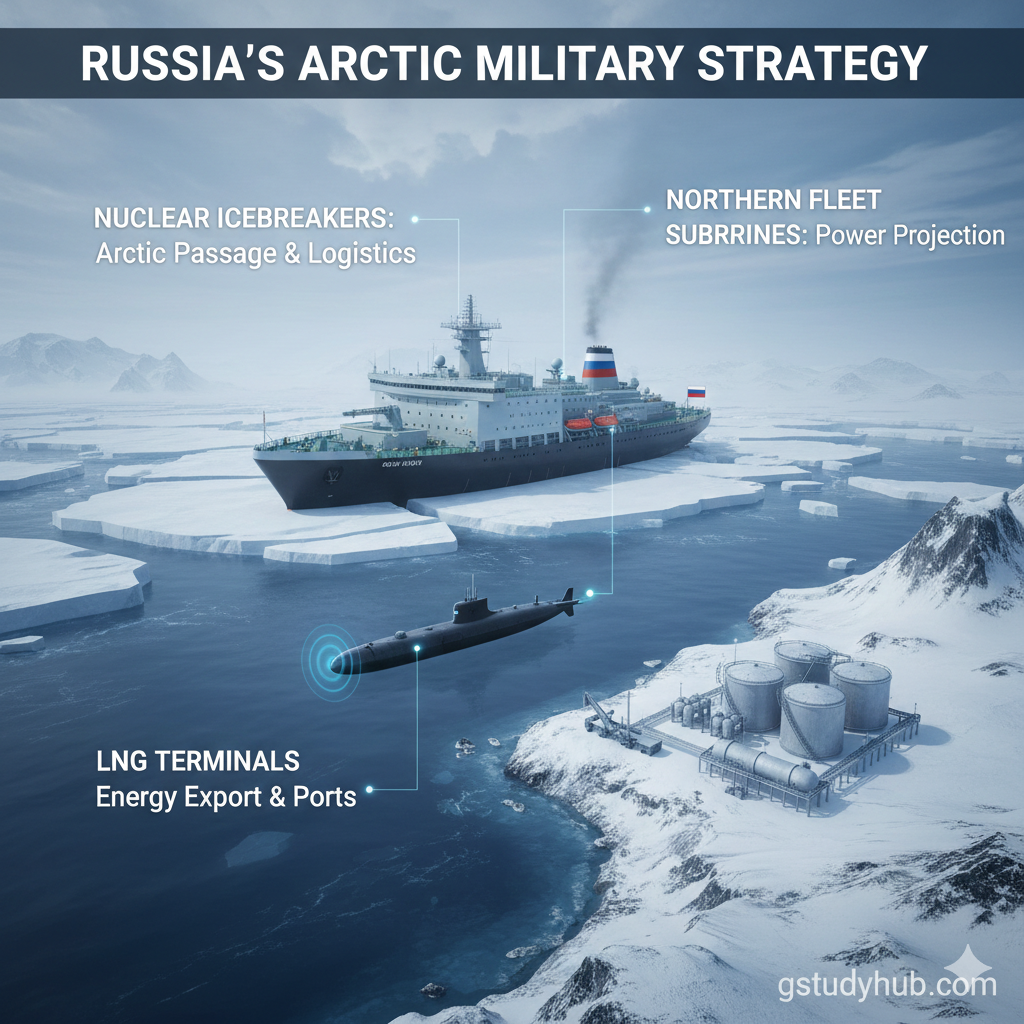
A central pillar of Russia’s Arctic strategy is the modernization and expansion of its Northern Fleet. This fleet serves as the backbone of Russia’s military presence in the Arctic region.
Equipped with advanced submarines, missile systems, and modern naval assets, the Northern Fleet ensures the protection of Arctic sea lanes and energy installations. Beyond defense, it sends a clear geopolitical message: Russia intends to secure and defend its Arctic interests against potential rivals.
🚢 Nuclear Icebreaker Fleet
Russia operates the world’s largest nuclear-powered icebreaker fleet. Icebreakers are specialized vessels designed to cut through thick sea ice, enabling year-round navigation in Arctic waters.
Nuclear-powered icebreakers can travel long distances without refueling, providing Russia with a significant technological and operational advantage. This capability allows Moscow to maintain continuous access to the Northern Sea Route, strengthening both economic and military logistics in the region.
🔥 LNG Projects and Energy Exports
Energy development forms another crucial component of Russia’s Arctic policy. Major Liquefied Natural Gas (LNG) projects, particularly in the Yamal Peninsula, are central to Russia’s global energy strategy.
These LNG initiatives enable Russia to expand gas exports to both European and Asian markets. By leveraging Arctic gas reserves, Russia aims to reinforce its position as a leading global energy supplier, even amid shifting geopolitical dynamics.
🛡️ Transforming the Arctic into a Strategic Fortress
Russia does not view the Arctic merely as an economic opportunity; it considers the region essential to its national security and global influence. The construction of new military bases, deployment of radar systems, and installation of advanced defense infrastructure reflect this strategic vision.
From a geopolitical perspective, the Arctic could shape the future global balance of power. By consolidating control over energy resources and maritime routes, Russia strengthens its strategic autonomy and international bargaining power.
Conclusion: Russia’s Arctic strategy is long-term, calculated, and multi-dimensional. Through military expansion, nuclear icebreaker dominance, and LNG development, Moscow is positioning the Arctic as a central pillar of its geopolitical future.
In light of recent geopolitical tensions, it’s worth exploring how NATO’s strategy in Eastern Europe is reshaping global impact and influencing international security dynamics.
🇺🇸 U.S. and nato Response: Strategic Rebalancing in the Arctic
As Arctic Geopolitics gains momentum, the United States and NATO have significantly adjusted their strategic priorities in the High North. Russia’s expanding military infrastructure and energy ambitions have prompted Western powers to strengthen their presence in the Arctic region.
The Arctic is no longer viewed as a distant frozen frontier. It is now seen as a zone of growing geopolitical competition involving energy security, emerging shipping routes, and military positioning. In response, the United States and NATO have adopted a multi-layered strategy aimed at maintaining balance and deterrence.
🛡️ Military Investments in Alaska
Alaska forms the backbone of the United States’ Arctic strategy. As America’s only Arctic state, Alaska provides direct access to Arctic waters and strategic maritime corridors.
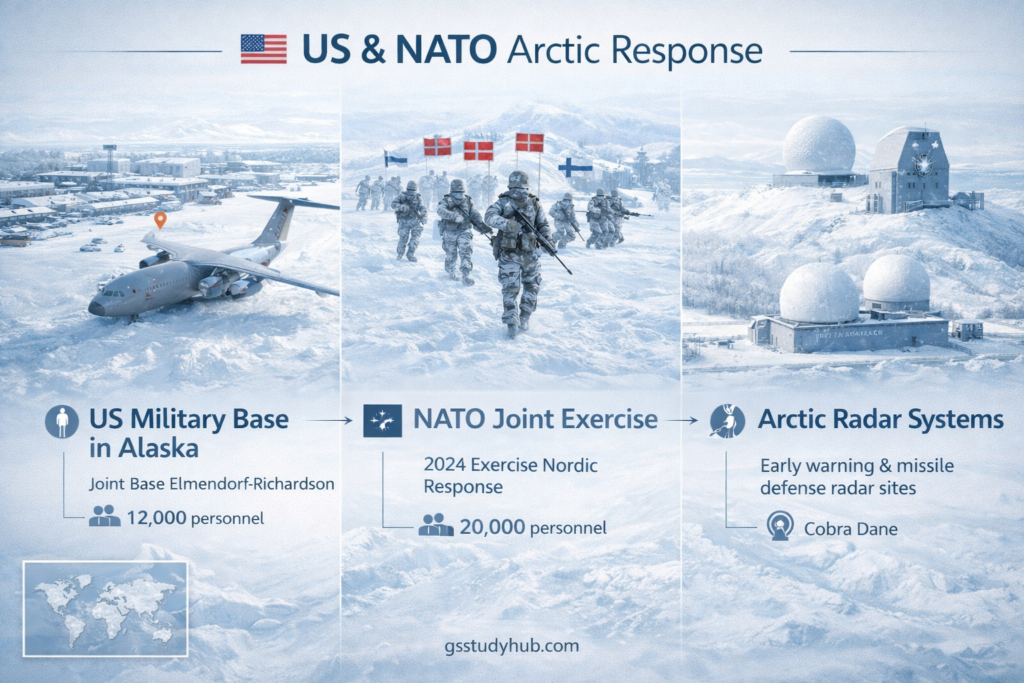
In recent years, the U.S. has increased military investments in Alaska, including upgraded radar systems, missile defense installations, and airbases. Advanced fighter aircraft and surveillance capabilities are being deployed to monitor regional activity and ensure rapid response capability.
These measures are intended to counterbalance Russia’s expanding Arctic presence and to safeguard critical sea lanes and infrastructure.
⚓ NATO Military Exercises in the High North
NATO (North Atlantic Treaty Organization) has intensified joint military exercises in Arctic and sub-Arctic regions. Countries such as Norway and Canada play key roles in hosting and participating in these high-latitude operations.
The objective of these exercises is to improve interoperability in extreme cold-weather conditions and enhance collective defense readiness. NATO’s growing involvement signals that the Arctic is increasingly viewed as a strategically sensitive region requiring coordinated security planning.
Through joint drills and expanded cooperation, NATO seeks to prevent unilateral dominance and preserve stability in the region.
🌍 The Rising Importance of Greenland
Greenland has emerged as a critical strategic location within Arctic geopolitics. Geographically positioned between North America and Europe, Greenland acts as a bridge between the Arctic Ocean and the North Atlantic.
The United States maintains a military presence in Greenland and has shown increasing interest in its strategic and mineral potential. Rare earth elements and other critical resources found in Greenland are vital for modern defense technologies and renewable energy systems.
The growing international attention toward Greenland reflects the broader strategic transformation of the Arctic region.
⚠️ Increased Tensions After the Russia–Ukraine War
The Russia–Ukraine conflict has intensified geopolitical tensions in the Arctic. Diplomatic cooperation within the Arctic Council — once a platform for regional dialogue — has faced significant strain.
Following the outbreak of war, several Western member states limited engagement with Russia in Arctic forums, affecting the council’s functioning. As a result, the Arctic has shifted from being primarily a zone of cooperation to an arena of cautious competition and strategic recalibration.
Conclusion: The U.S. and NATO response demonstrates that the Arctic is rapidly becoming a central theater of global strategic competition. Military investments in Alaska, NATO exercises, Greenland’s rising importance, and post-Ukraine war tensions collectively highlight the Arctic’s evolving role in 21st-century geopolitics.
To understand contemporary regional power shifts, it's essential to read how the South China Sea dispute is shaping global politics .
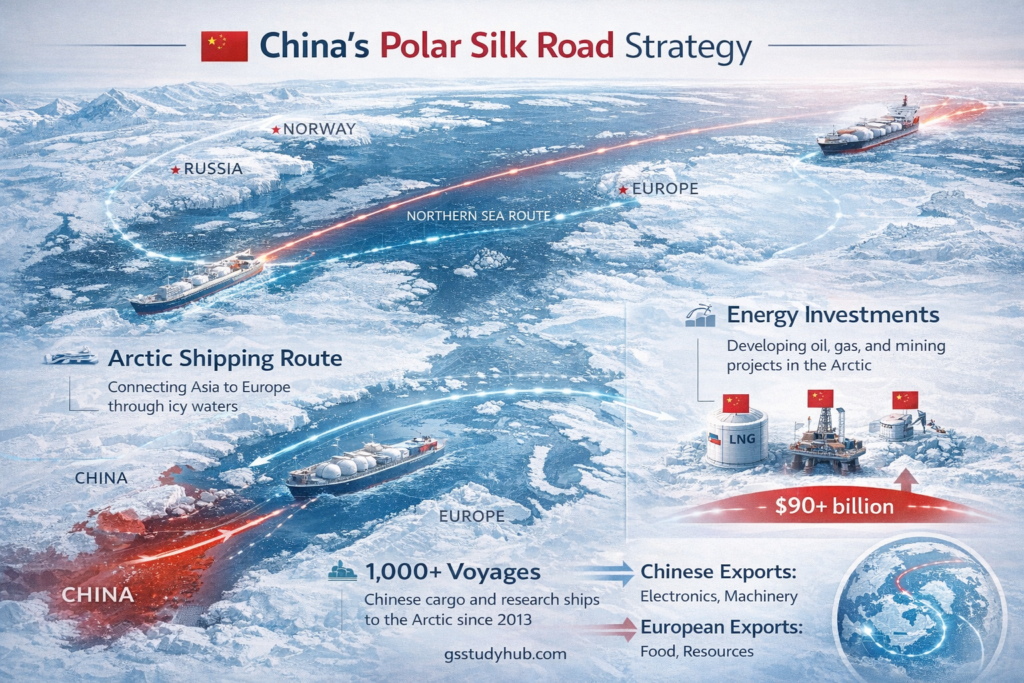
🇨🇳 China’s Polar Silk Road Strategy: Expanding Influence in Arctic Geopolitics
In the evolving landscape of Arctic Geopolitics, China has emerged as an increasingly significant player. Although China is not an Arctic coastal state, it officially describes itself as a “Near-Arctic State”. This terminology reflects Beijing’s long-term strategic vision: the Arctic is not a distant region, but a critical component of China’s global economic and geopolitical strategy.
China’s Arctic policy is multi-dimensional, encompassing energy investments, shipping routes, scientific research, and global supply chain integration. At the center of this strategy lies the Polar Silk Road, an extension of China’s broader Belt and Road Initiative (BRI) into the Arctic region.
🌍 The “Near-Arctic State” Concept
By labeling itself a “Near-Arctic State,” China signals that Arctic developments directly impact its national interests, particularly in climate change, global trade, and energy security. This diplomatic framing supports China’s argument that the Arctic is not exclusively reserved for coastal states, but holds global significance.
Through this narrative, China seeks legitimacy and influence in Arctic governance discussions, positioning itself as a responsible stakeholder in regional development and environmental protection.
🏛 Observer Status in the Arctic Council
China holds Observer status in the Arctic Council, the primary intergovernmental forum promoting cooperation, sustainable development, and environmental protection in the Arctic.
Although observer states do not possess voting rights, this role enables China to participate in discussions, scientific initiatives, and working groups. It also enhances Beijing’s diplomatic visibility and soft power influence within Arctic governance frameworks.
🚢 Polar Silk Road: New Maritime Connectivity
The Polar Silk Road aims to integrate emerging Arctic sea routes into global trade networks. As Arctic ice melts, routes such as the Northern Sea Route may significantly reduce shipping distances between Asia and Europe.
Shorter transit times mean lower shipping costs and enhanced supply chain efficiency. For China — the world’s largest trading nation — these Arctic corridors represent a strategic opportunity to diversify trade routes and reduce reliance on traditional maritime chokepoints.
🔥 Energy Investments and Resource Security
Energy security remains a central pillar of China’s Arctic engagement. Beijing has invested in several Arctic energy projects, particularly in Russian Liquefied Natural Gas (LNG) initiatives.
By participating in Arctic energy development, China aims to diversify its energy supply sources and secure long-term access to natural gas. This strategy aligns with its broader objective of stabilizing energy imports amid global geopolitical uncertainties.
🌐 Arctic and Future Global Supply Chains
Beyond energy and shipping, China views the Arctic as a key component of future global supply chain resilience. In the aftermath of pandemics, trade disruptions, and geopolitical tensions, Beijing seeks alternative corridors that enhance flexibility and reduce strategic vulnerability.
Through the Polar Silk Road, China aims to build a diversified, adaptive trade architecture that connects Arctic routes with Eurasian and global markets. This approach strengthens China’s long-term economic positioning in an increasingly multipolar world.
Conclusion: China’s Polar Silk Road Strategy demonstrates that Arctic Geopolitics is no longer a purely regional matter. Through diplomatic engagement, energy investments, and supply chain integration, China is embedding the Arctic into its long-term global strategic vision.
Climate change is reshaping the environment across continents. To dive deeper into its effects, see how climate change is driving rising natural disasters in South Asia .
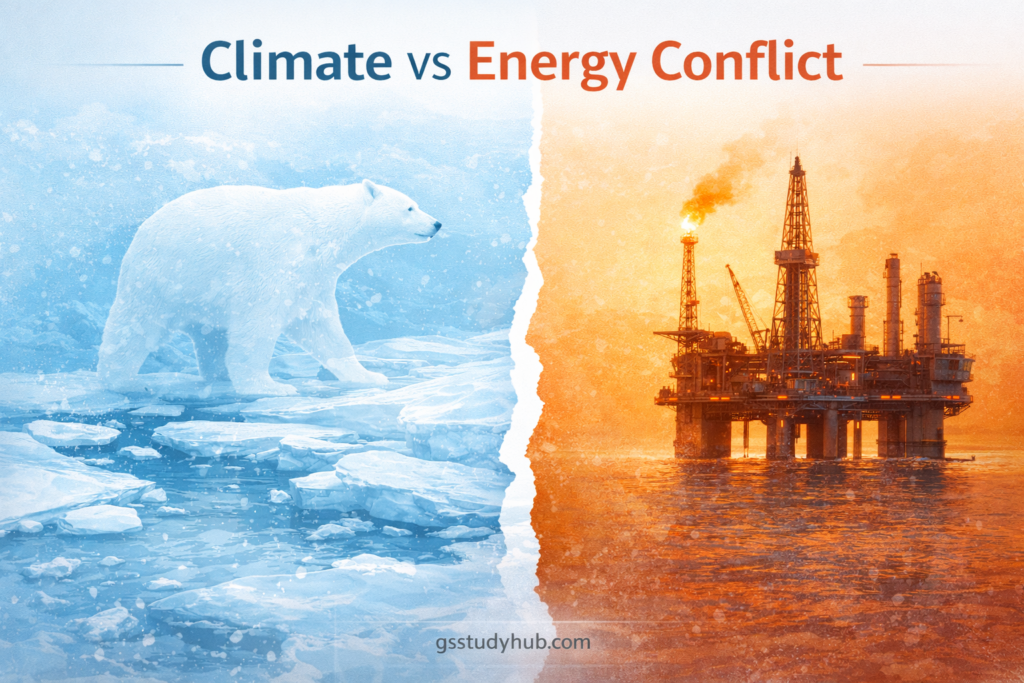
🌍 Climate vs Energy Conflict: Geopolitics and Environmental Tension in the Arctic
Arctic Geopolitics is not only about energy resources and emerging shipping routes. The Arctic functions as one of the planet’s most critical climate regulators. Its vast ice cover reflects sunlight back into space, helping to stabilize global temperatures. This means the Arctic is not just a regional concern — it is central to the environmental balance of the entire Earth.
As melting ice makes oil, gas, and mineral extraction more accessible, a pressing question arises: will the pursuit of energy security accelerate climate instability? The Arctic now stands at the intersection of economic ambition and environmental responsibility.
❄️ The Arctic as a Global Climate Regulator
Arctic sea ice plays a vital role in maintaining global temperature balance. When ice melts, darker ocean waters absorb more heat instead of reflecting it, intensifying global warming. This creates a dangerous feedback loop — rising temperatures cause more ice melt, which in turn accelerates further warming.
If large-scale fossil fuel extraction expands in the Arctic, increased carbon emissions could worsen climate change, undermining international efforts to reduce greenhouse gases.
🔥 Potential Consequences of Oil and Gas Expansion
- 🌿 Ecological Crisis: Oil spills and industrial activity could severely damage fragile Arctic ecosystems and marine biodiversity.
- 🌡 Acceleration of Global Warming: Increased fossil fuel production contributes to higher carbon emissions.
- 👥 Impact on Indigenous Communities: Traditional livelihoods and cultural identities of Arctic Indigenous peoples may be disrupted.
Indigenous communities such as the Inuit have relied on Arctic ecosystems for centuries. Rapid industrial expansion and environmental degradation could threaten their way of life, food security, and cultural heritage.
⚖️ Geopolitics vs Environmental sustainability
The Arctic today represents a clear tension between geopolitical ambition and environmental protection. On one side, nations seek energy security, economic gains, and strategic dominance. On the other, scientists and environmental advocates warn of irreversible ecological consequences.
If countries prioritize cooperation and sustainable governance, the Arctic could become a model for responsible development. However, if competitive resource extraction dominates, the environmental costs could extend far beyond the polar region.
🌐 Global Responsibility and the Path Forward
Addressing the Arctic climate–energy dilemma requires global collaboration. Reducing carbon emissions, investing in renewable energy, and strengthening environmental regulations are essential steps toward balancing development with sustainability.
The future of Arctic Geopolitics will depend on how effectively the international community reconciles energy demands with climate responsibility.
Conclusion: The Arctic is not merely a resource frontier — it is a cornerstone of Earth’s climate system. The struggle between energy expansion and environmental preservation will shape not only Arctic policy but the global future.
To understand the foundations of environmental shifts, it’s important to explore the causes of climate change and global warming that are driving unprecedented changes worldwide.
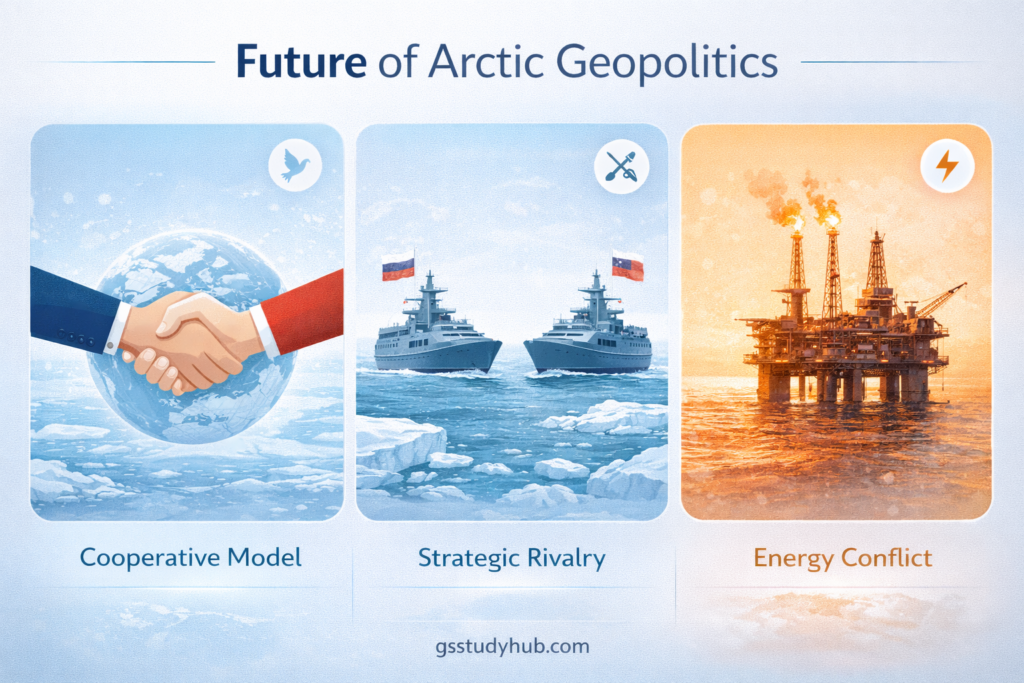
🔮 Possible Future Scenarios in Arctic Geopolitics (Featured Snippet Guide)
Arctic Geopolitics stands at the crossroads of global energy security, climate change, and great power competition. As melting ice opens access to untapped resources and new maritime corridors, the future of the Arctic will largely depend on how major powers choose to engage with one another.
Analysts generally outline three primary future scenarios for the Arctic region: Cooperative Model, Strategic Rivalry, and Energy Conflict. Each scenario carries different implications for global stability, environmental sustainability, and geopolitical balance.
1️⃣ Cooperative Model
Under the Cooperative Model, Arctic states prioritize shared governance and environmental protection. Institutions such as the Arctic Council serve as platforms for dialogue, scientific collaboration, and coordinated policymaking.
Key features of this scenario include:
- 🌍 Strong multilateral cooperation among Arctic and non-Arctic stakeholders
- 🌿 Strict environmental regulations and sustainable resource management
- ⚖️ Balanced economic development with climate responsibility
- 👥 Protection of Indigenous rights and local communities
If successfully implemented, the Cooperative Model could transform the Arctic into a symbol of peaceful collaboration, balancing economic interests with ecological preservation.
2️⃣ Strategic Rivalry
The Strategic Rivalry scenario represents a middle ground between cooperation and conflict. States avoid direct confrontation but maintain a visible military presence and compete for influence over shipping routes and energy projects.
Core characteristics of this scenario include:
- 🛡️ Limited military competition and deterrence strategies
- 🚢 Strategic control over emerging Arctic sea routes
- ⚡ Competitive investment in energy infrastructure
- 🌐 Diplomatic tension without open warfare
Many analysts consider Strategic Rivalry the most realistic near-term scenario, as current global dynamics reflect controlled competition rather than full-scale confrontation.
3️⃣ Energy Conflict
The Energy Conflict scenario is the most volatile and high-risk outcome. Escalating disputes over resource ownership, maritime boundaries, or infrastructure security could trigger direct confrontation.
Potential elements of this scenario include:
- ⚔️ Direct military clashes or aggressive posturing
- 🔥 Disputes over oil and gas installations
- 🌍 Destabilization of global energy markets
- 📉 Increased geopolitical uncertainty worldwide
Although a full-scale conflict remains unlikely in the short term, rising geopolitical tensions could push the Arctic toward deeper instability if diplomatic channels weaken.
📌 Conclusion: Which Path Will the Arctic Choose?
The future of Arctic Geopolitics will depend on whether global powers prioritize cooperation or competition. A collaborative approach could ensure sustainable development and climate protection. Conversely, unchecked rivalry could transform the region into a new theater of geopolitical tension.
Ultimately, the Arctic is more than a resource frontier — it is a test of global leadership, environmental responsibility, and strategic foresight in the 21st century.
Final Insight: The direction chosen in the coming decades will determine whether the Arctic becomes a model of cooperation or a catalyst for the next global energy crisis.
The disruption in maritime routes has global consequences. To understand this in detail, see how the Red Sea crisis in 2026 is affecting global trade and shipping .
🇮🇳 India Angle: India’s Long-Term Strategic Outlook in Arctic Geopolitics
While Arctic Geopolitics is often discussed in the context of Russia, the United States, China, and nato countries, India’s role—though indirect—is strategically significant. India is not an Arctic coastal state, yet the region’s evolving energy dynamics, climate shifts, and maritime developments have long-term implications for its economic and geopolitical interests.
In the 21st century, India cannot afford to treat the Arctic as a distant or isolated region. Instead, it must view Arctic developments through the lens of energy security, climate science, and maritime strategy.
⚡ Energy Import Dependence
India is one of the world’s largest energy consumers and relies heavily on imports to meet its oil and natural gas requirements. This energy import dependence makes global energy market stability a critical national concern.
If Arctic energy production expands significantly, it could alter global supply patterns and influence oil and gas prices. Any fluctuation in global energy markets directly impacts India’s economic stability and growth trajectory.
In the long term, India may explore partnerships or investments in Arctic energy projects, particularly in collaboration with countries that are already active in the region. Diversifying energy sources strengthens India’s strategic autonomy.
🔬 Scientific Missions: Himadri Research Station
India’s Arctic engagement is not limited to economic interests. In 2008, India established the Himadri Research Station in Svalbard, Norway. This station supports scientific research on climate change, atmospheric sciences, marine ecosystems, and polar ice studies.
Changes in the Arctic climate have measurable effects on global weather systems, including the Indian monsoon. Therefore, Arctic research contributes directly to India’s environmental planning and climate resilience strategies.
Through scientific diplomacy and research collaboration, India enhances its credibility in Arctic governance discussions and strengthens its global environmental leadership.
🌏 Indo-Pacific Balance and Maritime Strategy
India’s foreign policy strongly emphasizes the Indo-Pacific region. However, emerging Arctic sea routes may gradually reshape global trade flows. If shipping routes shift partially toward the Arctic, the strategic importance of traditional maritime corridors could evolve.
China’s Polar Silk Road initiative and Russia’s Northern Sea Route strategy indicate that Arctic developments may influence broader global maritime balances. India must assess how these changes could affect the Indian Ocean’s strategic landscape.
Proactive engagement ensures that India remains prepared for potential shifts in global trade architecture and strategic alignments.
📊 Long-Term Strategic Necessity
India’s Arctic approach should remain balanced and forward-looking. Rather than military competition, India’s strengths lie in multilateral cooperation, climate research, and sustainable development partnerships.
By maintaining a strategic watch on Arctic developments, India can protect its energy interests, contribute to climate science, and position itself as a responsible global stakeholder.
Conclusion: Although India is not an Arctic power, the region’s evolving geopolitical and environmental dynamics are closely linked to India’s long-term national interests. A carefully calibrated Arctic strategy will strengthen India’s energy security, scientific leadership, and global strategic relevance.
To better understand rising prices worldwide, check out the effects of global inflation on developing countries and how economies are coping with accelerating cost pressure.
🌍 Conclusion: Arctic Geopolitics and the Future of Global Energy Power
Arctic Geopolitics has emerged as a defining theme of 21st-century global politics. Melting ice caused by climate change has transformed the Arctic from a remote frozen frontier into a strategic arena of energy resources, emerging shipping routes, and geopolitical competition. The growing involvement of Russia, the United States, China, and nato clearly indicates that the Arctic is becoming central to future energy and security dynamics.
With an estimated 13% of the world’s undiscovered oil and 30% of undiscovered natural gas, the region holds enormous economic potential. Additionally, newly accessible maritime routes could shorten trade distances between Asia and Europe, potentially reshaping global supply chains and commercial flows.
However, the Arctic is far more than a resource frontier. It functions as a critical climate regulator for the planet. Uncontrolled fossil fuel extraction could accelerate global warming and disrupt fragile ecosystems. Therefore, the Arctic represents a crucial balance between geopolitical ambition and environmental responsibility.
Even countries that are not Arctic powers, such as India, are indirectly affected by Arctic developments through energy markets, climate patterns, and shifting maritime strategies. This makes Arctic governance not merely a regional issue, but a shared global responsibility.
Final Insight: The future of the Arctic will determine whether the 21st century is shaped by cooperation or competition. If nations prioritize sustainable development and multilateral collaboration, the Arctic can become a model of balanced progress. Otherwise, it risks evolving into the next major theater of global energy conflict.
Understanding regional security dynamics? Read how the QUAD and Indo-Pacific strategy highlight India’s critical role in shaping Asia’s strategic future.
❓ FAQs: Arctic Geopolitics (Voice Search + Rich Snippet Optimized)
Q1: Why is Arctic Geopolitics important?
Arctic Geopolitics is important because it is directly connected to energy resources, global trade routes, and military strategy. The Arctic contains vast reserves of oil, natural gas, and critical minerals, while newly emerging sea routes could shorten shipping distances between Asia and Europe. As a result, the region plays a crucial role in shaping the future global balance of power.
Q2: Which countries are key stakeholders in the Arctic?
The primary Arctic stakeholders include Russia, the United States, Canada, Norway, and Denmark (through Greenland). These nations have Arctic coastlines and legal claims over parts of the Arctic Ocean, giving them strategic and economic interests in the region.
Q3: Is war in the Arctic possible?
A direct military war in the Arctic is considered unlikely in the near term, as most countries prioritize economic cooperation and diplomatic engagement. However, strategic rivalry and increased military presence are expected to grow. The Arctic is likely to remain a region of controlled competition rather than open conflict.