Beginning of British Rule in India
British rule in India began in the 17th century under the pretext of trade, but gradually it expanded into political and military domination. The British East India Company strengthened its influence by subduing Indian kingdoms, and by 1858, India formally became part of the British Empire.
Beginning of British Rule: A Detailed Study
Arrival of the East India Company (1600–1757)
1. Establishment of the East India Company (1600)
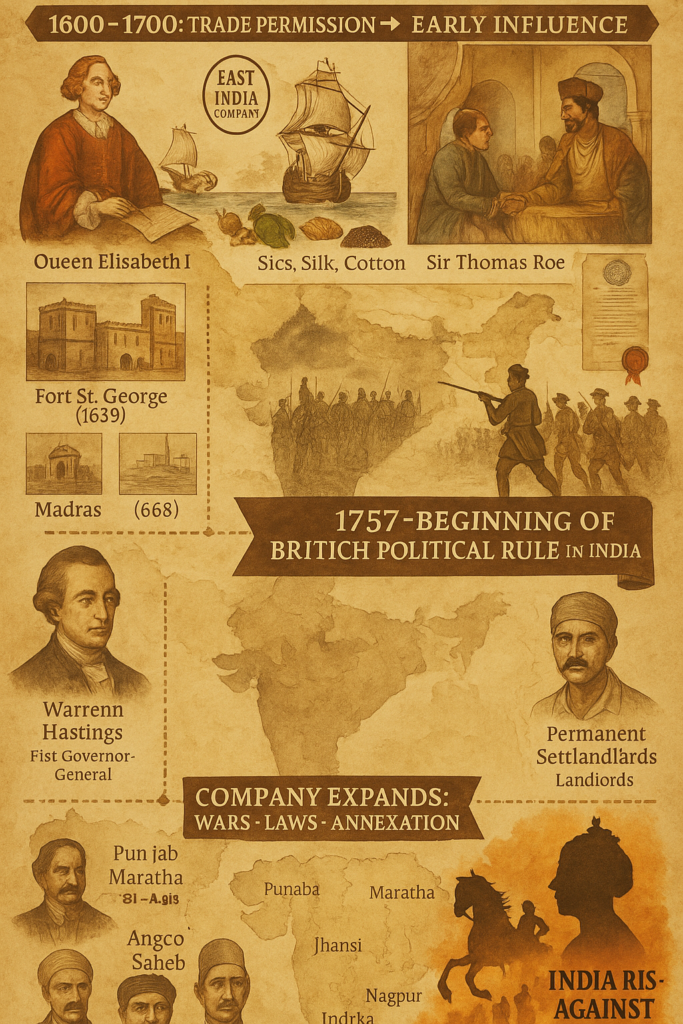
- On 31 December 1600, Queen Elizabeth I granted permission to the East India Company to trade in India.
- The main purpose of the company was to buy and sell spices, cotton textiles, silk, and other commercial goods.
2. First Steps in India (1608–1612)
- In 1608, the first British merchant ship arrived at the Indian coast.
- In 1612, Emperor Jahangir allowed the British to conduct trade in Surat.
- In 1615, Sir Thomas Roe secured special trading rights at the Mughal court.
3. Early Trading Centers
- In 1639, the British built their first fort, Fort St. George, in Madras (Chennai).
- In 1668, Bombay (Mumbai) was acquired from the Portuguese and came under British control.
- In 1690, the British began trading in Kolkata, and by 1696, Fort William was established.
Expansion of British Power (1757–1857)

✔ Useful for exam preparation
✔ Trusted educational resource
✔ Positive reader feedback
1. Battle of Plassey (1757) — Foundation of British Rule
The Battle of Plassey was fought between the British East India Company and the Nawab of Bengal, Siraj-ud-Daulah. Robert Clive led the British forces and secured victory after bribing key Bengal officials, including Mir Jafar.
Outcome: The British East India Company gained control over Bengal, marking the beginning of political rule in India.
2. Battle of Buxar (1764) — Consolidation of Power
The British army defeated the combined forces of Mir Qasim (Bengal), Shuja-ud-Daula (Awadh), and Mughal Emperor Shah Alam II.
Under the Treaty of Allahabad (1765), the East India Company received the Diwani rights (revenue collection) of Bengal, Bihar, and Orissa.
East India Company’s Complete Control (1765–1857)
1. Establishment of British Administration
- The Regulating Act of 1773 was introduced, and Warren Hastings became the first Governor-General of India.
- In 1793, the Permanent Settlement system was implemented, giving landlords the right to collect revenue.
2. Expansionist Policies
- 1818: Third Anglo-Maratha War — The Marathas were defeated, expanding British control.
- 1849: Second Anglo-Sikh War — Punjab came under British rule.
- Doctrine of Lapse: By 1856, Indian princely states like Jhansi, Satara, and Nagpur were annexed into the British Empire.
Revolt of 1857 — End of Company Rule
In 1857, Indian soldiers and common people revolted against British oppression. Leaders such as Mangal Pandey, Rani Lakshmibai, Bahadur Shah Zafar, Tatya Tope, and Nana Saheb played key roles.
Although the rebellion was suppressed, it ended the rule of the East India Company.
Rule of the British Crown (1858–1947)
- In 1858, under the Government of India Act, Queen Victoria took direct control over India.
- In 1877, Queen Victoria was declared the Empress of India.
- The position of “Governor-General” was transformed into the “Viceroy of India.”
Conclusion
British rule entered India in the guise of trade, but gradually took complete control of the subcontinent. The Battle of Plassey (1757) marked the beginning of British political dominance. After the revolt of 1857, the British Crown established direct rule, which continued until 1947.
This period was extremely challenging for India, yet it ignited the spirit of nationalism and paved the way for the long struggle for independence.
Major Phases of India’s Freedom Struggle
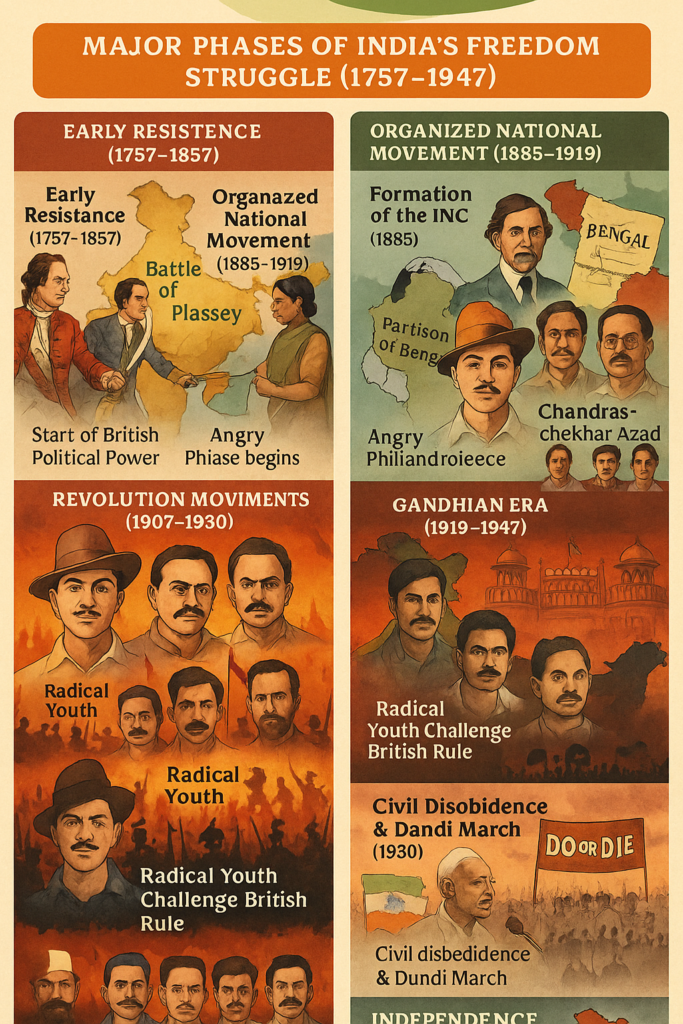
India’s freedom struggle lasted for almost 200 years and evolved through various stages. It included early resistance, revolutionary movements, non-violent protests led by Mahatma Gandhi, and finally, India’s independence in 1947.
🔹 1. Early War of Independence (1757–1857)
1.1 Battle of Plassey (1757) and Battle of Buxar (1764)
Battle of Plassey (1757): The British defeated Siraj-ud-Daulah, the Nawab of Bengal, and established their political power.
Battle of Buxar (1764): This battle gave the East India Company complete control over Bengal, Bihar, and Orissa.
1.2 First War of Independence (1857)
The Revolt of 1857 is also known as the “Sepoy Mutiny” or “India’s First War of Independence.”
Main Leaders: Mangal Pandey, Rani Lakshmibai, Tatya Tope, Nana Saheb, Bahadur Shah Zafar.
The revolt failed militarily, but it strengthened the spirit of independence among Indians.
Result: In 1858, the British government ended the rule of the East India Company and established direct Crown rule.
🔹 2. Beginning of the Organized National Movement (1885–1919)
2.1 Establishment of the Indian National Congress (1885)
The Indian National Congress (INC) was founded in 1885 by A. O. Hume. Initially, its objective was to demand constitutional reforms from the British government.
2.2 Partition of Bengal and Swadeshi Movement (1905–1911)
In 1905, Lord Curzon partitioned Bengal, which caused widespread anger among Indians.
Swadeshi Movement: People boycotted foreign goods and promoted Indian-made products.
Main Leaders: Bal Gangadhar Tilak, Lala Lajpat Rai, Bipin Chandra Pal (Lal-Bal-Pal).
2.3 Revolutionary Movement (1907–1930)
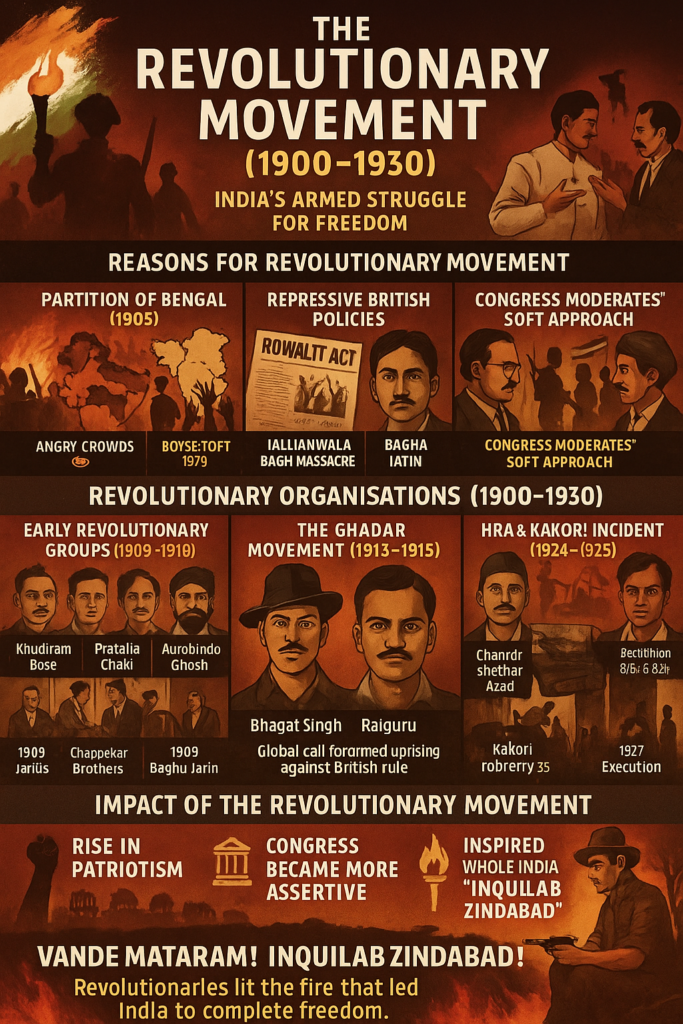
Many Indian youths adopted revolutionary methods and took up arms against British rule.
Main revolutionaries: Bhagat Singh, Chandrashekhar Azad, Khudiram Bose, Batukeshwar Dutt, Rajguru, Sukhdev.
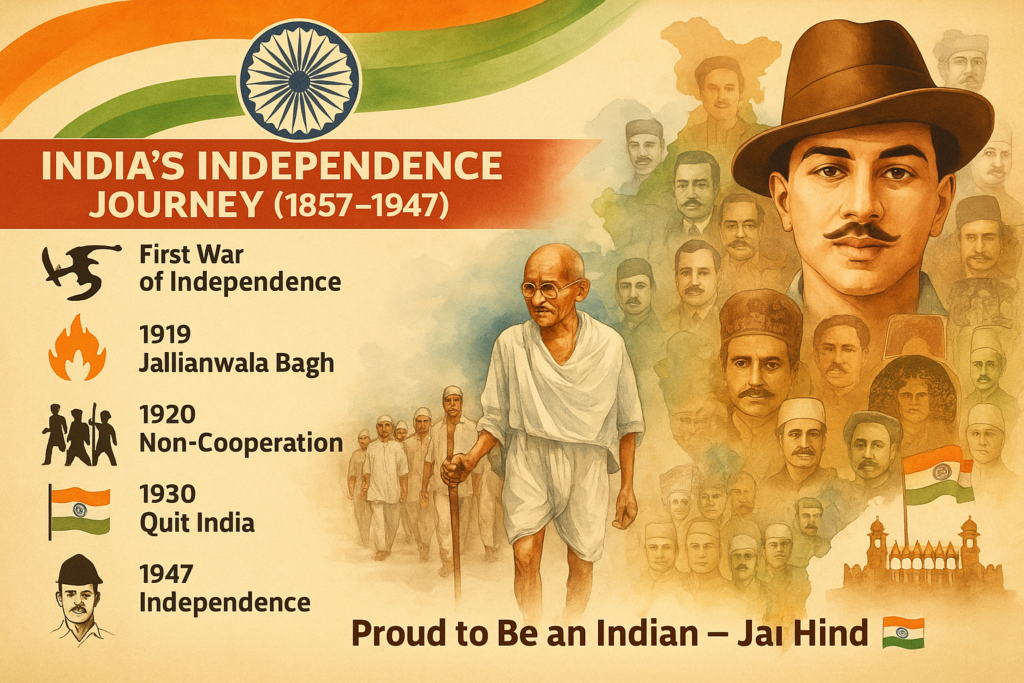
1919 – Jallianwala Bagh Massacre: General Dyer opened fire on unarmed people, intensifying the freedom struggle.
🔹 3. Freedom Struggle Under Mahatma Gandhi (1919–1947)
3.1 Non-Cooperation Movement (1920–1922)
After the Jallianwala Bagh massacre, Mahatma Gandhi launched a non-violent protest movement.
People boycotted foreign goods, British schools, and government jobs.
The movement was withdrawn after the Chauri Chaura incident in 1922.
3.2 Civil Disobedience Movement and Dandi March (1930)
After the 1929 Lahore Congress demand for Purna Swaraj, Gandhi initiated the Civil Disobedience Movement.
He led the historic Dandi March to protest against the British Salt Law.
3.3 Quit India Movement (1942)
During World War II, Gandhi gave the famous call, “Do or Die” and demanded “British Quit India.”
Millions of Indians were jailed, yet the movement continued strongly.
🔹 4. Independence and Partition of India (1947)
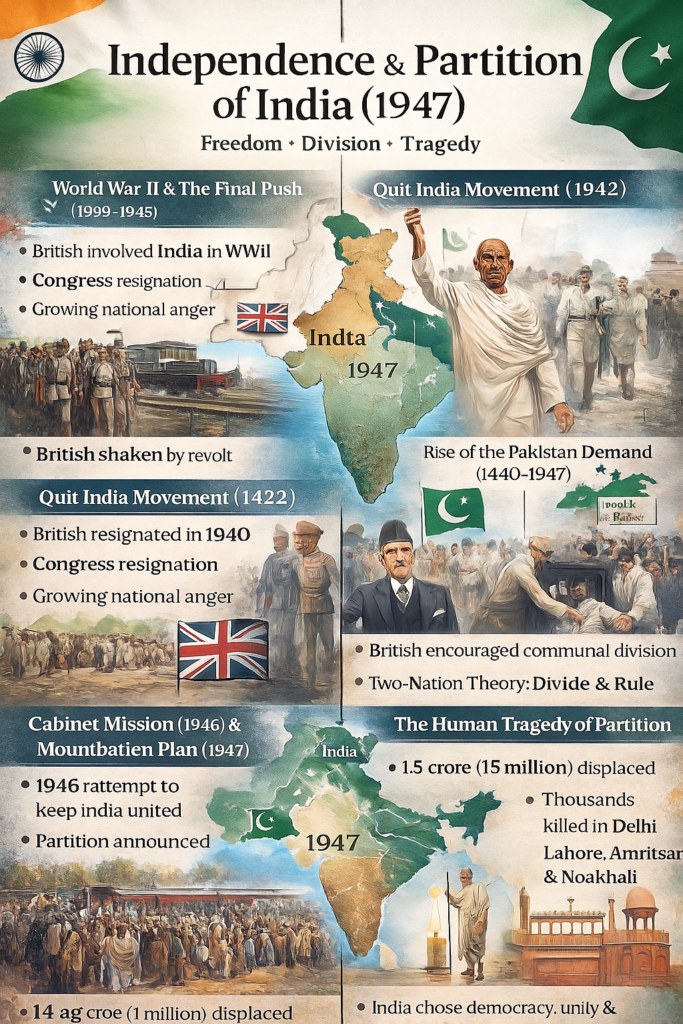
The Cabinet Mission Plan of 1946 failed to create a consensus on power transfer.
14 August 1947: Pakistan was created.
15 August 1947: India became independent.
Pandit Jawaharlal Nehru became the first Prime Minister of independent India.
Conclusion
India’s freedom struggle went through many phases, and countless people sacrificed their lives. It was not just a political battle—it was also a struggle for national awakening and self-reliance. After independence, India adopted a democratic constitution and moved forward on the path of progress.
“Salute to the heroes of the freedom struggle, who sacrificed their lives and gave us a free India!”
✔ Useful for exam preparation
✔ Trusted educational resource
✔ Positive reader feedback
🔹 The Revolt of 1857 (First War of Independence)
Introduction
The Revolt of 1857 was the first major organized attempt to overthrow British rule. It is known as “India’s First War of Independence,” the “Sepoy Rebellion,” or the “Great Revolt of 1857.”
The revolt was triggered by political oppression, economic exploitation, socio-religious interference, and soldier discontent.
Although the revolt was suppressed in 1858, it ignited the spirit of nationalism and laid the foundation for future movements.
Main Reasons for the Revolt of 1857
1. Political Reasons
- The Doctrine of Lapse allowed the British to annex states without a natural heir (Jhansi, Satara, Nagpur, Awadh).
- Mughal Emperor Bahadur Shah Zafar was declared the last Emperor of Delhi.
2. Social and Religious Reasons
- The British interfered in Indian customs and traditions.
- Laws against practices like Sati and child marriage caused resentment.
- Missionary activities created fear of forced religious conversion.
3. Economic Reasons
- British policies ruined farmers, artisans, and local industries.
- Zamindari system and heavy taxation pushed farmers into debt.
- Traditional Indian industries declined sharply.
4. Soldier Discontent
- Indian soldiers were paid less and treated unequally.
- Greased cartridges (cow and pig fat) hurt the religious sentiments of Hindu and Muslim soldiers.
Beginning of the Revolt and Major Centers
📍 1. Meerut (10 May 1857) – Beginning of the Revolt
On 9 May 1857, 85 Indian soldiers were imprisoned for refusing to use greased cartridges. On 10 May, soldiers revolted, freed the prisoners, and marched toward Delhi.
📍 2. Delhi – Leadership of Bahadur Shah Zafar
On 11 May 1857 the rebels captured Delhi and declared Bahadur Shah Zafar the leader of India. Delhi became the center of the revolt but was recaptured by the British in September 1857.
📍 3. Kanpur – Leadership of Nana Saheb
Nana Saheb led the revolt in Kanpur, and Tatya Tope resisted British forces. Ultimately Kanpur fell, and Tatya Tope was executed in 1859.
📍 4. Jhansi – Struggle of Rani Lakshmibai
Rani Lakshmibai fought valiantly to defend Jhansi. She achieved martyrdom in 1858. Her iconic slogan: “I will not give up my Jhansi!”
📍 5. Bihar – Kunwar Singh’s Rebellion
Kunwar Singh led the revolt in Bihar and fought the British until his last breath.
📍 Lucknow – Begum Hazrat Mahal
Begum Hazrat Mahal revolted in Awadh. She fought bravely but was eventually forced to retreat to Nepal.
Suppression of the Revolt and Reasons for Failure
1. Suppression
By late 1857, Delhi was recaptured. By 1858, major centers like Kanpur, Jhansi, Lucknow, and Bihar were defeated. Bahadur Shah Zafar was exiled to Rangoon; Rani Lakshmibai, Tatya Tope, and many others died fighting.
2. Reasons for Failure
- Lack of unified leadership and organization.
- British military superiority.
- Poor communication between rebel groups.
- Some princely states supported the British.
Results and Effects of the Revolt
1. Direct British Rule (1858)
In 1858, the British Crown took direct control of India. The Governor-General’s position changed to “Viceroy.” Lord Canning became the first Viceroy.
2. Changes in the Army
Recruitment policies changed and efforts were made to weaken Hindu-Muslim unity.
3. Rise of Nationalism
Though the revolt failed, it sparked national consciousness and laid the foundation for the Indian National Movement.
Conclusion
The Revolt of 1857 was not just a rebellion—it was the beginning of the Indian freedom movement. Although unsuccessful, it forced the British to change their policies and paved the way toward India’s independence in 1947.
“The War of 1857 was the first spark that lit the flame of Indian Independence.”
Indian National Congress (INC) and the Early Movement
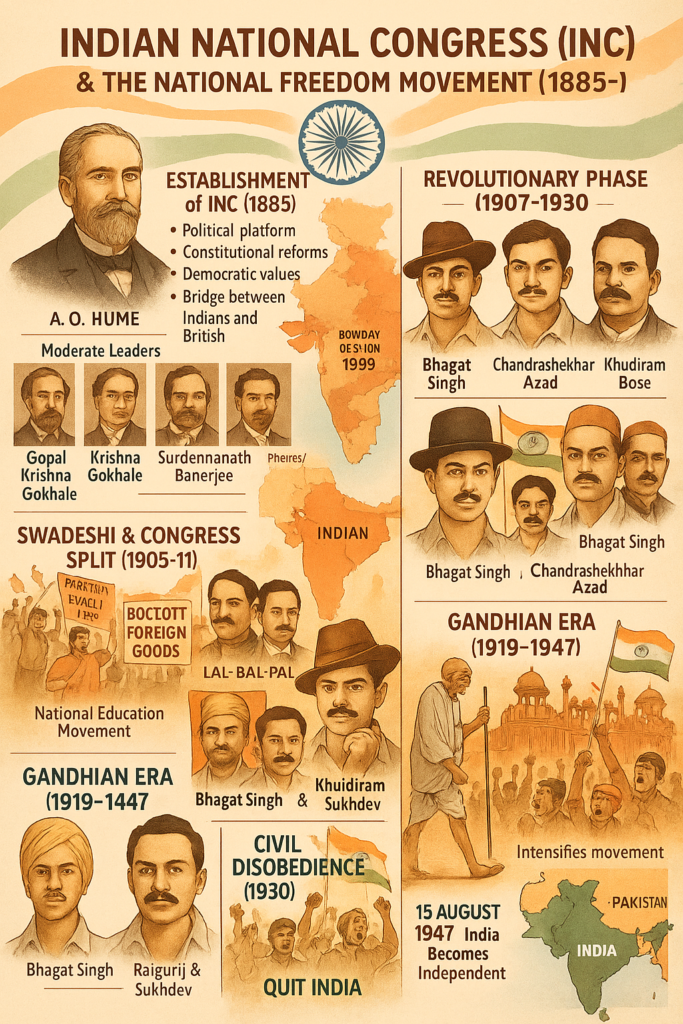
The Indian National Congress (INC) was the most prominent political organization of India’s Freedom Struggle. Established on 28 December 1885, it led major political movements against British rule and played a crucial role in achieving India’s independence in 1947.
Introduction to the Indian National Congress (INC)
The INC provided a national platform for Indians, demanded constitutional reforms, promoted democratic values, and acted as a bridge between British authorities and Indian leaders.
Establishment of the Indian National Congress
1. Purpose of Establishment
- To provide a political platform for Indians.
- To demand constitutional reforms from the British Government.
- To promote democratic ideology in India.
- To maintain cordial relations between Indians and the British.
2. How the Indian National Congress Was Established
- A. O. Hume, a retired British officer, played a key role in founding the INC.
- He acted as a mediator between Indian leaders and the British administration.
- The first session of INC was held in Bombay (Mumbai) on 28 December 1885 and was presided over by Vyomesh Chandra Banerjee.
3. Prominent Leaders of the First Congress Session (1885)
- A. O. Hume (Founder)
- Vyomesh Chandra Banerjee (First President)
- Dadabhai Naoroji
- Surendranath Banerjee
- Badruddin Tyabji
- Gopal Krishna Gokhale
- Pherozeshah Mehta
The Early Congress and Its Movements (1885–1905)
1. Early Congress Policy (Moderate Era: 1885–1905)
This period is known as the Moderate Era. The Congress focused on constitutional reforms and dialogue with the British Government.
Main Demands of the Moderates
- Greater opportunities for Indians in government services.
- Expansion of self-government for Indians.
- Reduction of heavy taxes imposed on Indians.
- Appointment of Indians to high administrative and judicial posts.
Key Leaders of the Moderate Era
- Dadabhai Naoroji – Known for his “Drain of Wealth Theory.”
- Gopal Krishna Gokhale – A moderate leader who believed in dialogue with the British.
- Pherozeshah Mehta and Surendranath Banerjee – Advocated for political rights of Indians.
🔹 1905–1919: Congress Split and the Swadeshi Movement
1. Partition of Bengal and the Swadeshi Movement (1905–1911)
- In 1905, Lord Curzon partitioned Bengal.
- The Swadeshi Movement began as a protest against the partition.
- People boycotted foreign goods and promoted Indian-made products.
- The National Education Movement also began during this time.
- Lal-Bal-Pal (Lala Lajpat Rai, Bal Gangadhar Tilak, Bipin Chandra Pal) played a major role.
2. Congress Split (1907) – Moderates vs. Extremists
- The Congress split at the Surat Session in 1907.
- Moderates: Gopal Krishna Gokhale, Ferozeshah Mehta, Dadabhai Naoroji.
- Extremists: Bal Gangadhar Tilak, Lala Lajpat Rai, Bipin Chandra Pal.
- Extremists believed in stronger, sometimes revolutionary, methods against British rule.
3. Lucknow Pact (1916)
- An agreement between the Congress and the Muslim League.
- Both organizations jointly demanded constitutional reforms from the British Government.
- The pact was led by Bal Gangadhar Tilak and Muhammad Ali Jinnah.

✔ Useful for exam preparation
✔ Trusted educational resource
✔ Positive reader feedback
🔹 1919–1947: National Movement Under Mahatma Gandhi
1. Rowlatt Act and Jallianwala Bagh Massacre (1919)
- Rowlatt Act: Allowed imprisonment without trial.
- 13 April 1919: General Dyer fired upon unarmed Indians at Jallianwala Bagh in Amritsar.
2. Non-Cooperation Movement (1920–1922)
- Started by Mahatma Gandhi as a non-violent mass movement.
- People boycotted foreign clothes, government jobs, and British institutions.
- The movement was withdrawn after the Chauri Chaura incident in 1922.
3. Civil Disobedience Movement (1930) – Dandi March
- Gandhi initiated the Salt Satyagraha (Dandi March) protesting against the British Salt Law.
- Millions of Indians participated by breaking unjust British laws.
4. Quit India Movement (1942)
- Launched on 8 August 1942.
- Gandhi gave the historic call “Quit India.”
- Many Congress leaders were arrested.
- This movement became the final push towards Indian independence.
5. Independence of India (1947)
- India became independent on 15 August 1947.
- Pandit Jawaharlal Nehru became the first Prime Minister of independent India.
Conclusion
The Indian National Congress (INC) led many important movements—from constitutional reforms to mass non-violent struggles. Initially, the Congress followed a moderate, dialogue-based approach, but later, under Mahatma Gandhi’s leadership, it mobilized the entire nation and ultimately achieved independence.
“The Indian National Congress played the most important role in freeing India from colonial rule.”
Mahatma Gandhi and The Non-Violent Movement
Introduction
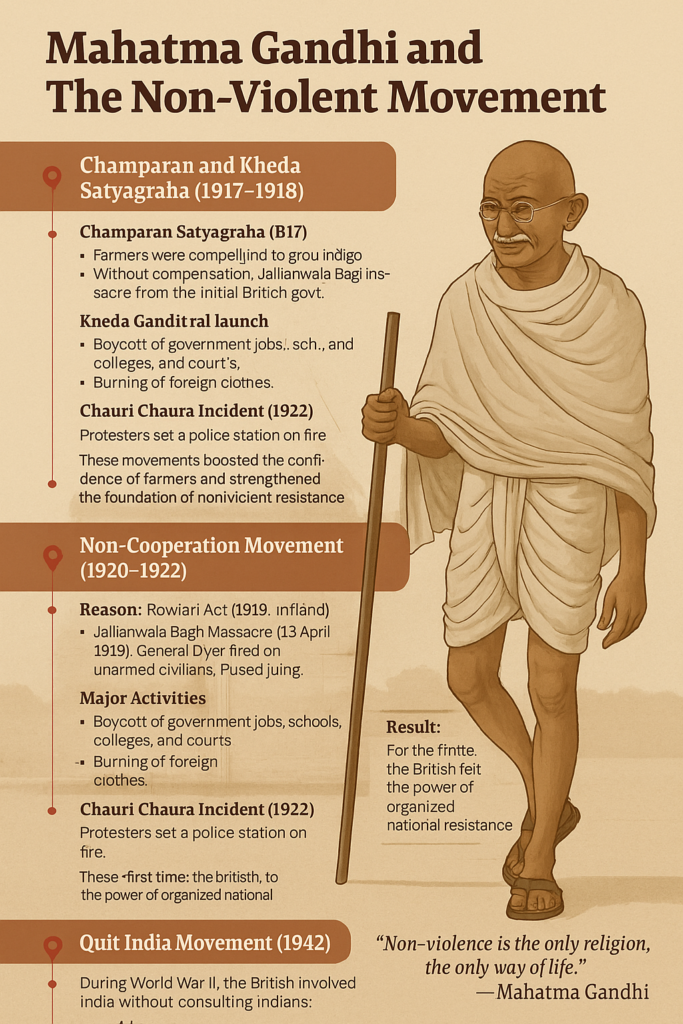
Mahatma Gandhi was the great leader of India’s freedom struggle who fought British rule through the principles of non-violence and Satyagraha. Under his leadership, three major National Movements were launched — the Non-Cooperation Movement (1920), the Civil Disobedience Movement (1930), and the Quit India Movement (1942). Gandhi believed that violence could never bring permanent change in society, therefore he adopted the path of peaceful struggle.
Biography of Mahatma Gandhi
- Full Name: Mohandas Karamchand Gandhi
- Birth: 2 October 1869, Porbandar, Gujarat
- Education: Studied law in England
- 1893–1915: Led the struggle against apartheid in South Africa
- 1915: Returned to India and became a central figure in the freedom struggle
Gandhiji transformed the ideas of non-violence and Satyagraha into powerful political tools and used them to challenge British rule.
Gandhi’s Major Non-Violent Movements
📍 1. Champaran and Kheda Satyagraha (1917–1918)
Champaran Satyagraha (1917)
- In Champaran (Bihar), farmers were forced to cultivate indigo under exploitative conditions.
- They received no compensation from the British government.
- Gandhiji led a Satyagraha movement which secured justice for the farmers.
Kheda Satyagraha (1918)
- Kheda (Gujarat) faced severe famine but the British refused to reduce taxes.
- Gandhiji launched a non-violent Satyagraha.
- Eventually, farmers were granted tax relief.
Result: These movements boosted the confidence of farmers and strengthened the foundation of non-violent resistance in India.
📍 2. Non-Cooperation Movement (1920–1922)
Reason
- Rowlatt Act (1919): Allowed imprisonment without trial.
- Jallianwala Bagh Massacre (13 April 1919): General Dyer opened fire on unarmed civilians.
In response, Gandhiji launched the Non-Cooperation Movement as a national protest against British injustice.
Major Activities
- Boycott of government jobs, schools, colleges, and courts.
- Burning of foreign clothes.
- Promotion of Khadi and Swadeshi goods.
Chauri Chaura Incident (1922): Withdrawal of the Movement
- On 5 February 1922, at Chauri Chaura (Uttar Pradesh), protesters set a police station on fire.
- Twenty-two policemen were killed.
- Gandhiji immediately withdrew the movement due to the violent turn of events.

✔ Useful for exam preparation
✔ Trusted educational resource
✔ Positive reader feedback
Result: For the first time, the British felt the power of organized national resistance.
📍 3. Civil Disobedience Movement (1930) – Dandi March
Reason
- The British imposed a tax on salt, affecting even the poorest citizens.
- Gandhi launched the Civil Disobedience Movement to oppose unjust British laws.
Dandi March (12 March – 6 April 1930)
- Gandhiji walked 240 miles from Sabarmati Ashram (Gujarat) to Dandi on the Arabian Sea coast.
- He produced salt from seawater, symbolically breaking British law.
Result:
- The movement spread across the nation.
- Gandhiji was arrested.
- The Gandhi–Irwin Pact (1931) was signed, leading to the release of several leaders.
📍 4. Quit India Movement (1942)
Reason
- During World War II, the British involved India in the war without consulting Indians.
- Gandhiji gave the slogan “Quit India” demanding immediate British withdrawal.
The Quit India Resolution – 9 August 1942
- Gandhiji declared the historic slogan “Do or Die.”
- British authorities arrested Gandhiji and the entire top Congress leadership.
Result:
- Massive nationwide protests took place.
- By 1945, the British government decided to grant independence to India.
Gandhi’s Ideas of Non-Violence and Satyagraha
- Non-Violence: Violence cannot be answered with violence. Truth and justice must be pursued peacefully.
- Satyagraha: Non-violent resistance against unjust laws through the power of truth.
- Swadeshi: Boycott foreign goods and promote Indian products.
- Complete Independence: A self-reliant India where every citizen is free.
- Public Service: Politics must serve people and society.
Impact of Gandhiji’s Movements
- Unified the Indian freedom struggle.
- Brought ordinary citizens into the national movement.
- Forced the British to consider granting independence.
- India finally became independent on 15 August 1947.
Conclusion
The non-violent movements led by Mahatma Gandhi played a decisive role in achieving India’s independence. He showed the world that injustice can be defeated through peaceful means. His ideals remain relevant and continue to inspire humanity.
“Non-violence is the only religion, the only way of life.” — Mahatma Gandhi