
Introduction: The Red Sea Crisis 2026 – A Geopolitical Tsunami
It is crucial to understand that the Red Sea Crisis 2026 is not merely a regional conflict but a global economic shock. What started as a local maritime disruption has now escalated into a major challenge for international trade, affecting shipping routes and insurance premiums worldwide.
The Red Sea Crisis 2026 has emerged as one of the most defining geopolitical and economic challenges of the mid-2020s. What began in late 2023 as a regional disruption has, by 2026, calcified into a permanent Global Maritime Conflict. This is no longer just about sporadic missile attacks on cargo ships; it is a historic event that has exposed the fragility of global supply chains, altered the calculus of energy security, and redrawn the map of international trade.
In simple terms, the Red Sea Crisis represents a de facto military and economic blockade of one of the world's most vital trade arteries by Yemen’s Houthi Rebels (Ansar Allah). This crisis has served as a wake-up call for the modern world, demonstrating how vulnerable the globalized economy is to disruptions at specific maritime "Chokepoints."
🌐 The Strategic Context: Why Geography Matters
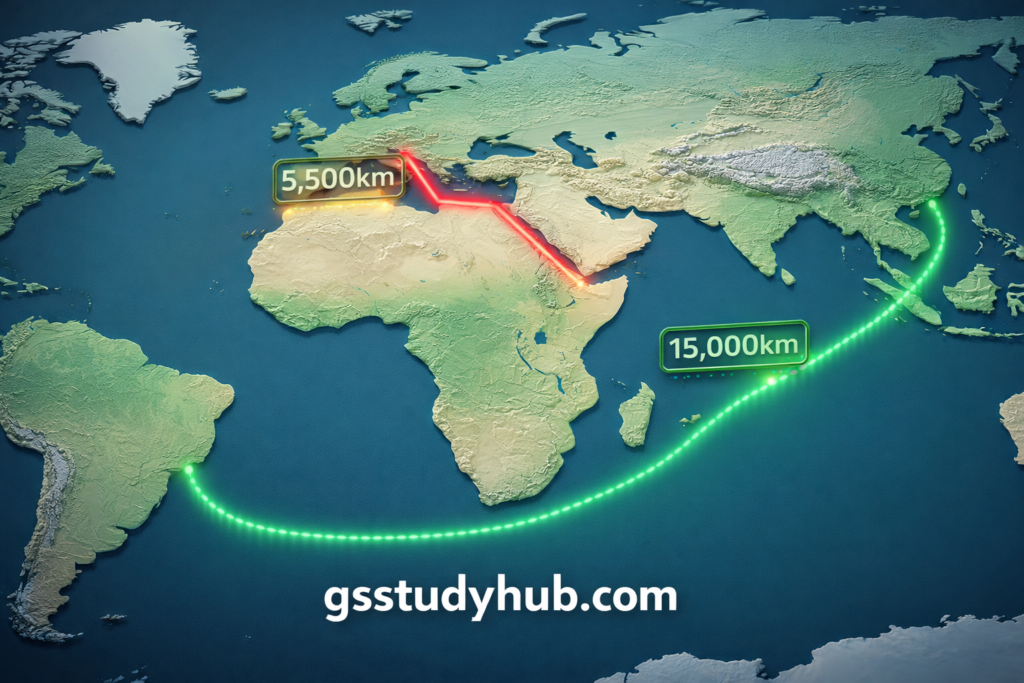
To grasp the severity of this crisis, one must understand the geography where this "chessboard" is set. The Red Sea acts as the critical connector between the Indian Ocean and the Mediterranean Sea. It is the shortest maritime route between Asia (the factory of the world) and Europe (the consumer market).
This route is guarded by two strategic gates:
1. The Suez Canal (North): An artificial waterway in Egypt that revolutionized trade by eliminating the need to sail around Africa.
2. The Bab-el-Mandeb Strait (South): Known historically as the "Gate of Tears," this natural strait lies between Yemen on the Arabian Peninsula and Djibouti/Eritrea on the Horn of Africa.
Under normal conditions, approximately 12% to 15% of global trade and nearly 30% of global container traffic pass through this corridor. However, the ongoing crisis has effectively turned this bustling highway into a "No-Go Zone" for major Western shipping alliances.
🔥 Origins & Escalation: From Protest to War
The roots of the current instability lie in the Israel-Hamas war that erupted in October 2023. The Iran-backed Houthi rebels, who control large swathes of northern Yemen and its coastline, declared their intent to target ships linked to Israel as a show of solidarity with Palestinians. Initially, this was viewed by global powers as a symbolic, localized threat.
However, the situation deteriorated rapidly throughout 2024 and 2025. The scope of targets expanded indiscriminately. The Houthis began attacking commercial vessels flagged, owned, or operated by the United States, the United Kingdom, and European nations. Utilizing a sophisticated arsenal of Anti-Ship Ballistic Missiles (ASBMs) and loitering munitions (Kamikaze Drones), they rewrote the rules of naval engagement.
Current Status (2026 Context):
Despite the formation of international naval coalitions like "Operation Prosperity Guardian," the Red Sea remains unsecured. Major shipping giants—including Maersk, Hapag-Lloyd, and MSC—have largely abandoned the route. The region has transformed into a zone of "Low-Intensity, High-Impact" warfare, where safe passage can no longer be guaranteed.
⚔️ The Complexity: 'Asymmetric Warfare' at Sea
The Red Sea Crisis is a textbook example of Asymmetric Warfare—a conflict where the two sides have vastly different military power and resources, yet the "weaker" side effectively disrupts the stronger one.
- The Cost Imbalance: A Houthi drone might cost between $2,000 and $20,000 to manufacture. In contrast, the advanced interceptor missiles used by US or UK destroyers to shoot them down can cost up to $2 million each. This creates an economically unsustainable defense model for Western navies.
- The Invisible Enemy: The attackers are not a conventional navy but a mobile, guerrilla force hidden in rugged terrain, making them incredibly difficult to neutralize through air strikes alone.
📉 The Ripple Effect on Global Order
This prolonged disruption has shattered the "Just-in-Time" manufacturing model that the global economy relied upon. With the Suez route compromised, vessels are forced to reroute around the southern tip of Africa—the Cape of Good Hope.
The implications of this detour are staggering:
✦ Distance: An additional ~6,000 kilometers (3,500 nautical miles) to the journey.
✦ Time: A delay of 10 to 14 days for goods reaching their destination.
✦ Cost: Massive spikes in fuel consumption, crew wages, and insurance premiums.
In conclusion, the Red Sea Crisis of 2026 is not merely a regional security issue involving Yemen or Israel. It is a direct economic challenge to the Global South, particularly nations like India, whose energy security and export competitiveness are tethered to this narrow strip of water.
The Strategic and Economic Significance of the Red Sea 2026
In the complex theatre of modern geopolitics, the Red Sea is far more than a mere body of water; it is the "Jugular Vein" of the global economy. Connecting the Indian Ocean to the Mediterranean via the Suez Canal, this maritime corridor serves as the primary bridge between the industrial powerhouses of the East (Asia) and the wealthy consumer markets of the West (Europe and North America).
By 2026, the protracted crisis in this region has proven one undeniable fact: the world’s economic stability is dangerously dependent on this narrow strip of water. To understand why this crisis matters, we must dissect its importance into three critical dimensions: Global Trade, energy security, and Digital Connectivity.
1. The Global Trade Superhighway
The Red Sea route is the shortest maritime link between Asia and Europe. It is the backbone of the "Just-in-Time" supply chain model that defined global commerce for decades.
📊 Key Economic Indicators (2025-26 Estimates)
- Volume: Approximately 12% to 15% of total global trade passes through this corridor.
- Container Traffic: A staggering 30% of global container traffic relies on the Red Sea.
- Value: Goods worth over $1 Trillion traverse this route annually.
The strategic value of this route lies in pure mathematics: Distance = Time = Money. When the Red Sea is blocked, ships must reroute around the entire continent of Africa via the Cape of Good Hope. The economic impact of this detour is massive, as shown in the comparison below:
| Parameter | Via Red Sea (Suez Canal) | Via Cape of Good Hope (Africa) |
|---|---|---|
| Route Distance (Mumbai to London) | ~11,600 km | ~19,800 km (+40%) |
| Transit Time | 25-26 Days | 35-40 Days (+10-14 Days) |
| Fuel Cost Impact | Baseline | +$1 Million per voyage (approx.) |
This additional cost is not absorbed by shipping companies; it is passed down to consumers, directly fueling global Inflation (Cost-Push Inflation).
2. Oil Supply and Energy Security: The Global Lifeline
The Red Sea is a critical Chokepoint for hydrocarbon transport. Any disruption here sends shockwaves through global energy markets, affecting the price of petrol at the pump and electricity bills in homes across Europe and Asia.
The energy flow through this corridor is bidirectional:
- Northbound Flow: Crude oil and refined petroleum products from the Persian Gulf (Saudi Arabia, Iraq, UAE) move north towards Europe and North America.
- Southbound Flow: Since the geopolitical shifts of 2022 (Ukraine War), massive volumes of Russian Crude Oil now flow south through the Suez Canal to reach markets in India and China.
According to the International Energy Agency (IEA), nearly 10% of seaborne oil and 8% of Liquefied Natural Gas (LNG) trade passes through the Bab-el-Mandeb Strait. For nations like India, which imports over 85% of its oil needs, the security of this route is synonymous with national energy security.
3. Beyond Ships: The Digital Connectivity & Submarine Cables
While most discussions focus on cargo ships, the Red Sea holds a secret strategic asset: Submarine Internet Cables.
The seabed of the Red Sea is one of the most densely packed telecommunications corridors in the world. It serves as the "Digital Silk Road" connecting Europe to Asia.
- Data Traffic: It is estimated that nearly 90% of all data traffic between Europe and Asia flows through cables laid on the Red Sea floor.
- The Vulnerability: The crisis has exposed the fragility of this digital infrastructure. In 2024 and 2025, we witnessed incidents where cables were damaged—allegedly by the anchors of ships drifting after being attacked, or potentially through seabed sabotage.
Conclusion: If the Red Sea closes, we don't just lose access to goods; we risk losing the high-speed data connectivity that powers the modern digital economy. This makes the region a focal point not just for navies, but for tech giants and governments worldwide.
Root Causes & Escalation: A Multidimensional Analysis
The Red Sea Crisis of 2026 is not an isolated maritime incident; it is a symptom of a much larger fracture in the geopolitical architecture of the Middle East. While the immediate trigger was the conflict in Gaza, the sustained nature of this crisis is rooted in regional power struggles, the evolution of non-state actors, and the changing dynamics of modern warfare. To understand why this crisis persists, we must analyze three core dimensions.
1. regional conflict: The Internationalization of War
The catalyst for the crisis was the eruption of the Israel-Hamas war on October 7, 2023. However, the attacks in the Red Sea were not random acts of piracy; they were a calculated strategic move by the "Axis of Resistance".
📚 Key Concept: The Axis of Resistance
This term refers to an informal, anti-Western and anti-Israeli military alliance led by Iran. It operates across the Middle East through various proxy groups:
1. Hezbollah (Lebanon)
2. Hamas (Gaza)
3. The Houthis (Yemen)
4. Shia Militias (Iraq/Syria)
The strategy is "Unification of Fronts"—attacking Israel and its allies from multiple directions simultaneously to stretch their defenses.
The Houthis (Ansar Allah) declared a maritime blockade on any vessel linked to Israel as a form of "Economic Pressure." Their goal was to internationalize the conflict—forcing the global community to pay attention to Gaza by choking global trade. By 2024-25, this scope expanded to include US and UK vessels, turning the Red Sea into a theater of proxy war between Iran and the West.
2. The Houthi Rebellion: A New Era of Naval Warfare
The Houthis have fundamentally altered naval history. Despite not having a conventional navy, they have successfully challenged the world's most powerful armadas. This is a textbook example of 'Asymmetric Maritime Warfare'.
Unlike Somali pirates of the past who used skiffs and AK-47s, the Houthis possess state-level military capabilities (supplied largely by Iran):
- Anti-Ship Ballistic Missiles (ASBMs): The Houthis are the first non-state actor in history to use ballistic missiles against moving commercial ships.
- Kamikaze Drones (Loitering Munitions): Low-cost, long-range drones (like the Samad-3) that can overwhelm ship defense systems through sheer volume.
- Unmanned Surface Vehicles (USVs): Remote-controlled "drone boats" packed with explosives that detonate upon impact with a ship's hull.
- Helicopter Assaults: As seen in the hijacking of the Galaxy Leader, they possess the tactical capability to board and seize massive cargo vessels.
Their objective isn't necessarily to sink every ship, but to create a "Zone of Denial" where insurance premiums become so high that shipping companies voluntarily abandon the route.
3. International Military Response: The Cost of Defense
In response to the blockade, the United States launched Operation Prosperity Guardian (OPG) in December 2023, a multinational security coalition aimed at protecting freedom of navigation.
1. Operation Prosperity Guardian (US-Led): A defensive coalition involving the UK, Bahrain, Canada, France, Italy, and the Netherlands. Its primary mission is to intercept incoming missiles and drones.
2. Operation Aspides (EU-Led): Launched in February 2024, 'Aspides' (Greek for 'Shield') focuses specifically on protecting European merchant vessels and maintains a strictly defensive posture, unlike US/UK forces which also conduct airstrikes on Yemen.
The Economic Challenge of Defense:
While these coalitions have saved countless ships, they face a severe "Cost Curve Problem."
- The Attack Cost: A Houthi attack drone costs approximately $20,000 to manufacture.
- The Defense Cost: A sophisticated interceptor missile (like the SM-2 or Sea Viper) used by Western destroyers costs between $1 Million and $2 Million.
This massive economic disparity means that while the US Navy can shoot down threats, doing so indefinitely is financially unsustainable. This "Cost Asymmetry" is a core reason why the crisis has dragged on into 2026—military superiority does not guarantee an economic victory.
Impact on Global Trade: Economic Shocks & Disruptions
The Red Sea Crisis of 2026 has fundamentally rewritten the mathematics of global trade. What began as a "temporary logistics hiccup" in late 2023 has now calcified into a permanent "Structural Economic Shift." Between 2024 and 2026, this crisis has rippled through every layer of the economy—from shipping conglomerate profits to the wallet of the common consumer.
We will analyze this impact through four critical pillars: Shipping Costs, Insurance Premiums, Supply Chain Disruption, and Inflationary Pressure, using a data-first approach.
1. Shipping Costs: The Skyrocketing Freight Rates
When vessels are forced to bypass the Suez Canal and reroute via the 'Cape of Good Hope' around Africa, operational costs explode. This has a direct multiplier effect on Freight Rates.
According to the Drewry World Container Index (WCI), the cost to ship a 40-foot container from Shanghai to Rotterdam (China-Europe route), which averaged around $1,500 pre-crisis, surged past the $5,000-$6,000 mark during peak disruptions in 2024-25.
To offset these costs, shipping lines have introduced a barrage of Surcharges:
- TDS (Transit Disruption Surcharge): A fee for rerouting vessels.
- PSS (Peak Season Surcharge): Applied during high-demand periods.
- CSS (Contingency Safety Surcharge): To cover security and insurance hikes.
2. Insurance Premiums: The "War Risk" Factor
The Red Sea has been designated a "War Risk Zone" by the Joint War Committee (JWC) of the London insurance market. This classification has caused Marine Insurance premiums to skyrocket.
| Insurance Type | Pre-Crisis Rates | Current Crisis Scenario |
|---|---|---|
| War Risk Premium | 0.01% of Vessel Value | 0.7% - 1.0% of Vessel Value |
| Cost Example | $10,000 per voyage | $1 Million per voyage (for a $100M vessel) |
This additional $1 million expense is not absorbed by the carriers; it is passed directly to importers and, ultimately, to the end consumer.
3. Supply Chain Disruption: The "Container Imbalance"
The most insidious effect of delayed shipping is "Container Imbalance." Because ships are taking 15-20 days longer to complete a rotation, empty containers are not returning to export hubs like China or India on time.
Key Disruptions:
- Blank Sailings: Due to a shortage of available vessels, shipping lines have been forced to cancel scheduled voyages (blank sailings), reducing overall capacity.
- Inventory Crisis: The 'Just-in-Time' (JIT) manufacturing model has been shattered. Major companies like Tesla and Volvo were forced to temporarily halt production at their Berlin and Belgium plants because critical components (like gearboxes) were stuck at sea.
4. Inflationary Pressure: A New Wave of Rising Prices
There is a direct correlation between transport costs and commodity prices. An International Monetary Fund (IMF) study suggests that when freight costs double, global inflation increases by approximately 0.7%.
Sectoral Impact:
- Food Security: Grain prices in East Africa and Asia have risen as shipments from Ukraine and Russia face longer transit times.
- Energy Markets: Europe continues to face volatility in gas (LNG) prices as tankers from Qatar are forced to take the long route around Africa.
- Retail: Giants like IKEA and Walmart have warned that "low-stock" alerts and the end of deep discounts are the new normal due to high logistics costs.
Conclusion: In 2026, the Red Sea Crisis has proven that Globalization is as fragile as it is efficient. The world is now pivoting from "Just-in-Time" to "Just-in-Case" (hoarding inventory), a strategy that permanently raises the cost of doing business.

Impact on India: Challenges & Economic Strain
Geographically, India has emerged as one of the primary casualties of the Red Sea Crisis 2026. With approximately 80% of India's merchandise trade with Europe relying on this route, the disruption has led to soaring freight costs and delayed shipments for key sectors like textiles and agriculture.
The crisis has not only spiked freight costs but also eroded the global competitiveness of Indian exporters. Let's break this down sector by sector.
1. Key Export Sectors: Textiles, Agriculture & Engineering
India’s labor-intensive sectors, which operate on thin margins, have borne the brunt of this crisis. When shipping costs jump from $700 to over $4,000 per container, profitability evaporates.
Exporters in Tiruppur (Tamil Nadu) and Ludhiana (Punjab) face severe headwinds. Orders for summer clothing in Europe saw a 15-20% decline because shipments could not reach on time for the season, leading to inventory pile-ups.
A large volume of Basmati rice is exported to Red Sea nations and Europe. High freight costs have made Indian rice more expensive compared to competitors like Thailand and Pakistan, leading to a loss in market share.
Exports of steel and machinery have slowed down. European buyers are increasingly sourcing from Turkey or Eastern Europe ("Near-shoring") to avoid the long transit times from India.
2. Pharmaceuticals: Crisis for the "Pharmacy of the World"
The Indian pharmaceutical industry faces a double-edged sword:
- Raw Material Delay (API): India imports nearly 70% of its Active Pharmaceutical Ingredients (API) from China. Due to container shortages, these critical inputs are getting stuck at ports.
- Export Delays: The US and Europe are the largest markets for Indian generic drugs. Shipments are now taking 2-3 weeks longer, disrupting the "Just-in-Time" medical supply chains in the West.
3. Oil Imports: The Russian Connection & Price Pressure
India imports over 85% of its crude oil requirements. The Red Sea Crisis has complicated India’s energy mathematics.
| Import Source | Impact Scenario (2026 Assessment) |
|---|---|
| Russian Oil | Russian tankers still use the Red Sea (as they are generally not targeted by Houthis), but the 'War Risk Premium' has increased insurance costs, slightly eroding the "discount" India enjoys. |
| Middle East (Saudi/Iraq) | Relatively safe as it transits via the Strait of Hormuz to India, bypassing the Bab-el-Mandeb. However, global volatility affects pricing. |
| US Oil | Tankers from the US must now take the long route around the Cape of Good Hope, increasing the Landed Cost by $1-$2 per barrel. |
4. Indian Ports: Congestion & Container Shortage
The ripple effects are visible at India’s western ports, particularly JNPT (Mumbai) and Mundra (Gujarat).
- Container Shortage: Since ships are taking longer to return from Europe, there is a severe shortage of empty containers for Indian exporters to load their goods.
- Inventory Pile-up: Millions of tons of export-ready goods are stuck in warehouses near ports, locking up vital Working Capital for small and medium enterprises (MSMEs).
Conclusion: For India, the Red Sea Crisis is a strategic wake-up call. It has accelerated the need for alternative corridors like the IMEC (India-Middle East-Europe Corridor) and emphasized the urgency of developing a national merchant shipping fleet to reduce reliance on foreign carriers.

Future Scenarios: 2026 and Beyond
The Red Sea Crisis has transitioned from a breaking news story to a permanent geopolitical case study. Standing in mid-2026 and looking toward the horizon, three distinct scenarios emerge. Will global trade snap back to its old efficiency, or have we entered a new era of maritime instability?
From the perspective of a Geopolitical Analyst, here are the three primary possibilities:
1. Scenario A: Diplomatic Breakthrough (The Optimist View)
Probability: Low (20%)
In this scenario, a sustainable ceasefire is achieved in Gaza, leading to a broader Middle East peace accord. Iran, facing internal economic pressure and international sanctions, agrees to rein in the Houthis.
- Outcome: Shipping lines gradually return to the Red Sea, war risk premiums collapse, and Suez Canal revenues are restored.
- Why it's unlikely: The ideological roots of the conflict and the deep entrenchment of proxy warfare mean that trust cannot be rebuilt overnight. Shipping giants will remain risk-averse.
2. Scenario B: The 'Grey Zone' Conflict (The Realist View)
Probability: High (60%)
This is the most realistic outlook for 2026-27. Attacks may not stop completely but will fluctuate in intensity.
This creates a "New Normal" where:
- Permanent 'War Risk Premium': Traversing the Red Sea remains expensive—a permanent "Geopolitical Tax" on trade.
- Bifurcated Shipping: The world divides into two maritime spheres. Chinese and Russian vessels (largely immune to Houthi targeting) continue to use the Red Sea, while Western and Indian ships are forced to use the longer Cape of Good Hope route.
- Naval Fatigue: Western navies cannot sustain billion-dollar defensive operations indefinitely and may eventually scale back their presence.
3. Scenario C: Strategic Re-Alignment (The Transformative View)
Probability: Medium/Growing
This is the most intriguing scenario. The world stops relying on choked maritime routes and actively builds alternatives. The Red Sea blockage becomes the catalyst for "Globalization 2.0".
- Rise of IMEC: The India-Middle East-Europe Corridor gains immense strategic value. Instead of sea routes, goods move via rail and road through UAE, Saudi Arabia, and Jordan to Israel/Europe, bypassing the Red Sea entirely.
- The Northern Sea Route: As Arctic ice melts due to climate change, Russia’s Northern Sea Route emerges as a viable alternative for connecting Asia and Europe.
- Near-Shoring: Europe reduces dependence on Asian factories, shifting manufacturing to Turkey, North Africa, and Eastern Europe to shorten supply chains.
Frequently Asked Questions (FAQ)
Expert answers to the most common questions about the Red Sea Crisis 2026 and its global impact.
1. Why did the Red Sea Crisis happen?
The Red Sea Crisis is not a random act of piracy; it is a calculated geopolitical move. The root causes can be traced to three main factors:
- The Trigger (Israel-Hamas War): Following the outbreak of war on October 7, 2023, Yemen’s Houthi Rebels declared a maritime blockade against any ship linked to Israel. They framed this as a "Humanitarian Intervention" to support Gaza.
- The Axis of Resistance: The Houthis are part of the Iran-backed 'Axis of Resistance'. Analysts believe these attacks are a strategy by Iran to exert pressure on the West and Israel without entering a direct conventional war.
- Strategic Signaling: By choking a global chokepoint like the Bab-el-Mandeb, the Houthis aim to demonstrate their capability to disrupt the global economy at will.
What started as targeted attacks on Israeli ships escalated into indiscriminate strikes on Western commercial vessels, prompting US/UK airstrikes and transforming the region into a conflict zone.
2. How does the Red Sea Crisis impact India?
For India, this crisis is not just a headline; it is a direct economic hit. Approximately 80% of India's merchandise trade with Europe relies on the Red Sea route. The impact is visible across three areas:
- Export Competitiveness: Indian exporters are facing a massive spike in Freight Costs (up by 200-300%). A container to Europe that cost $1,000 pre-crisis now costs upwards of $3,500. This has severely hurt low-margin sectors like Textiles, Basmati Rice, and Tea.
- energy security: While Middle Eastern oil is relatively safe, oil tankers coming from Russia now face higher 'War Risk Insurance Premiums'. This increases India's import bill and puts pressure on the Rupee.
- Fertilizer Imports: India imports significant rock phosphate and ammonia from Jordan and Egypt. Disruption in this route threatens to increase fertilizer prices for Indian farmers.
3. Can the Suez Canal close completely?
This is a critical distinction to make. The answer is both 'Yes' and 'No'.
Physically: The Suez Canal is open. There is no blockage like the Ever Given incident of 2021. Egypt is desperate to keep it open as it relies on the $10 Billion annual revenue.
Practically: It is facing an "Economic Closure".
- Even though the canal is open, the southern entry point (Bab-el-Mandeb) is a war zone.
- Shipping giants like Maersk, MSC, and Hapag-Lloyd have deemed the route unsafe and are rerouting vessels around the 'Cape of Good Hope' in Africa.
- As a result, traffic through the Suez Canal has dropped by 50% to 60% compared to pre-crisis levels.
Conclusion: Until safety is guaranteed by naval powers, the canal remains a "No-Go Zone" for major Western carriers, effectively rendering it closed for a large chunk of global trade.
4. What is the solution and when will it end?
Military experts suggest there is no quick fix. The Houthi's use of "Asymmetric Warfare" (cheap drones vs. expensive missiles) makes it difficult to neutralize them purely through airstrikes.
Potential Endgames:
- Diplomatic Solution: A ceasefire in Gaza and a broader Middle East peace deal is the most likely path to de-escalation.
- Convoy System: Navies providing armed escorts to merchant ships (like 'Operation Prosperity Guardian'), though this is slow and costly.
Most analysts agree that we must accept "High-Cost Shipping" as the 'New Normal' for at least the remainder of 2026.
Conclusion: Is This the Dawn of 'Globalization 2.0'?
Ultimately, the Red Sea Crisis 2026 has taught the global economy a harsh lesson: efficiency cannot come at the cost of security. As nations look for alternative routes like the IMEC corridor, this crisis will be remembered as the turning point for modern supply chain resilience.
History will likely record the Red Sea Crisis of 2026 not merely as a maritime disruption, but as the definitive Turning Point where the old world order of the 20th century finally crumbled. For three decades (1990-2020), the guiding principle of globalization was "Efficiency." However, low-cost Houthi drones and rising geopolitical tensions have brutally demonstrated that efficiency without security is an illusion.
Today, we have entered the era of "Globalization 2.0." This is not the end of global trade, but rather its "Strategic Re-wiring." Let us analyze this through a visionary lens.
1. The Philosophical Shift: From 'Just-in-Time' to 'Just-in-Case'
For years, global supply chains operated on the "Just-in-Time" model, aiming to reduce inventory costs to zero. The Red Sea Crisis has shattered this model. Nations and corporations are now rapidly pivoting to a "Just-in-Case" philosophy.
- Companies are prioritizing the Safe Route over the Cheap Route.
- Hoarding inventory (Stockpiling) is no longer seen as an 'expense', but as 'insurance'.
- The question "Where is it cheapest?" has been replaced by "who is most reliable?" (Friend-shoring).
2. The Weaponization of Supply Chains
The crisis has exposed how non-state actors can hold the global economy hostage. In 2026, the high seas are no longer a benign 'Global Common', but a fiercely 'Contested Battleground'.
This implies that future trade routes will only remain secure where there is a strong naval presence. This directly benefits nations with powerful navies or those part of robust military alliances (like the Quad or nato). India's central position in the Indian Ocean Region (IOR) positions it as a primary 'Net Security Provider' for the coming decade.
3. India and the 'Corridors of Power'
If the Suez Canal is vulnerable, the world needs alternatives. This is where India emerges not just as a market, but as a "Global Connector."
- IMEC (India-Middle East-Europe Corridor): The instability of the Red Sea has validated the strategic necessity of the IMEC. This corridor aims to bypass maritime chokepoints by connecting India to Europe via a "Rail and Road" network through the Arabian Peninsula.
- Voice of the Global South: Since developing nations in Africa and Asia are hit hardest by this Inflation, India has emerged as their voice, advocating for the decentralization of global supply chains.
Future trade will only flow between strategic partners who trust one another."
4. The Final Verdict: The Way Forward
Ultimately, the Red Sea Crisis of 2026 has taught us that Geography has taken its revenge. We can no longer live in a world where our energy security and exports depend on a single, narrow maritime chokepoint.
The future belongs to "Multi-Modal Connectivity." The nations that invest today in resilient logistics, deep-water ports, and strategic oil reserves will be the superpowers of 2030. For India, this crisis is both a warning and a golden opportunity to cement its status as the "Factory of the World" in a diversified global economy.
Did you find this analysis insightful? Join us for more deep-dive geopolitical articles.