Top 50 Current Affairs – 10 February 2026
(Bilingual English + Hindi)
Daily Current Affairs 10 February 2026 includes major updates from defence, economy, digital growth, governance and international affairs for competitive exams.
Daily Current Affairs 10 February 2026 – Major Highlights
Daily Current Affairs 10 February 2026 covers major updates from defence, economy, governance, digital growth and international affairs. This Daily Current Affairs 10 February 2026 compilation is specially designed for UPSC, SSC and state PCS aspirants.
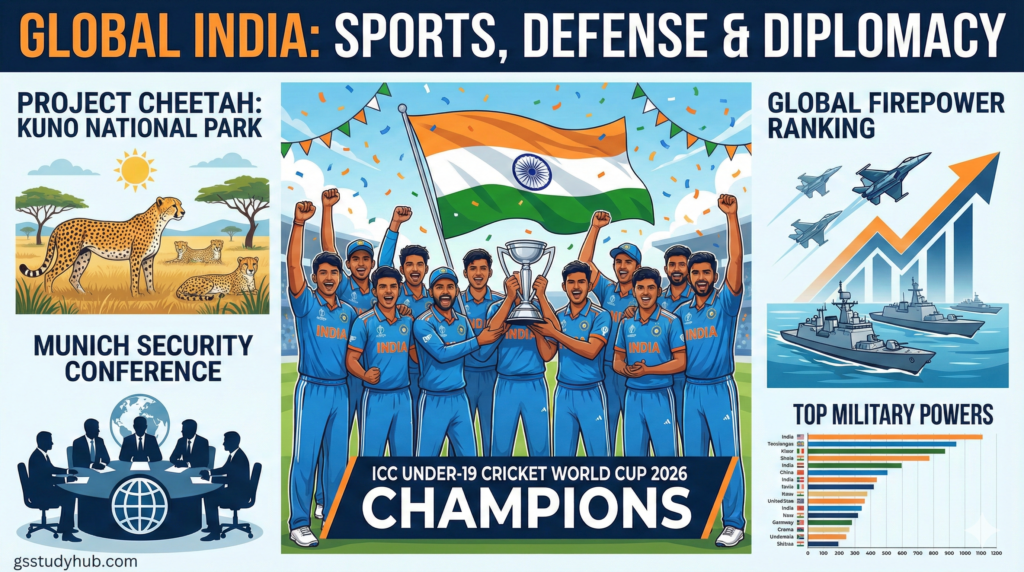
1. How did India secure its sixth ICC Under-19 Cricket World Cup title in 2026, and why is it important for future cricket development?
India defeated England by 100 runs in the ICC Under-19 Cricket World Cup 2026 final held in February 2026.
This victory marked India’s sixth U-19 title, showcasing strong grassroots cricket infrastructure.
The consistent success reflects effective talent identification and youth development programs.
भारत ने फरवरी 2026 में आयोजित ICC अंडर-19 क्रिकेट विश्व कप के फाइनल में इंग्लैंड को 100 रन से हराया।
यह भारत का छठा खिताब है, जो मजबूत जमीनी क्रिकेट ढांचे को दर्शाता है।
लगातार सफलता युवा खिलाड़ियों की पहचान और प्रशिक्षण प्रणाली की मजबूती को प्रदर्शित करती है।
2. What does India’s 4th rank in the Global Firepower Index 2026 indicate about its military strength and strategic capabilities?
India ranked 4th in the Global Firepower Index 2026 after the USA, Russia and China.
The ranking evaluates defence budget, manpower, air power, naval strength and logistics.
India’s growing indigenous defence production contributed to this position.
ग्लोबल फायर पावर इंडेक्स 2026 में भारत चौथे स्थान पर रहा, जबकि अमेरिका, रूस और चीन शीर्ष पर रहे।
रैंकिंग रक्षा बजट, सैन्य क्षमता और लॉजिस्टिक शक्ति पर आधारित होती है।
स्वदेशी रक्षा उत्पादन में वृद्धि ने इस स्थिति को मजबूत किया है।
3. How does the expansion of Project Cheetah strengthen India’s wildlife conservation efforts in 2026?
India plans to relocate 8 cheetahs from Botswana to Kuno National Park.
The initiative aims to restore ecological balance and revive grassland ecosystems.
This project reflects India’s commitment to biodiversity conservation.
भारत बोत्सवाना से 8 चीते लाकर मध्य प्रदेश के कुनो राष्ट्रीय उद्यान में छोड़ेगा।
इस पहल का उद्देश्य पारिस्थितिक संतुलन को पुनर्स्थापित करना है।
यह परियोजना जैव विविधता संरक्षण के प्रति भारत की प्रतिबद्धता को दर्शाती है।
4. Why is World Pulses Day observed on 10 February, and how does it support sustainable agriculture?
World Pulses Day is observed annually on 10 February to promote nutrition and food security.
Pulses improve soil fertility and provide essential protein.
India remains one of the largest producers and consumers of pulses.
विश्व दलहन दिवस 10 फरवरी को मनाया जाता है ताकि पोषण और खाद्य सुरक्षा को बढ़ावा दिया जा सके।
दलहन मिट्टी की उर्वरता बढ़ाते हैं और प्रोटीन का प्रमुख स्रोत हैं।
भारत दलहन का प्रमुख उत्पादक और उपभोक्ता देश है।
5. What does the Global R&D Spending Report 2026 reveal about shifting innovation leadership?
Global R&D expenditure reached 2.87 trillion USD, according to recent reports.
China surpassed the USA in total R&D investment.
Asia now contributes more than 45% to global innovation spending.
हालिया रिपोर्ट के अनुसार वैश्विक R&D खर्च 2.87 ट्रिलियन डॉलर तक पहुँचा।
कुल निवेश में चीन ने अमेरिका को पीछे छोड़ दिया।
वैश्विक नवाचार में एशिया का योगदान 45% से अधिक हो गया है।
6. How will the expansion of the Banglar Yuva Saathi Scheme in 2026 support unemployed youth in West Bengal?
The Government of West Bengal expanded the Banglar Yuva Saathi Scheme to provide financial assistance to unemployed youth.
Eligible beneficiaries aged 21 to 40 years receive 1,500 per month.
The scheme aims to support skill development and competitive exam preparation.
पश्चिम बंगाल सरकार ने बांग्लार युवा साथी योजना का विस्तार किया है।
21 से 40 वर्ष के पात्र युवाओं को प्रतिमाह ₹1500 की सहायता दी जाती है।
इस योजना का उद्देश्य कौशल विकास और प्रतियोगी परीक्षा की तैयारी में सहयोग देना है।
7. What is the significance of government approval for the Sawalkot Hydroelectric Project in 2026?
The Government approved the Sawalkot Hydroelectric Project on the Chenab River in Jammu & Kashmir.
The project has an estimated capacity of around 1856 MW.
It will strengthen India’s renewable energy and power infrastructure.
केंद्र सरकार ने जम्मू-कश्मीर में चिनाब नदी पर सावलकोट जलविद्युत परियोजना को मंजूरी दी।
इसकी अनुमानित क्षमता लगभग 1856 मेगावाट है।
यह परियोजना देश की अक्षय ऊर्जा क्षमता को मजबूत करेगी।
8. Why is the 62nd Munich Security Conference 2026 important for global diplomacy and security dialogue?
The 62nd Munich Security Conference will be held in Germany from 13–15 February 2026.
Global leaders will discuss international security, geopolitical tensions and defence cooperation.
India is expected to highlight its Indo-Pacific strategy.
62वाँ म्यूनिख सुरक्षा सम्मेलन 13–15 फरवरी 2026 को जर्मनी में आयोजित होगा।
इसमें वैश्विक सुरक्षा और भू-राजनीतिक मुद्दों पर चर्चा होगी।
भारत इंडो-पैसिफिक रणनीति पर अपने विचार प्रस्तुत करेगा।
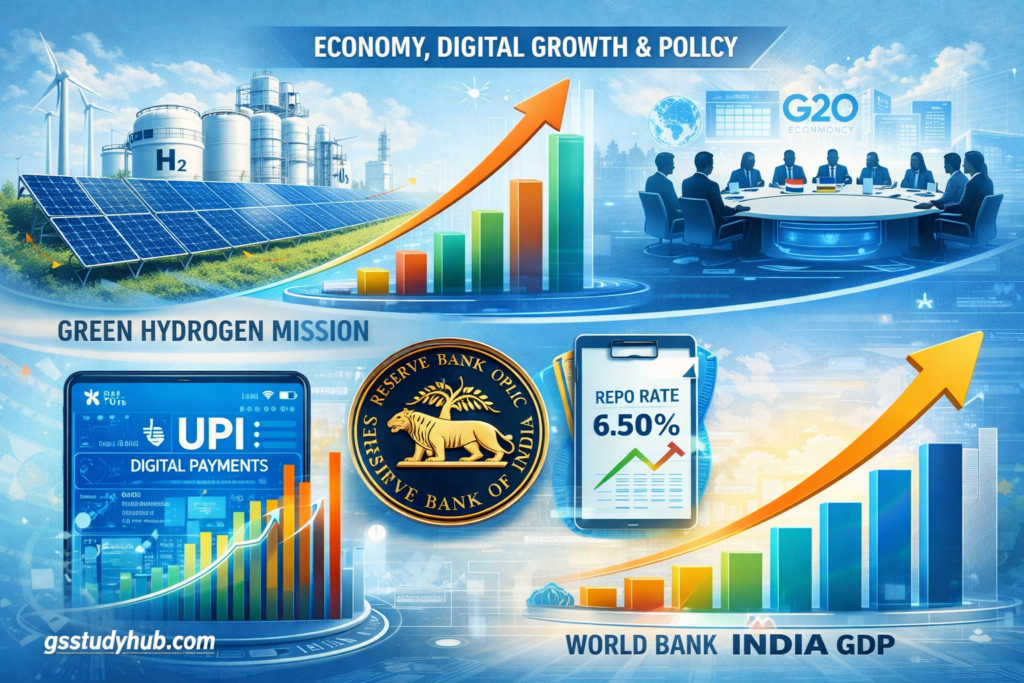
9. How does India’s Green Hydrogen Mission aim to transform clean energy production by 2026?
India targets 5 million metric tons of green hydrogen production annually.
The policy encourages private investment and export opportunities.
This mission supports carbon neutrality and energy transition goals.
भारत ने हरित हाइड्रोजन उत्पादन का वार्षिक लक्ष्य 5 मिलियन टन रखा है।
नई नीति निजी निवेश और निर्यात को प्रोत्साहित करती है।
यह पहल कार्बन उत्सर्जन में कमी और स्वच्छ ऊर्जा संक्रमण को बढ़ावा देती है।
10. What does the record growth in India’s digital payment transactions in January 2026 indicate about its fintech revolution?
Digital transactions crossed ₹20 lakh crore in January 2026.
UPI processed more than 15 billion transactions in a single month.
India has become one of the fastest-growing digital payment ecosystems globally.
जनवरी 2026 में डिजिटल लेनदेन ₹20 लाख करोड़ से अधिक दर्ज किया गया।
UPI के माध्यम से 15 अरब से अधिक ट्रांजैक्शन हुए।
भारत विश्व के सबसे तेजी से बढ़ते डिजिटल भुगतान बाजारों में शामिल है।
Why is Daily Current Affairs 10 February 2026 Important for UPSC & SSC Exams?
11. How did India host the G20 Digital Economy Working Group Meeting in 2026, and what were its major focus areas?
India hosted the G20 Digital Economy Working Group meeting in February 2026.
The discussions focused on Digital Public Infrastructure, cybersecurity and data governance.
India showcased its UPI and Aadhaar models as global digital solutions.
भारत ने फरवरी 2026 में G20 डिजिटल इकोनॉमी वर्किंग ग्रुप की बैठक की मेजबानी की।
बैठक में डिजिटल पब्लिक इंफ्रास्ट्रक्चर, साइबर सुरक्षा और डेटा गवर्नेंस पर चर्चा हुई।
भारत ने UPI और आधार मॉडल को वैश्विक समाधान के रूप में प्रस्तुत किया।
12. What is the importance of ISRO’s latest communication satellite launch in strengthening India’s space capabilities?
ISRO successfully launched a new communication satellite from Sriharikota in 2026.
The satellite aims to enhance broadband and digital connectivity in remote regions.
This mission strengthens India’s self-reliance in space technology.
ISRO ने 2026 में श्रीहरिकोटा से नया संचार उपग्रह सफलतापूर्वक प्रक्षेपित किया।
यह उपग्रह दूरदराज क्षेत्रों में डिजिटल कनेक्टिविटी को मजबूत करेगा।
यह मिशन भारत की अंतरिक्ष आत्मनिर्भरता को सशक्त करता है।
13. How does the joint naval exercise’ Varuna 2026′ enhance India-France strategic maritime cooperation?
India and France conducted the joint naval exercise’ Varuna 2026′ in the Indian Ocean region.
The drill included anti-submarine warfare, air defence,e and maritime security operations.
This strengthens Indo-Pacific strategic cooperation.
भारत और फ्रांस ने हिंद महासागर क्षेत्र में ‘वरुण 2026’ नौसैनिक अभ्यास आयोजित किया।
इसमें पनडुब्बी रोधी युद्धाभ्यास और समुद्री सुरक्षा अभ्यास शामिल थे।
यह इंडो-पैसिफिक क्षेत्र में सामरिक सहयोग को मजबूत करता है।
14. Why did the Reserve Bank of India keep the repo rate unchanged in February 2026, and what does it indicate?
The RBI maintained the repo rate at 6.50% in its February 2026 monetary policy review.
This decision was taken to balance inflation control and economic growth.
Retail inflation remained within the target range.
RBI ने फरवरी 2026 की मौद्रिक नीति में रेपो दर 6.50% पर स्थिर रखी।
यह निर्णय महंगाई नियंत्रण और आर्थिक विकास के संतुलन हेतु लिया गया।
खुदरा महंगाई दर लक्ष्य सीमा के भीतर रही।
15. How will the new National Sports Policy 2026 strengthen India’s preparation for upcoming international competitions?
India introduced a new National Sports Policy in 202,6 focusing on infrastructure and athlete support.
The policy includes setting u1,00000 new training centres in rural areas.
It aims to improve performance in the Asian and Olympic Games.
भारत ने 2026 में नई राष्ट्रीय खेल नीति लागू की।
इसमें ग्रामीण क्षेत्रों में 1000 नए प्रशिक्षण केंद्र स्थापित करने की योजना है।
इसका उद्देश्य एशियाई और ओलंपिक खेलों में बेहतर प्रदर्शन करना है।
16. What does the World Bank’s 6.8% GDP growth projection for India in FY 2026–27 indicate about its economic resilience?
The World Bank projected India’s GDP growth at 6.8% for FY 2026–27.
The report highlighted infrastructure investment, manufacturing expansion and digital economy growth.
India remains one of the fastest-growing major economies globally.
विश्व बैंक ने वित्त वर्ष 2026–27 के लिए भारत की GDP वृद्धि दर 6.8% अनुमानित की।
रिपोर्ट में अवसंरचना निवेश, विनिर्माण विस्तार और डिजिटल अर्थव्यवस्था को प्रमुख कारण बताया गया।
भारत विश्व की सबसे तेज़ी से बढ़ती प्रमुख अर्थव्यवस्थाओं में शामिल है।
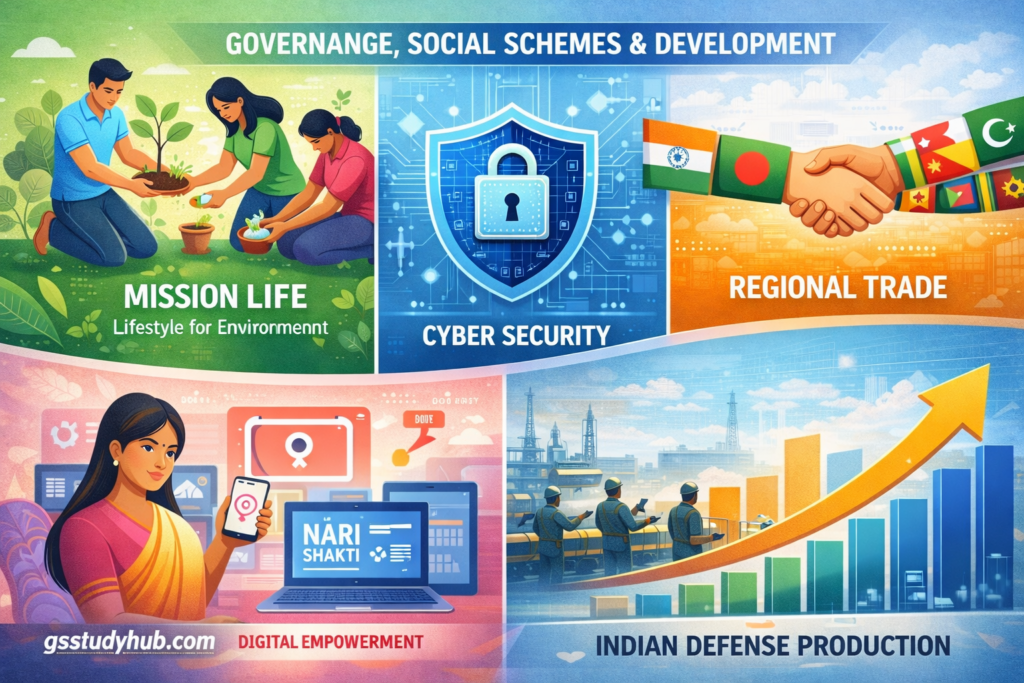
17. How does India’s Mission LiFE campaign promote sustainable lifestyle and environmental responsibility in 2026?
Mission LiFE (Lifestyle for Environment) encourages citizens to adopt eco-friendly habits.
The campaign focuses on reducing plastic use, conserving water, and promoting tree planting.
It aligns with the global Sustainable Development Goals (SDGs).
मिशन लाइफ नागरिकों को पर्यावरण अनुकूल जीवनशैली अपनाने के लिए प्रेरित करता है।
इसमें प्लास्टिक के उपयोग में कमी, जल संरक्षण और वृक्षारोपण पर बल दिया गया है।
यह सतत विकास लक्ष्यों के अनुरूप है।
18. Why is the National Cyber Security Strategy 2026 crucial for protecting India’s digital infrastructure?
India released the National Cyber Security Strategy 2026 to address rising cyber threats.
The framework strengthens protection of critical infrastructure and sensitive data.
It mandates stronger cybersecurity standards for the public and private sectors.
भारत ने बढ़ते साइबर खतरों को देखते हुए राष्ट्रीय साइबर सुरक्षा रणनीति 2026 जारी की।
यह महत्वपूर्ण अवसंरचना और संवेदनशील डेटा की सुरक्षा को मजबूत करती है।
सरकारी और निजी संस्थानों के लिए सुरक्षा मानक निर्धारित किए गए हैं।
19. How will India’s new regional trade initiative strengthen South Asian economic cooperation?
India announced a new regional trade initiative to boost South Asian economic ties.
The plan includes customs relaxation and digital trade facilitation.
This step supports India’s “Neighbourhood First” policy.
भारत ने दक्षिण एशियाई आर्थिक सहयोग बढ़ाने के लिए नई व्यापार पहल की घोषणा की।
इसमें सीमा शुल्क रियायत और डिजिटल व्यापार सुविधा शामिल है।
यह ‘पड़ोसी प्रथम’ नीति को सशक्त करता है।
20. What does the record surge in electric vehicle sales in January 2026 reveal about India’s green mobility transition?
India recorded over 1.8 lakh electric vehicle sales in January 2026.
Government subsidies and the expansion of charging infrastructure supported this growth.
The rise indicates rapid adoption of clean transportation.
जनवरी 2026 में भारत में 1.8 लाख से अधिक इलेक्ट्रिक वाहनों की बिक्री दर्ज की गई।
सरकारी सब्सिडी और चार्जिंग इंफ्रास्ट्रक्चर के विस्तार ने इस वृद्धि को बढ़ावा दिया।
यह स्वच्छ परिवहन की ओर तेजी से बढ़ते कदम को दर्शाता है।
21. How will the revised Agricultural Export Policy 2026 strengthen India’s global agri-trade position?
The Government revised the Agricultural Export Policy to boost exports of rice, spices and dairy products.
The policy focuses on logistics improvement and quality certification standards.
India aims to reach 55 billion USD in agricultural exports during 2025–26.
केंद्र सरकार ने कृषि निर्यात नीति में संशोधन कर चावल, मसाले और दुग्ध उत्पादों के निर्यात को बढ़ावा दिया।
नीति में लॉजिस्टिक्स सुधार और गुणवत्ता प्रमाणन पर जोर दिया गया है।
2025–26 में कृषि निर्यात को 55 बिलियन डॉलर तक पहुँचाने का लक्ष्य रखा गया है।
22. What does the progress report of the National Education Policy implementation reveal about education reforms in India?
The Ministry of Education released a progress report on NEP 2020 implementation in 2026.
More than 60% of higher education institutions adopted multidisciplinary curriculum structures.
The reform emphasizes digital learning and skill-based education.
शिक्षा मंत्रालय ने 2026 में राष्ट्रीय शिक्षा नीति के क्रियान्वयन की प्रगति रिपोर्ट जारी की।
60% से अधिक उच्च शिक्षा संस्थानों ने बहु-विषयक पाठ्यक्रम अपनाया।
सुधारों में डिजिटल शिक्षा और कौशल आधारित प्रशिक्षण पर जोर दिया गया है।
23. How does the expansion of the One District One Product (ODOP) scheme promote local industries and exports?
The ODOP scheme has been expanded to cover over 750 districts across India.
It promotes unique local products and provides marketing and financial support.
The initiative strengthens MSMEs and rural entrepreneurship.
‘एक जिला एक उत्पाद’ योजना को 750 से अधिक जिलों तक विस्तारित किया गया है।
यह योजना स्थानीय विशिष्ट उत्पादों को विपणन और वित्तीय सहायता प्रदान करती है।
यह पहल MSME और ग्रामीण उद्यमिता को मजबूत करती है।
24. How will the launch of the Nari Shakti Portal enhance women’s empowerment through digital integration?
The Ministry of Women and Child Development launched the Nari Shakti Portal in 2026.
The portal integrates various schemes related to women safety, education and employment.
It aims to connect nearly 2 crore women digitally.
महिला एवं बाल विकास मंत्रालय ने 2026 में ‘नारी शक्ति पोर्टल’ लॉन्च किया।
यह पोर्टल महिला सुरक्षा, शिक्षा और रोजगार योजनाओं को एकीकृत करता है।
लगभग 2 करोड़ महिलाओं को डिजिटल रूप से जोड़ने का लक्ष्य रखा गया है।
25. What does India crossing ₹1 lakh crore defense production mark indicate about self-reliance in defense sector?
India’s defence production crossed ₹1 lakh crore in 2025–26.
Indigenous manufacturing and export growth contributed significantly. Government aims to reach ₹25,000 crore in defence exports by 2028.
2025–26 में भारत का रक्षा उत्पादन ₹1 लाख करोड़ से अधिक हो गया।
स्वदेशी निर्माण और निर्यात वृद्धि ने इसमें महत्वपूर्ण योगदान दिया।
2028 तक रक्षा निर्यात को ₹25,000 करोड़ तक पहुँचाने का लक्ष्य रखा गया है।
26. What does India crossing 1.5 lakh registered startups in 2026 indicate about its growing innovation ecosystem?
India crossed 1.5 lakh registered startups as per DPIIT data in 2026.
Government incentives, tax benefits and funding support boosted entrepreneurship.
India is now among the top startup ecosystems globally.
DPIIT के अनुसार 2026 तक भारत में 1.5 लाख से अधिक स्टार्टअप पंजीकृत हुए।
सरकारी प्रोत्साहन, कर छूट और फंडिंग सहायता से उद्यमिता को बढ़ावा मिला।
भारत वैश्विक स्टार्टअप पारिस्थितिकी तंत्र में अग्रणी देशों में शामिल हो गया है।
27. How does the successful sea trial of India’s indigenous destroyer strengthen naval defence capabilities?
The Indian Navy completed sea trials of an indigenous advanced destroyer.
The warship is equipped with modern missile systems and radar technology.
This enhances India’s maritime security and self-reliance in defence.
भारतीय नौसेना ने स्वदेशी उन्नत विध्वंसक पोत का सफल समुद्री परीक्षण पूरा किया।
यह पोत आधुनिक मिसाइल और रडार प्रणाली से सुसज्जित है।
यह समुद्री सुरक्षा और रक्षा आत्मनिर्भरता को मजबूत करता है।
28. What is the objective of the National Water Mission 2.0, launched in 2026, for water conservation?
The Ministry of Jal Shakti launched National Water Mission 2.0.
The program focuses on groundwater recharge and rainwater harvesting.
Over 500 water-stressed districts will benefit from this initiative.
जल शक्ति मंत्रालय ने राष्ट्रीय जल मिशन 2.0 की शुरुआत की।
यह कार्यक्रम भूजल संरक्षण और वर्षा जल संचयन पर केंद्रित है।
500 से अधिक जलसंकटग्रस्त जिलों को इसका लाभ मिलेगा।
29. How has India’s tourism sector recovered beyond pre-pandemic levels in early 2026?
India recorded a 15% increase in foreign tourist arrivals in early 2026.
Tourism revenue surpassed pre-pandemic levels.
Improved infrastructure and global promotion campaigns supported growth.
2026 की शुरुआत में भारत में विदेशी पर्यटकों की संख्या में 15% वृद्धि दर्ज की गई।
पर्यटन से होने वाली आय पूर्व-कोविड स्तर से अधिक हो गई।
बेहतर अवसंरचना और वैश्विक प्रचार अभियान से वृद्धि संभव हुई।
30. How will the establishment of new AI Excellence Centres boost India’s role in the Fourth Industrial Revolution?
India announced the establishment of 10 new AI Centres of Excellence.
The centres will focus on healthcare, agriculture and defence applications.
This strengthens India’s position in advanced technologies and innovation.
भारत ने 10 नए AI उत्कृष्टता केंद्र स्थापित करने की घोषणा की।
ये केंद्र स्वास्थ्य, कृषि और रक्षा क्षेत्र में AI समाधान विकसित करेंगे।
यह चौथी औद्योगिक क्रांति में भारत की भूमिका को मजबूत करता है।
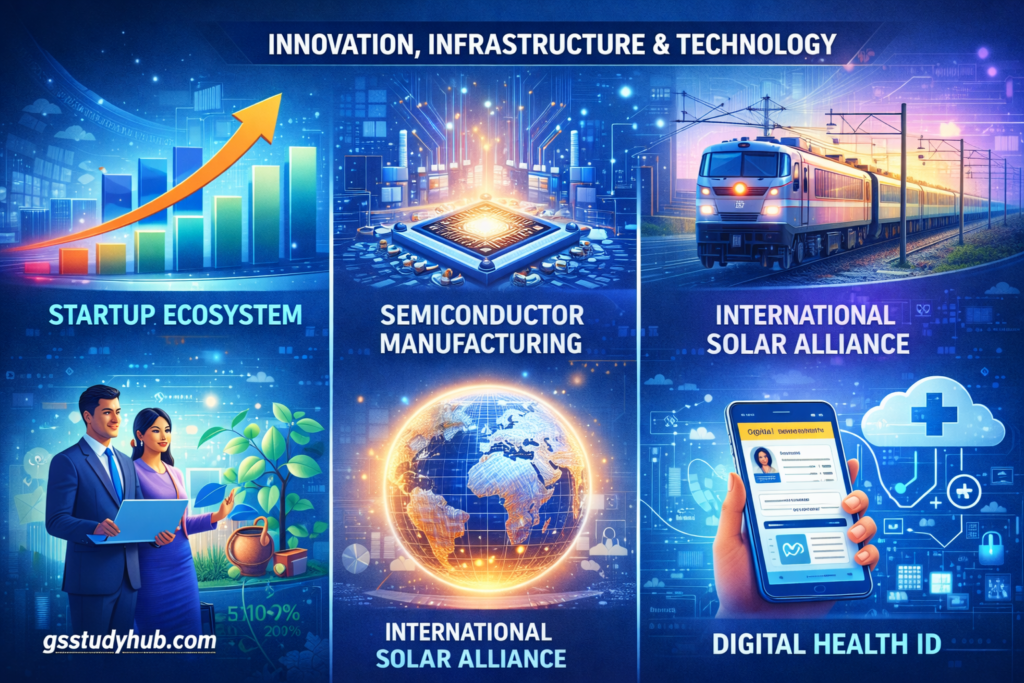
31. How will the new multi-modal connectivity initiatives under the National Logistics Policy reduce India’s logistics?
The Government strengthened multi-modal connectivity by integrating road, rail, air, and waterways.
The objective is to reduce logistics cost from 13–14% of GDP to around 8–9%.
This reform will improve export competitiveness and supply chain efficiency.
राष्ट्रीय लॉजिस्टिक्स नीति के तहत सड़क, रेल, वायु और जलमार्ग को एकीकृत किया जा रहा है।
लॉजिस्टिक्स लागत को GDP के 13–14% से घटाकर 8–9% तक लाने का लक्ष्य है।
यह कदम निर्यात प्रतिस्पर्धा और आपूर्ति श्रृंखला दक्षता को बढ़ाएगा।
32. What is the significance of India approving a new semiconductor manufacturing unit in 2026?
India approved a new semiconductor manufacturing unit under the Make in India initiative.
The project will boost chip production and reduce dependence on imports.
It is expected to generate thousands of direct and indirect jobs.
भारत ने ‘मेक इन इंडिया’ पहल के तहत नई सेमीकंडक्टर निर्माण इकाई को मंजूरी दी।
इससे चिप उत्पादन बढ़ेगा और आयात पर निर्भरता कम होगी।
इस परियोजना से हजारों रोजगार सृजित होने की संभावना है।
33. How does the expansion of International Solar Alliance membership support global clean energy goals?
The International Solar Alliance added new member countries in 2026.
More than 120 nations are now part of this solar energy initiative.
The alliance promotes a global transition toward renewable energy.
अंतरराष्ट्रीय सौर गठबंधन में 2026 में नए सदस्य देश शामिल हुए।
अब 120 से अधिक देश इस पहल का हिस्सा बन चुके हैं।
यह गठबंधन वैश्विक स्तर पर स्वच्छ ऊर्जा संक्रमण को बढ़ावा देता है।
34. How is Indian Railways nearing its 100% electrification target, and what are its environmental benefits?
Indian Railways achieved over 95% route electrification by early 2026.
Electrification reduces diesel consumption and carbon emissions.
This step supports India’s green transport commitment.
2026 की शुरुआत तक भारतीय रेलवे ने 95% से अधिक मार्गों का विद्युतीकरण पूरा किया।
इससे डीजल खपत और कार्बन उत्सर्जन में कमी आई है।
यह हरित परिवहन लक्ष्य की दिशा में महत्वपूर्ण कदम है।
35. How will the expansion of Digital Health ID under the National Digital Health Mission improve healthcare delivery?
India expanded Digital Health ID coverage under the National Digital Health Mission.
More than 50 crore citizens received digital health IDs.
This enables seamless access to medical records and healthcare services.
राष्ट्रीय डिजिटल स्वास्थ्य मिशन के तहत डिजिटल हेल्थ आईडी का विस्तार किया गया।
50 करोड़ से अधिक नागरिकों को डिजिटल स्वास्थ्य आईडी जारी की गई।
इससे स्वास्थ्य सेवाओं और मेडिकल रिकॉर्ड तक आसान पहुंच संभव होगी।
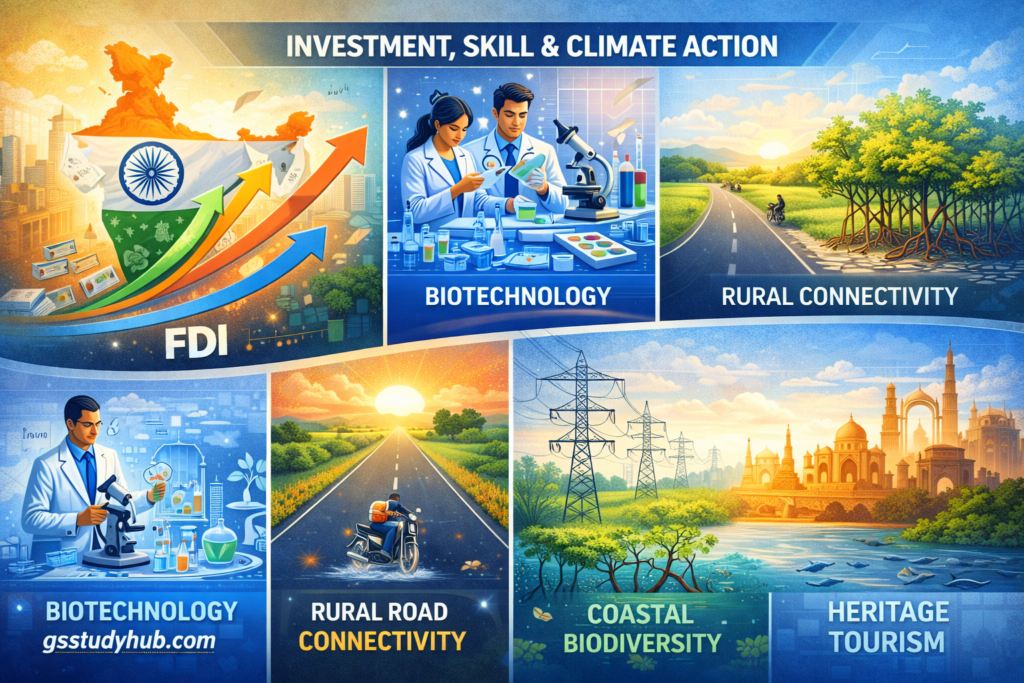
36. What does the 12% rise in Foreign Direct Investment (FDI) inflows indicate about India’s global investment appeal?
India recorded a 12% increase in FDI inflows during the third quarter of FY 2025–26.
Major investments were made in the services, manufacturing, and information technology sectors.
This reflects growing investor confidence in India’s economic stability.
वित्त वर्ष 2025–26 की तीसरी तिमाही में भारत में FDI प्रवाह में 12% की वृद्धि दर्ज की गई।
सेवा, विनिर्माण और आईटी क्षेत्रों में प्रमुख निवेश हुआ।
यह भारत की आर्थिक स्थिरता पर बढ़ते वैश्विक भरोसे को दर्शाता है।
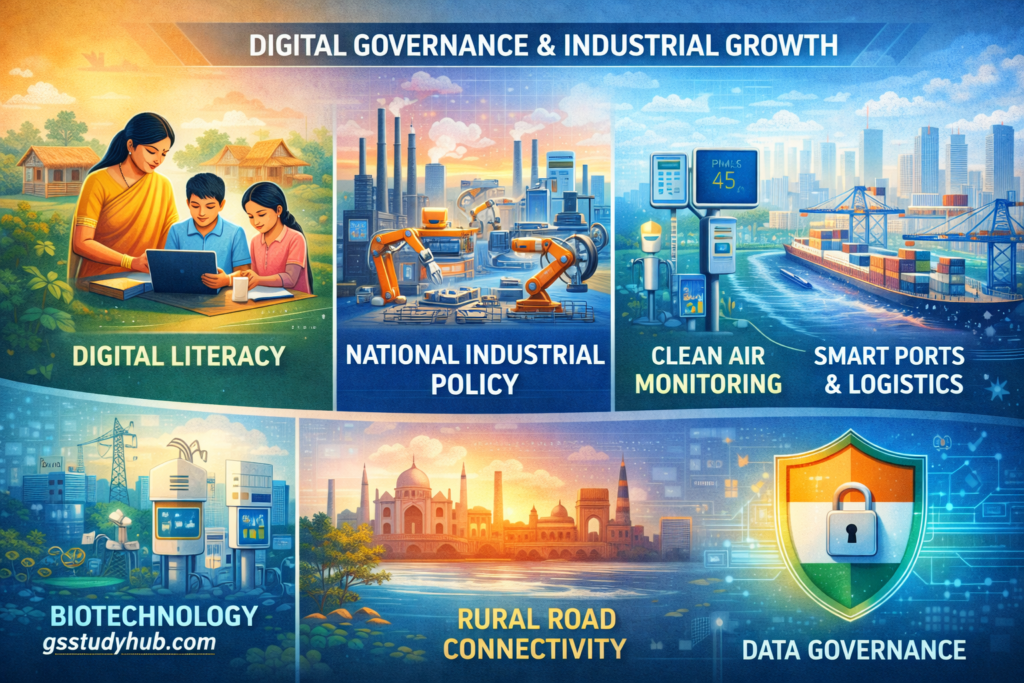
37. How will the new biotechnology funding scheme boost research in India?
The Government introduced a new biotechnology funding scheme in 2026.
The program provides grants to research institutions and biotech startups.
It aims to strengthen healthcare, agriculture and industrial biotechnology sectors.
सरकार ने 2026 में नई जैव-प्रौद्योगिकी फंडिंग योजना शुरू की।
इस योजना के तहत शोध संस्थानों और स्टार्टअप को अनुदान दिया जाएगा।
यह स्वास्थ्य, कृषि और औद्योगिक जैव-प्रौद्योगिकी को मजबूत करेगी।
38. How will the construction of 10,000 km rural roads under PMGSY improve rural connectivity?
The government announced construction of 10,000 km additional rural roads under PMGSY.
The initiative aims to connect remote villages to markets and urban centers.
Improved connectivity will boost rural economy and employment opportunities.
प्रधानमंत्री ग्राम सड़क योजना के तहत 10,000 किमी अतिरिक्त ग्रामीण सड़कों के निर्माण की घोषणा की गई।
इससे दूरस्थ गांवों को बाजार और शहरों से जोड़ा जाएगा।
बेहतर कनेक्टिविटी ग्रामीण अर्थव्यवस्था और रोजगार को बढ़ावा देगी।
39. Why is the new coastal regulation policy important for marine biodiversity conservation?
India introduced a revised coastal regulation policy to protect marine ecosystems.
The policy emphasises mangrove conservation and pollution control.
It promotes sustainable fishing and coastal development practices.
भारत ने समुद्री पारिस्थितिकी तंत्र की रक्षा हेतु नई तटीय विनियमन नीति लागू की।
इसमें मैंग्रोव संरक्षण और प्रदूषण नियंत्रण पर जोर दिया गया है।
यह सतत मत्स्य पालन और तटीय विकास को बढ़ावा देती है।
40. How will the National Skill Development Mission’s target of training 1 crore youth by 20Government employability?
The Government aims to train 1 crore youth under the National Skill Development Mission by 2026.
The focus areas include digital skills, green energy and manufacturing technologies.
This initiative will improve employability and productivity across sectors.
राष्ट्रीय कौशल विकास मिशन के तहत 2026 तक 1 करोड़ युवाओं को प्रशिक्षित करने का लक्ष्य रखा गया है।
डिजिटल कौशल, हरित ऊर्जा और विनिर्माण तकनीक पर विशेष ध्यान दिया जाएगा।
यह पहल रोजगार क्षमता और उत्पादकता को बढ़ाएगी।
41. How will Phase II of the Green Energy Corridor project accelerate India’s renewable energy transition?
The government approved Phase II of the Green Energy Corridor project in 2026.
The project aims to integrate 20 GW of additional renewable energy into the national grid.
This strengthens India’s commitment to achieving 500 GW renewable capacity by 2030.
सरकार ने 2026 में ग्रीन एनर्जी कॉरिडोर परियोजना के दूसरे चरण को मंजूरी दी।
इसका लक्ष्य 20 गीगावाट अतिरिक्त नवीकरणीय ऊर्जा को राष्ट्रीय ग्रिड से जोड़ना है।
यह 2030 तक 500 गीगावाट नवीकरणीय क्षमता के लक्ष्य को मजबूत करता है।
42. How does the expansion of Agri-Stack under the Digital Agriculture Mission benefit Indian farmers?
The Ministry of Agriculture expanded the Agri-Stack platform under Digital Agriculture Mission.
The platform provides crop insurance, credit access and real-time market information.
This improves transparency and income opportunities for farmers.
कृषि मंत्रालय ने डिजिटल कृषि मिशन के तहत एग्री-स्टैक प्लेटफॉर्म का विस्तार किया।
यह प्लेटफॉर्म फसल बीमा, ऋण और बाजार जानकारी उपलब्ध कराता है।
इससे किसानों की आय और पारदर्शिता में सुधार होगा।
43. Why is the National Space Policy 2026 significant for private sector participation in India’s space economy?
India introduced new guidelines under National Space Policy 2026.
The policy encourages private sector involvement in satellite manufacturing and launch services.
This move aims to expand India’s share in the global space economy.
राष्ट्रीय अंतरिक्ष नीति 2026 के तहत निजी क्षेत्र की भागीदारी को बढ़ावा दिया गया।
उपग्रह निर्माण और प्रक्षेपण सेवाओं में निजी कंपनियों को अवसर मिलेंगे।
यह कदम वैश्विक अंतरिक्ष अर्थव्यवस्था में भारत की हिस्सेदारी बढ़ाएगा।
44. How will the development of new Heritage Circuits under the National Tourism Policy boost India’s cultural tourism?
The Ministry of Tourism announced plans to develop new Heritage Circuits in 2026.
Fifty major cultural and historical destinations will be upgraded.
This initiative is expected to increase tourism revenue and employment.
राष्ट्रीय पर्यटन नीति के तहत नए हेरिटेज सर्किट विकसित करने की घोषणा की गई।
50 प्रमुख सांस्कृतिक और ऐतिहासिक स्थलों का उन्नयन किया जाएगा।
इससे पर्यटन आय और रोजगार में वृद्धि होगी।
45. What is the objective of establishing a Climate Adaptation Fund in 2026?
The Government announced a Climate Change Adaptation Fund to support vulnerable regions.
Funds will be allocated for coastal protection and drought management projects.
This initiative strengthens resilience against climate risks.
सरकार ने जलवायु परिवर्तन अनुकूलन कोष स्थापित करने की घोषणा की।
तटीय संरक्षण और सूखा प्रबंधन परियोजनाओं को वित्तीय सहायता दी जाएगी।
यह पहल जलवायु जोखिमों के प्रति लचीलापन बढ़ाती है।
46. How will the Digital Literacy Campaign targeting 5 crore citizens strengthen India’s digital inclusion?
The Ministry of Electronics and IT announced a Digital Literacy Campaign targeting 5 crore citizens by 2026.
The focus is on rural and backward regions to bridge the digital divide.
This initiative enhances access to e-governance and online services.
इलेक्ट्रॉनिक्स एवं आईटी मंत्रालय ने 2026 तक 5 करोड़ नागरिकों को प्रशिक्षित करने हेतु डिजिटल साक्षरता अभियान की घोषणा की।
इसका विशेष ध्यान ग्रामीण और पिछड़े क्षेत्रों पर रहेगा।
यह पहल ई-गवर्नेंस और ऑनलाइन सेवाओं तक पहुंच को मजबूत करेगी।
47. What are the key objectives of India’s new National Industrial Policy draft released in 2026?
The government released the draft of the new National Industrial Policy.
The policy emphasizes export promotion, MSME support and green manufacturing.
It aims to make India a global manufacturing hub.
सरकार ने नई राष्ट्रीय औद्योगिक नीति का मसौदा जारी किया।
नीति में निर्यात प्रोत्साहन, MSME समर्थन और हरित विनिर्माण पर जोर दिया गया है।
इसका उद्देश्य भारत को वैश्विक विनिर्माण केंद्र बनाना है।
48. How will strengthening air quality monitoring in 100 cities under NCAP improve public health outcomes?
Under the National Clean Air Programme (NCAP), air monitoring systems were upgraded in 100 cities.
The goal is to reduce PM2.5 levels by 20–30% by 2026.
This move supports long-term environmental sustainability and public health protection.
राष्ट्रीय स्वच्छ वायु कार्यक्रम के तहत 100 शहरों में वायु निगरानी प्रणाली को मजबूत किया गया।
2026 तक PM2.5 के स्तर में 20–30% की कमी का लक्ष्य रखा गया है।
यह कदम पर्यावरण संरक्षण और जनस्वास्थ्य सुधार में सहायक है।
49. How will India’s port modernisation plan under the new maritime policy enhance trade efficiency?
The Ministry of Ports launched a port modernisation initiative under the new maritime policy.
The plan includes smart port technologies and digital logistics systems.
This will improve cargo handling efficiency and export competitiveness.
नई समुद्री नीति के तहत बंदरगाह आधुनिकीकरण योजना शुरू की गई।
इसमें स्मार्ट पोर्ट तकनीक और डिजिटल लॉजिस्टिक्स प्रणाली शामिल हैं।
इससे माल ढुलाई दक्षता और निर्यात प्रतिस्पर्धा में वृद्धि होगी।
50. Why is the implementation of the National Data Governance Framework for India’s digital economy in 2026?
The Government implemented the National Data Governance Framework in 2026.
The framework sets standards for data protection, privacy and secure management.
It ensures transparency and strengthens trust in India’s digital ecosystem.
भारत सरकार ने 2026 में राष्ट्रीय डेटा गवर्नेंस ढांचा लागू किया।
इसमें डेटा सुरक्षा, गोपनीयता और सुरक्षित प्रबंधन के मानक निर्धारित किए गए।
यह डिजिटल अर्थव्यवस्था में पारदर्शिता और विश्वास को मजबूत करता है।
In summary, Daily Current Affairs 10 February 2026 provides a complete analysis of national and international developments. Regular reading of the Daily Current Affairs 10 February 2026 helps aspirants improve their exam preparation strategy.
FAQ – Daily Current Affairs 10 February 2026
What are the key topics covered in Daily Current Affairs 10 February 2026?
Daily Current Affairs 10 February 2026 includes defence updates, economic growth data, digital governance reforms and international developments.