
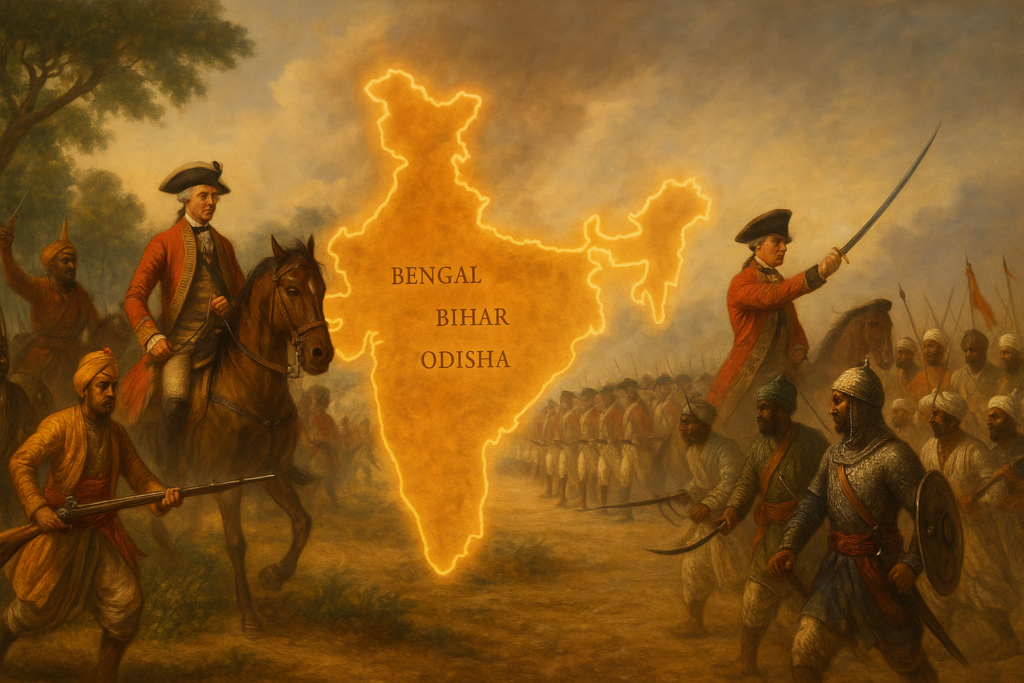
How did just two battles change the fate of India forever?
The Battles of Plassey (1757) and Buxar (1764) were not just wars—they marked the beginning of British rule in India.
In this article, you’ll learn their powerful effects on politics, economy, and society in a simple, exam-ready way.
The Battle of Plassey and Buxar
Battles of Plassey and Buxar: Decisive Battles in Indian History
The Battles of Plassey (1757) and Buxar (1764) were pivotal events in Indian history that accelerated the expansion of British power. As a result of these conflicts, the British gained control over Bengal, Bihar, and Odisha, laying the foundation of their political dominance in India.
Battle of Plassey (1757)
Place and Date
- Place: Plassey, present-day Nadia district, West Bengal
- Date: 23 June 1757
Parties to the War
British East India Company
- Commander: Robert Clive
- Troops: About 3,000 (900 Europeans and 2,100 Indians)
Siraj-ud-Daulah, Nawab of Bengal
- Commander: Nawab Siraj-ud-Daulah
- Troops: Nearly 50,000 (40,000 infantry, 10,000 cavalry, 50 cannons)
- Allies: French Army
Causes of the War
- Trade Disputes: Conflicts emerged over trading rights and taxes between the British and the Nawab.
- Fortification Issue: The British increased their military strength in Calcutta (Fort William), which Siraj-ud-Daulah viewed as a threat.
- ‘Black Hole of Calcutta’ Incident: Siraj-ud-Daulah attacked Calcutta, where many British prisoners reportedly died.
- British Conspiracy: The British secured the support of Mir Jafar, Jagat Seth, Umichand, and Rai Durlabh against the Nawab.
Result of the War
- Mir Jafar betrayed Siraj-ud-Daulah, leading to the Nawab’s defeat.
- The British gained control of Bengal and installed Mir Jafar as the new Nawab.
- The battle marked the beginning of British rule in India.
Top Rated Amazon Product
Trusted quality • Excellent performance • Great value for money
- ✔ 100% Genuine Product
- ✔ Fast & Secure Amazon Delivery
- ✔ Easy Return Policy
Battle of Buxar (1764)
Place and Date
- Place: Buxar, present-day Bihar
- Date: 22 October 1764
Parties to the War
British East India Company
- Commander: Hector Munro
- Troops: Around 7,000
Combined Indian Forces
- Mir Qasim, Nawab of Bengal
- Shuja-ud-Daula, Nawab of Awadh
- Mughal Emperor Shah Alam II
- Total Troops: Nearly 40,000
Causes of the War
- Conflict between Mir Qasim and the British: The British first installed Mir Jafar as Nawab, later replaced him with Mir Qasim. Mir Qasim resisted British interference.
- Trade and Tax Disputes: Mir Qasim ended the British privilege of tax-free trade and strengthened his army.
- Alliance Formation: Mir Qasim allied with Shah Alam II and Shuja-ud-Daula to challenge British authority.
Result of the War
- The British under Hector Munro defeated the combined Indian armies.
- Mir Qasim fled, and Shah Alam II surrendered to the British.
- The Treaty of Allahabad (1765) granted the British the Diwani rights (revenue collection) of Bengal, Bihar, and Odisha.
Effects of the Battles of Plassey and Buxar
- Establishment of British Rule: British authority became firmly rooted in Bengal and later spread across India.
- Decline of Mughal Power: The Mughal Emperor became a symbolic figure under British influence.
- Economic Exploitation: The British began draining Bengal’s wealth, weakening its economy.
- Administrative Control: The British gained administrative and military authority, paving the way for colonial rule.
Conclusion
The Battle of Plassey granted the British control over Bengal, while the Battle of Buxar strengthened their authority across northern India. These wars marked the beginning of British rule, which continued until the First War of Independence in 1857.
Battles of Plassey and Buxar
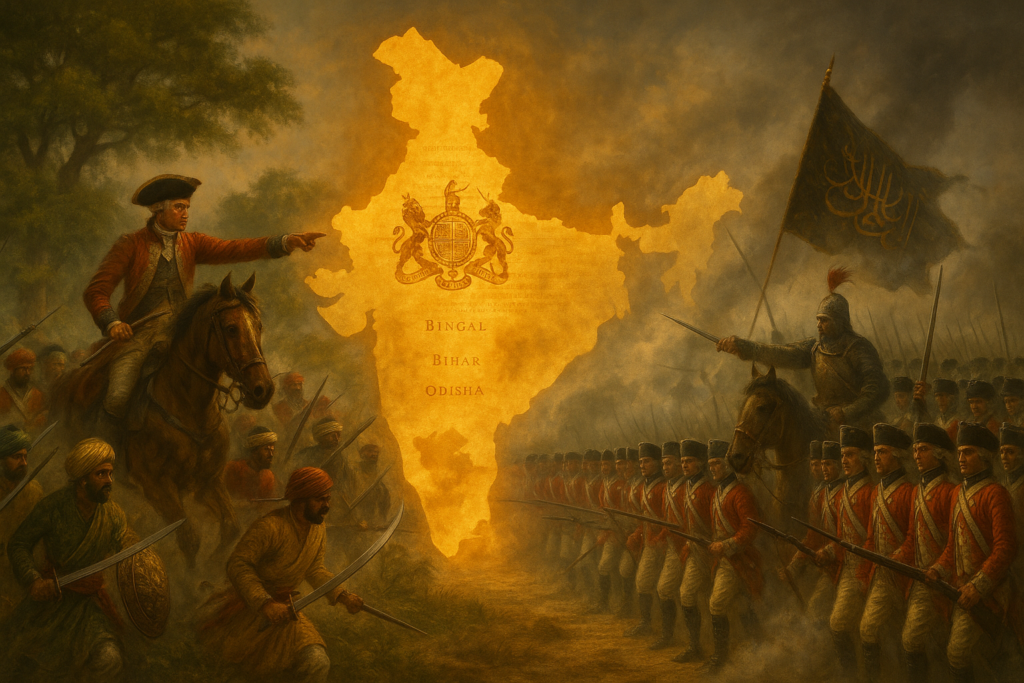
Battles of Plassey and Buxar: Decisive Battles in Indian History
In the History of India, the Battles of Plassey (1757) and Buxar (1764) were extremely important. As a result of these wars, the British East India Company strengthened its hold over Bengal and North India. These conflicts laid the foundation of British rule in India and expanded the company’s control over Indian administration.
Battle of Plassey (1757)
Location and Date
- Place: Plassey, Nadia district, West Bengal
- Date: 23 June 1757
Sides of the War
British East India Company
- Commander: Robert Clive
- Army: About 3,000 (900 European troops and 2,100 Indian soldiers)
Siraj-ud-Daulah, Nawab of Bengal
- Commander: Nawab Siraj-ud-Daulah
- Army: About 50,000 (40,000 infantry, 10,000 cavalry, and 50 cannons)
- Ally: French Army
Reasons for the War
- Trade Disputes: Conflicts escalated regarding trading rights. The British wanted tax-free trade, which the Nawab opposed.
- Fortification and Black Hole Incident: The British strengthened Fort William in Calcutta without permission. Siraj-ud-Daulah attacked and captured Calcutta in 1756. Many British prisoners died, an event known as the "Black Hole of Calcutta."
- British Conspiracy: The British gained the support of Mir Jafar, Jagat Seth, Rai Durlabh, and Umichand, weakening the Nawab’s strength.

Top Rated Amazon Product
Trusted quality • Excellent performance • Great value for money
- ✔ 100% Genuine Product
- ✔ Fast & Secure Amazon Delivery
- ✔ Easy Return Policy
Result of the War
- Mir Jafar did not support the Nawab’s army, leading to Siraj-ud-Daulah’s defeat.
- Siraj-ud-Daulah fled but was later captured and killed.
- The British installed Mir Jafar as the new Nawab of Bengal.
- This war marked the first major step toward establishing British rule in India.
Battle of Buxar (1764)
Location and Date
- Place: Buxar, present-day Bihar
- Date: 22 October 1764
Sides of the War
British East India Company
- Commander: Hector Munro
- Army: About 7,000 soldiers
Combined Indian Army
- Mir Qasim (Former Nawab of Bengal)
- Shuja-ud-Daula (Nawab of Awadh)
- Shah Alam II (Mughal Emperor)
- Total Army: About 40,000 soldiers
Reasons for the War
- Conflict Between Mir Qasim and the British: After Plassey, the British replaced Mir Jafar with Mir Qasim. Mir Qasim removed tax-free trade privileges and tried to rule independently. Later, the British reinstated Mir Jafar, angering Mir Qasim.
- Alliance of Indian Rulers: Mir Qasim took help from Shah Alam II and Shuja-ud-Daula to fight against the British.
Result of the War
- The British defeated the combined Indian forces.
- Mir Qasim fled; Shuja-ud-Daula surrendered; Shah Alam II came under British protection.
- The Treaty of Allahabad (1765) granted the British the Diwani rights (revenue collection) of Bengal, Bihar, and Odisha.
- This gave the British full economic and administrative power in India.
Effects of the Battles of Plassey and Buxar
- Establishment of British Rule: After Plassey, the British controlled Bengal; after Buxar, they gained dominance over northern India.
- Decline of Mughal Power: Shah Alam II became a nominal ruler under British supervision.
- Economic Exploitation: The British began extracting Bengal’s wealth, weakening the regional economy.
- Administrative Control: Following the Treaty of Allahabad, Bengal’s administration came under British authority, eventually extending across India.
Conclusion
The Battle of Plassey established the British foothold in Bengal, while the Battle of Buxar gave them real power across India. These wars strengthened British dominance, which lasted until 1857. They also laid the foundation for the Indian freedom struggle, marking the beginning of resistance against British rule.
Battle of Plassey
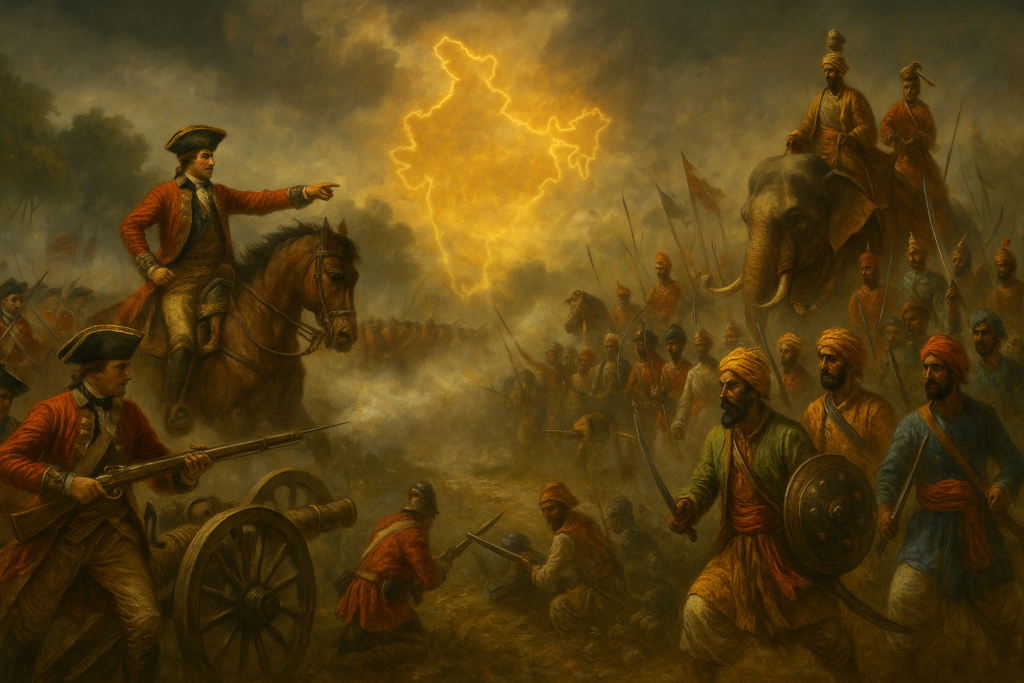
Battle of Plassey (1757) – A Detailed Study
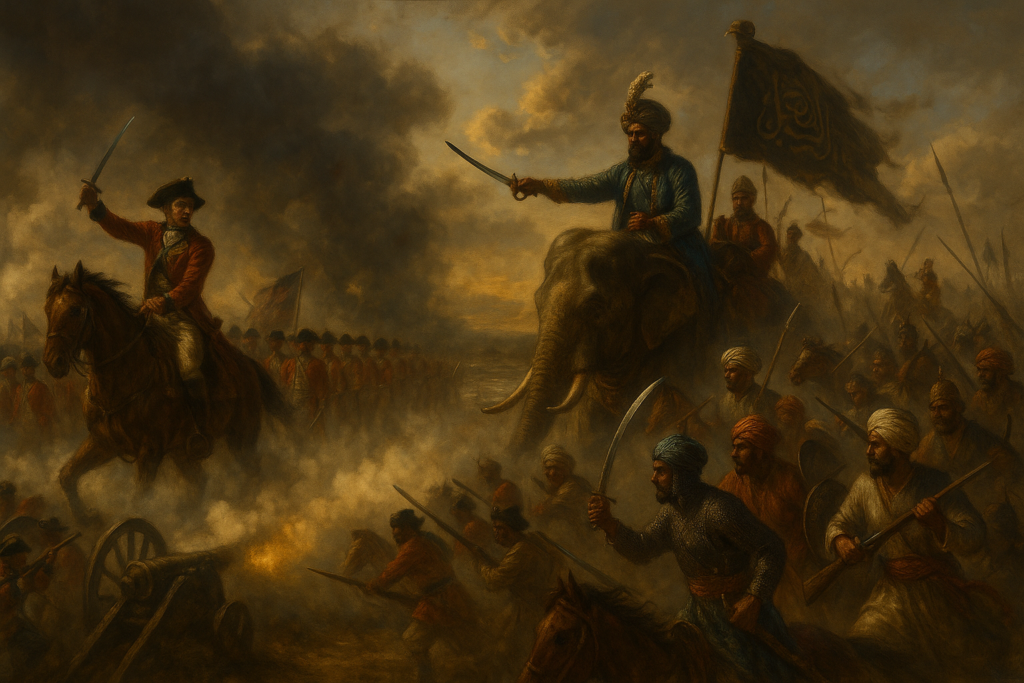
The Battle of Plassey, fought on 23 June 1757 between the British East India Company and the Nawab of Bengal, Siraj-ud-Daulah, proved to be a turning point in Indian History. This war gave the British an opportunity to control Bengal and laid the foundation of their political dominance in India.
Place and Time of the Battle
- Place: Plassey (present-day Nadia district of West Bengal, on the banks of the Hooghly River)
- Date: 23 June 1757
Sides of the War
1️⃣ British East India Company
- Leader: Robert Clive
- Army: About 3,000 soldiers
- 900 European soldiers
- 2,100 Indian sepoys
2️⃣ Siraj-ud-Daulah, Nawab of Bengal
- Leader: Siraj-ud-Daulah
- Army: About 50,000 soldiers
- 40,000 infantry
- 10,000 horsemen
- 50 cannons (with French cooperation)
Leadership of Bengal Army
- Mir Jafar (Commander-in-Chief)
- Rai Durlabh
- Jagat Seth (wealthy banker of Bengal)
- Umichand
Main Causes of the War
1️⃣ Trade Disputes and Tax Policy
- The East India Company received the privilege of tax-free trade in Bengal from Mughal Emperor Farrukhsiyar.
- Nawab Siraj-ud-Daulah opposed this as it caused huge economic loss to Bengal.
- The Nawab ordered the Company to pay taxes, but the British refused.
2️⃣ Fortification of Fort William
- The British began repairing and fortifying Fort William (Calcutta) without the Nawab's permission.
- Siraj-ud-Daulah considered this a direct challenge to his authority.
3️⃣ ‘Black Hole of Calcutta’ Incident
- In 1756, Siraj-ud-Daulah attacked Calcutta and captured Fort William.
- Some British officers were imprisoned in a small room, where many died due to suffocation.
- The British publicized this incident as the “Black Hole of Calcutta” and sought revenge.
4️⃣ Betrayal and Conspiracy in the Nawab’s Court
- Mir Jafar, Jagat Seth, Rai Durlabh and Umichand conspired with the British.
- They assured the British that they would not support the Nawab during the war.
Description of the Battle (23 June 1757)
- The battle began at 7 AM and continued until around 11 AM.
- The British army was small, but well-trained and had superior artillery.
- Siraj-ud-Daulah’s army was large but poorly coordinated due to betrayal.
- Only commanders Mirza Mohammed and Mohanlal fought bravely for the Nawab.
- Heavy rain soaked the Nawab’s gunpowder, making his cannons useless.
- The British took advantage of this and launched a strong attack.
- Realizing the betrayal of Mir Jafar, the Nawab fled to Murshidabad.

Amazon Choice Recommended
Trusted quality • Excellent performance • Great value for money
- ✔ 100% Genuine Product
- ✔ Fast & Secure Amazon Delivery
- ✔ Easy Return & Refund
Result of the War
Defeat and Death of Siraj-ud-Daulah
- Siraj-ud-Daulah fled to Murshidabad after losing the battle.
- Mir Jafar’s son Miran captured him and he was killed on 2 July 1757.
Mir Jafar Becomes Nawab
- The British appointed Mir Jafar as the new Nawab of Bengal.
- The British looted wealth worth ₹17.7 crore from the Bengal treasury.
Strengthening of British Power
- The British gained commercial and military influence in Bengal.
- They began interfering in Bengal’s internal politics.
Foundation of British rule in India
- The Battle of Plassey was the first major victory of the British in India.
- This victory helped them gain economic and political stability.
Effects of the Battle of Plassey
1️⃣ Economic Impact
- The British took control of Bengal's immense wealth.
- The Company received tax-free trade privileges, causing losses to Indian traders.
2️⃣ Political Influence
- The British made Mir Jafar a puppet Nawab.
- Later, Mir Jafar was removed and Mir Qasim was made Nawab (1760), but he too opposed the British.
3️⃣ Establishment of British Rule
- The victory at Plassey marked the beginning of British rule in India.
- The later Battle of Buxar (1764) strengthened this dominance.
4️⃣ Foundation of Indian freedom struggle
- The Battle of Plassey showed how foreign powers benefited from internal betrayal.
- The struggle against British rule continued until the First War of Independence in 1857.
Conclusion
The Battle of Plassey was not merely a military conflict, but a victory achieved through conspiracy and betrayal. This war laid the foundation of British rule in India, which later expanded into complete control over the subcontinent. If Mir Jafar and other Indian chiefs had supported the Nawab, British rule in India might not have been possible. This battle remains one of the most significant events in Indian history, shaping the future of the nation.
Battle of Buxar
Battle of Buxar (1764) – A Detailed Study
The Battle of Buxar, fought on 22 October 1764 between the British East India Company and three powerful Indian rulers—Mir Qasim (former Nawab of Bengal), Shuja-ud-Daula (Nawab of Awadh), and Mughal Emperor Shah Alam II—was a decisive conflict in Indian History. The British won this major battle and gained complete control over Bengal, Bihar, and Odisha. This war firmly established British power in India.
Place and Time of the Battle
- Place: Buxar (present-day Bihar)
- Date: 22 October 1764
Sides of the War
1️⃣ British East India Company
- Leader: Hector Munro
- Army: About 7,000 soldiers
- 850 European soldiers
- 5,000 Indian soldiers
- 900 horsemen
2️⃣ Combined Indian Forces
- Mir Qasim (Former Nawab of Bengal)
- Shuja-ud-Daula (Nawab of Awadh)
- Shah Alam II (Mughal Emperor)
- Total Army: About 40,000 soldiers
Main Causes of the War
1️⃣ Conflict Between Mir Qasim and the British
- After the Battle of Plassey (1757), the British made Mir Jafar the Nawab of Bengal.
- In 1760, the British removed Mir Jafar and appointed Mir Qasim as Nawab.
- Mir Qasim wanted to rule independently and opposed British interference.
2️⃣ Dispute Over Tax-Free Trade
- The British enjoyed tax-free trade rights in Bengal, causing huge losses to the Bengal treasury.
- Mir Qasim abolished this privilege and tried to give equal rights to Indian traders.
- This policy increased tension between Mir Qasim and the British.
Amazon Choice Recommended
Trusted quality • Great performance • Excellent value for money
- ✔ 100% Genuine Product
- ✔ Fast & Secure Amazon Delivery
- ✔ Easy Return Policy
3️⃣ Confrontation and British Interference
- Mir Qasim shifted his capital from Murshidabad to Munger and strengthened his army.
- Angered by this, the British removed Mir Qasim in 1763 and reinstated Mir Jafar as Nawab.
- Mir Qasim fought the British but lost the battles of Geria and Udhua Nala (1763) and fled to Awadh.
4️⃣ Alliance of Three Indian Rulers
- To defeat the British, Mir Qasim sought help from Shuja-ud-Daula and Shah Alam II.
- The three rulers formed a joint army and confronted the British at Buxar.
Description of the Battle (22 October 1764)
- The battle began early in the morning and continued throughout the day.
- The combined Indian Army was much larger, but its leadership was weak.
- Hector Munro adopted European military strategy and divided his forces into three divisions.
- The Indian armies lacked coordination, which gave the British an advantage.
- Mir Qasim's troops weakened early and fled from the battlefield.
- Ultimately, the British achieved a decisive victory and completely defeated the Indian forces.
Result of the War
Defeat and End of Mir Qasim
- Mir Qasim fled to Nepal after the war and died there in 1777.
Defeat of Shuja-ud-Daula
- The British attacked Awadh, forcing Shuja-ud-Daula to surrender.
Shah Alam II Under British Protection
- The Mughal Emperor Shah Alam II took refuge under the British.
- He became only a nominal ruler with no real power.
Treaty of Allahabad (1765)
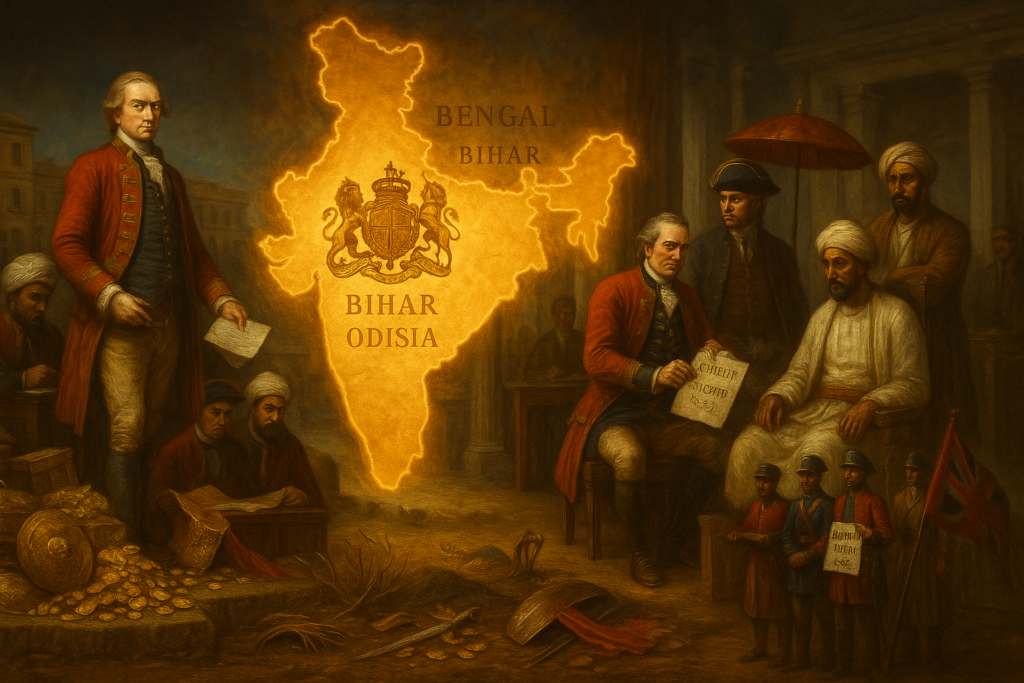
- Shah Alam II granted the British the Diwani rights (revenue collection) of Bengal, Bihar, and Odisha.
- Shuja-ud-Daula was reinstated as Nawab of Awadh but had to pay heavy taxes to the British.
- Bengal now came completely under British control.
Effects of the Battle of Buxar
1️⃣ Establishment of British Rule
- The Battle of Buxar firmly strengthened British rule in India.
- The British obtained Diwani rights and became not just traders but administrators.
2️⃣ Decline of the Mughal Empire
- Shah Alam II surrendered completely to the British.
- The Mughal Emperor became a symbolic figure while real power shifted to the British.
3️⃣ Dependence of Indian Rulers
- Indian rulers became dependent on the British for military and political support.
- The Nawab of Awadh and other rulers had to rely on British forces.
4️⃣ Beginning of British Administration
- The East India Company took control of Bengal and started collecting revenue.
- In 1772, Warren Hastings became the first Governor of Bengal.
5️⃣ Beginning of British Economic Exploitation
- The British gained full control over Bengal’s wealth and revenue system, causing severe economic losses to Indians.
Conclusion
The Battle of Buxar was a decisive battle that firmly established British rule in India. If the Indian rulers had united and followed a stronger strategy, the British might have been defeated. However, due to internal divisions and weak leadership, the British won and became the undisputed rulers of India. This battle became a turning point in Indian history, giving the British a long-term opportunity to dominate the region.

Top Rated Amazon Product
Trusted quality • Great performance • Excellent value for money
- ✔ 100% Genuine Product
- ✔ Fast & Secure Amazon Delivery
- ✔ Easy Return & Refund
References
- Bipan Chandra – Modern India
- R. C. Majumdar – The History and Culture of the Indian People
- P. J. Marshall – The Eighteenth Century in India: Decline of the Mughal Empire
- S. M. Edwardes – The Rise of the East India Company
- NCERT History Textbooks – Class 8 & 12 (Themes in Indian History)
- National Archives of India – Documents and Treaties related to the East India Company and the Treaty of Allahabad (1765)
- William Dalrymple – The Anarchy: The East India Company, Corporate Violence, and the Pillage of an Empire
- Cambridge History of India – Volume V
- Research Papers – Department of History, Aligarh Muslim University
- British Library Archives – East India Company Records