
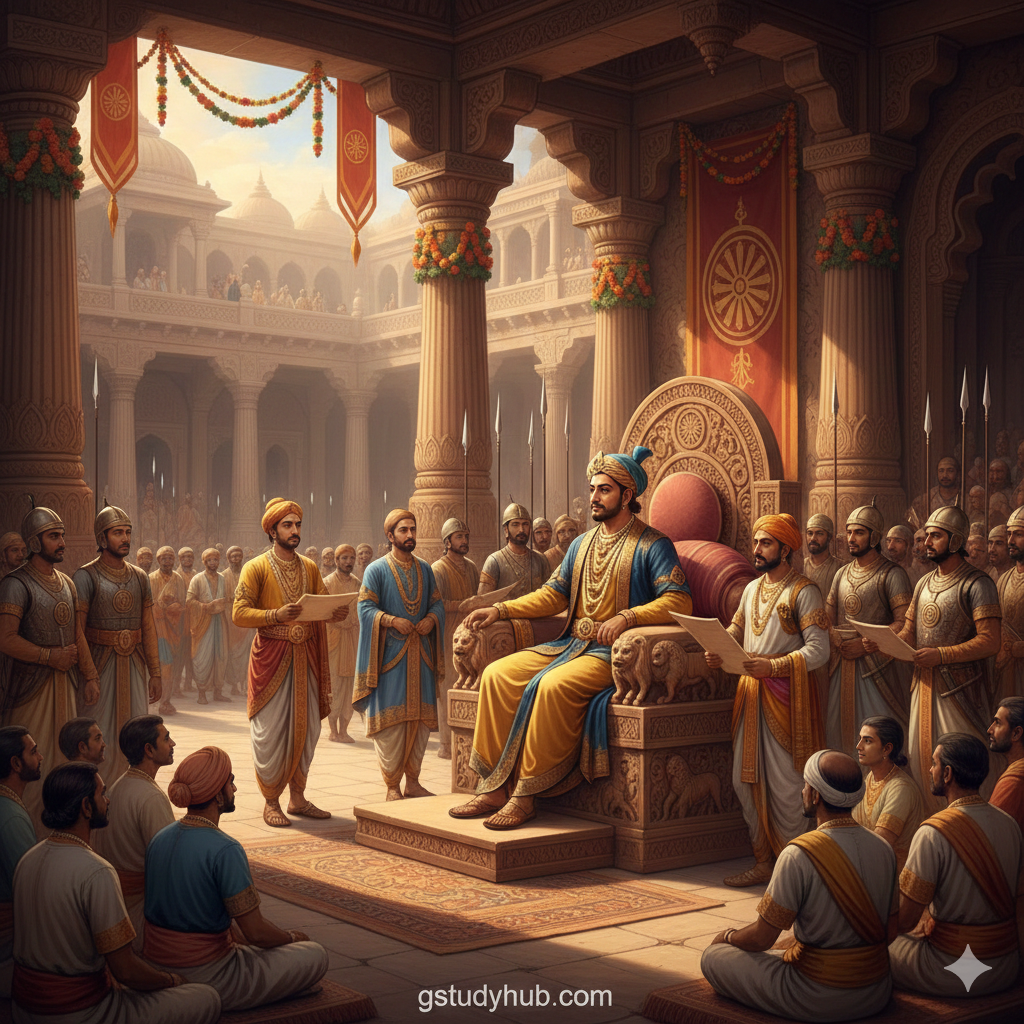
Introduction: When Power Became Service
Whenever I turn the pages of ancient Indian History, the Maurya Empire appears not merely as a powerful political state, but as a living example of disciplined governance and public welfare. The Maurya Administration stands out as an extraordinary system in which the primary purpose of the state was not only to rule, but to ensure justice, stability, and prosperity for its people.
From Chandragupta Maurya to Emperor Ashoka, the Maurya Administration evolved into a structured and highly organized framework of governance. Mauryan rulers transformed authority into a responsibility rooted in service. Their policies, administrative institutions, and ethical vision continue to inspire modern ideas of good governance and accountable leadership.
This article explores the historic journey of Maurya Administration, highlighting how power was guided by morality, authority was balanced with compassion, and governance became a tool for the welfare of all sections of society.

Premium Quality Everyday Product
Designed for durability and reliable daily use. A smart choice for performance, convenience, and great value.
- ✔ Durable and long-lasting
- ✔ Easy to use & maintain
- ✔ Excellent value for money
Structure of Maurya Administration
The structure of Maurya Administration reflects an advanced and systematic approach to governance. It was not merely a mechanism for issuing orders or collecting revenue, but a well-organized framework designed to ensure efficiency, justice, and public welfare. Clear division of duties, strict discipline, and strong accountability formed the foundation of this administrative system.
Central Administration
Central administration functioned as the backbone of Maurya Administration. Under the leadership of the emperor, a powerful and coordinated system operated, binding the vast empire into a single political unit.
Role of the Emperor
In Maurya Administration, the emperor was regarded not only as a ruler, but also as the guardian of his people. His foremost responsibilities were the protection of subjects, maintenance of justice, and promotion of prosperity. The emperor actively participated in major administrative decisions.
He regularly received reports from officials and kept himself informed about the conditions of the realm. This practice demonstrates that Maurya Administration emphasized responsibility alongside authority.
Council of Ministers
To assist the emperor in Maurya Administration, a council of ministers was established. It consisted of experienced and capable individuals who advised the ruler on various administrative and policy matters.
The council’s role extended beyond consultation; it also helped in implementing state policies, thereby making Maurya Administration more balanced and practical.
Provincial Administration
Given the vast size of the Maurya Empire, the territory was divided into several provinces for efficient management under Maurya Administration. Each province was administered by a prince or a high-ranking official appointed by the central authority.
The provincial governor was responsible for enforcing central policies at the local level and reporting regional issues back to the capital. This ensured that Maurya Administration maintained a continuous and effective link between the centre and the provinces.
Local Administration
One of the most remarkable features of Maurya Administration was its strong local administrative network. Separate officials were appointed in towns and villages to oversee taxation, law and order, and public welfare activities.
Village administration was conducted through village assemblies and local headmen, while urban centres had special officers to supervise trade, sanitation, and security. Through this decentralized yet controlled structure, Maurya Administration was able to reach even the most remote sections of society.

Historical Background of the Maurya Empire
The rise of the Maurya Empire marks one of the most transformative phases in Indian History, when a politically fragmented subcontinent began its journey toward unity and centralized rule. This period witnessed constant rivalry among kingdoms, republics, and regional powers, creating an atmosphere of insecurity and instability for ordinary people. The emergence of the Maurya state was therefore not merely a change of dynasty, but the beginning of a new political and administrative vision that later shaped the foundations of Maurya Administration.
Political Conditions
Before the establishment of the Maurya Empire, India’s political landscape was dominated by numerous mahajanapadas and regional kingdoms competing for power. Warfare was frequent, and territorial expansion was often considered the primary measure of a ruler’s success. As a result, public life was deeply affected by conflict, uncertainty, and economic disruption.
At the same time, the north-western frontiers of India faced the threat of foreign invasions, particularly from Greek forces following Alexander’s campaigns. These external pressures made it clear that India required a strong and organized central authority capable of defending its borders and maintaining internal stability — a need that would later be fulfilled through a disciplined and centralized administrative system under Mauryan rule.
Under the leadership of Chandragupta Maurya, this need was fulfilled. He overthrew the Nanda dynasty and laid the foundation of a vast empire based on discipline, efficiency, and a highly structured governance framework. The early structure of Maurya Administration demonstrated for the first time that political power could be used not only for conquest, but also for ensuring long-term peace and order.
Social and Economic Conditions
Prior to Mauryan rule, society was characterized by sharp social divisions and widespread economic inequality. Farmers, artisans, and traders formed the backbone of the economy, yet they often lacked adequate protection and state support. Taxation was irregular and, in many regions, burdensome and arbitrary.
With the establishment of the Maurya Empire, significant efforts were made to improve social and economic organization. Agriculture was encouraged, irrigation systems were expanded, and major trade routes were secured and regulated. These measures increased production, stimulated commerce, and gradually raised the standard of living.
Equally important was the growing emphasis on ethical values and social responsibility. The purpose of governance began to shift from mere revenue collection to public welfare. This welfare-oriented approach later became a defining feature of Maurya Administration, particularly under the reign of Ashoka.
Revenue, Judicial, and Military System
One of the fundamental reasons behind the long-term stability and success of Maurya Administration was its carefully structured revenue system, impartial judicial framework, and highly organized military establishment. These three pillars formed the backbone of the Mauryan state, ensuring economic strength, social discipline, and political security. Rather than functioning independently, they were interconnected components of Maurya Administration, working together to maintain order and promote welfare across the vast empire.
Revenue System
The revenue system under Maurya Administration was systematic, regulated, and primarily agrarian in nature. Land revenue formed the principal source of state income, as agriculture was the foundation of the economy. Farmers were required to pay a fixed share of their produce, generally one-sixth of the total yield, which was considered both practical and sustainable. This standardized approach reduced arbitrariness and ensured fairness in tax collection.
Beyond agriculture, Maurya Administration diversified its revenue sources through taxes on trade, customs duties, mining operations, forest produce, and craft production. State supervision extended to marketplaces, where officials monitored weights, measures, and pricing mechanisms to prevent exploitation. Such regulatory measures strengthened economic stability and reinforced public confidence in the administrative system.
Transparency and accountability were central features of the Mauryan fiscal structure. Officials responsible for revenue collection were subject to strict supervision, and corruption or embezzlement invited severe punishment. This disciplined financial management ensured that Maurya Administration maintained both economic efficiency and moral credibility. Revenue was not merely accumulated for luxury or conquest; it was also utilized for irrigation projects, infrastructure development, welfare activities, and maintenance of public institutions.
Judicial System
justice occupied a central and respected place within Maurya Administration. The emperor was regarded as the supreme judicial authority, yet the system functioned through a hierarchy of courts operating at provincial and local levels. This structured judicial arrangement ensured that disputes could be addressed efficiently across different regions of the empire.
Cases were decided based on established laws, customary practices, and ethical principles. The influence of texts such as the Arthashastra reflects the emphasis on codified legal procedures and administrative accountability. Punishments were designed not solely for retribution but also for deterrence and reform. The judicial system under Maurya Administration sought to maintain social harmony by ensuring that law applied equally to all sections of society.
Particular attention was given to protecting vulnerable groups, including the poor, women, and marginalized communities. This humanitarian dimension became even more pronounced during the reign of Ashoka, whose policies emphasized moral conduct and compassion alongside legal discipline. Thus, the judicial framework of Maurya Administration combined authority with ethical responsibility.
Military System
The military organization of the Maurya Empire formed the strategic pillar of Maurya Administration. A vast and permanent standing army was maintained to safeguard the empire’s territorial integrity. The army consisted of infantry, cavalry, war elephants, and chariot divisions, reflecting a diversified and balanced defense structure.
Administrative precision extended to military management. Separate boards and officials supervised different branches of the armed forces, ensuring discipline, logistical coordination, and systematic recruitment. Soldiers received regular training and were equipped adequately, demonstrating that Maurya Administration viewed military preparedness as essential for long-term stability.
Importantly, the objective of the Mauryan military system was not confined to territorial expansion. It was equally concerned with border security, internal peace, and deterrence against foreign aggression. A strong military presence enabled the empire to maintain unity across diverse regions and ethnic groups. Through this balanced approach, Maurya Administration ensured that military power remained a tool for protection and order rather than unchecked aggression.
Together, the revenue, judicial, and military systems illustrate the structural depth and administrative sophistication of Maurya Administration. By integrating economic management, legal discipline, and strategic defense, the Mauryan state created a stable and resilient governance model that continues to be studied as one of the earliest examples of organized statecraft in Indian History.

administrative reforms under Ashoka
The reign of Emperor Ashoka represents one of the most remarkable phases in the evolution of Maurya Administration. After the devastating Kalinga War, Ashoka underwent a profound moral transformation that reshaped the objectives and spirit of governance. Military conquest and territorial expansion, which had characterized earlier imperial ambitions, gradually gave way to principles of ethical conduct, compassion, and public welfare. This shift did not weaken Maurya Administration; rather, it strengthened its moral foundation and broadened its humanitarian vision.
Ashoka’s reforms marked a transition from a power-centered model of governance to a welfare-oriented administrative system. While maintaining political authority and central control, he redefined the role of the state as a guardian of moral and social well-being. In doing so, Ashoka transformed Maurya Administration into a model that combined efficiency with ethical responsibility.
Concept of Dhamma and Its Impact
The cornerstone of Ashoka’s reforms was the concept of "Dhamma." Dhamma did not represent the imposition of any particular religion, nor was it confined to Buddhist doctrine alone. Instead, it was conceived as a universal moral code emphasizing truthfulness, non-violence, tolerance, compassion, respect for elders, and self-discipline. Through Dhamma, Ashoka aimed to promote social harmony and moral upliftment across diverse communities.
The principles of Dhamma deeply influenced Maurya Administration. Royal edicts inscribed on pillars and rocks across the empire communicated ethical guidelines directly to the people. These inscriptions emphasized religious tolerance, kindness toward animals, proper behavior toward family members, and fairness in public life. In this way, administrative authority was linked with moral education, strengthening both governance and social cohesion.
Appointment of Dhamma Mahamatras
To ensure the effective implementation of Dhamma, Ashoka appointed special officials known as "Dhamma Mahamatras." These officers were entrusted with supervising moral conduct and promoting ethical values among the population. Their role extended beyond routine administration; they functioned as intermediaries between the state and society, ensuring that governance remained humane and compassionate.
The Dhamma Mahamatras paid particular attention to the welfare of vulnerable sections of society, including the elderly, women, prisoners, and economically disadvantaged groups. By institutionalizing compassion within Maurya Administration, Ashoka ensured that state power was exercised with empathy and responsibility.
Public Welfare Measures
Public welfare became a defining objective of Ashoka’s administration. Infrastructure development received renewed attention, with roads constructed to improve connectivity and facilitate trade and communication. Rest houses were built for travelers, and wells as well as irrigation facilities were established to support agriculture and daily life.
Hospitals were established not only for humans but also for animals, reflecting Ashoka’s broader ethical commitment to all living beings. Medicinal herbs were cultivated and distributed for public benefit. These welfare initiatives demonstrate that Maurya Administration under Ashoka actively sought to enhance quality of life rather than merely maintain political control.
Humanitarian Approach to justice and Administration
Ashoka introduced a more humane approach to law and punishment within Maurya Administration. Reformative justice was emphasized over harsh and purely retributive penalties. Prisoners were sometimes granted opportunities for repentance and rehabilitation. This approach reflected the belief that governance should correct and guide rather than simply punish.
Transparency and fairness in judicial procedures were also promoted. Officials were expected to administer justice impartially and remain accessible to the people. By integrating moral principles with legal structures, Ashoka strengthened public trust in the state and reinforced the legitimacy of Maurya Administration.
Establishing Ethics in Administration
Under Ashoka, administrative officials were expected not only to demonstrate competence and efficiency, but also to uphold high moral standards. Corruption, injustice, and negligence were treated as serious offenses. Officers were reminded of their duty to serve the people with honesty and dedication.
The emperor himself set an example by remaining accessible to his subjects and by actively engaging with their concerns. This personal involvement reinforced the idea that Maurya Administration was grounded in responsibility and ethical leadership.
In conclusion, the administrative reforms under Ashoka were not limited to structural adjustments; they represented a moral and philosophical transformation of governance. By embedding ethical values within state policy, Ashoka elevated Maurya Administration into a pioneering model of welfare-oriented and value-based governance. His reforms continue to be studied as an early example of how power, when guided by morality, can serve the greater good of society.

Lessons from Maurya Administration for Modern governance
The experience of Maurya Administration is not merely a historical chapter of ancient India, but a rich source of guidance for contemporary governance systems. The Mauryan approach demonstrated that political authority must be exercised with discipline, responsibility, and a deep commitment to public welfare. In a world where governments face challenges such as corruption, inequality, social conflict, and administrative inefficiency, the principles embedded in Maurya Administration continue to hold remarkable relevance.
By examining the institutional strength, ethical orientation, and welfare-driven policies of Mauryan rulers, modern states can draw valuable lessons for building transparent, accountable, and people-centered governance structures.
Accountability and Responsibility
One of the defining features of Maurya Administration was strict accountability. Officials were closely supervised, and misconduct or corruption invited severe punishment. The Arthashastra outlines detailed mechanisms for auditing officials and preventing financial irregularities. This culture of responsibility ensured that public offices were treated as positions of duty rather than privilege.
In the modern democratic context, institutional accountability through independent watchdog bodies, transparent recruitment processes, and regular audits can reduce corruption and improve administrative efficiency. The Mauryan model reminds us that effective governance requires both authority and answerability.
Priority to Public Welfare
The primary objective of Maurya Administration was the welfare of the people. Policies were framed not only for revenue collection but also for agricultural development, irrigation, infrastructure, and social stability. Under Ashoka in particular, welfare initiatives such as hospitals, roads, rest houses, and water reservoirs demonstrated the state’s active role in improving quality of life.
Modern governments, similarly, must prioritize inclusive growth by focusing on education, healthcare, employment generation, environmental sustainability, and social security. The welfare-oriented character of Maurya Administration highlights that economic development must be aligned with human well-being.
Strong and Impartial Judicial System
justice formed a core pillar of Maurya Administration. Courts functioned at multiple levels, and the emperor was regarded as the ultimate guardian of justice. Legal decisions were guided by established laws, customs, and moral considerations, ensuring fairness and discipline in society.
In contemporary democracies, an independent judiciary remains the cornerstone of constitutional governance. A transparent and impartial legal system strengthens citizens’ trust in the state and ensures protection of rights. The Mauryan example illustrates how justice and morality together sustain political stability.
Efficient and Transparent Administration
Maurya Administration operated through a clearly defined hierarchical structure with division of responsibilities at central, provincial, and local levels. Systematic record-keeping, departmental specialization, and effective communication ensured administrative coherence across a vast empire.
In the modern era, digital governance, e-administration platforms, and data-driven policy-making can enhance Transparency and efficiency. By reducing bureaucratic delays and increasing accessibility, governments can replicate the organizational clarity that characterized Maurya Administration.
Importance of Ethical Leadership
Leadership in Maurya Administration was not limited to political authority; it carried a moral dimension. Chandragupta Maurya emphasized discipline and institutional strength, while Ashoka promoted compassion and ethical governance. Their leadership styles reveal that moral character and administrative competence must coexist for sustainable governance.
Today, ethical leadership remains essential for guiding societies through economic crises, social divisions, and global uncertainties. Leaders who combine integrity with vision inspire public trust and long-term stability.
National Unity and Stability
The Maurya Empire successfully united diverse regions, languages, and communities under a centralized authority while allowing administrative flexibility. This balance between unity and diversity contributed to long-term stability and integration.
In the contemporary world, preserving national unity while respecting cultural diversity is crucial for social harmony. The administrative integration achieved through Maurya Administration demonstrates that strong institutions, inclusive policies, and shared values are essential for maintaining stability in large and diverse societies.
Thus, the lessons derived from Maurya Administration extend beyond historical study. They provide practical insights into building a governance system that is humane, efficient, accountable, and ethically grounded. By adapting these principles to modern democratic frameworks, states can move closer to achieving sustainable and inclusive development.
Conclusion: From History to the Future
The legacy of Maurya Administration is not merely a reflection of India’s glorious past, but a timeless framework of governance whose relevance extends into the present and the future. The Mauryan rulers demonstrated that political authority must be rooted in discipline, accountability, and moral responsibility. By linking power with service and administration with welfare, Maurya Administration established a model that balanced strength with compassion.
The organizational genius of Chandragupta Maurya laid the structural foundation of a centralized and efficient state, while the compassionate vision of Ashoka infused the system with ethical depth and humanitarian purpose. Together, they transformed Maurya Administration into a governance model where law and order coexisted with empathy and moral leadership. This combination ensured not only political stability but also social harmony across a vast and diverse empire.
In today’s complex global environment—marked by political polarization, economic inequality, and governance challenges—the principles of Maurya Administration remain strikingly relevant. Strong institutions, transparent procedures, accountable officials, and welfare-oriented policies continue to be the pillars of effective governance. The Mauryan experience reminds us that administrative efficiency alone is insufficient; ethical intent and public trust are equally essential.
If modern political systems adopt the core values embedded within Maurya Administration— accountability, justice, Transparency, ethical leadership, and commitment to public welfare— they can build societies that are more resilient, inclusive, and prosperous. The Mauryan example demonstrates that governance achieves legitimacy when it protects human dignity and promotes collective well-being.
Thus, the historical journey of Maurya Administration conveys a profound message from history to the future: true governance is not about domination or mere control, but about responsible stewardship. When authority is guided by morality and power is exercised for the benefit of all, the state becomes not just a ruler of people, but a servant of society.
Frequently Asked Questions (FAQ)
What was the Maurya Administration and governance System?
The Maurya Administration and Governance System was a highly organized and centralized system of governance developed during the Maurya Empire. It focused on efficient administration, strong law and order, economic regulation, and public welfare.
who established the Maurya administrative system?
Chandragupta Maurya laid the foundation of the Maurya administrative system with the guidance of Chanakya. Later, Emperor Ashoka further strengthened and humanized the system through moral and welfare-oriented reforms.
What were the main features of Maurya administration?
The main features included a strong central government, provincial and local administration, systematic revenue collection, organized military, impartial judiciary, and emphasis on public welfare.
How did Ashoka change Maurya governance?
After the Kalinga War, Ashoka introduced moral governance based on Dhamma. He emphasized non-violence, tolerance, social harmony, and welfare policies, making administration more humane.
Why is Maurya administration important today?
Maurya administration provides valuable lessons for modern governance, such as accountability, ethical leadership, Transparency, strong institutions, and people-centered policies.
What role did the military play in the Maurya Empire?
The Maurya military ensured internal stability and protected the empire from external threats. It was well-organized, disciplined, and one of the strongest armies of the ancient world.
References
The information presented in this article is based on the study of authentic historical texts, scholarly works, and reliable academic sources related to ancient Indian History.

High Quality Daily Use Product
Designed for durability and everyday convenience. A reliable choice offering great performance and value for money.
👉 Buy on Amazon- Kautilya (Chanakya) – Arthashastra
- Romila Thapar – Ashoka and the Maurya Empire
- R.C. Majumdar – History of Ancient India
- Upinder Singh – A History of Ancient and Medieval India
- NCERT History Textbooks (Classes 6–12)
- Publications of the Indian Council of Historical Research (ICHR)
- Reputed academic journals and scholarly websites