

Introduction
Andaman and Nicobar Islands are one of India’s most beautiful and historically significant island territories.
The introduction sets the emotional and thematic tone of the journey, inviting the reader into a world that feels distant yet deeply connected to the soul of India. It hints at discovery, wonder, and the quiet realization that some places are not just destinations, but experiences that stay with you long after you return. From the very first thought of traveling, a sense of curiosity begins to grow, pushing the mind toward unknown shores and unexplored horizons.
This journey is not merely about reaching a location on the map; it is about stepping into a different rhythm of life. It is about leaving behind the familiar and allowing oneself to be embraced by nature, silence, and simplicity. Such experiences often become milestones in our personal stories, shaping the way we see the world and ourselves.
My First Glimpse: India’s Paradise in the Middle of the Sea
The first moment I saw this island felt almost unreal. Surrounded by endless shades of blue, the land appeared like an emerald jewel floating gently on the surface of the sea. As the boat moved closer, the sound of waves became softer, replaced by a calming silence broken only by the calls of seabirds and the rustling of palm leaves in the breeze.
The air was fresh and carried a subtle scent of salt mixed with tropical greenery. The horizon seemed to stretch infinitely, blurring the line between sky and ocean. In that instant, time appeared to slow down, allowing every detail to sink in—the shimmer of sunlight on water, the gentle sway of coconut trees, and the sense of isolation that felt both humbling and peaceful.
What struck me most was the purity of the landscape. There were no towering buildings or noisy crowds, only nature in its raw and untouched form. The clear water revealed coral formations beneath the surface, hinting at a vibrant marine life hidden just below. It felt as if this place existed in its own rhythm, far removed from the rush of the mainland.
Standing there, I realized why this place is often called India’s paradise in the middle of the sea. It was not just the beauty that made it special, but the feeling it created—a rare sense of calm, wonder, and connection with nature. That first glimpse was more than a visual experience; it was the beginning of a journey that promised reflection, discovery, and quiet joy.

Top Study Essential for Competitive Exams
- Perfect for UPSC, SSC, Banking & State exams
- Durable quality for long study sessions
- Compact and student-friendly design
- Highly rated by competitive exam aspirants
Geographical Introduction of Andaman and Nicobar Islands
Location and Extent
The Andaman and Nicobar Islands are a group of islands located in the southeastern part of the Bay of Bengal, extending into the Andaman Sea. These islands lie approximately 1,200 kilometers away from the eastern coast of mainland India, making them one of the most remote Union Territories of the country.
Geographically, the island chain stretches in a north–south direction and consists of more than 500 islands, islets, and rocky outcrops. Out of these, only about 38 islands are permanently inhabited, while the rest remain untouched, covered with dense forests and surrounded by pristine waters.
The island group is divided into two major sections—**the Andaman Islands in the north** and **the Nicobar Islands in the south**. These two sections are separated by the **Ten Degree Channel**, a significant geographical marker that lies at 10° north latitude. Due to their strategic location near major international sea routes, the Andaman and Nicobar Islands hold immense geopolitical and maritime importance for India.
Climate and Natural Beauty
The climate of the Andaman and Nicobar Islands is predominantly **tropical maritime**, characterized by warm temperatures, high humidity, and moderate seasonal variations. Throughout the year, temperatures generally range between **23°C and 30°C**, creating a pleasant yet humid environment. The islands receive rainfall from both the southwest and northeast monsoons, which ensures abundant water resources and lush vegetation.
This favorable climate supports extraordinary natural beauty. The islands are home to dense tropical rainforests, mangrove ecosystems, coral reefs, and rich marine biodiversity. Long stretches of white sandy beaches, crystal-clear turquoise waters, and vibrant coral formations make the coastline breathtakingly scenic.
In addition to beaches, the islands feature rolling hills, freshwater streams, waterfalls, and protected wildlife reserves. The untouched landscapes and limited human interference have preserved the ecological balance of the region. As a result, the Andaman and Nicobar Islands are often described as a natural paradise, offering visitors a rare opportunity to experience nature in its purest and most tranquil form.
Shadows of History and the freedom struggle
The Story of the Cellular Jail
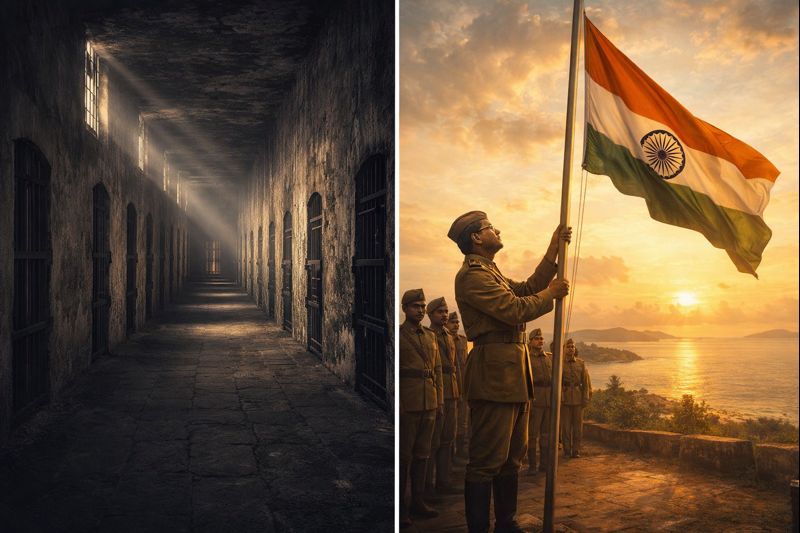
The land of the Andaman and Nicobar Islands is not known only for its natural beauty, but also for being a silent witness to some of the most painful and heroic chapters of India’s freedom struggle. The Cellular Jail in Port Blair, commonly known as “Kala Pani,” stands as a powerful symbol of British colonial cruelty and the unbreakable spirit of Indian revolutionaries.
Built in the late nineteenth century, this massive prison was designed to isolate political prisoners and subject them to severe punishment far away from the Indian mainland. The jail followed a unique cellular structure, where each prisoner was confined in a separate cell so that no one could communicate with another. This system of isolation aimed to crush not only the body, but also the mind and soul of the inmates.
Great freedom fighters such as Veer Savarkar, Batukeshwar Dutt, Yogendra Shukla, and many others endured unimaginable suffering within these walls. Chains, hard labor, hunger, and humiliation were part of their daily lives, yet their faith in India’s independence never faded. Today, when visitors walk through the narrow corridors and cells of the Cellular Jail, they can almost feel the echoes of sacrifice and courage that still linger in the air.
Netaji Subhas Chandra Bose and Andaman
The Andaman and Nicobar Islands hold a special place in the legacy of Netaji Subhas Chandra Bose. During the Second World War, when the Azad Hind Fauj (Indian National Army) took control of these islands from British forces, it marked a historic milestone in the freedom movement.
On 30 December 1943, Netaji hoisted the Indian national flag in Port Blair and formally declared the Andaman and Nicobar Islands as part of free India. He also renamed the islands—Andaman as “Shaheed Dweep” (Martyr Island) and Nicobar as “Swaraj Dweep” (Self-Rule Island).
This bold and symbolic act inspired millions of Indians and strengthened the collective resolve to achieve independence. Even today, the soil of Andaman seems to whisper the stories of that historic moment, reminding every visitor of the courage, vision, and sacrifice that shaped India’s destiny.
Tribal Life and Culture
The Jarawa, Onge, and Sentinelese Tribes
The Andaman and Nicobar Islands are not only famous for their natural beauty and historical importance, but also for their ancient and unique tribal cultures. The Jarawa, Onge, and Sentinelese tribes have lived on these islands for thousands of years, maintaining a deep connection with nature. Their way of life is largely independent of modern civilization, which makes their culture both rare and invaluable.
The Jarawa tribe mainly inhabits the dense forests of Middle and South Andaman. They follow a hunter-gatherer lifestyle, depending on hunting, fishing, and collecting forest produce for survival. Their traditional tools, language, and customs reflect a culture that has remained largely unchanged for centuries.
The Onge tribe lives primarily on Little Andaman Island. Like the Jarawas, they traditionally relied on hunting and gathering. Although some aspects of their lifestyle have changed over time, they have managed to preserve much of their cultural identity, including their language and traditional practices.
The Sentinelese tribe is considered one of the most isolated and mysterious tribes in the world. They live on North Sentinel Island and strongly resist contact with outsiders. The Indian government has declared their area a protected zone in order to safeguard their way of life and prevent external interference.
The existence of these tribes reminds us that human societies can thrive in harmony with nature, even without the influence of modern technology.
Lessons Learned from Them
Tribal communities teach us the value of simplicity, self-reliance, and respect for nature. Their lives show that true happiness does not come from material wealth, but from a balanced relationship with the environment and a sense of inner peace.
They also remind us that humans are not masters of nature, but a part of it. In today’s fast-paced and consumer-driven world, the wisdom of these tribal societies offers an important lesson: sustainable living and harmony with nature are the keys to a meaningful and peaceful life.

A Dialogue with Nature: Forests, Sea, and Silence
In the Andaman and Nicobar Islands, nature is not merely something to be observed—it feels as if it speaks directly to the soul. The dense forests, the endless ocean, and the profound silence together create an experience that refreshes both mind and spirit. At every step, nature makes its presence felt, gently washing away the burdens of everyday life.
Early in the morning, when the melodious calls of birds echo through the forests and golden sunlight filters softly through the leaves, it seems as though nature itself is wishing good morning. The rustling of branches, the distant murmur of a hidden stream, and the cool, fragrant air fill the heart with deep calmness and clarity.
Standing on the seashore, watching the waves rise and fall, time appears to slow down. The rhythmic sound of water touching the shore and retreating again feels like the heartbeat of the earth. The vast blue sky, the endless horizon, and the cool sand beneath the feet come together to create a moment that is both humbling and uplifting.
As evening approaches, the sunset paints the sky with shades of orange, pink, and purple, resembling a masterpiece created by a divine artist. In that moment, one realizes that true beauty lies in simplicity and stillness.
This journey through Andaman taught me that when we move closer to nature, we also move closer to ourselves. The silent conversation with forests, sea, and sky fills the heart with renewed energy, peace, and a sense of gratitude that stays long after the journey ends.

Top Study Essential for Competitive Exams
- Perfect for UPSC, SSC, Banking & State exams
- Durable quality for long study sessions
- Compact and student-friendly design
- Highly rated by exam aspirants
Beyond Tourism: A Journey of Self-Discovery
My journey to the Andaman and Nicobar Islands was not limited to sightseeing alone; it gradually transformed into a deep and meaningful journey of self-discovery. Every moment spent there invited me to look inward and reconnect with my own thoughts and emotions. Like the gentle rhythm of the waves, my restless mind slowly began to settle, creating space for clarity and reflection.
When we step away from the constant rush of everyday life, we begin to realize how often we neglect ourselves. The calmness of these islands taught me that pausing is just as important as moving forward. Silence, instead of feeling empty, becomes a powerful presence that helps us listen to our inner voice.
The stillness of the forests, the depth of the ocean, and the vastness of the sky offered quiet lessons about existence. They reminded me that while we are small in the grand design of the universe, our thoughts, choices, and intentions still carry great significance. True happiness, I learned, does not lie in external comforts, but in inner contentment.
This journey also taught me the values of patience, acceptance, and gratitude. Every sunrise felt like a promise of a new beginning, while every sunset gently whispered that endings can be beautiful too.
In the end, Andaman became more than a destination—it became a mirror that reflected my true self. What began as a simple trip turned into a transformative experience that encouraged me to grow, reflect, and become a better version of myself.

Changes That Came Into My Life
My journey to the Andaman and Nicobar Islands did not only gift me with beautiful memories, but it also brought a profound transformation in the way I think, feel, and live. This experience gave me the courage to look within myself and be honest about my priorities, fears, and dreams.
Earlier, I often used the excuse of being busy to ignore my inner world. Now, I have realized that making time for myself is not a luxury, but a necessity. This journey taught me that a balanced life is one where external responsibilities and inner peace exist together in harmony.
I have developed a deeper sense of patience. Like the steady rhythm of the ocean waves, I have learned to accept life’s ups and downs with calmness. Instead of reacting instantly to every challenge, I now try to understand situations more clearly and respond with a peaceful mind.
Gratitude has become an important part of my daily life. Simple moments—such as the cool morning breeze, the first rays of sunlight, or a stranger’s smile—now feel meaningful and precious.
The greatest change is that I no longer view life only in terms of achievements and goals. I now see it as a continuous journey of learning, growth, and self-discovery. The Andaman experience became a turning point that guided me toward becoming a more aware, balanced, and compassionate person.

Featured Amazon Choice Product
- High-quality durable build
- Best for everyday use
- Trusted by thousands of buyers
- Excellent value for money
Message for the Youth
The youth of today are the architects of tomorrow. Within you lies the power to shape societies, transform nations, and redefine the future. Every idea you nurture, every skill you develop, and every value you uphold contributes to a larger vision of progress and purpose.
In a world full of challenges and constant change, courage and curiosity become your greatest strengths. Do not be afraid to question, to explore new paths, and to stand up for what is right. Growth begins when you step beyond your comfort zone and dare to dream bigger than your fears.
Education is not just about degrees and certificates; it is about building character, discipline, and a lifelong love for learning. Use knowledge as a tool to empower yourself and others. When you combine learning with compassion and responsibility, you become a force for positive change.
Remember that success is not measured only by wealth or status, but by the impact you create in the lives of others. Stay grounded in your roots, respect your culture, and at the same time remain open to global ideas. Balance tradition with innovation, and you will find your unique path.
Believe in your potential, work with honesty, and move forward with determination. The journey may not always be easy, but every step you take with integrity brings you closer to becoming the leader the world needs. The future belongs to you—shape it with wisdom, courage, and hope.
Conclusion
The journey to the Andaman and Nicobar Islands was not merely a travel experience for me; it became a lesson in viewing life from a new perspective. The natural beauty, historical legacy, tribal culture, and peaceful atmosphere of these islands together left a deep and lasting impression on my heart and mind.
This journey made me realize that true happiness does not lie in material comforts, but in balance, simplicity, and inner peace. When we move closer to nature, we also move closer to ourselves.
Andaman is not just a place to visit, but a place to feel—where every wave carries a message, every tree whispers a story, and every sunset reminds us of the fleeting yet beautiful nature of life.
For anyone seeking a break from the rush of daily life and a chance to reconnect with their inner self, the Andaman and Nicobar Islands offer an ideal destination. This journey will always remind me that the most meaningful travels are those that take us deep within.
Frequently Asked Questions (FAQ)
What is the best time to visit the Andaman and Nicobar Islands?
The best time to visit the Andaman and Nicobar Islands is between October and May, when the weather is pleasant and suitable for sightseeing and water activities.
How can one reach the Andaman and Nicobar Islands?
Port Blair is well connected by regular flights from major Indian cities such as Delhi, Chennai, and Kolkata. Passenger ship services are also available from Chennai and Kolkata.
Are the Andaman and Nicobar Islands safe for tourists?
Yes, the Andaman and Nicobar Islands are considered safe and peaceful for tourists. However, visitors should always follow local rules and administrative guidelines.
Is internet and mobile network available on the islands?
Mobile network and internet services are available in Port Blair and major tourist areas, though connectivity may be limited in remote locations.
What activities can be enjoyed in the Andaman and Nicobar Islands?
Visitors can enjoy scuba diving, snorkeling, beach walks, trekking, visiting historical sites, and experiencing local culture.
Is vegetarian food easily available in Andaman and Nicobar?
Yes, most hotels and restaurants offer vegetarian options, along with a wide variety of seafood dishes.
References
- Official Website of Andaman and Nicobar Administration – General information about the Andaman and Nicobar Islands.
- Ministry of Tourism, Government of India – Travel guidelines and tourism-related information on Andaman and Nicobar.
- National Archives of India – Historical documents related to India’s freedom struggle and the Cellular Jail.
- NCERT Geography and History Textbooks – Information on geographical features and cultural diversity.
- Various research articles, journals, and reliable news sources – Studies on tribal life, biodiversity, and environment.